Calling Out Around the World, Are You Ready for a Brand New Beat?

[If you just dropped in, I’ve been hounding the internet with my recollections of a recent trip to Mérida, Mexico. Hey, look, something is finally happening!]

Well, hardly a brand new beat, but it was to me. They dance in the streets in Mérida.

That video is from 7 years ago, but I assure you there’s still doing this every week in the street hard by the Zocalo, the big park in front of the very big cathedral in the heart of Mérida. Sorry, I couldn’t get you a fresh video, but I couldn’t get near the action. See? Packed:
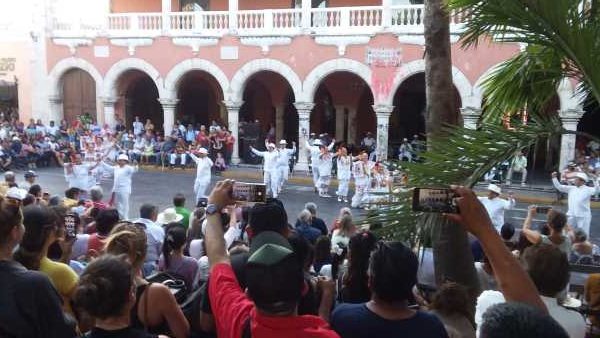
I lost my wife in the crowd there. That was in no way a worry. There is, for all intents and purposes, no crime in Mérida. It’s a profoundly conservative place. The governor was asked once if he could cut the police budget because crime was so low, so he gave the police a raise instead, and hired more. He remarked that the number of arrests is a poor metric for judging the performance of the  police. If there’s no bad hombres left to arrest, the police are actually doing their jobs.

The dancers in the video are wearing traditional garb. You actually see women out and about from time to time wearing some approximation of that dress. Of course young girls wear a very brief version of it, with less floral acreage, and look quite fetching in it.

In the US, this sort of thing would be an anachronism, and slowly die out for want of interest. I’m not Methuselan, or anything, but I remember when every high school had a marching band, wore uniforms, and marched in parades while blaring Sousa marches. Try and find one now. In Mérida, this tradition isn’t going anywhere. While we made our way through the big park, we passed darling little girls wearing miniature versions of the floral white outfits, with their hair and makeup done up like you see in the video. I didn’t notice any of them dancing, so I assume they’re like guys who wear black Megadeth t-shirts to Megadeth shows. But different, of course. They aspire to this, from an early age. Wonderful.

They do a kind of Maypole thing at around 19:00 in the video. We didn’t see that. Around 22:00 they start dancing with cervezas on their heads, and around 24:00, they dispense with smaller orders and dance with the whole drink tray balanced on their head. Marvelous.

Just in case you think the whole thing is a put-up job strictly for tourists and squares, I can testify that regular people dance in the street in Mérida, too. We went to the Super Aki one evening, hard by Santiago Park in the Barrio Santiago where we were living. Super Aki is a small supermarket, across the calle from the park. During the day, the market was fairly staid, but we went in there later in the evening, and it was a scene, man. They had some kind of wild Mexican disco blasting over the speakers in the ceiling, and the help was boogieing around a bit while mopping the floor. It was a stone groove, my man.

We stumbled out into the hot evening air (it was 104 during the day, ratcheted back to the high 80s at night). Right across the street, in the sweet little park, a twenty+ piece band was holding court, and the whole neighborhood was dancing in front of them:
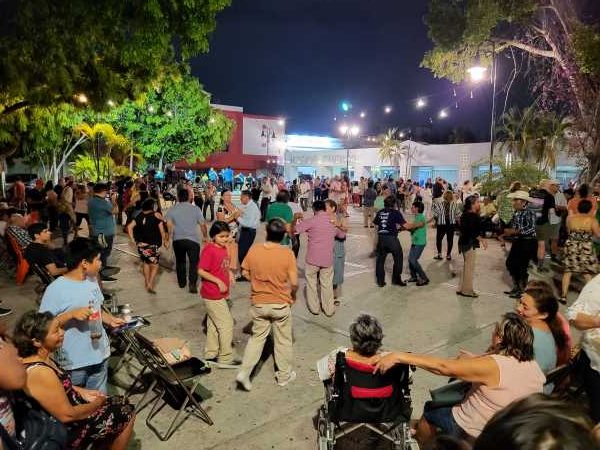
The band is in the powder blue shirts in the background there. They were excellent, and they had a jackhammer MC who introduced each number, and goaded the crown to join in, because all MCs like to tell audiences to do what they’re already doing. It’s easier than convincing them to do something they’re not.

The abuelas sat at the periphery and watched and clapped and smiled at us. Occasionally their grandchildren would haul them out of their chairs and dance with them, including that feisty dama in the foreground there.

They do it all the time, and in different parks around the city on different nights. Here’s our little Santiago park again:

My wife and I stood and watched for a long time, grinning the same grin you get when two fifty-dollar bills get stuck together and counted as one at the bank. We were tired from a day of hoofing it around the city, exhausted from trying to shop in another language to disco music, and lugging big sacks of groceries back to our casa. But we paused under one of those big trees at the darkened corner behind the band, put down our bags, and I turned her around to a Cumbia.

It doesn’t matter what you wear
Just as long as you are there
So come on, every guy, grab a girl
Everywhere around the world

[To be continued, if you can stand it. Thanks for reading and commenting, recommending this site to others, buying my book, and contributing to our tip jar, which, ahem, is getting lonesome lately. It is greatly appreciated]

Colorful Facades, Flowery Streets, and Fixer Uppers

[Buenos dias, or tardes, or noches, or whenever you’re reading this. I’ve been boring the internet with my impressions of a recent trip to Mérida, Mexico for a week now. I’m on day six, and I haven’t done anything or gone anywhere interesting yet. Welcome to Sippican Cottage!]

I spoke passable Spanish back when I was a welder in the desert. Well, I was a fair hand at swearing and ordering two beers and so forth. You know, important stuff. But that was quite a while back, and my vocabulary had withered on the vine. No one speaks Espanol where I live. If you don’t use it, you lose it is very apropos of languages. Lucky for you, I can still emit English like a Maxim gun, written or spoken. That’s because my wife speaks English within earshot every day when she yells at the cat for ripping at the furniture, so I get exposed to the lingua regularly and keep current.

Hey, I’m not currently doing anything bad. Leave me out of this.

There are some Mexicans in Maine, however. They accumulate in two of Maine’s out of the way appendixes. Some pick blueberries in the far Downeast. We drove through there last fall. The landscape was totally alien to us. The blueberry bushes turn a violent red color, like a murder scene carpet, and they’re framed by some sort of aspen-y trees with leaves that turn screaming yellow. It’s a Doctor Suess world over there.

The rest of the Mexicans in Maine are mostly held prisoner in the basements of Chinese restaurants. No, really. I think they’ve mostly been rescued at this juncture, and are only being exploited in Maine’s not very numerous Mexican restaurants now, as God and the immigration officials with the dogs, the dark glasses, and the canes intended. It must be nicer for them to be abused in a language they understand. In any case, you don’t hear a lot of Spanish spoken in Maine.

Mérida, Yucatan, Mexico, isn’t a tourist trap like Cancun, which is dead east about 4-hours drive. Or more accurately, it’s not solely a tourist trap for norteamericanos. The majority of tourists are mostly from other parts of Mexico, as far as I could tell. Cancun is popular with US americans, for example, but Google Map drivebys give me the impression it’s a hole. Playa del Carmen is just south of Cancun, and looks nicer, but what do I know? Never been. Cozumel is an island off the coast of Playa, and is likewise considered a desirable resort. That’s the Carribean.

Mérida isn’t waterfront like those places. It’s about 30 or 40-minutes drive inland from Porto Progreso, a beach on the Gulf of Mexico. It’s a very, very sweet looking beach. White sand, shallow swimming, not much seaweed, not crowded, a big malecon (waterfront drive) to tarry on.

Progreso Beach from Wikipedia

We never made it there, but would someday if we get the chance. You see, we couldn’t rent a car.

No one in Mexico would rent us a car. No. Bud. Dee. Believe me, I tried. Please don’t offer me any advice on the subject. I assure you it can’t be done. Well, it can’t be done with a debit card.

You see, you’re talking to a weirdo here. We don’t use credit cards. I get four or five credit card offers a week, which I shred. We pay our bills with money, i.e. a debit card, so we can’t rent a car. Don’t get me wrong, Expedia and suchlike will let you make a reservation with a debit card, because as Frito Pendejo says in Idiocracy: I like money. They do too, with the same amount of enthusiasm and brains as Frito displayed. But show up at the rental counter with your Expedia reservation, but without a credit card, and you’ll be SOL, and in a foreign country, too.

I find this amusing, sorta, because I do website work for a business in Los Angeles that rents cars to people who use debit cards, and even just cash. In other words, I’m the internet’s greatest oracle for information about renting a car with a debit card, and I couldn’t do it in Mérida.

I’ve grown accustomed to the fact that the world doesn’t like you anymore if you’re willing to pay for what you use. They only like you if you can go into debt while doing it. Well, we’re poor, I guess, but we pay our bills with money we earn. I can’t recommend the fiscal leper colony we’re living in to everyone, but we like it.

So we signed up for Uber. I know you’re thinking, you’ve never used Uber before either? Nope. They don’t have that sort of thing in western Maine, and even if they did, I wouldn’t use it anyway. But in Mérida, we had to get around, and they wouldn’t let me drive to do it. C’est la guerre. Oops, slipped into French there, and that’s no bueno down there since that Cinco de Mayo contretemps got sorted out. Whoops. “Contretremps.” There I go again.

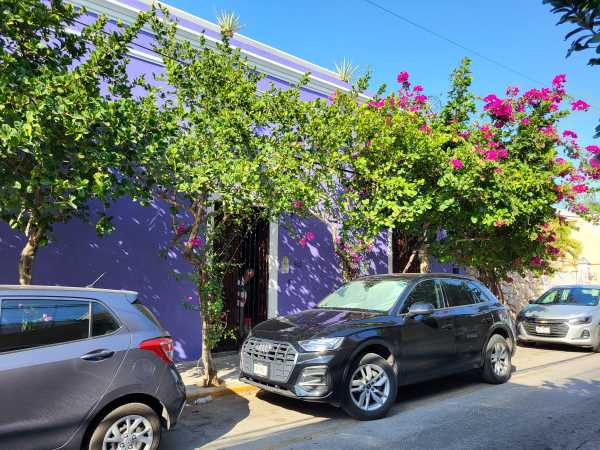
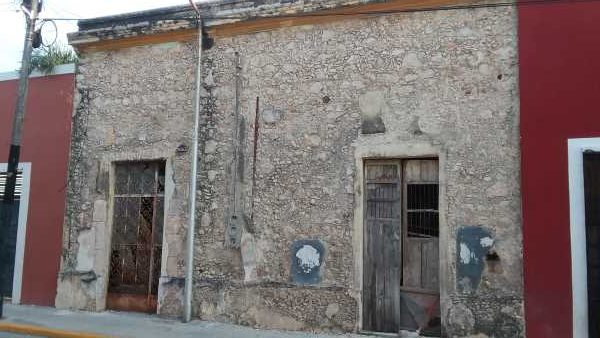
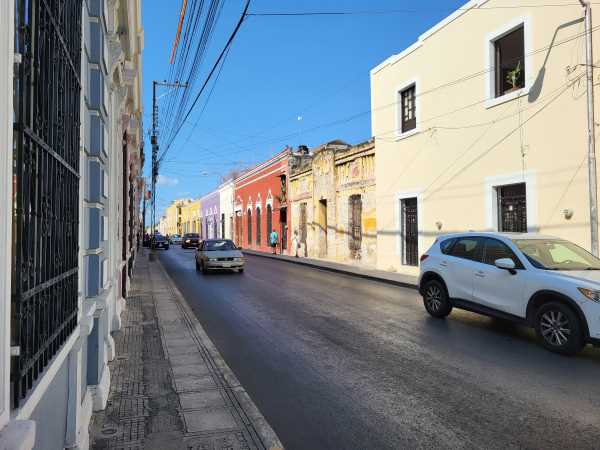
At any rate, I’m going to talk like a short bus student about Uber, too, if you don’t mind, not just flying on a plane. You know, I don’t know what it’s like in the US, but in Mérida Uber was pretty sweet. And you get to gape out the window at the colorful facades, the flowery streets, and the fixer-uppers, instead of at your white knuckles and the windshield.

Mérida is big, at least by our standards. Around a million people. There are only 1.3 million people in Maine, for comparison, and I live in the portion of it where those people ain’t. Mérida is a city and it bustles. If you call an Uber, there’s a ton of them around, and they show up lickety split and take you where you want to go for a pittance. Literally a pittance. I’m looking at the receipts. We went everywhere in the city proper, and the rides were like six bucks, five bucks, four bucks, three bucks. Tipping is optional, but not with us. We gave them all 20 peso tips, the largest button on the app, and all the drivers really appreciated it. They deserved it for listening to me murder their language in the back seat. It’s only $1.20, but it’s real money in a country that thinks like I do, and buys things with money they earned instead of money they borrowed.

I think tipping an Uber driver isn’t common in Mérida because Uber is not just for out-of towners. Mexicans don’t tip each other. Tipping does kinda smack of noblesse oblige, and they don’t go for that sort of thing among themselves. I’m not sure why norteamericanos put up with so much of it. Meridians (I can’t believe I typed that, no one calls themselves that) appreciate it from dolts like me because they understand it’s a gesture of respect, I think. And an apology for talking to them in second-grade castellano.

Because Mérida isn’t a tourist trap, not many people spoke English. More people spoke straight Mayan than English. We learned some. My favorite Mayan word sounds like “sheesh.” I said sheesh about something at dinner one night, and our Mexican friend laughed and dabbed her mouth with a napkin because she thought I was pointing out crumbs on her face. She tried to translate it for us as “leftovers,” which increased the frivolity, because that’s how she understood the English word.

What, you don’t have Mexican friends? You really should get out more, and meet people. My wife and I go on vacation every twenty-five years or so, and we swear by it.

[To be continued, if you can stand it. Thanks for reading and commenting, recommending this site to others, buying my book, and contributing to our tip jar, which, ahem, is getting lonesome lately. It is greatly appreciated]
Chinese Whispers and Other Rumors About Mérida

The Monumento a la Patria. It’s a monument to civic unity. I know, weird, huh? Now back to your regularly scheduled American race riots.

[If you’re lost and in need of assistance, I’m detailing my impressions of a recent trip to Mérida, Mexico in lapidary text, sprinkled with fart jokes. I’m on day five, but I’ve finally cleared the airport. It’s a long road that has no turning.]

We got a taxi in the terminal aeropuerto, because like many American airports, Uber cabs are verboten to pick up passengers at the airport. They can drop you off, but in Merida, everyone hoofs it a quarter of a mile to a bus stop to get an Uber if you’re leaving the building. Well, we’re not everyone, I gather. It was 104 degrees out, and while it felt grand to step out of the air conditioned terminal, and by extension, our 19-degree Maine morning sendoff, I didn’t want to re-enact any scenes from Lawrence of Arabia just yet. Besides, I had two drinks and some lime soup sloshing around in me, and I didn’t want to make a bad impression on any passing pedestrians with my decks awash like that.

I was warned about the taxi stands in the airport. Hooboy I was warned. I was counseled by the internets that they were all as crooked as snakes in a hurry. In case you’re new to the internet, I’ll explain that the interwebs contain six billion websites, but somehow only one opinion for any given topic. Someone writes something, then everyone else paraphrases it in search engine optimized text, boned for weak intellectual teeth. Eventually the various invariable versions are gathered together in roundups and social media what-have-yous, and occasionally news outlets survey these roundups and say, “It is reported…”, or maybe, “People say….”, and re-report the same tired story. It’s a dark and bloody mystery who gets to write the first version of any given internet fib. The intertunnel isn’t a series of tubes. It’s the telephone game.

So I steeled myself against the onslaught of the taxi gauntlet. Taxi service procedures are unusual in Mérida, or so it seemed to me. I haven’t been in a taxi since the 1980s or so, so it would be easy to fool around with me. “No, senor, you must ride in ze trunk. It is how it is done!” At any rate, there are no standard fares for cab rides from the airport. And you don’t deal with the cab driver. There are a series of booths filled with clerks and drivers hanging around. You walk up to the booth and tell them where you want to go, and they look it up, and hand you a number written on a piece of paper. The internet tells me this is where they always get the better of the traveling gringo. Fleeceamos. Internauts counsel you to take the number to the next booth and they’ll beat it, and so on down the line, until you’re practically carried to your destination in a sedan chair for pennies.

I just looked at the offer I’d been given at the first booth, and the number was so low that I checked to make sure they were planning on doing more than driving me once around the parking lot, that my wife could also come along, because I’m sentimental like that, and that we could ride inside the car. Assurances made, I stopped paying attention to the internet altogether, paid the fare with a few pesos we’d cadged from the nearby redi-teller, and took the proffered receipt out to a driver on the curb. We were finally abroad in the land. Hey, no jokes about my wife, fellas.

The cab was sparkling new and clean, and the driver took a stab at English instead of the passengers. I’d tell you the make and model of the car, but I honestly don’t know. Mexicans drive a thousand models of cars we can’t buy in the United States. I was amused to see a Duster drive by us more than once, drifting back to my Mopar high school days, but it turns out that these new Dusters are made as a joint venture between Renault and Dacia. I just looked that up, so now I guess I have to look up Dacia, because what the hell is that? Oh, they’re Romanian. Romanian cars. Man, I have to get out more.

So I wondered why everyone in Mexico is driving a new car, because they were, while I’m driving an 18-year-old Volvo back in the states. I couldn’t find a Duster price handy, so I substituted another Renault, the amusingly named “Kwid.” It’s a very small 4-door compact. Hmmm. It’s listed at 232,100 pesos. Here we go with the grammar school math again. A peso is like a nickel, except the dollar is losing ground fast to the peso, so it’s more like 6 or 7 cents now, or at least until tomorrow when congress wakes up and sends the dollar hurtling down the crapper even further. That’s… that’s… no, that can’t be.

That’s $13,895.55 American dollars. You can buy a new car in Mexico for under 14 grand? As my toddler son once remarked, “Why for?” I was riding in one, and I didn’t have to pedal or anything. And unlike my car, the AC worked. That must be an outlier, right? Nope, the next nine cars in the list of Mexican cars I discovered maxed out at $17,500. You’ll have to drive an Ignis, or an Aveo, or a Mirage, or a “2”, or a V-Drive, or an Attitude, or a March, or an i10, or a Mobi, but you couldn’t spend twenty grand on a car in Mexico if you tried. Well, that’s not exactly accurate. You can buy an elephantine F-150 if you really want to, and pay real money for it, but you’ll have to listen to the side view mirrors thwapping pedestrians in the back of their heads as you drive downtown, in between scraping along the sides of the houses on both sides of the skinny streets. I’ll take a roller skate car for under 15 large anyday, thanks.

Later on, a maintenance guy came to our house driving a little VW pickup truck of the kind I’ve coveted for decades. He thought I was nuts when I said Usted camionetta es muy bueno, which is very bad Spanish, and sounds weird to a guy who thinks to himself, “It’s just a little truck,” only in good Spanish.  That’s because a Robust is an actual pickup truck, not a ridiculous American pickup which is essentially a $80,000 four-door Crown Victoria with the trunk lid pried off, used only to haul daughters to dance class. I looked it up when I got home. You can’t buy one of course, because Gaia is angry, and she has money for lobbyists, but Mexicans can buy one for under twenty grand. A bench seat and an open bed. God, I could weep.

[To be continued. Thanks for reading and commenting, recommending this site to others, buying my book, and contributing to our tip jar. It is greatly appreciated]

The Mérida Method Seems Superior, if Somewhat Less Exciting

In case you’ve never seen its like before, I should explain that the guy in the red shirt was simply happy. In an airport. I know, huh? Weird, wacky stuff.

[For the uninitiated, I’m recounting a recent trip to Mérida, Mexico in excruciating detail. I’m on day four, and I’m still in the airport. When I was born, I was inoculated with a phonograph needle. Sorry]

First there was a short line to talk to one of two immigration officials. They smiled and greeted us in ingles, because certain things are obvious. White as a sheet and a foot taller than the population is a giveaway, I gather. We tried our pidgen espanol on him, which got a smile, if not a true exchange of information going. How long are you staying? What is the purpose of your trip? Ka-chunk goes the stamp on the passports, and adioses all around.

After we ran this gauntlet of two polite questions, we weren’t hustled to a dank cell and beaten by an unshaven dastard with a gold tooth and wearing a greasy uniform two sizes too big for him until we give up our money belt, and then tossed into a mud puddle in the alley out back to allow the narcoterrorists to hold us for ransom. You know, like all our relatives warned us would happen when we set out. People really do have some interesting ideas about Mexico.

We entered a big hall where the luggage-go-round held court. The entire room, and all the other areas of the building, were entirely covered — floors, walls, columns, everything — with large, creamy polished stone tiles. The effect was the kind of futurism found on British space opera entertainment from the 70s. It was ever so much more elegant than Atlanta or Portland, if somewhat austere.

We haven’t traveled anywhere in a very long time. We were counseled that all savvy travelers only bring carry-on luggage with them. One for the overhead, and one for under the seat. Unfortunately, everyone gets the same advice, and when everyone does the same thing at the same time, it doesn’t work anymore. In Portland, they warned us that we were going to be sitting in the bleachers on the plane, and the chances of finding space in the overhead compartment by the time we boarded were slim to none. Also, our Mae West would be a rubber duckie, and the oxygen masks that dropped down in an emergency would have a coin slot, so bring change. The airline offered (demanded) to check our little overhead sized bags into the regular cargo hold for free, because after all, it was empty because no one will check their bags. We were assured that we wouldn’t have to grab them in Atlanta. They’d be sent on to Mérida automatically. Uh-huh.

I waved goodbye to our bags like they were soldiers pulling out on a rusty troopship. They might return, but certainty is not closely related to airline luggage handling in my experience. Wonder of wonders, they appeared promptly on the carousel in the aeropuerto. The carousel has a single sign that tells you not to sit on it, or ride it. This is helpful, because I’m an American, and I might get up to anything. Better warn me off early.

Then comes Customs. It was a card table with two little girls in spanking uniforms holding court. There was a big American family already being processed, so we had to wait. They were inexplicably trying to get some apples past the checkpoint, over and over. We waited patiently while the teenaged daughter pitched a minor fit in English about losing her apples. Eventually one of the uniformed young ladies stood up and approached us. I loomed over her tiny self like bad grades on a report card. She smiled and asked, in good english, with a twinkle in her eye, well within earshot of the others, “Do you have any apples? No? Go on ahead, you’re fine.”

Other miracles began to follow on the heels of the resurrection of our luggage. We’d been awake all day and the night before, and were hungry and bleary. We had to kill two hours before our rental house would be available. I’ve killed two hours, and more, in various airports. Believe me, when an airport kills an hour, it shoots the corpse even after it has long stopped breathing. Not Mérida. There’s the usual this and that in the little mall of the terminal. Coffee shop, tchotchke stalls, car rental counters, taxi stands, a bank, that sort of thing. I noticed a very inviting bar facing the concourse, and I wondered how slurred pidgen spanglish would sound to our landlord when we finally showed up. My wife pointed out there was a real restaurant hiding behind the bar.

So we sat down and expected airport food, which is generally served in a trough to farm animals when air travelers aren’t available. And while we didn’t get a miracle of loaves and fishes, we did get one of first-rate lime soup and grilled chicken. I started reciting lines from The In Laws without thinking:

“…they make a chicken sandwich here. They serve it on a hard roll, they heat it up. With orange juice, you know. Grande, a big one. Or pineapple juice. And coffee. Do you take coffee, Shel? Espresso, with that beautiful foam.”

Lime soup sounds weird but it isn’t. It’s really turkey soup, and they toss in a slice of lime and some crispy tortilla strips and it’s kinda heavenly. It’s soul food down here.

The miracles continued when the bill came. A Mexican peso is like a nickel in the USA. Bills denominated in pesos make for amusing interludes when the check comes. Unlike the United States, when you’re done eating, and not before, you signal the waiter, who immediately comes over instead of playing hide-and-go-seek with you. You simply say, “La cuenta, por favor,” and show him/her a payment card. They immediately return with a handheld point of sale machine. You insert your card and take care of the whole transaction there and then at the table. I’m aware that Americans prefer to give the tattooed, meth-y, purple-haired waitress their credit card and watch her wander off and do various things with it in the back room, but the Mérida method seems superior, if less exciting.

Of course, since pesos are nickels, you’re still doing third-grade math in your head, wondering if you’re looking at a lunch tab or a property tax bill. Once you work it out, you realize two people just had cocktails, appetizers, full meals, and coffee, and the bill is around $25. In an airport, mind you. In Atlanta I paid twenty for a cup of coffee that tasted like polonium, a bottle of water, and a bun.

Tipping is actually somewhat uncommon in Mexico, so I had to search the recesses of my mind for, “propina?”, and the waiter smiled and showed me the screen he was looking at, that had 10, 15, and 20% buttons at the bottom. I pressed the 20 button, and the waiter lit up like a slot machine. I’ve never made anyone so happy for five bucks, except maybe a bouncer when I left a club once after five minutes and didn’t ask for my cover charge back.

[To be continued. Thanks for reading and commenting, recommending this site to others, buying my book, and contributing to our tip jar. It is greatly appreciated]

A Shave With Ockham’s Razor

His seat reclined. Why didn’t mine?

[If you just arrived, I’m recounting a recent trip to Mérida, Mexico in painful detail. Perhaps the perspective of someone who doesn’t travel all the time might be useful. But I doubt it.]

It is always interesting to land in a plane. I’m sure it’s interesting for the pilot. It’s one of the few opportunities he gets to do anything except tell you the time and temperature in a place you haven’t arrived at yet. He slumbers peacefully through the whole journey, I’ll bet. There’s nothing to do on a plane worth doing for good, long stretches. He’s likely trained himself to sit bolt upright while he does his nothing, a useful skill I don’t have. I fidget, and wonder if I’m expected to carry my legs in a basket and stow them in the overhead compartment, but missed the sign in the airport that told me to. There is a lot of signage in an airport, but precious little actionable advice. The recorded voice on the loudspeaker in the terminal in Portland just told me to stop putting handguns in my carry-on, over and over. I don’t generally expect gunplay over the little packs of peanuts, so I leave my gat at home anyway.

Pilots must be conditioned not to look right or left as they while away the hours, and doze, and tap the occasional dial. They’re like dray horses used for carriage rides. It would be bad form to notice the other pilot sleeping if you wake from your slumber and started looking around. But landing gets the blood racing, and keeps the arteries from hardening. We all have something to do. The stewardesses have to totter up and down the aisle clutching a trash bag while the plane careens into the correct angle for landing, while wondering if you’re ever going to finish that shot glass of Sprite they gave you two thousand miles ago, so they can collect it. They hit the tackling dummies of the seats with their shoulders as the pilot awakens and starts pressing all the buttons and pulling all the levers to make flaps flap and landing gear gear, as they say in Liverpool, or should if they don’t.

I get busy too, looking out the little window to see the city below as it scoots by. It’s mildly exciting to see an oil tanker or container ship in the Gulf of Mexico from near earth orbit and wonder if it’s a bug stuck on the window or a giant hulking rusting beast abroad on the water, looking for a bridge abutment to shake hands with. Generally, dead bugs don’t leave a wake, so you can sort them out.

But cruising over the rooftops, close enough to worry the passengers and the citizens alike, now that’s interesting. You can tell a lot about a place when you see it from the air. You’re not supposed to. See it from the air, I mean. Cities are designed to be viewed from the ground, and nobody bothers much about their appearance from overhead. An airplane window is a backstage pass. The cars move like phages in some great beast’s arteries. The clutter on the roofs of big, modern buildings reveals the lie told by the austere, featureless deserts of their glass facades, and the lamebrain architects who design them.

Cities have a general color, I’ve noticed. Each is a pointillist painting when viewed from the sky, the final effect produced by letting all the bits and dabs run together to give an impression. I’ve flown into Detroit, for instance, which is the color of a Pall Mall stubbed out in a plastic plate of fast food. Atlanta is a golf course, with lots of big lawns around the edges, dotted with the stark white sand trap roofs of big commercial buildings all around.

I figured Mérida would be green, as the Yucatan peninsula is a jungle, but it’s not. It’s white. Santorini white. Moroccan white. The houses huddle together in privadas and show their flat, white concreta faces to the sky in a blank stare. Its nickname is the White City, I later discovered. It makes a hell of a lot more sense than calling New York the Big Apple. Wikipedia has some very specious logic on display about the origin of the name. But logic isn’t big on the internet, and I don’t go there looking for it. The city looks white from space, in a sea of green, and it looks white from a one-story rooftop downtown, and everywhere in between. Wikipedia needs a shave with Ockham’s Razor.

Mérida is big and low and spread out like Los Angeles used to be, before they ran out of little squares of desert to put houses on and started to look up instead of out. It has a small-ish airport. It’s newish, too. On Google maps, you can roll the map cursor back and forth in the parking lot and see the terminal building disappear and be replaced with a few blockhouses and the roofs over the car rental lots.

So we’re in another country now, not just someplace totally alien, like Atlanta, Georgia. We rolled off the plane, smiles all around, and followed the crowd through the halls, ready to get pawed over by a series of vicious, dimwitted, bribe-happy martinets in dirty, ill-fitting uniforms. Well, that’s how the same sort of people who write for Wikipedia describe interacting with the Mexican authorities. As is usual, reality is something else altogether.

[To be continued. Thanks for reading and commenting, recommending this site to others, buying my book, and contributing to our tip jar. It is greatly appreciated]

Month: April 2024

Find Stuff:

Archives