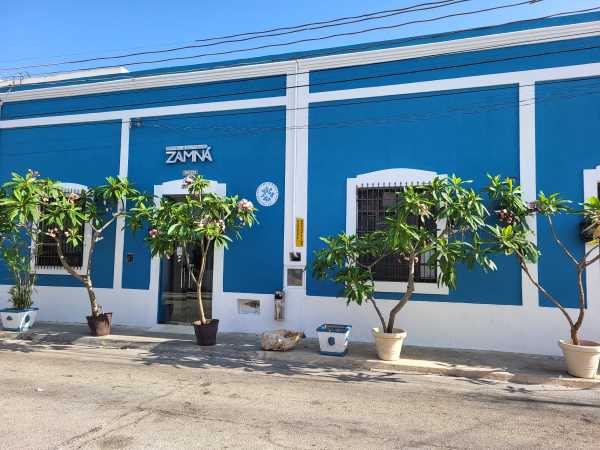
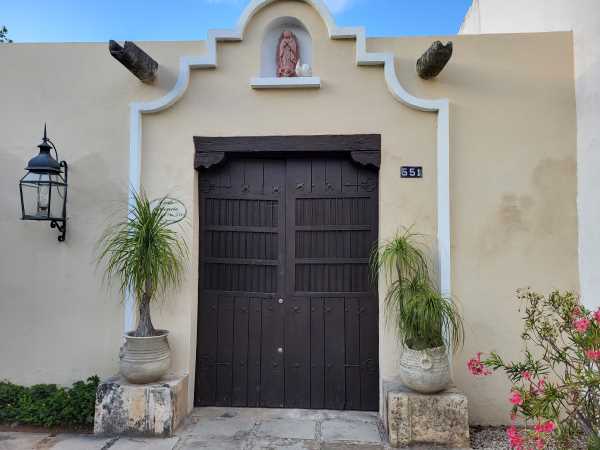
We walked by this building in Mérida, Mexico a couple of times. I thought it might be in the running for the most charming structure on Earth, but maybe that’s just me. We mulled it over as we walked, trying to guess what function it might have served. It’s not readily apparent. It started to bug me. I must know! So the third time we passed by, I asked, and was very surprised to find out the answer.
Now it’s your turn. Everyone gets three guesses. What is this building for? What would a person do there? The only clues are what you see in the two pictures.
In the great tradition of Don Rickles, the winner gets a cookie.
[We’re still traipsing around Mérida, Mexico and gawking at everything like toddlers. Hope you (still) like it]
The big square in Mérida has a lot of names. The Zocalo is the one we settled on. The big cathedral is there, fronting one side of the spacious park. It’s Franciscan, massive, and somewhat austere, inside and out. Just one city block away is the park everyone calls Hidalgo Park. The park’s official name changes every so often, bending to political winds, but Mérida is not a transient city, and when people call something a certain something, it sticks. A hidalgo is a form of aristocrat, although it’s the lowest form there is. There was some sort of club or gang or bowling team of hidalgos back in the day, and they used to hang around the park, and people started calling it after them.
It’s a nice park, with a statue of someone or other on a pedestal in the middle, and lots of shade and benches. Lively, day and night. But just one block further, there’s a wonder. Another church, pretty big, but no match for the scale of the nearby cathedral. The Iglesia de Jesus.
US Americans are unaccustomed to churches named after the big fella himself. Churches are named after saints and whatnot. But this church was built by the Jesuits, and they’ve got the original CEO of Catholic, Inc. embedded right in their name. Why not their church, too?
The exterior is the usual masonry affair. It looks bland, but it isn’t. When you get up close to it, just looking at the patterns of the stones that comprise the very thick walls is endlessly intriguing. A building built bit by bit. The larger stones came from a demolished Mayan temple of some sort (sorry, Kukulkan), and are fascinating in their own right. There are lots of fossils embedded in the stones. Seashells and little fishie skeletons. It’s marvelous.
We didn’t tarry in the Hidalgo Park, because there’s another park right on the other side of this church we couldn’t stay out of, day or night, because it’s the pleasantest place on the planet, day or night. I’ll bore you with that some other time. Let’s go in the church and impress your rods and cones and at least one hemisphere of your noggin first.
That would make a pretty sweet church, but that’s just a chapel. Churches like these are laid out in a cruciform shape. Bang a right off the nave (the long, straight section leading to the main altar), and you’ll sometimes find chapels like this one in one of the transepts.
You might think to yourself, “Now we’re getting somewhere. Now that’s an altar.” Sorry, nope. Another chapel in the other transept. Let’s see what’s in the apse:
Yeah, you can always tell the main altar. They got a stone corral to keep the priests in and the parishioners from cutting the line at communion. The last time I was in a Catholic church in the US, I thought it was a converted car dealership. I forget the name of it, but I think it was named after the patron saint of vinyl siding. There’s none of that in Mérida.
Looking back towards the front door, there’s a choir loft and a nicely decorated barrel vault over the nave.
And you just have to have a dome where the nave and the apse and the transepts meet, or the Franciscans will snicker at you. No one snickers at Jesuits and gets away with it.
Here’s a video of someone passing through the church. It’s easier to get a feel for the place when you’re moving through it. And yes, there really are mendicants with their hands out in front of the church, and yes, you damn well better believe I pressed some pesos into their hands. Unlike the US, there really was something wrong with them that didn’t involve a liquor license.
The streets really bustle outside. The city posts people on the corner who speak multiple languages, to help lost souls like ourselves. We met Mario twice out front there. He was as pleasant as all get-out. He was a college professor, and went to the gym more often than I do. Or you do. Or a football team does. His English was perfect, and he pointed us back to our digs in Barrio Santiago, because we’d been wandering and were disoriented.
I had no way of knowing if he was correct about the directions, but when Mario points, you go that way. The Mexican Techno Viking isn’t just listened to. He’s obeyed.
[To be continued. Thanks for reading and commenting and buying a book and contributing to the tip jar. It keeps this place going.]
[New around here? We’re Mainers temporarily lost in the Yucatan. I promise we’ll go home and shovel more snow eventually]
There are distinct strains of Mesoamericans wandering around Mejico. Everyone in the US sorta lumps them all together, but they’re quite different. In the Yucatan, pretty much everyone is mestizo, i.e., mixed with Europeans, but the original gene pool is Mayan. I’m not capable of sorting out the Toltecs and the Aztecs and the Mixtecs, and the Zapotecs or even the Tlaxcaltecs, who had a (stone) ax to grind with the Aztecs, and helped Cortes conquer them.
The Maya civilization encompassed what is now the Yucatan peninsula, Guatemala, and Belize, plus parts of Honduras and El Salvador. I’d been in Guatemala before, and everyone in Mérida looked like long-lost brothers to them. The Mayas weren’t mud hut people, that’s for sure. They built stuff like this:
Click on the picture to visit the Wikiup and see a great big version of the picture.
That was nicknamed The Castle by the Spanish freebooters who showed up post-Columbus. Unlike your humble author, it’s in great shape for its age. It’s fun to compare it today with the way it looked in 1892 when they Indiana Jonesed it out in the jungle:
It’s in Chichen Itza, along with a lot of other interesting, monumental structures. It’s a day trip from Mérida. There’s a new train called the Tren Maya that runs from Cancun, too. I don’t know what gets into human beings that makes them stack block on block in a pyramid shape, but it gets in their heads all over the world. It’s always been a Minecraft world, just waiting for computers to be invented.
The Maya were a pretty fierce polity. I think you might have descended those stairs with fewer internal organs or heads than you climbed up there with. I don’t judge such behaviors. Queen Elizabeth I was still burning people at the stake around the same time. It took the Spanish hundreds of years to beat the Mayans. In comparison, the Aztecs folded their tents pretty quickly. Then again, they might have mistaken the Spanish for gods. And you can’t blame them for being cautious about frontin’ some conquistadors. You don’t want to FAFO with anybody who might be Mexican gods, from the look of them in the museums.
They had a set of gods to put the Greeks to shame for variety and ferocity. The Guatemalans call this gent Quetzalcoatl, and the Mayans call him Kukulcan, but whatever you want to name him, he’s mostly pictured getting up to hijinks like this:
Putting on my archaeological thinking cap, and using my prodigious powers of observation, I gather he was either a serpent god, or a tax collector. In any case, even when he’s pictured at rest, having already devoured everyone within arm’s length, he always looks like he hasn’t heard a good joke in years.
We went to the Museo Regional de Antropologia on the Paseo Montejo, a sort of Champs Elysee in Mérida. It was full of Mayan stuff, but I would have gone to see it if it was emptier than a politician’s promise. Look at this baroque pile, will ya:
The interior is downright staid compared to the exterior. I doubt it was like that back in the day. Museums want you to look at the stuff, not the walls, so they have a tendency to paint everything in a plain color scheme. Still majestic in there, though:
That’s our friend Abby from Mérida. She was a good person to take along on these excursions. When in doubt, she could talk to whoever was giving you fits in rat-a-tat Spanish. I was getting along better with Spanish by this time, and didn’t even have to call her over to save me when I got yelled at for leaning on an exhibit. I took my beating like a caballero.
Here’s the more or less patron saint of the place, even if his halo is a little dented.
Desire Charnay got permission from the Mexican government to wander around and find archaeological treasures, and he only pocketed some of them when no one was looking. He appears to always have his likeness taken while standing on a subway grate. Someday when I’m old I’m going to start combing all my hair straight up like that.
Here’s a few things from the exhibits:
I like the Yucatan, and their museums. All the gods on display are either laughing at you, making funny faces, wearing a funny hat, or sticking their tongues out at you. It’s like a shrine to being in the fourth grade.
[To be continued.Thanks for reading and commenting and buying my book and contributing to my tip jar. It keeps this place going]
[If you’re new here, I went to Merida, Mexico and it’s more interesting than recounting how we shoveled snow for two days when we got back, so I’m sticking with it]
Across the street from our little house.
We were living in a barrio called Santiago. It’s not quite the center of town. A little south and west from the Zocalo, the big square where they flense the pesos from the tourists. Santiago is considered a nice neighborhood, but hardly the nicest in the city. There are some mansions in Mérida that defy description. Mérida is like New Bedford.
I know that last sentence makes you want to lay a hand on my forehead to gauge my fever, and to instruct me to lay down before I keel over. What I mean is that for a certain period of time, both were the center of the commercial world, and money flowed through their streets in rivers. And then it dried up as fast as it appeared. In New Bedford, and nearby Nantucket, it was whale oil that made the towns into some of the richest in the world. At least until Colonel Drake drilled a hole in the ground in Pennsyltucky and ruined it for everyone. In Mérida, it was henequen.
You think you don’t know what henequen is, but you do. Before Pier 1 did a swan dive into the deep end of the Chapter 7 pool, it was full of henequen. We USA-ers mostly call it sisal. It’s a plant that grows in evil-looking, thorny, spiny blades that can be crushed, shredded into fibers, and woven into very strong rope, and twine, and suchlike. Ships used to require a great deal of rope, and henequen was just the thing for it, especially during the late 19th century. During the Spanish American war, we got to monkeying around in the Philippines, and they stopped sending us rope made of hemp. Henequen plantations went from making their owners well-off to making them very, very, rich indeed when they, ahem, took up the slack.
Thirty-five years or so later, you couldn’t give the stuff away, and the Yucatan turned into a sort of ghost town. It reminds me a lot of western Maine, only here it was paper mills that went belly up instead of henequen plantations. Luckily for the Yucatan, you can also make booze out of henequen. That’s what agave is. First you make pulque, which is the equivalent of Thunderbird wine of the house of henequen. You can distill mezcal from the stuff, too. Tequila is a kind of mezcal, I think. I can’t remember because I drank a half-dozen tequilas once, in one sitting, about thirty years ago, and my mind is still a little fuzzy. Here in Maine, you can’t make anything worth drinking out of poplar pulp, so they switched to cooking meth in the trailer parks instead when the mills closed down.
So Mérida was nowhere, and they it went way, way up, and then way, way down, and now it’s on its way up again. Everyone loves that story. I think it’s usually called Cinderella. Anyway, here’s some more street scenes from a city that stayed put, and persevered, and got rewarded for hanging in there.
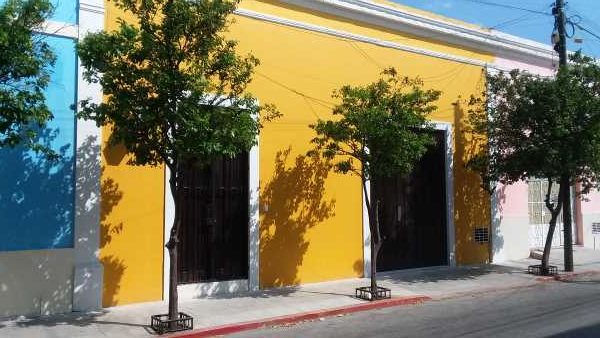
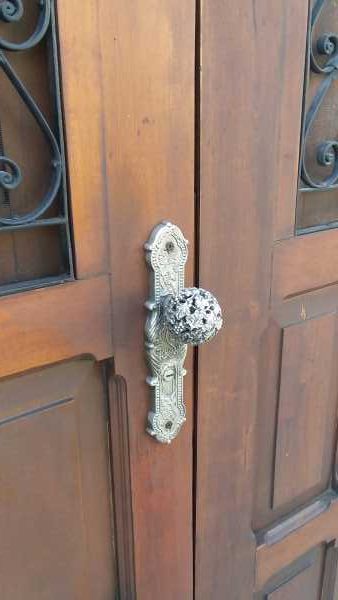
Yellow (amarillo) is popular in Merida.There’s an interesting rhythm to the facades. Really varied, but coherent somehow.Doorways that give Beacon Hill a run for its money.Doorknobs that put Beacon Hill in the shade.Lotsa churches (iglesias). All still busy with parishioners.My wife’s favorite forecourt. In my little neighborhood growing up, we used to call that BVM on the halfshell. There are icons everywhere, and they’re not used as kitsch, either.
[To be continued. Thanks for reading and commenting and buying my book and contributing to my tip jar. It keeps this place going]
[If you’re just zooming in, I’ve been desolating the internet landscape with recollections of our recent trip to Mérida, Mexico for a week now]
There I go with the French again. It’s just not done in Yucatan. But no other word can describe our little rental house in Mérida as accurately as maisonette, or at least none with the amount of alliteration I require for my headlines. The only thing better than alliteration in a title is some succulent sentence sibilance, and we ain’t got any.
Pied-à-terre falls short of describing the housing stock in the Barrio Santiago where we were staying, although it’s close. Translated, it means “foot on the ground.” I think it does, anyway. French class was a very long time ago. Sorry. It refers to an apartment you keep empty but ready for occasional trips into the metrop. New York used to be full of them, for instance. A goodly portion of the city’s apartments were empty for most of the year. I think the internet killed the pied-à-terre concept dead. Everything that can produce a revenue stream, produces a revenue stream. A goodly portion of the Barrio Santiago neighborhood is for rent at any given time.
People think up new ways to refer to old things. “Grab an Uber” has replaced “calling a taxi” for a lot of people. “An AirBnB” has replaced any reference to a hotel room in many people’s lingo haversack as well. But modern euphemisms often mask underlying facts, many of the unfortunate variety. Ask a Millennial if they aspire to live in a tiny house. You betcha, that’s awesome! How about a single-wide? No way, that sucks!
We at the Cottage are not immune to such shifts in nomenclature. We did the Air BnB thing, only using their competitor, VSOP, TSOP, or VTOL, or whatever it’s called. And the last thing we would call our digs, but what it really is, is a time-share condo. It’s ever so much more flexible, and you don’t have to buy in forever, but the idea is the same, with social media thrown in.
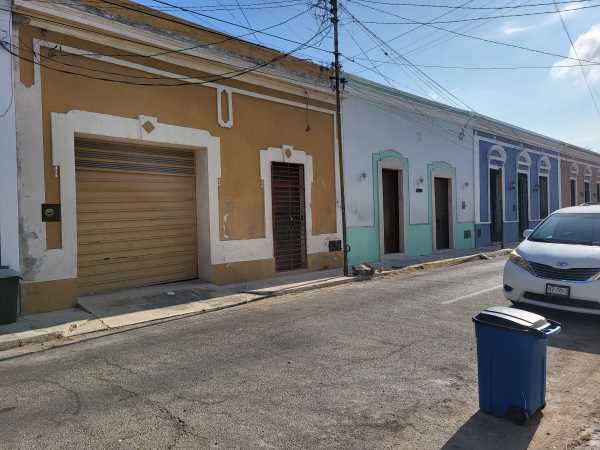
In the city center of Merida, the houses are almost always attached. They show a variegated but unbroken wall of facades fronting the streets. Like this:
It’s very European to my eye, and medieval, with more than a dash of Classical Antiquity thrown in. Forget about judging these books by their covers. We discovered that you can’t really tell what’s going on inside any particular residence by looking at the front of it. It’s common for the houses to be only 10 or 12-feet wide, and 150 feet deep. There are interior courtyards, and pools, and gardens, and guest houses, and not a hint of any of it visible to passersby. There are literal palaces in this town that look as nondescript outside as that mustard-yellow job in the last photo.
Here is our little place. The hosts call it the Casa Gatita. The front (blue) is entirely covered with a steel louvered grate. Some form of wrought iron or steel gate is common, almost universal down there:
The man-door in it is open a skosh. The entire gate is a garage door, with an electric opener. You can park on the street, but they’re crowded and skinny. Lots of people have garages like this. Do you have a garage like this? I doubt it. This one is tiled:
It’s not really a garage. It’s more accurate to call it a gated forecourt, but whatever it is, it’s pretty nifty. The flooring is called pasta tiles. I believe the European version of this is called encaustic tile. They’re similarly durable and attractive and wonderful. [Jeez, the uploader has already pulled the video. Here’s a pretty similar process from a guy in Egypt]
Pasta tiles were popular around the turn of the twentieth century, when a lot of the houses in Mérida were built. Realtors point them out as especially desirable finishes in restored homes. They’re nearly indestructible, and amazingly vibrant and colorful. Carpets are basically unusable in Yucatan. It’s too hot and damp. So the patterns and colors you might get with a rug, they get with tile floors.
I’ve already told you that Mérida is quite safe. So what’s with the locking gates on the houses? The city seems to have the same vibe as the old Russian proverb, Doveryay, no proveryay. That means “trust, but verify.” In some ways it reminds me of many people in Maine. They’re very friendly, but they mind their own business for the most part. The gates perform that most useful function in decent environs: they signal to your friends that you’re not home.
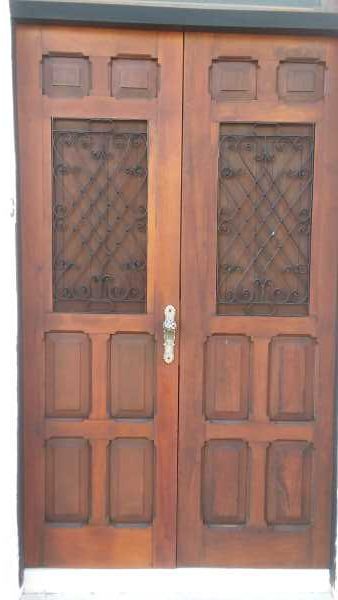
In the second picture above, you can see a true Yucatan doorway. It’s really old, but restored nicely. It allows a series of different opening schemes to let in the desired amount of light, breezes, and street views, along with the amount of privacy you want on a door that faces a street. Here it is from the interior:
Louvers and frosted windows.Screens for the bugs, who never showed up.Wide open to move a couch or something.
The denizens of Merida lived here for a long time without air conditioning. It routinely gets well over 100-degrees, but they knew how to manage the temps pretty well. The houses are massive masonry affairs. Everything is either concrete, block, or parged rubble stone. The walls are really thick, and absorb a lot of heat during the day and meter it back in at night. The ceilings are very high, and airy, with lots of fans to get a draft going. And even though the houses are mostly only one or two-rooms wide, they get air to pass right through them if they can. Here’s the vestibule just inside the door:
Straight on through to the kitchen and living area.
There’s a big bedroom upstairs, with a full bath, and a half bath under the stairs in the foyer. Out the back, there’s this:
That’s open to the sky, with an indoor/outdoor area in the foreground. There’s a laundry room behind the mural that gives the house its name. Splash pools like this are popular in Mérida. The mural is not just a put-on. We sat outside in the evening, and watched cats commuting over the rooftops and parapet walls, pausing only to give us dirty looks on the way by.
Everything was included in the price of the rental, but you’ll have to bring your own girl with you if you visit the joint. I took the one in the picture home with me.
[To be continued. Thanks for reading and commenting and buying my book and hitting the tip jar. It is greatly appreciated]
Month: April 2024
sippicancottage
A Man Who Has Nothing In Particular To Recommend Him Discusses All Sorts of Subjects at Random as Though He Knew Everything.





Recent Comments