Harmattan Bow Waves and Other Discontents

To market, to market, to buy a fat pig…

Well, not exactly. But I bet you could, if you went to the Lucas de Galvez market. We’d been advised, and directed, and cajoled, and practically suborned to visit the Lucas de Galvez market in Merida by pretty much the entire population of the city, and anyone the airlines could import from abroad to tell us to go to the Lucas de Galvez market. Have you heard? You have to see the market!

Shopping as an activity has never had any appeal to me. This might have something to do with my wedding vegetables. I’ve heard that the distaff set enjoys it, but this could just be a wild intertunnel rumor. That joke about the guy telling his friend that his wife’s credit card was stolen, but he didn’t report it to the cops because the thief was spending less, can’t be true, can it?

I dunno. I dunno a lot, these days. There are a great many limbs the average person in America has crawled out on, and started furiously sawing at, while we stood stock still, clinging to the trunk. Don’t ask me what the man in the street thinks. I ain’t average, and I stay out of the street, lest I get run over.

But you have to see the market. You just do. It’s Tangiers and Stamboul and the Mercado de San Lorenzo and any number of other famous souks rolled into one, with tacos on the side. Ya gotta go.

Of course the temperature during the day is comparable to the sunny side of the strada on the surface of the sun, so you gotta go at night. Yucatecans aren’t vampires, but only because they aren’t afraid of crosses, or garlic, or dumb enough, gringo, to walk around in the noonday sun. Mad dogs and Englishmen, and all that.

Wrong continents, mostly, and I ain’t no Englishman, but the point stands. We learn by observing the local flora and fauna. When the iguanas are basking, there’s no point in asking. We won’t walk to the Lucas de Galvez market.

But night falls, and with it the temperature, to something simply sultry. We decided to hoof it south, and get Galveznized. There was a problem. We couldn’t find it.

No, really. We have Gargoyle Maps and that kind of app-y stuff. We can speak Spanish well enough to gargle a donde and maybe understand the izquierdas and derechas that get fired back at us. We could just take a cab (Uber) and simply demand to be taken there. But the Lucas de Galvez market is visible from space. It’s the Great Wall as shopping mall. It’s a hinge of history, it’s not a mystery. I’m told you can walk into the side of it, and break your nose while espying it. How hard could it be?

So we walked on the skinny sidewalks groaning with pedestrians, fanned by the harmattan bow waves of buses that tickled your shirtsleeve (outbound side only). We searched high and low. Me high, wife low. That sounds like Chinese, but isn’t. This is not a testimonial about problems matrimonial. For reasons of stature I don’t seem to match her.

She gets along better than I do, because a tall man in Merida is a wive’s tale told to frighten children. That’s an effect I had pretty often, events my complexion didn’t soften. So she shopped in the windows as we walked, while I browsed for chances to open my scalp on street signs, awnings, and the odd air conditioner, while occasionally moving my part to the other side of my head via cable wires.

We never did find it. We think we were near it. We felt its gravitational pull, like a bowling ball on a hammock, but succumbed to cares more thermodynamic. It was too hot to walk anymore, footsore, so we purchased regalos in the outlying barrios.

I can’t believe this wasn’t the big market that we had for our target. But it wasn’t. It’s just some shops, into which we straggled and haggled and then shuffled off home:

I went on Gargoyle maps this morning to see if I could manage the trek virtually. I pitched and yawed down the digital calles, until I finally discovered it. It was a huge, concrete building that looks like it could hold the gross domestic produce of Mexico, with room for Belize left over. And there, over the doorway, was a sign that read: San Benito Marketplace. You know, the little market down the street (some street, who knows), from the elephantine mise en scene of the mysterious, ethereous Galvez Market.
The Mexican Lost and Found

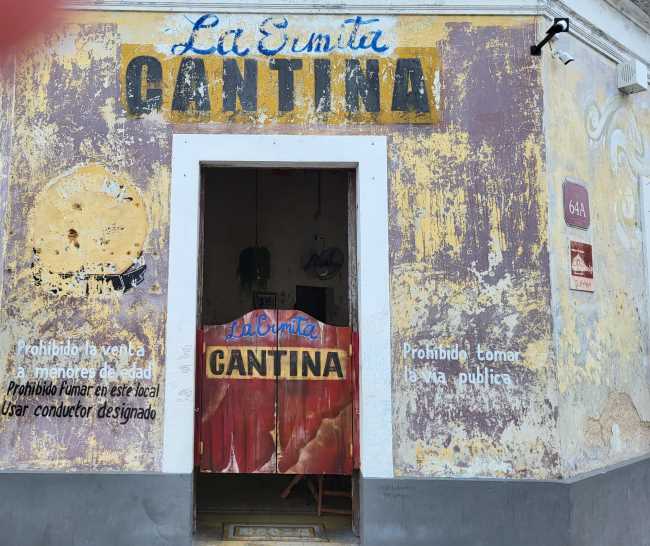
We were droopy. Sunburned a bit from a sojourn to Sisal the day before. Still exuding a hint of cervezas from our pores from the night before that. My wife suggested something less than a plan. Take a nap, and then go to La Ermita barrio again on a whim.

A plan would have been deadly. It would have killed and stuffed our evening, and set it out to frighten off the crows of amusement. Whims are underrated. They’re alive. They hum. We only knew one destination in that part of town: Take us to the La Ermita Cantina, senor, and don’t spare the horses, or the hydrocarbons, or the electrons, or whatever.

The sun had retired for the evening. It still had enough oomph to spread a marmalade backdrop for the palms and the boxy houses on the horizon. It was Saturday night, and the street was jammed. We’d visited in the heat of the afternoon once, and the sidewalks had been deserted. The locals know better than to wander around without a mission during the open oven door of midday. Even with the sun fading fast, it was ninety.

It was… a cantina. No other word can describe hullabaloo like that. Barroom, nightspot, taproom, bucket of blood; a cantina is different than all other forms of local enclosed benders. It appeared that every single inhabitant of the La Ermita barrio was present and accounted for in there, and they had a three-drink head start. The manager met us at the door, wearing a shirt that exclaimed in Spanish that he could speak additional languages depending on how many drinks he had in him. There wasn’t an inch to spare in there, or a centimeter I should say, because they measure things in soccer in Mexico. He offered what he had: You can share a table.

It was that kind of place. We joined a couple already seated at a table for four, and were met with a buenas noches and no ill will. We’re American. This confused us a little. Being deposited at a half-filled table would have precipitated a one-star review on Yelp, or maybe a fistfight back home. Here it was just another Saturday night. There were people on every horizontal surface, and if they could have figured out how to hang people on the wall, I think they would have done it.

The La Ermita jukebox. Fifty percent Mexican torch songs, fifty percent American rock from the 80s. Plenty of accordion. The mortar is chipped away from the doorframes from generations staggering through them.

Here’s where the bosh comes in. If you read online reviews, and influencer crapola about Merida, Mexico, you’ll hear glowing encomiums for this cantina, urging all their readers to visit the place. They all have a very shallow bag of adjectives. Everything is amazing, whether it is or not, and this cantina is no exception.

Except that it is. I’m here to tell you that I was amazed. In the real sense of the word, not over a middling meal. The place dropped my jaw. It was packed and loud and lively, and it was real. A neighborhood meetup place, where everyone gathers at the end of the week without a schedule to shepherd them in. And no matter how many Instagramholes talk about the place, none of their followers go there. We were very obviously the only extranjeros in the place.

Ordering food was easy. I asked for a menu, which elicited a laugh. They had one thing on, and you could choose one of two different ways to get it. And it wasn’t, you know, amazing, but it was fine, and we chased it down the hatch with arctic beers and laughter. Then he brought la cuenta — the bill. Four beers, two plates of chicken. $260.00.

Don’t panic. Those are pesos. A peso is worth slightly less than a nickel now. Grammar school math says it was thirteen bucks. A bartender anywhere in Maine will charge you ten bucks just to glare at you before you order something. I’d say it was amazing, but I get hives using that word all the time.

We glided out into the night, and were hit right in the face with an unexplained fiesta. They’d set up shop in the square in front of the church, closed a few streets, and were partying down.

It was still ninety degrees at 9 PM. Nobody much minded, us included. After all, it’s a Barrio Magico. It’s ten degrees cooler than the afternoon, so you’re mesmerized into thinking it’s almost chilly.

Hot or not, they dance in La Ermita. The following video shows local kids. It was fun to see them walking down the street in their performance togs, and to see their parents buy them treats after they were done.

That music. I try to identify the various strains in it. The clear clarion call of the Spanish trumpet. The blattering roar of the French music hall saxophone. The twinges of oompah loompah background from the center of Europe. Mexico took them all in, and made them their own, and their children embrace them all, and  keep their traditions alive in the street before the church they were baptized in.

It struck me that Mexico is the continent’s lost and found, but nothing is lost, and everything is found. That includes my wife and me. We weren’t lost, but got found in La Ermita anyway.

Italiano Got the Sleepy Eye

The intertunnel didn’t always suck pond water. All sorts of people used to contribute all sorts of things to it. It wasn’t a rigged game yet. It was lively and wide open. Guys like Claudio would close their bedroom door and do their best with their webcam blinking at them and their neighbors pounding on the wall to quiet down.

This video is thirteen years old. If there’s anything as direct and real on the intertunnel now, it won’t be surfaced by a search engine. Claudio is/was some kind of working musician, not a rank amateur or anything, but then again, the word “amateur” translates to “does it for love.” I’d call him a professional amateur out of respect, because Yoruba Tube wasn’t expected to make you famous back in the day. His website link on his Toob page is dead, for instance. Rock on, Claudio, wherever you are.

I don’t mind James Taylor. My big sister used to play his records incessantly, rouletted with Cat Stevens and CCR hits and things like that. Songs are just aural wallpaper, if examined harshly. But they can conjure up images and feelings when they reappear. My sister can never reappear, so I’ll take what I can get.

James Taylor’s general appeal is kind of hard to pin down. He just seems like Jimmy Buffet without a sense of humor to me. But Mexico is right on the money, man, and harder to play and sing than it first appears. And the words are a nice little flash fiction story, like most good songs are.

Baby’s hungry and the money’s all gone
The folks back home don’t wanna talk on the phone
She gets a long letter, sends back a postcard
Times are hard

It’s not quite For sale: baby shoes, never worn, but it’s pretty good nonetheless.

Everybody Knows This Is Nowhere

I guess I am required to tell you about La Ermita. We have scampered over its brick pavers, risked lightning bolts by entering its ancient church, wandered its quiet streets, and desolated the provisions in its bakery, served by a true cinnamon girl. I’ll tell you about it, even though I will have to betray my new friends to do it.

Everyone is sworn to secrecy about La Ermita. When asked about it, you’re first required to deny its existence entirely. You can increase the efficacy of this approach by feigning deafness, or speaking Italian all of a sudden. In some cases, if that doesn’t put the inquirer off the scent sufficiently, the fallback approach is lying like a Turk in a bazaar.

  • The Germans bombed it flat during WW2. Little known battle. Nothing there casts a shadow anymore
  • It’s an iguana sanctuary. They say the iguanas are rabid, but that’s silly. They’re just vicious
  • There’s a narcoterrorist hiding behind every bush, waiting to kidnap you. They’ll hold you in a bunker underground and collect your Social Security check, and they keep renewing your prescription for Paxil, which they sell in the US for fabulous sums. It’s also a desert, so there are no bushes
  • I’m not saying it’s aliens, but it’s aliens
  • Two words: human sacrifice. Even the Catholic church has ’em. At least they’re not cannibals, like the Methodists down the block
  • It’s a leper colony. It’s illegal to wave to passersby, because their hands fly off
  • It’s incredibly boring there, so the locals appreciate the daily earthquakes. It breaks up the monotony. And the houses
  • It’s in the Guinness Book of Records under “tarantulas”

Of course the real story I’m supposed to hide from you is La Ermita is the pleasantest little barrio in Merida. If too many people find out about it, it won’t also be one of the most affordable barrios near the centro, and it will be filled with expats like me instead of the MexiMayans who live there now, and like it.

Luckily for the Ermitans, pretty much nobody reads this blog. This is as close to a cone of silence as you’re going to see in this world. So it’s safe to tell my several readers, an NSA agent or two, and four thousand  scraper bots how much we like La Ermita. The barrio will slumber peacefully at night, knowing not a manjack from the US will ever be enticed by my description to go there. Except my wife and I, but La Ermartians seem to like us OK.

Walking down the streets in La Ermita is a trip. I am, for want of a better word, an exotic there. The whole time we were there, we only saw two people who looked even vaguely gringolicious, and when they walked by us they were arguing in some European argy-bargy language. Well, if arguing is defined as a guy being yelled at in Cyrillic by his consort. I didn’t need an interpreter to know the problem was it was hot, and nearly-noon hot at that, and it wasn’t her idea to visit Mercury on short notice.

Yes, it’s hot in La Ermita. The temps were in the high nineties, and they routinely go well into the hundreds. Hitting 120 is not unheard of. I’d stay away from the place if I were you.

But the place is built for it. The houses show blank masonry faces to the sun. The walls of every structure are thick enough to hold in a thousand Edmond Dantes, and hold out the heat at the same time. The roofs are catapulted off the floors into low earth orbit, which is about eighteen feet high if I remember my high school science classes correctly (I skipped school a lot, but it doesn’t seem to have hurt me none). High ceilings, thick walls, and fans and minisplits make the indoor climate straddle the line between bearable and comfy. The little square by the old church is shady and cool with lots of benches to malinger on. Some people call it the Plaza del Gallo, because way back when it was an empty dirt lot where they held cockfights. See, this place is too scary for you. I’d give it a miss.

The square isn’t square, which is a rarity in Merida. The city is laid out on a grid, E-W, N-S, so parks and squares really are square. But La Ermita is very old, and was once outside the city proper. The road leading out of town headed straight to Campeche, so it collides with the city grid at a Flatiron Building angle. This lends interest to the park, and it makes the streets around it bustle in unusual ways.

The La Ermita church is now called Santa Isabel. My recollections of Science class might be sketchy, but I had the nuns for grammar school, so I remember that Isabel was John the Baptist’s mother. I don’t recall her opinion of Salome’s recipe for The Head of John the Baptist With a Side of Fries, but I assume she didn’t approve.

That wasn’t the original name of the church, though. it was “Nuestra Señora del Buen Viaje.” Our Lady of the Good Journey. The road to Campeche (the Camino Real), was pretty scary back in the day, so people stopped to pray and fill their canteens and reload before setting out. It’s still terrifying, I’ll bet. I’d stay clear away if  I were you.

As I mentioned before, we were served in the bakery across from the park by an actual cinnamon girl. She had bright eyes and a winning smile and a cinnamon complexion. She brought us stuff with actual cinnamon on it. She wore a T-shirt with a cute little unicorn on it, a kind of My Little Pony riff. And in a cute, girlish, glitter font above unicorn, it read “Don’t F*ck With Me.”

I’d stay out of La Ermita if I were you. With terrifying creatures like that roaming the land, it’s not safe.

The Boy on a Dolphin, Grown Older and Wiser

I met a traveler from an antique land.

He was riding a Dolphin. No, really. He was the type of philosopher who used to drop a flag when he met you. He spoke no English — he said. He did not lie. I don’t think his interior regions were arranged with room for the organ that permitted true prevarication. I wondered how humans, who are all brothers when you get right down to it, can be assembled so differently, because there’s always been plenty of room in me for one. But words are tricky things. I speak no English. Examine that fabulation closely, and get back to me.

You had to find the key to his lock. Entiendo un poco espanol, senor. Buen dia. Nos gusta mucho su ciudad. Then his accented English appeared like a ship on the horizon, sails full, coming into port. He was thoughtful in an offhand way, and wise. It became his city because I had awarded it to him in clumsy castellano.

He said most extranjeros made no effort, and effort that is not made cannot be rewarded. He did not see many Americans. He wondered where we were from, in particular, and why it made us the way we were. I had not thought of that. He was all of a sudden a simple, goodhearted Spengler, wondering if we were rootless, sargasso floating on any warm water that would support us, or arboles, pulling our life from the ground below us and the peculiar sky above us.

He laughed at the imaginary friction between our countries, and called it that. We said that la gente de la ciudad es muy amable, y feliz, and it suited us. He told us that he meant no harm, but Americans seemed to him to be caught up in a spiral, always climbing, looking for more, grasping at a higher rung on an endless ladder. He did not understand it, or did not like it, I’m not sure which. But he said that when a man and his family have enough to eat, and a roof over their heads, their minds should be tranquilo. He used that word.

Tranquilo is a Spanish adjective that means calm, peaceful, or relaxed. It can describe a person, place, or situation that is free from stress, noise, or disturbance.

I know enough about Spanish to know that it’s more malleable than it first appears. Subtle. Manana can mean tomorrow, or later, or never. And tranquilo can mean more than the dictionary can offer.

It dawned on me that I was riding a Dolphin with a Mexican Buddha, a Mayan Epictetus. And it made me tranquilo.

Month: March 2025

Find Stuff:

Archives