It Is Never Too Much. It Is Only Not Enough

I had this friend when I was a kid. Let’s call him Fish. Lost track of him many years past. He was a hoot. Fish might be an example for us all. I’ll explain.

His family was a huge Irish affair. There were something like eight of them packed into this little split-level ranch. Eventually, the older siblings got married, and their spouses moved in, too. I swear you could see the walls of the house breathing in and out with their respiration. Their septic system spawned an Okefenokee in the side yard.

Fish was a rough and tumble kid. His parents would send him outside in the spring wearing nothing but a pair of jean shorts, cut off raggedly from some pair he burst through at the knee on their first day in harness. He’d stay like that until the first frost. He was barefoot, wild, and free. I was never any of those things. He was the neighborhood Huckleberry Finn. I guess that makes me Tom Sawyer. If there was a Becky Thatcher, she kept indoors.

But not Huck, really. Huckleberry Finn was uneducated, if not dull, and simply had some version of moral genius to carry him along. If my friend, Huckleberry Fish, had any morality in him, it wasn’t visible underneath the carapace of dirt he was coated with. He’d never do anything bad, mind you. He was simply a wildman. Two different things. Morality doesn’t enter into it.

My friend was smarter than the other kids, too, not just a knockabout waif. His family would play cards to amuse themselves, just like ours did. Whist was the game then. It was our lower middle class version of playing Bridge. Bridge was strictly for dentists or Presbyterians or something. Whist requires a non-Vegas-level, but high requirement to count cards, and remember what’s already been played, and who played it. It’s fast and fun, with an element of audacity in bidding based on mental arithmetic. There’s a single round of bidding after the deal, to determine who calls “trumps” (the suit that “trumps” the others), and who gets to swap the four hidden cards in the kitty for their worst cards. If you’re bold, you can leave your opponents holding a handful of cards they could beat you with if they won the bid, but were too timid to bid high enough.

I was very, very good at Whist. It appealed to the analytical part of my mind. Fish was a wizard at it. He’d sit there, dressed like a coolie, dirty, teeth spaced like headstones, a hayrick of hair hanging in his eyes, and beat the pants off all comers. It was all I could do to keep up with him. Likewise, he looked out the window all day at school, but passed all the tests anyway. I know intelligence when I see it. I’d recognize a Bigfoot, too, on sight, because it’s about as rare.

I could tell many stories about Fish. People like him spawn many wild tales as they swim up the stream of life. But there’s one that comes to mind that explains him to a T, and is perhaps a lesson for us all:

We rode bicycles all the damn time. All over, everywhere. We delivered newspapers. Rode to the little convenient store and bought bread and milk for our moms and enough candy bars for ourselves to make Bridge-playing dentists rich.  Whenever there was nothing to do we’d ride bicycles to get to the place to not do it.

There were dogs all over the place back then. Maybe even more than now, if that’s possible. People used to treat their dogs like pets, though, not like hemophiliac children that need to be carried everywhere and get their food catered. They’d tie them up in the yard, play with them from time to time, or just let them roam around some. When we rode our bikes, getting chased by dogs, snapping at your heels, was pretty common. We’d just smirk and ride on by when the little yipyip dogs took a run at us. We learned pretty quickly where the biggest beasts that could do some damage were prowling, and avoided riding past their houses.  Eventually, I got a ten-speed bike, and it had one of those hand air pumps that fit between two pins on the bike’s frame. It made a pretty handy billy club, if a little light. Swinging it wildly was enough to keep most Cujos at arm’s length.

One day, Fish and me were riding far afield, and encountered a substantial canine on the loose. German Shepherd. He came tearing after us, snarling and slavering, all business, if your business was the perimeter fence in a prison camp, anyway. I was a timid soul, and my mind shifted back and forth between pedaling faster and reaching for my pneumatic billy club. Fish wasn’t having any of it. He stopped dead, threw his bike on the tarmac, and started snarling and barking right back at the dog, which had closed to maybe ten yards. His canine brain (the dog’s, not Fish’s) couldn’t process this turn of events. Surprise is an unusual expression on a dog’s face, but he had it. But Fish was just warming up. He started chasing the dog.

The beast shied, and flinched, and then scampered away with that skulking, circuitous motion dogs get when they get a rap on the nose. Fish never wavered. Just went after it like a missile. The dog switched from confusion to plain terror, and finally tried to bolt in a dead run. Fish tackled it, grabbed two fistfuls of the fur on its back, and bit it, hard, on the ass.

What a howl that dog let out. Real terror, the kind brought on by a combination of pain and fear and confusion. The dog lit out like it was on fire, and Fish calmly walked back to his bicycle, and we rode off. He didn’t say a word about it. It was just business, as the mobsters used to say. We rode our bikes many times past that same house, untroubled from then on.

Sometimes, as Pascal in Big Night so colorfully expressed, you have to sink your teeth into the ass of life, and drag it to you. It is never too much. It is only not enough. Lately it’s occurring to me that everything good in my life has happened when I channeled my inner Fish, and sank my teeth into the ass of life, and dragged it to me. I’m thinking of doing it again. The dog’s going to bite you anyway. Might as well go for it.


Sippican Abides

star lebowski

The world is moving at warp speed lately. The picture pretty much encapsulates how I’ve been dealing with it for my whole life.

I’m not that old. I don’t fart dust or have God’s unlisted phone number or anything. But a lot of earthshaking shifts have taken place in my lifetime. Chatbots/LLMs/Ai/whateveryouwanttocallthem are just the latest shake of the technological snowglobe we live in.  Off the top of my head:

  • Phones went from a single black thing on the kitchen wall that rang like a four-alarm fire, to Dick Tracy communicators, with multiple steps between
  • Photography went from B&W to Polaroids to 35mm Kodachrome, to potato cams to megapixel cameras in everything. Been to a Fotomat recently?
  • Television went from 3 channels to cable to streaming to coming out of gas pump screens
  • Movies went from giant screen, destination viewing to VHS tapes to DVDs to digital files people watch on their phones in the subway
  • Attention spans went from 8 hours to 8 swipes on TikTok
  • Social media went from bulletin boards (actual cork ones) to chat rooms to MySpace to Facebook to Instagram to Twitter to Discord to heaven knows what now
  • Cars went from 2 tons of sheet metal, a bench seat, and an AM radio, to rollerskate/spaceship/iPhone cradles
  • Finding out stuff on the internet went from (blog)lists to directories (Yahoo) to Google to Chad
  • Making images, including moving images, went from pen and ink or cameras the size of a refrigerator, to pixels via an LLM, with mucho layoffs in between

When I say Chad, I mean Chat GPT. Or Claude. Perplexity. Gemini. Any of a number of large language models that elicit scorn or paranoia to taste. Both scorn and paranoia are understandable, but I fear the scornful have forgotten the saying, “You may not be interested in war, but war is interested in you.” And while armies of terminators aren’t currently roaming the countryside, relying on their chatbot overlords to send them to hunt the next Sarah Conner on the list, there are bound to be lots of casualties from the integration of leviathan computational machines into everyday life. It might not be you directly, but there’s bound to be a lot of collateral damage.

If you’re like me, you’re mostly like The Dude in the picture above. You’re hurtling at warp speed to god knows where, but you’re just along for the ride. I have mostly avoided relying on, or even participating in every step in the technological chain I listed above. But that didn’t mean I scoffed, exactly. I just stood athwart the world and yelled whatever. I didn’t bother yelling stop, because I knew you wouldn’t. I didn’t willingly cooperate in any degringolade, but I didn’t stick my fingers in my ears and chant la la la, either. The world beamed me down to some pretty unpleasant digital planets along the way, though, and I’ve had to change my job description more often than my wardrobe.

So there’s hysteria and there’s scorn about Chad’s effect on damn near everything, depending on who you’re listening to. But someone is at least starting to ask the right questions about the LLM phenomenon. Who’s going to be Crewman Expendable when beaming down to the planet’s surface wearing a red pullover instead of a bathrobe?

Payrolls to Prompts: Firm-Level Evidence on the Substitution of Labor for AI (study found via Marginal Revolution)

It’s an economic treatise, so they’re using weird economist backwards nomenclature. They mean that AI is being substituted for human labor. The study tries to track whether firms are replacing human labor with generative AI in their spending patterns, and what it might cost them to do so. They measured the amount of money being spent on freelance marketplaces like Fiverr and Upwork, or whatever they’re calling themselves this week, and then comparing it to the amount of money the same people spent on AI to do the work instead. Here’s a taste of what they came up with:

We see differential patterns of spending shifts by exposure quartile. In the highest exposure quartile, we find that for every $1 decrease in labor marketplace spend, there is a $0.03 increase in AI model provider spend in Q3 2025 relative to Q1–Q2 2022 baselines. In the middle exposure quartile, we find that for every $1 decrease in labor marketplace spend, there is a $0.30 increase in AI model provider spend in Q3 2025 relative to Q1–Q2 2022 baselines. The true magnitude most likely lies somewhere between these two quartiles. The middle exposure quartile is only significant in the last time period, whereas the highest exposure quartile is significant in all time periods. We note that we cannot observe all potential additional spending that comes from bringing AI in-house, such as infrastructure costs for serving models, as well as increases in engineering headcount to build and maintain AI capabilities. Even if this estimate is conservative, it is still a significant cost savings. For example, if a firm is spending $100,000 on labor marketplaces and $10,000 on AI model providers, the firm is saving $90,000 by substituting labor for AI. Understanding how these cost savings are distributed both across and within firms is important to understand the potential impact of AI on labor markets and the economy more generally.

Got that? It’s possible to save somewhere between 70 and 97 cents on the dollar by firing someone and hiring Chad to do your intellectual scut work.

I can assure you that the replacement of freelance webworkers with Ai chadworkers is happening, bigtime. Entire ecosystems of people gulled into thinking they could write SEO articles or product descriptions or fake reviews or whatever other phony dreck the internet mostly consists of are becoming dead as Scrooge’s doornails, almost overnight. Over the last fifteen years or so, these people have seen one after another internet toehold shift under their feet and leave them without a crummy internet income. They’ve adapted somewhat as webwork changed, but Chads are currently putting a fork in a lot of them permanently. So what are they going to do with themselves?

I have a theory. They’re not going to get real jobs. If they thought they could handle real jobs, they wouldn’t be trying to make their Etsy store pay for their rent, student loans, and medical marijuana in the first place. Even if they’re capable, they’re not willing. They think the world has dealt them some pretty shitty cards, and whatever they can get back from that crooked dealer, they deserve. This is what they’re going to do, in general, if not in particular:

Of course I’m the worst kind of prognosticator. I often predict things that have already happened, and this is no exception. The United States is already awash in criminality. It’s almost ubiquitous at this point, but boy howdy, it can get worse. Shoplifting, aggressive panhandling, porch pirates, vexatious litigants, learing center operators, disability fakirs, drug dealers, gift card scammers, phishers, hackers, and just plain old scofflaws riding around smoking a J with an expired registration and a suspended license.

Chad will be the dread god of such dinky criminality. It’s the rough beast that slouches toward a datacenter in Bethlehem, Pennsylvania. What to do? I’m not full of advice on the topic. I’ll simply abide, I guess, as best I can, while everyone around me loses their mind over Chad, until the next thing to lose your mind over appears.

To suffer woes which Hope thinks infinite;
To forgive wrongs darker than death or night;
To defy Power, which seems omnipotent;
To love, and bear; to hope till Hope creates
From its own wreck the thing it contemplates;
Neither to change, nor falter, nor repent;
This, like thy glory, Titan, is to be
Good, great and joyous, beautiful and free;
This is alone Life, Joy, Empire, and Victory (Shelley)

I’m So Amtrak I Could Cry

I’ve been traveling again. I have to steel myself against the process. I knew going in what it would be like. The transportation schedules would be byzantine. The cab drivers wouldn’t speak English, or any other Romance language I could take a stab at. I understood from the get-go that the public transport would be rundown and unreliable. I’d have to keep my head on a swivel in public places, because as the philosopher Fagen once opined, “Everybody on the street has murder in their eyes.” I anticipated that traffic would obey the same rules as piglets at the tit, and fender bender disputes would be adjudicated by throwing hands in the street, if not gunfire. The denizens would shuffle by, morose, staring at the dirty sidewalks three feet in front of them, afraid to look anyone in the eye, as crazy people, beggars, and vagrants patrol the sidewalk.

Am I going to Mexico? Moldova? Mogadishu? Nah, Boston.

I know Boston, of course. Well, knew Boston. Past tense, now. Born there. Lived there. Built some of it. Worked there. Met my wife there. We decided to stay at the Parker House, a venerable Boston landmark. The concierge asked us if we’d ever stayed there before. We said, “Yes, thirty years ago.” There was a short, stunned pause, and she said, “That doesn’t count.” Alrighty, then. The Parker House is famous for various things. They invented Boston Cream Pie. That’s like claiming you came up with Zyklon B, if you ask me, who wouldn’t eat it on a dare. They have Parker House Rolls, which are better than snowballs in a fight. They were also the first people to make up a term for off-brand codfish to be served to the Irish pols back in the day. “We went to the Parker House, and we got scrod,” is an old, almost joke.

There is an ominous OMNI in front of the words “Parker House” on the sign these days. The stately pile was swallowed up and made to look like every other thing you sleep in when you feel like paying convention tax and sales tax and accommodation tax and are in the mood to spend $70 for valet parking. It used to have a certain James Michael Curley vibe. Now it has squiggles on the wall.

The Parker House is on School Street. That’s old bastid Boston. The Old City Hall is across the street, more or less. It’s a magnificent Second Empire dustcatcher. It was replaced by the new city hall, which I formerly referred to as the ugliest building on earth, but I no longer do that. Frank Gehry entered the sweepstakes and upped the ante since then. I don’t think anyone was trying to make the new Boston city hall deliberately ugly. It was just deliberately Brutalist, which is bound to be ugly. The architects were simply imbecilic ideologues, not misanthropes. Two hunchbacks don’t try to make ugly kids. They just can’t help it if they turn out that way.  Slice Gehry anyway you like, he was an a-hole through and through. His mistakes weren’t mistakes.

We were doing basically the same thing that gestational Jesus, Mary and Joseph did back when crucifixion was the preferred method of torturing the locals to death, instead of just onerous taxation, which takes longer and hurts more, I think. We had to return to the city of my birth to be taxed. Our patience was taxed, mostly, and our wallet, boy howdy. But there are certain administrative functions that cities hoard for themselves, and we required, so we had to go there. I generally give all cities a wide berth otherwise.

We tried to make the best of it. Took the train. Amtrak Downeaster. The sign on the train was scratched, and it looked like Amtrak Downcaster, which I liked better. If the conductor had asked me if I’d ever taken the train to Boston before, I could have told the truth for once and said, “Yes, thirty years ago,” but he didn’t. His appearance suggested that he was more qualified to tie maidens to the tracks than punch our tickets. Come to think of it, the train might have been the same one I rode in last time. I would have looked for my gum under the seat, but figured it might have stiffened up overmuch in the interim to be useful, so I let it be.

The train station in Portland is a combo with a bus station, because you can never get downscale enough to suit public transit. There was an interesting mix of people in the waiting area. Kliban would have had a field day in there. There was Psychedelic Babushka, Snorting Businessman, Failed Student Athlete, Girl With Dorm Fridge Backpack and a Dent In Her Head. Amazing Mom and Mortified Teenage Son made an appearance. There was a quorum of furtive guys who looked like their backpacks couldn’t stand an olfactory inspection by even an untrained German Shepherd, never mind the police kind. Everyone was wearing workout clothes, evidently to do everything they do in this world except work out. I’m not sure when the shift occurred exactly, but all the men wear ladies’ eyeglasses now, and all the women wear Elton John’s glasses.

The train trip itself was exactly as I remembered it. An endless tour of downscale back yards, more tarpaulins than Harbor Freight, sorry trampolines sleeping under a meringue of snow, all the while the elderly railcars clanking and banging and chugging like an offensive linemen who picks up a fumble and tries to run with it. I knew we’d entered Massachusetts when the stations sported clear lexan trash barrels that were chained to metal posts, with clear plastic liners so you could see if there was a bomb or a baby in them. I did love the train whistle, though, as we passed through the center of towns:

♬ I hear the lonesome whistle blow — I’m so Amtrak I could cry ♬

Ah, Dirty Old Boston. I’d forgotten what it was like to hear car horns blown in anger, with every lane change a fight for primacy. Just like old times. The women in the city have changed, though. When I used to come here, they would get all dolled up for work. Now they’re uniformly unhappy, sourpussed, and dressed alike — all in black, like a giant Mennonite funeral with a crummy paycheck at the end.

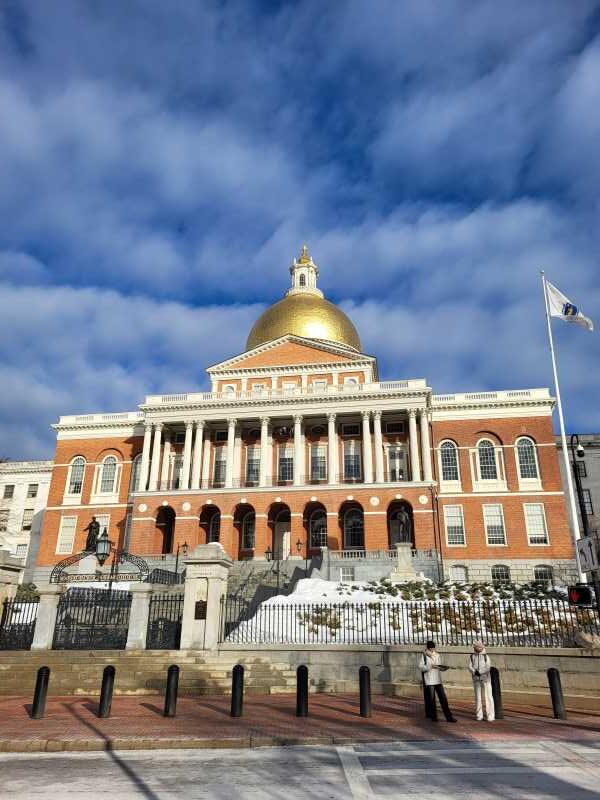
We sat in the coffee shop across from the golden dome of the state house, downed our ration of coffee and buns, and enjoyed the hell out of the fender bender played out right in front of us, wild gesticulations and rubbing each other’s bumpers and screaming that it would buff right out. The dogs with better shoes than the people walking them. The whole ghastly wintertime scene.

But we mostly enjoyed it because we knew we’d never have to look on it again.

The Kindness of Strangers vs. The Wisdom of Crowds

I’m so old I remember when people looked things up on the internet like a leap of faith. Ancient history now. Maybe five years ago. You’d type a question into the little box, hit enter, and hope that somewhere out there, a stranger would be kind to you.

The intertunnel was Blanche DuBois central. If you’re not familiar with Blanche, you should watch “A Streetcar Named Desire,” and see Vivien Leigh fading away while Marlon Brando became the next big thing. At any rate, just like Blanche, you had to be off your rocker to trust the internet, but by gad, people sure did. It involved more self-deception than trust, and a healthy dose of bad judgment.

No matter what it said on the masthead of whatever site Google sent you to:

  • You didn’t know who answered your question
  • You didn’t know why they answered it
  • You didn’t know whether they were brilliant, biased, drinking heavily, goofing off at work, or trying to sell you something on the sly

But there they were on the first ten results on Google. Strangers. And you depended on them.

Lording over this whole mess was Google itself. The ultimate stranger. Google never claimed to be your friend, exactly. It claimed to be helpful. Reached out an elbow for you to grasp on the way to the funny farm, and you took it. It claimed to be neutral and objective. That was a laugh. Its methods of curation were always opaque, its incentives were never purely aligned with your best interests. Google didn’t wonder what was true or even what was useful. Its ranking system consisted entirely of discerning who was kissing Google’s buttocks sufficiently to make Google some money.

What followed was inevitable. If Google rewarded visibility, then visibility became the greasy pole every website operator tried to climb. Entire industries sprang up to reverse-engineer the G’s algorithm. SEO experts. Content farms. Listicles with suspiciously specific headlines. “Doctors Hate This One Simple Trick” became a genre.

The internet quickly filled up with very strange people indeed, strangers shouting, waving, and stuffing keywords, all angling for a click. To be fair, no matter how bad it got, some people actually knew useful and amusing things, and offered them to the public, free of charge. These benighted souls, through titanic efforts, could climb to be found on page 114 of the Google results. It was left to the brave internaut to sort sincerity from strategy in real time. Pretty much, we all failed at that. Hence, Buzzfeed!

The kindness of strangers, it turned out, was unreliable, and just like Blanche lying on the floor, often exhausting. We were all ripe for something different. Google had hogtied the whole internet. The only place sadder than page 114 of Google was the top of the Bing results. You could hide dead bodies on Bing. The internet went from sclerotic to petrified. Only a completely different way to look for information could save us.

That’s what Large Language Models actually represent. They’re not glorified autofill, as many would characterize them. They’re not intelligent, either, in the true sense of the word, but so what? Unlike Google, which claimed to have the world’s digital information all curated for you, LLMs like Chad (Chat GPT) read the whole internet, and then some, and settle on a crowdsourced answer for you. Not original thinking. Not thinking at all, really. Just paying attention to everything, everywhere, more or less. Instead of being handed a ranked list of links curated by an inscrutable and avaricious stranger, you were handed a synthesis. Not a single authoritative voice, but an average. A blending. A statistical distillation of countless human scribblings. The good, the bad, and the ugly.

The prime idea behind this has a name: The Wisdom of Crowds. The term was popularized by James Surowiecki in the early 2000s. The observation itself is much older. Francis Galton came up with the concept, more or less, back in the 1800s. He spent half his time being pretty smart about statistics, and the other half writing a rough first draft of Idiocracy. He didn’t have faith in any single member of a crowd, not by a long shot.  One of Galton’s classic illustrations is a fairground guessing game. A crowd is asked to estimate the weight of an ox or the number of jellybeans in a jar. Individual guesses are all over the place, too high, too low, and confidently wrong, usually. But if you take the average of all those guesses, the result is often eerily accurate. No single person knew the answer, but the crowd, in aggregate, effectively did.

This core insight is counterintuitive. Under the right conditions, large groups of ordinary people can collectively make better judgments than a small group of experts, or even the smartest individual you can find. That includes me, I guess. I’m the smartest individual I can find, but then again, I’m alone in my apartment right now. I’d have to put on pants and go outside and look for someone smarter than me. It could take minutes. Never fear. The wisdom of crowds doesn’t work because people are especially wise. It works because their mistakes are all over the place. Biases cancel out. Overconfidence is diluted. Individual blind spots are cancelled out by other individual idiocies.

Large language models are sorta like that. They are not intelligent in the human sense. They don’t reason or understand, and probably never will. They’ve been trained on enormous amounts of human-created text.  Everything from high-quality scholarship mixed with drunken Reddit screeds, “journalism” (tee hee) mixed with marketing copy, insight mixed with the comments under cat videos. Much of it, taken individually, is not to be believed, never mind trusted. But when the model predicts answers based on patterns across all of that stuff, what emerges is something like a crowd’s best guess. It ain’t truth, exactly, but it’s at least a probabilistic consensus shaped by millions of whoevers rather than one loud stranger.

This is a subtle but profound shift. Before, you depended on the kindness of strangers. You hoped that someone, somewhere, had taken the time to answer your exact question thoughtfully. Then you hoped Google had decided this person deserved to be seen. Good luck with that. “Don’t be evil” is right up there with “Arbeit Macht Frei” in the accurate slogan department.

Now, you depend on mediation. The LLM doesn’t care about clicks (yet). It doesn’t care about ad revenue (right this minute). It doesn’t care about SEO tricks or keyword density (don’t worry, it will eventually). It doesn’t wake up hoping to sell you a multi-level marketing membership. Its incentives are different: produce something that sounds coherent, relevant, and responsive. That hardly makes it perfect or unbiased. Far from it. The wisdom of crowds can be wise under the right circumstances, it’s true. But crowds can also be lynch mobs. Garbage in, garbage out, averaged.

And since LLMs are programmed never to say, I don’t know, you end up reading hallucinations. You wish you’d get Sargent Shultz, and end up with Cliff Clavin instead:

The experience feels fundamentally different. You’re no longer wandering a digital marketplace, hoping to bump into a benevolent stranger. You’re having a conversation with a synthesized amalgam of John von Neumann and Cliff Clavin. Good luck figuring out who is who.

Month: February 2026

Find Stuff:

Archives