
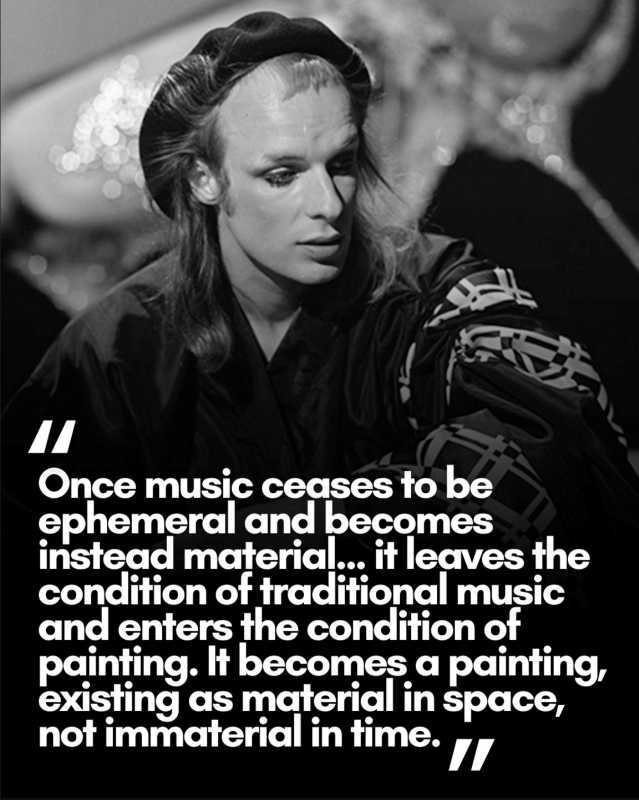
If you don’t recognize the name, Brian Eno was one of the original members of Roxy Music. They were pioneers in what I call Art School Rock. Eno drifted away from Roxy Music after a couple of records, and set up shop as a deep thinker about shallow music. He championed a style called Ambient Music. In some ways, it’s not even music. It’s just roughly organized sounds. It mostly doesn’t have definable rhythm, melody, chordal progressions, and all the things that normal people associate with listenable music. There’s the rub. There’s lots of organized noise in our world, and it can’t all be called music. To give one example, Eno composed this:
Because Windows 95 use was so widespread, Eno might have been the most listened-to composer in the world at the time. That sort of proves his point, that background sounds matter, and should be selected with as much care as the Top 40.
The quote up top is interesting to me, and trenchant:
Once music ceases to be ephemeral – always disappearing – and becomes instead material… it leaves the condition of traditional music and enters the condition of painting. It becomes a painting, existing as material in space, not immaterial in time.
I’ve made this point myself, in my hamfisted way. Eno is talking about all recorded music, I think. The act of recording it makes it A Thing, and a different kind of thing than it was when it was being performed live. The idea for Ambient Music is older than recorded music, though. Erik Satie called his compositions Furniture Music. He composed music that was intended to just fade into the background, or as he said, become part of the furniture. That was the style, but it still had to be performed live.
Beats the hell out of hearing Bad Company records playing on the muzak speakers in the Walmart.
A lot of musicians besides Eno have given the topic a lot of thought. I’ve heard Donald Fagen, who is one of the most precise (anal, really) composers of pop/jazz/rock material I can think of, express his interest in music that isn’t really music. Jingles, muzak, the bumpers played between scenes on TV shows, theme songs, and that sort of thing.
I go back to Sgt. Pepper’s Lonely Hearts Club Band. It’s the first record album I can think of that couldn’t practically be reproduced live by the pop musicians who made it, or anyone else for that matter. There are tape loops playing backwards on it, for instance. George Martin and the Beatles were deliberately making an artifact, not a recording of a performance.
That sent the ephemeral quality of pop right out the window. The production values of music trumped every other value of their appeal. They were no longer written to be performed, they were recorded to be played on machines. And as you know, the machines to play the music and other noises so saturate our lives that there’s no escaping them. The gas pumps play music. People wear noise cancelling headphones to drown out the constant ambient sounds and inject their own playlist into their heads instead. We’re not exposed to it; we’re marinated in it. Now that Ai produces the stuff by the metric carload, they’ll be no end to it.
Eno doesn’t mind that music ceases to be ephemeral. He’s arguing that it needs to be approached differently, because it has become different. I do mind, though. I have always liked music made fresh daily, as it were. I used to play live music for mostly live audiences. I watched the entire industry of performing music in bands in front of an audience die on the vine, right as I was doing it. Covid was just the stake through the heart and the garlic. It was already dead. Now there’s no place to play, and precious few people who can be entertaining live, anyway. I discount arena concerts out of hand. It’s not really a live performance. The equipment to fill an arena is so complicated that the noises that reach the audience have only a passing resemblance to the sounds the musicians are making. Milli Vanilli were honest compared to the audio spackle and pitch correction arena bands rely on.
Even if the bands could play something real, the audience doesn’t treat it like an ephemeral, enjoyable experience anyway. Look at any notable arena performance, and every single person in the audience is doing the Steve Jobs Hitler salute with their phone. It’s not real to them until it’s recorded.
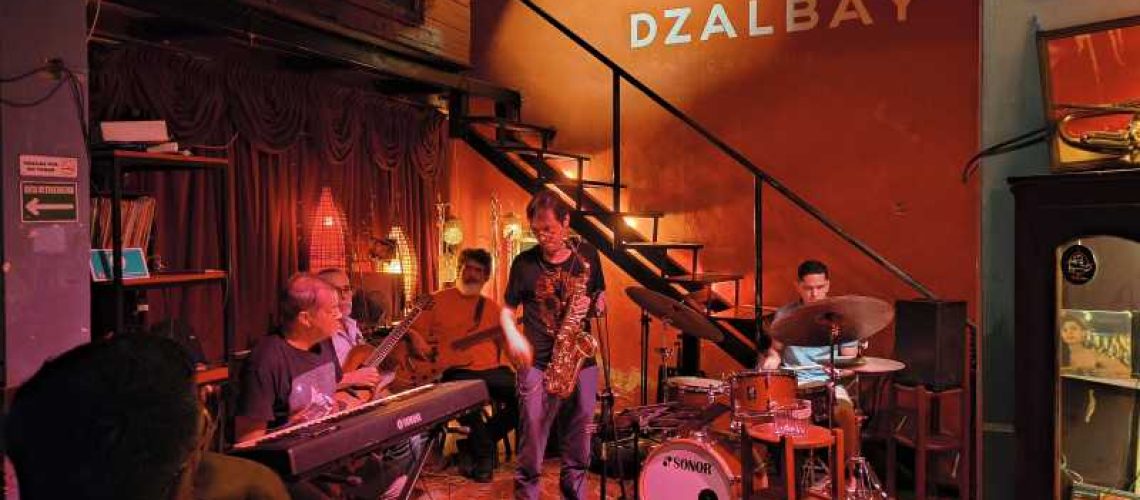
We went out on Sunday night. The local corner cantina, the Dzalbay, had a jazz jam session. In the US, they have open mike nights of the same stripe, and they’re generally horrible, one step past karaoke. The people who participate simply want an audience that can’t leave, because they’re also waiting to inflict their favorite song on anyone deaf enough to stay and listen to it. The Dzalbay ain’t like that.
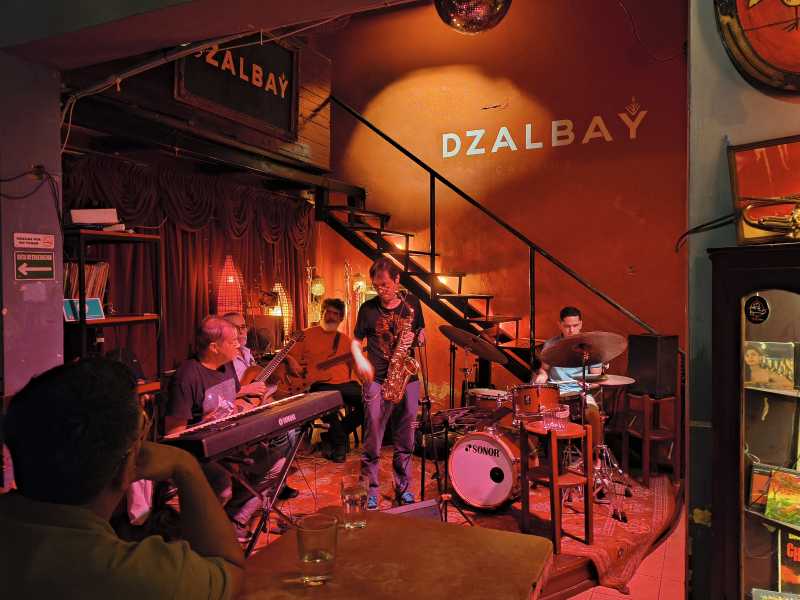
Man, everybody who played was a stone cold monster. It was a cutting contest without a hint of cutting. Not a lot of showing off, just an attempt to make music together, fresh, ephemeral, right in front of you. Music played live with no gimmicks is like watching a tightrope walker. You’re tuned in, maybe rooting them on, perhaps a little anxious, wondering if they might fail.It lends a sense of excitement that’s missing when guys are just spinning records.
Like everywhere we go in town, it’s free to get in, and the beer is cheap. I hated the guitar player a little, because at first I thought he was looking at a chord chart on the floor while he was blazing away, but my wife pointed out that he was just looking at the floor, because the supercharged version of Autumn Leaves, and some Ornette Coleman weirdness didn’t require him to look at his hands or anything. Then the fellow sitting next to me told me that the guitar player was also a luthier, and had made his own guitar, and I really had to hate him then, out of mad respect.
L. P. Hartley penned the semi-famous line: The past is a foreign country; they do things differently there. I think he got it wrong. I’ll fix it right now: The foreign country is the past; they do things the way I remember them.