Tony The Devil

Do you watch “Reservoir Dogs” with your toddler in the room? He can’t talk, after all, and barely understands the world around him, right? The doctor told you not to bother letting him watch television because it’s just a bunch of flashing lights and disconnected sounds, like our doctor did, right? And if he can’t understand “The Little Mermaid,” why would he understand “Silence of the Lambs?” And you can stop swearing when he learns to talk, too.

I have my doubts. My ten year old son, who’s hardly unsophisticated, leaves the room during the commercials when we watch football games, because the vast majority of the spots are for other TV shows about picking over dead corpses, hunting around for abducted children, and generally getting your entertainment out of the horrifying misery of other people. It boggles my mind that you might watch the actual shows with your children in the room; I scramble for the remote every time there’s a 30 second time out because I know there’s likely as not going to be kidnapping, rape, garroting, transfixion or cannibalism presented as a fun kind of puzzle, and that’s just a 30 second come-on for the stuff. The commercials are disturbing enough; why would you wallow in it for hours at a time is beyond me.

My two year old doesn’t talk yet. Does he know what’s going on? You tell me:

I discovered an interesting website for my older child. It’s called: Devices of Wonder, and it’s an online presentation of goodies from the Getty Museum. They have a fabulous little movie of an automaton from 150 years ago. It’s the kind of thing that delights and interests people even in our age, where any visual trick is made possible by arranging ones and zeroes on a disk in a Pixar cubicle. You try to put yourself in the place of its original audience, who’ve never even seen a movie, and picture their wonder. Check it out:

Antonio Diavolo

Well, the elder boy liked it well enough, but the little one was transfixed by it. He demands I play it over and over again, and giggles every time the little fellow nods his head to take his bow during his performance.

The performance is accompanied by a familiar piece of music, even for those not that interested in classical music: Kinderszenen op.15 by Robert Schumann. Kinderszenen means “Scenes from Childhood” in English. They chose the most recognizable snippet from the whole piece, “About Foreign Lands and Peoples” for the presentation, and it’s lovely. You’ll recognize it immediately, I’m sure.

Back to our story. I own a nice version of Kinderszenen on Deutsche Grammophon, performed by Martha Argerich. The woman can pound the elephant teeth, I’m tellin’ ya, though she appears so demure as to weigh less than little Antonio Diavolo himself. I removed Vivaldi or The SpongeBob Movie Soundtrack or Louis Prima or Jimmy Cliff or Respighi or something from the disc player and put in Martha, as one thing always suggests another, and I wanted to hear all the other szenen too.

Momentary pause; out pops “About Foreign Lands and Peoples.” The little one’s head bobs up like a prairie dog, or a bloodhound with a scent. There is a short interlude of confusion, excitement, and a hint of recognition. (this is my new definition of life, by the way; a short interlude of confusion, excitement, and recognition) Then the Wee One is up on his feet like a shot, left arm windmilling for balance as he tries to keep his stocking feet underneath him on the polished floor while sprinting around the corner, tearing down the hallway, desperate to get to the computer in the office to see his friend Antonio.

Antonio wasn’t there, of course, the screen was shuttered and dark. He came back, confused and disconsolate, and we were all laughing, which must have seemed awful in his disappointment, but he wasn’t through amusing and educating us yet. He ran to me and made his Up, Up! gesticulations, and I knew he wanted his all knowing and all seeing father to make the magic box spit out the pictures of his friend Tony. Or so I thought.

I grabbed his wrists to pick him up, and he ran his feet straight up my chest to the shoulder and did a backward somersault to the floor. I barely held onto his hands or I would have had to look for him one floor down through the hole in the floor. Again, again; Up Up!

Trust me. They’re paying attention.

Devices of Wonder

You’re Welcome In Advance

This is the time of year that gets me. Winter taunts you a bit; it gives you a hint that it’s over soon, and lures you outside on some pretext. You have a little interlude, basking in the sun, peering over the garden looking for the first shoots of crocus, no snow, no wind, the kind benificent orb starting to stretch its burgeoning spring muscles…

And then it slaps you again, to remind you who’s boss. Miserable little flakes like winter’s dandruff sift down for days, the wind finds its way where you wish it wouldn’t, the miserable dishwater clouds scudding across the sky like they’re embarrassed to be there.

It’s easy here, compared to many places. Near the ocean in the Northeast is fairly mild, winterwise. People in Minnesota must laugh when they hear us bleat about 35F and cloudy. But Three Card Monte weather only needs to wear you down. It doesn’t need apocalyptic fury. Many a housewife eyes the kitchen knives when the Santa Ana Winds blow too many days in a row. I’d kill for ten minutes of that right now. To each his own.

But I am refreshed, and wish to share it, if I might, with my internet friends. I was cleaning my virtual desktop, and stumbled upon this trifle, drawn with love and care by my older son for me when he was very small. Such things are personal, perhaps, and not transferable, maybe, but I’ll offer to share it on the off chance that you too need a smile, like this portrait derived from a heart untainted by even the remotest hint of malice or calculation or pretension. It’s not sophisticated. No matter. It might be enough to carry me to spring. How about you?

The Square Root of All Evil

Hello everybody-

Well, I’m depressed. You see, I’ve discovered the funniest writer on the Internet, but reading his prose isn’t as enjoyable as it should be, because it’s me, and I already know the punch lines because I wrote them. It spoils the effect somehow.

The latest installment in the “Old School” series is up over at HotHardware.com, and it’s topical and funny and incisive and witty and informative and … what’s that dear? Oh yes, it’s about 500 words too long.

Here’s a little:

I’m supposed to be afraid of the Chinese, I think. They’re going to have all the money. Or is it the Japanese? I forget. No, that was 1985. My memory is a little fuzzy, but I think the Japanese plan for world economic domination was:
1. Make Americans a bunch of VCRs.
2. Invest the money in more VCR factories to work in, to make more VCRs.
3. Be too honest to steal a VCR at work.
4. Sing Manilow songs in a Karaoke Bar on Fridays.
5. End up fifteen years later still trying to save up enough money to buy a VCR by working in Flatscreen TV factory.

So this ended up badly for the Japanese; and Barry Manilow is number one on the pop charts again in America, so it ended up badly for us too. But when Barry Manilow has more money than the whole Japanese economy, I guess we can stop worrying about them.

You can read the rest of it over at HotHardware.com Don’t read every sixth word and it will be just the right length:

The Square Root of All Evil

Afraid of China?

Good morning all.

I read the latest in a long line of “Fear the Chinese” newspaper items, today’s version is in the Greensboro News-Record . The perceived Chinese menace to American made furniture and cabinetry cannot be overstated. I often read and occasionally comment on internet forums geared toward cabinet and furniture makers. In those forums, it’s common to hear people to wax nostalgic for a time before imports put pressure on domestic suppliers of these items. They express opinions about Chinese imports that range from contempt to paranoia. Is any of it appropriate?

I can recall fairly well a similar outpouring of fear and concern about thirty years ago regarding imported automobiles. Detroit got caught flat-footed by a sudden rise in gasoline prices, and didn’t have any products to offer to compete with foreign, especially Japanese, imports. Sound familiar?

There was more to it than that, and it’s largely overlooked today. I bought a Japanese car twenty five years ago because I needed a small inexpensive economical car. At the time, although I was not involved in the manufacture of automobiles, I was a member of the United Autoworkers Union, which at the time was the second largest trade union in the world. It was common to hear about foreign cars being vandalized in Big Three Automaker parking lots, and “Buy American” was all the rage in bumper stickers, if not in showrooms. “Buy American” was discussed in a desultory fashion in our own coffee room, but solidarity only goes so far, and gas went from $0.35 to $1.00 per gallon after all.

American automakers behaved strangely. They tried to compete with Honda Civics by taking a very poorly designed car, the Chevette, and offering it at the same price, and realizing the savings necessary by selling it without its back seat. I’m not joking. My neighbor bought one, and I looked in the window and saw a big sheet of galvanized metal where the back seat would normally be.

I waited six weeks on a list and paid a premium over list to get a Honda Civic.

The reason was a lot simpler than the media and the struggling car manufacturers let on: I couldn’t afford to own a car that didn’t run, never mind one that didn’t have a back seat. Did Detroit really think you’d buy a Pinto with a reputation as a Improvised Explosive Device or a Chevette with a reputation for the engine to melt when I could get a Corolla that ran like a top?

Now, indeed, the American car manufacturers were inexpertly building the wrong kind of cars at an inopportune moment, but the adversity of higher gas prices exposed the underlying corporate and union character flaw: they were making crummy cars, poorly designed, engineered, and manufactured. And they treated their customers as a cow to be milked, not a constituency to be served. And they got their butts kicked by people that had been bombed back into the stone age just 30 years earlier, and knew that had to do things better, faster, and more cheaply than their economic big brothers or they’d stay in that stone age. And Detroit got caught napping. They got caught drowsing again recently, and still tried to blame the Japanese; the problem this time is that the Japanese factory is in Kentucky now, and the one thing that’s different from old American Iron is there’s no collusion of management and union against the customer. There can’t be, because there is an alternative for the consumer now.

There are real people, hard-working and salubrious, caught up in the changes wrought by inexpensive furniture imports coming in from China and Malaysia,and India and Vietnam, and I’ve heard of this IKEA thing too; they’ve snuck up from the west while we were looking east. And we must be very sympathetic to the plight of people who order their lives based on current conditions only to have the march of events overtake them and their crafts, and subsume them. But we cannot pretend that it’s going away anytime soon, and encourage people to continue on by special political pleading, making the denouement of their struggle worse.

The article specifically mentions tariffs geared to avoid dumping of cheap furniture on the American market. Analysts who are either foolish or worse believe that the Chinese are dumping goods on the market below their costs, in the hopes of driving out domestic American manufacturers and then charging whatever they want for the goods later. I doubt it.

You see, the analysts are describing what they understand from the playbook as previously written, when the powers that be just needed enough capital to outlast their competition and then could lord it over the consumer later. Always, it boils down to a fixed game against the consumer. That’s how you get a CEO in Detroit signing off on a sheetmetal back seat in the 1970s. They thought what the consumer will accept is what we give them. That works, if there’ s no other alternative. But it’s 1949 Soviet tractor factory management thinking. Who thinks that’s going to work any more?

Well, I doubt it’s the case that China is dumping goods on the American market to get market share, and will just hang on until our own industries tank, and then charge what they want. China has a resevoir of hundreds of millions of persons who will jump at the chance to make those inexpensive items. And if you think you can outlast them by making the exact same stuff, only more expensive but made more cheaply, you better be ready for a long siege. And if you think you’re going to keep everything the way it is, and all of us frozen in amber, marching off with lunchpails to factories belching smoke and churning out furniture sold in department stores by clerks with pencil thin moustaches and pinstriped suits, you’re dreaming. You’ll all lose your jobs anyway, and the stores will be empty to boot. The market for cheap furniture you’re fighting for wouldn’t exist if the furniture wasn’t cheap. Put another way, you can’t make expensive cheap furniture and expect to sell it. The market would go away along with your competitors.

Make what the Chinese, won’t, or can’t. You’ve got a 3000 mile head start. You know what your neighbor wants; the chinese manager has to guess. People will buy what you have if you have what they want, made in the fashion they require, where they want it, in a timely fashion, with excellent customer service.

You can be the Honda Civic; let others be the Chevette with the sheet metal back seat.

Bog Hockey

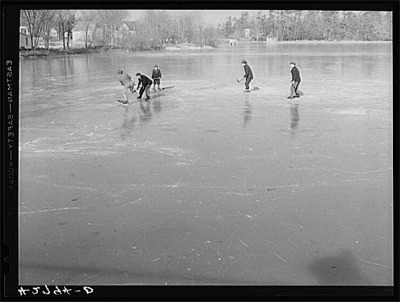
This picture is a lot older than I am. Probably thirty years older. But it is an exact rendering of my winter life in our little suburb — check that– exurb — check that — that word didn’t exist then– out in the sticks where we lived in the sixties.

I was born in Boston. When I was but small, we moved into the country. And my life was amazingly different from my cousins who remained in the city.

We didn’t have any money, really, but not so’s you’d notice. We lived in a little house on a little plot in a little neighborhood, and had little, salubrious lives. Our mother would turn us out of doors, no matter the season, and we’d take our battered belongings, pool them, and play self -organized sports. We’d sort out the teams, and the rules, and the size and shape of the playing surface, and rarely quarrelled, unless it seemed like more fun than playing any more. And we could have sorted out the Mideast thing, if they’d let us. Maybe their quarrelling is more fun than they let on.

In the summer, we’d play baseball, and have to mow the field before playing. Right field’s an out! In the winter, we’d play basketball in the elementary school gym. Shirts and skins. Onlookers were no doubt sorely tempted to play xylophone on many of the skins team’s ribs. Weight training was still far in the future. In the fall, we’d play tackle football in a cow pasture with no equipment. There were no hash marks or goal lines demarcated, of course, but in a field recently used by ruminant animals, those weren’t the things on the ground you would have been keeping an eye out for anyway. And in the winter, we’d dress in wool, gather our rusting hand-me-down skates that lacked steel toes, grab the sticks that were generally broken and discarded and then repaired with electrical tape, and we’d shamble on down to LaFleur’s Pond, and get up a game. The idea of actually owning and wearing a replica of the sweater worn by our local professional hockey team was as remote and mystical as a strawberry on the kitchen table in the winter.

We were always half frozen with the cold. We had no protective gear of any kind. Hell, at the time, there was only one professional hockey player who wore a helmet — Terrible Teddy Green– and he only wore it because he’d already had his head staved in from a stick fight, and needed to protect the steel plate in his head from any further persuasion. When we first started going to Boston Garden to see Bobby Orr’s mighty Bruins play, some of the goalies weren’t wearing masks yet.

The ice was never really frozen properly, one way or the other. If it was thick enough to be safe, it was so corrugated it would rattle your teeth out of your head. If it was fresh enough to offer a smooth surface, it was thin enough to drown you. We always skated anyway. If you got checked, you’d occasionally slide to the margins of the pond, get caught in the brambles reaching up through the ice, get tangled up, and fall in up to your waist, and you’d spend the rest of the day skating with your pants frozen to your legs. You wouldn’t stop.

“NO LIFTING!” you’d shout every time the more adept stickhandlers would get the puck up off the ice and crack your shins. We’d all readily and solemnly agree that there’d be no lifting, before we began each game, of course; some of us because we knew we were incapable of lifting it, and the others because they were incapable of not lifting it, so no one was much put out by the bargain.

We’d put two sticks five feet apart on the ice to mark out the goal, and get to it. Guys who never passed at basketball never passed at hockey either, we noticed. And they’d forever be taking shots from fifty yards from the goal, missing by fifty yards, and requiring a ticklish trip to the brambles to fetch the errant puck without swimming amongst the prickers.

When we got older, we’d fashion real nets out of scavenged lumber and chicken wire, and without fail we’d forget to fetch them off the ice in time for spring thaw, and we’d see them, on the bottom like scuttled privateers, winking at us beneath the new year’s ice.

I wanted to be a goalie, but had no equipment. My father drove an old Rambler Station Wagon. Underneath the carpet in the back, there was — check that — there originally was a layer of foam rubber.
My brother and I spent many a miserable car ride rolling around in the back of the car with only the thin carpet between us and the rivets and bolt heads because I cut the pad up into rectangles, wove olive drab straps from army surplus utility belts through slits in the foam, tied them to my legs, and played the net like that.

At the time, the Bruins had a goalie named Gerry Cheevers. He was cool. He wore a white plastic mask, and he’d draw the stitches he would have received had he not worn the mask right on it, in magic marker, adding one every time he got hit in the face. He looked fierce like that. Young boys like fierce. So I tried to fashion one for myself out of the plastic scavenged from a Clorox bottle, held on my head with an elastic band, and burned my face with the residue of the bleach. The plastic was as thin as a negligee, and wouldn’t protect me in any case; I didn’t care, I wore it anyway.

And some of the kids were real good. A few played college hockey. One played on the Olympic Team and the Bruins and is now an NHL coach. But by the time he had started coming around, there was a real rink next to the high school to play in. Real equipment started to show up. Right handed goalies didn’t use their brother’s left handed hand-me-down baseball glove and bleach bottle mask and Rambler foam as equipment. Time marched on, and the younger kid’s parents started getting up at 3:00 AM to make it to the rink for their allotted ice time, supplanting the older kid’s ritual: mothers sticking their heads out the back door when the light got weak and the sun skimmed the horizon, painting at the last only the very tops of the dormant oaks that ringed the pond with the winter dusk’s fire, shouting your name to call you to dinner.

My son played hockey on the Playstation once. Didn’t care for it.

Month: February 2006

Find Stuff:

Archives