I Heard It Through The Grapevine is a marvelous song.
It has an interesting pedigree. It was written by the very successful songwriting duo of Norman Whitfield and Barrett Strong in 1967. They tried ever sort of angle at recording and releasing it, with their employer, Motown records, never really seeing the potential in it, and shelving each one in turn. First the Miracles, then the Isley Brothers recorded it; neither version was released. Marvin Gaye recorded it in the form we’re accustomed to hearing next, but the owner of Motown, Berry Gordy, didn’t think it had any potential in that iteration, and shelved it too.
Whitfield didn’t give up, and Gladys Knight and the Pips recorded another version, and Whitfield got Gordy to allow the single to be released with no fanfare from Motown. It went to Number Two on the Billboard Pop Chart, and stayed there a good long time. It was Motown’s biggest seller up to that point.
Amusingly, what was destined to be the most popular version of the song almost didn’t get released because of the popularity of The Pips version. Motown just offhandedly stuck Gaye’s version as filler on his next album in 1968, and didn’t release his version of Grapevine as a single until they discovered that DJs were ignoring the album and simply playing that one song because they couldn’t get the single. They wised up and hurried a single out, and it went to number one, and remained the biggest selling single for Motown for the next two years.
The two versions are fascinating. Gladys Knight sings it with declaiming gospel uptempo verve, exuding a kind of glee, almost, at discovering that her lover perhaps has been unfaithful. It’s very different from the kind of dark brooding menace of Gaye’s vibe of betrayal, melancholy — and danger. Watch Gladys and the Pips sing it in a sort of supper club atmosphere, and hear the gathering of self awareness and pride as a woman discovers her man is unworthy of her, rears up to her full feminine stature, and tells him so:
There’s a real sort of affirmation of self-worth and blast of righteous anger — the anger sublimated, tamed and yoked to the plow of dignity: If you don’t love me enough to be faithful, I don’t need you. I’m worth it.
Now watch them sing it together, and see the pain in Marvin Gaye’s delivery, telegraphing the very real pain that was a constant in Gaye’s life:
It’s different for a man. The betrayal is an affirmation of another sort. Cuckolded. The fool. His essence as a person held up to others, behind his back –mocked and shamed. He doesn’t know what he’ll do if she leaves him; but he can’t stand to be played for a fool. This is dangerous territory for a man to navigate. The vibe of the version is subverted. Dark, gloomy and foreboding; anything might happen.
The same situation, two different ways. Could Shakespeare illuminate the human condition any better?
I like where I live, but it’s an odd place. It has a “village,” a portion downtown of mostly small cottages on urban sized plots, crowded in a rabbit warren of little streets hard by the ocean. But the appellation “village” usually connotes a kind of familial and bustling streetscene. Marion is like a mausoleum most of the time. We used to take our older child, when he was but small, to the playground on Saturday, and he’d literally be all by himself. No one would even walk by. We began to go to the neighboring towns to find some people outside.
There are institutions in town where the activity seems to be. There is a tony private high school- Tabor Academy; an exclusive yacht club – Beverley Yacht Club; and a very exclusive golf course – The Kittansett Country Club. There’s a tennis club that looks like it belongs in British Colonial India.
In case you haven’t figured it out by now, I’m not going to be joining the Beverley Yacht club or playing golf at Kittansett anytime soon. And I doubt either of my children will attend a high school that costs about the same in tuition as an Ivy League university. And I’m not really sure I’d join, even if they’d have me and I had money to burn. I don’t want to start calling my wife “Lovie” and wear green pants with whales on them, is all. It’s nothing personal.
These institutions and others are sort of revered around here, but they add little to the everyday life of the town. They are insular and private and are cordoned off from the rest of the population by money and walls and the money pit the ocean presents to the would-be sailor. Money doesn’t fill a playground.
It is because of this built-in distance from many of my neighbors, and the real distance my home, way out in the boonies, presents, that I crave the activities that happen from time to time that involve the general population of the town. Our older boy plays baseball with his brethren, our toddler goes to story time at the library. We used to revel in the magnificent fireworks display yearly at the town beach on Fourth of July, but the insular folks killed that because it grew too popular,and attracted people, well, people like me and my family, except they were from the surrounding towns. The folks in Marion that don’t like strangers kiboshed the proceedings rather than allow outsiders to enjoy it along with us. There was a representative letter to the editor in the local weekly newspaper replete with references to those sorts of people and undesirables and things of that nature that was a classic of the form. Being only recently freed from the ranks of the great unwashed, I found the the whole attitude repellant.
But nobody’s asking me. A town gets its vibe going almost without cognition; it just sort of coalesces around institutions and people and weather and all the other isalnds of interest in the ocean of humanity without thinking. You can propose; humanity disposes.
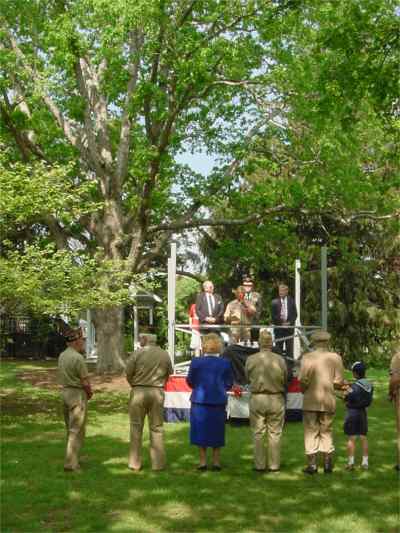
And so I was gratified to go to the center of town, and watch my son march in the Memorial Day parade, and play The National Emblem in front of the reviewing stand at the town hall, and help us to honor the people who fought– like my father and grandfather, and some — like my uncle Bobby — who died, in the military service of their country.
The parade was a zoo; a wonderful kind of rabble coursing down the three main streets in the little downtown. Doughy veterans marching smartly in a little claque, then an enormous amorphous throng of instrument wielding gradeschoolers, all cheered on by as big a crowd of people as the downtown ever sees –a few hundred people.
The first speaker was a local man, active in veterans associations, and a terrible and wonderful public speaker. His innate good sense and humility was revealed by his inability to speak to the crowd without stumbling over each word. I thought he was marvelous, a testament to the really dignified and self-effacing nature of the citizen soldier of the United States. His friend read the roll of the veterans from the town that had died since the last Memorial day tribute, and I was really jarred by how many names there were; they far outnumbered the persons present in uniform for the fete, and reminded my that my own father is becoming a rarer bird each day: a living reminder of World War Two.
There was another man in an officer’s uniform; younger, a bit, than the other veterans, and a member of the town government in some capacity –I didn’t catch his name. He was introduced in a perfunctory manner, and he launched into a rather lengthy droning speech. He spoke like someone who was used to speaking in places where the audience could not escape. It was as if he was talking at us, not to us. And he went on, for quite a bit, about pacifists. Wonderful antiwar people. Conscientous objectors. Quakers. Just plain uncooperative cranks, too, by the sounds of it. He directed us to graveyards where we could find those pacifists, some buried as long as 225 years, and asked us to honor them on Memorial Day.
He seemed really taken with the idea.
No one so much as murmured about the fellow’s remarks. No one really showed any enthusiasm for them, either. I’m not sure if he got any applause at the end of his stemwinder; I had since taken my little son across the street to the park, where he played amongst the magnificent rhododendrons, and stopped to run his little unknowing finger over the brass runes on a plaque set in the ground amongst the greenery. It reads:
He gazes out of the photo, mute, enigmatic, not quite smiling, and speaks to me across the decades.
When I was a little boy, amusements were few and far between. Television was still in black and white for us, and after the reruns of Gilligan’s Island and The Three Stooges, not much was on the idiot box, as my father called it.
I remember my father and me trying to watch a hockey game broadcast from the west coast featuring the California Golden Seals, who were setting a new low in sports sumptuary and getting pasted by our mighty Boston Bruins — Bobby Orr and Phil Esposito and Pie McKenzie and… well, I can still recite all their names down to the most obscure, even Garnet (Ace to his friends)Bailey. On a thirteen inch black and white TV with rabbit ears. We might as well have used the Etch-a-Sketch.
Eisenhower’s X-Box, the Etch-a-Sketch was.
And so it always seemed a real treat when we could wheedle our mother to drag out the elegant but battered silverware box, left from some set our family never owned, filled with the family photographs. The pictures were mostly black and white too, the current cutting edge of photography being Polaroid’s prehistoric b&w instant photos, which would come out of the camera, and you’d count to a now forgotten tempo, and pray, and pull off the cover paper to expose the image and stop the developer, and smear your clothes, and hope the picture was vaguely done.
We’d see the usual babies on the shag carpet, buns up, and confirmation and communion suits that fit like either a tent or a rubber glove, never any degree in between, and little girls in their Easter jumpers and patent leather shoes, with their mothers wearing a hat, a real hat, ready for church. Father, grim, unsmiling in his workday suit, a little shiny at the elbows and knees.
Those photos were only the littlest bit interesting after a while, because they were for the most part, well — us. The exotic ones were always deeper in the pile, instantly recognizable as special by that magnificent sepia tone that photos used to have, and spalling and cracking like a fresco in damp cathedral.
There they’d be, the southern Italian or Irish immigrant faces, looking stoically at the camera, surrounded by extended family on a stoop in Cambridge or Dorchester or Roxbury Massachusetts, or perhaps Antigonish, Nova Scotia. They had their hard lives written all over their faces. But always calm looking. Serene, really; neither introspective or egoist. And they looked into the lens in a way that we never do. Not into it, but through it.
Our parents would strain to remember all the names, and who did what and from where, and why and when. And I figure, with the small wisdom that I’ve accumulated with age, that when we pestered them too much about someone obscure, they made stuff up.
And then his face would turn up. Handsome, mysterious, forever young. Forte.
Who’s that?
That’s my brother Bobby, my mother would answer. And that was that.
I was young, and still in the thrall of my parents, and sensed it. Here is a place you do not go. And the years passed, and the TV was in color, and my wrists and ankles began to show from my hand-me-down cousins’ clothes. And the box came out less often. But when it did, the tantalizing face, handsomer than all the others, undiminished by time or care, resplendent in a uniform, always caught your eye. He died before I was born I learned, by osmosis I think, I don’t remember ever having the nerve to ask, and I’m sure it wasn’t offered.
In Korea.
And the earth spun, and the seasons changed, and then I was a man.
One day, my mother came to me. She had a picture. it had lain stored and untouched for fifty years, coiled, and she couldn’t unroll it without destroying it. We slowly, ever so carefully unrolled it, the flecks of black and white popping off, as I stared at the faces. Hundreds and hundreds of faces. Five rows, stretching right off the page, four feet long, all in identical infantry uniforms, except the six cooks dressed all in white. C Company 506- Infantry, 101st Airborne Division. Camp Breckinridge, KY. December 27, 1952.
And there was only four ways to stand out in that mob of faces. The cooks, of course. One man in the hundreds wears an officer’s hat, and looks ten minutes older than the rest. One man is holding drumsticks over a military style snare drum. And in the very center, in the very front, one man holds the company colors on a lance. Two crossed muskets, a Capital “C” and a “506.”
And he has the face that speaks to me.
Now when I was in college, on a lark, my friends and I went skydiving. We trained all day in a sweltering hangar in Upstate New York amongst the farms. They strapped army surplus gear on us, hung us on straps depending from the hangar roof, and shook us around violently by our heels until we demonstrated that we could unbuckle our main chute from the straps on our shoulders, then pull the cord on our belly chute. Fun.
We climbed resolutely into a Beechcraft Beaver, which now seems to me an odd name for a plane, and knelt in rows in the fuselage. A few long minutes later we launched ourselves, some with difficulty, out the open hole in the side and into a whirlwind far over the patchwork quilt of the fields. A tether pulled our chute for us, and we drifted down and found a place with a liquor license.
I called my father, and told him what I had done. Expecting praise, I guess, or some such. And he called me, gently, the fool I was.
I protested: but you were in a bomber plane. They must have made you jump. And he told me, son, if that plane was on fire, filled to the brim with rabid rats, and piloted by a dead man, I’d still take my chances in the plane. And to jump from a perfectly good one, he said, is foolish. Click.
My father was in the Army Air Force. Ball gunner, hanging in a plastic bubble under a B-24J, Les Miserables, over the Pacific. Air Medal. Distinguished Flying Cross. After I pestered him enough, he once told me a sort of a story about the war. He reeled off the names, Tarawa. Pelelau, Kwajalein, Tinian. He mentioned, in an offhand way, that after some island had been bombed flat, they later landed on it. It looked like the island had been picked up ten feet, he said, then dropped. His CO told them that some planes were coming. On these planes were some people. They were coming from somewhere. They were going somewhere else. When the planes landed, my father and his compatriots were instructed not to talk to these men, or even about them; and if he said so much as hello to one of them, or said “boo” about them to anyone else, he would spend the remainder of the war in a military prison, incommunicado. My father lost his desire, if he had had any, to speak about those men. Some of them flew a plane named the Enola Gay.
My Father seldom talked much about being in the military.
And my mother never talked about the brother in the photographs.
Now the picture, the coiled picture, was ruined. But then, we don’t watch black and white TV any more, do we? My mother took that picture, and a bankroll, and had a necromancer or an alchemist or something at a digital photography studio restore it, perfectly, and make copies for all of us nephews. Mine hangs today over my kitchen table.
He watches over me.
I was forty years old. My mother told me, Uncle Bobby hated his real name.
I’ve been in a thousand roadhouses. Paint peeling from tin ceilings, yellow pine floors stained with the offal of a million benders and scoured clean by the grit of numberless shoes. The neon winks at you. The Men’s room door is on its fifty-fourth set of hinges, the room itself is on its third cleaning in forty years. There are bowling trophies and fish heads and incongruous signs on the walls all donated by the denizens — some of whom are half forgotten but in attendance, others always present but dead. The glasses aren’t clean but beer comes in its own glass, and you can order it by holding up your fingers. The pool table lists to port a bit; after 11:00 PM the patrons do too, so all is well. The quarters, stacked like a tower in Pisa, signal “next game” ’til tomorrow and then some anyway.
There’s a stage, capacious enough for an anorexic to tell jokes from, with four people, their instruments and equipment, and a full drum kit on it. The singer wanders the floor anyway. He sings into a bus station microphone, whispering in it like a lover, or alternately screaming into it like a Stanley Kowalski sort of lover, and peppers his delivery with winks at pretty girls and harmonica playing like a distant elegaic train whistle on the prairie at night.
The guitar is a Fender Stratocaster, of course; it’s strung with strings like cable, and you never hear a note unless it’s intended. You can’t mash them all around. The amplifier is right behind him, that player, and if he swings his hips — he does– the sound shakes the strings into a sort of harmonic frenzy, and he rides the rising howl like a surfer does a wave, and then swings the neck away and the shimmering tone of the plucked chord returns to the slow boil.
There’s a lot of space in the music. The bass is an anchor. The drummer could make do with just a high hat and snare. His right foot is like a piston driving a pile. He moves his stick to the ride cymbal, and you sense that the bell of the cymbal is a world away from the edge.
The guitarist knows what he is doing, and never plays what is being sung; he winds his counterpoint around the vocal like a vine on a drainpipe, and the beautiful rainwater courses down inside, splashes down in the garden, the curb, the gutter — into the very earth. It rises again from that earth, and forms melancholy clouds, scudding across the musical horizon, then brings the cool, gentle rain down on all of our heads, which cleanses and anoints us.
Your girlfriend goes home with the bass player, of course.
I’ve too much to do, and not enough time to do it.
That’s fine; we all seek out that situation, if it’s not supplied to us already. The newspapers are always filled with things about simplifying our lives. It’s nonsense, always. We’d fill up whatever space we made in our lives with something else, the minute we had a free moment.
Life is richer, and fuller, than at any time in the past. I’m not that old, but I remember the limitless road of drudgery laid out in front of me when I was a young man. Get a job, do it, make your replacements on this mortal coil, watch Gilligan’s Island, die. Join the sepia ranks of the anonymous.
Work and family are still all that matter to me in the world, that hasn’t changed; it’s the dreary wallpaper of everyday life that’s improved, and I’m all for it.
Sometimes I catch people wishing for misery, nostalgic for a time when they were forced by circumstances to huddle together. They feel lost out in the landscape of life, and want company. And if you’re not willing to go back to their crabby world, they’d like to thrust you back into it. No thanks.
I know people I would not have known if this box of electronics wasn’t on my desk. I’ve seen places I’ve never been to, and will never visit. I know things I would not have known. I’ve been reminded of things that would have remained forgotten. I’ve seen that anybody that thinks they know very much about any one thing is a fool, and that anyone that thinks they know very much about everything is a total ass, and should mind their own business.
As I said, I’m busy, and pressed for time. I’ve seen the inside of one room for too long. I need to see something beautiful right now.


Recent Comments