The Irish Saved Civilization But I Couldn’t

When nothing in society deserves respect, we should fashion for ourselves in solitude new silent loyalties.

Nicólas Gómez Dávila

I was at a gathering. Certain kinds of people call a barroom a gathering. Certain kinds. Most everyone was familiar, although nearly no one is here. An extranjero to us, and everyone else, had appeared, friendly, gregarious. He’d been adopted into the brotherhood of the bar tab already. I tried to catch up.

He had been partially disassembled by his country, then put back together pretty well, thank God. But he was a ship of Theseus. He was the same person, but not the same. He was wandering the world in search of new silent loyalties, although he skipped right over the silent part.

A friend pointed to me and said that’s _________. He’s a writer.

No one had ever said that before. Never. I’ve been called every damn thing, but never that. It was way down the list of things to be called, on some second page of a resume that never gets printed.

Al was there. He wanted another copy of my book. He’s a philosopher, I guess. Or maybe a Buddha. A wandering ascetic. Whatever he might be, people sit next to him and feel better. I have. He had a copy once, and liked it, so he gave it to the library. He said he couldn’t do without it, even one step removed, so I gave him another one.

A young girl swam in our pool. When she comes she hugs us and says, “Mucho gusto,” instead of all the wan greetings we’ve learned from our lessons. She wanted a book, although she cannot read English. I signed it in Spanish, or maybe Italian, or both, the language is like that sometimes. She held it like a missal. I’ll never forget it.

No one speaks English here, but my book is in the library. It isn’t in the library where I pushed the rock of my life up its hill, over and over. I fashion for myself in solitude new silent loyalties.

Small World

I’m getting used to living in a city again. I’ve lived in Boston for a few years. Los Angeles. But for the most part, I’ve always gravitated to the exurban life. Occasionally the suburbs would swallow the exurbs I was in, but I’d generally moved on by then. Not always because the police told me to.

Mérida, Yucatan, where I am now, is big. Depending on how you count its metropolitan area, it’s got either just under a million souls, or 1.3 million. That’s about the same population of the entire state of Maine. Not many people here have even heard of Maine, when they ask me where we fled from. We usually give up after a few tries and say, “Boston,” and that satisfies them, if not me.

This city is like Los Angeles used to be, though. Not much of it is over a two stories tall. It’s spread out all over, but the houses are packed cheek to jowl. You can wander a long way without encountering any gap between buildings. The zoning is by sixteen-sided dice, I think. Everything is everywhere. You can encounter all kinds of things just by wandering around aimlessly. All kinds of people, too, if you’re open to it.

Yesterday evening, we went out to eat with some friends. After we lightened the larder at a sitdown restaurant, we walked down the Corredor Gastronomico, the long strip of restaurants, nightspots, and general folderol this city offers to the sunburned and the thirsty, i.e., us. We pounded dinner home with some frosty helado, sat outside, and watched the parade of people passing by. It’s in the mid-seventies at night, so we decided to just keep wandering around, in search of a nightcap or something.

We got to the head of the remate, the butt end of the big north-south boulevard called the Paseo Montejo. We’ve been there plenty of times before. We were going to pass on by, when we heard the clear, clarion call of a trumpet. Music spills out into the street from lots of doorways, but you can always tell when music isn’t recorded. And a trumpet carries further than other instruments. We shrugged and said, “What the hell,” and went to find our Mérida Joshua.

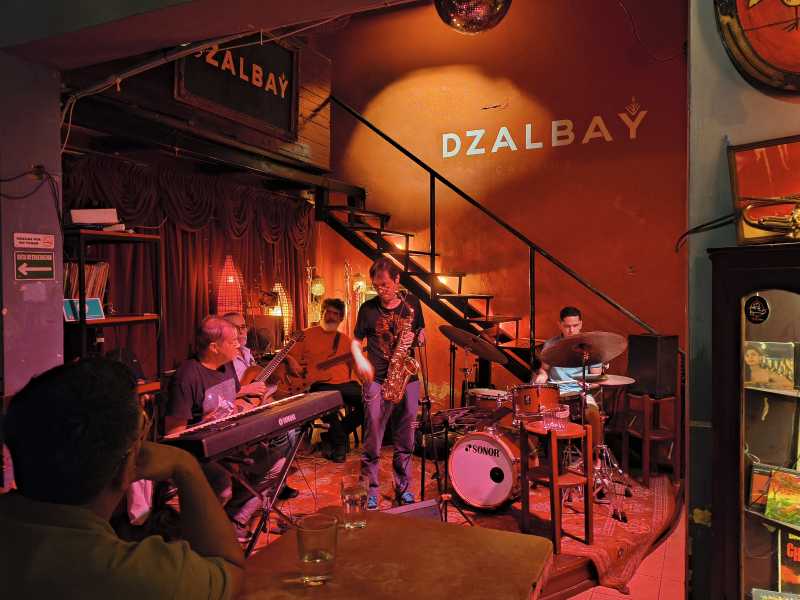
There was an unusual combo playing at the Tropico 56, an indoor/outdoor place we’ve been to plenty. There was the trumpet we heard first, joined by a keyboard, a pretty girl singer, and a percussionist. We sat down and decided to put ourselves outside some beers, and hang a while.

They were really good, and favored exactly the stuff we’d always like to hear, but never do. One Note Samba. Spooky, by the Classics IV, or the Atlanta Rhythm Section, depending on how old you are, or they were, at the time. We especially liked Perhaps, Perhaps, Perhaps:

We’ve always loved the Perez Prado version, but you can hear everyone from Doris Day to Cake performing that one.

So it was an eclectic, very cool jazz and pop combo, with an equally eclectic mix of music. When they took a break, the trumpet player walked by, and we asked him if he spoke English. He answered in American TV weatherman diction, which made us laugh. We asked him the name of the band. He said he didn’t know, but he’d ask, which also struck us funny.

Music is like that sometimes. Combos, especially jazz combos, are often put together on the fly. Guys that can really play can simply be plugged in at the last minute and still do the job. My brother is like that. I never was. I noticed the trumpet player reading a chart over the keyboard player’s shoulder. That’s a tell. He might not have ever played some of the tunes before, but as long as he could see the chart, no one in the audience would notice. His name was David Terran.

We got to chatting, because he used to live in Los Angeles, and my brother owns a music store in West LA that’s popular with jazz musicians, among others. Then he casually mentioned I might know who his father was. I did, and I bet you do too, even though you don’t know you do. I’m pretty sure this is him, playing the trumpet:

His dad was Tony Terran, a member of The Wrecking Crew, a loose assortment of regular recording sidemen that I’ve written about before. They played on so many hit records that if I listed them, the internet would run out of pixels. Tony played with everyone from Sinatra to Jay Z. You can check out a partial listing of his film work, television credits, and various kinds of music here.

Here he is making a featured appearance on I Love Lucy:

Tony passed away several years back, full of years and accolades. I’m sure he would have enjoyed hearing his son play outside the Tropico. I know we did.

Una Noche Perfecta

So, what shall we do on Sunday? We slept late. I still had a nap in the afternoon.

Overnight sleep is earned income. It’s a crummy paycheck of rest after you punch out of your weary daily timeclock. Various taxes on your time are taken out of the balance: A neighbor’s barking dog, the trash truck at an uncommon hour, various bips and braps from your phone.

I prefer naps. They’re like stolen sleep. All honest people will admit that anything stolen is sweeter than anything earned. Me and the cat decided it was 95 degrees, and running a marathon was out of the question. We passed out on the bed under the first ceiling fan that’s ever done me a good turn.

When night begins to fall, you put on your guayabera, and you can walk in the breeze to la iglesia. We went to the church in Santiago. La Parroquia de Santiago Apóstol. Santiago is one of the apostles, better known as James to norteamericanos.

The church is older than sin, almost. Finished in 1637. The mass was in Spanish, and my spanish is no bueno, but if you don’t recognize the Pater Noster in any language, you should go to confession and beg for forgiveness, or maybe alms for Spanish lessons.

So my wife was wearing a nice dress, and I was borderline presentable, so we went out into the starlight and wandered another ten or fifteen minutes down the calle to the Plaza Grande. There’s always something going on down there, but we’d forgotten that they dance the Cumbia in the street in front of the town hall every Sunday. This time, we did too.

The gringos mostly stay on the sidewalk and take pictures. The locals smiled broadly at us for joining in. My wife alternated between a huge grin and an equally huge grimace when I stepped on her feet, but all in all, quite a successful soiree. It’s the kind of dance you can learn by watching other people do it:

The explanation of the lyrics on that video is a hoot.

Then we walked across the park to Picheta, the best restaurant in town, I think. I haven’t eaten in all of them, so maybe that’s unfair, but I ain’t no monument to justice. No matter what the other restaurants put on their plates, only one will let you sit on the roof next to the governor’s palace and pester their bartender. They had three behind the bar when we arrived, but sent out for a fourth when they saw an Irish housepainter was in the house.

The food is dynamite at Picheta, too. We were only abusing our livers on Sunday, but we’ve eaten there before. I’ve had this, for instance:

Butter-and-rosemary aged beef steak, sauté of truffled mushrooms and tree spinach served with mashed potatoes
$ 560.00

I realize that in Boston or New York, you can actually pay $560 for a steak, but to avoid confusion, I guess I should clue you in that Mexico uses the dollar sign for pesos. A peso is about a nickel, so that steak is about 32 bucks American. You can’t get a glass of water in a Ruth Chris steakhouse for 32 bucks. At Picheta, it’s about the most expensive thing on the menu, in one of the poshest restaurants in town. If we’ve chosen a place to live unwisely, the unwisdom of it hasn’t slapped me in the face yet.

This is the view standing in front of the restaurant entrance looking the opposite way from the last photo:

We live in a neighborhood (colonia) called Santiago. It’s an older part of the city. We can walk to the Plaza Grande in about twenty or thirty minutes. It’s fun to walk home in the cool of the evening (78 degrees), the starlight and the streetlights taking turns keeping us company, after una noche perfecta.

Avoiding the Rio Grande Button

[It’s a long road that has no turning. Here’s the end of our quest for temporary residency permits in Mexico]

We went to our appointments the next day, and I shook Omar’s hand like a pump handle until he made me stop. I went first while my wife cooled her heels in the waiting room. Literally. They have air conditioning.

I got a “Tale of Two Cities” moment. To Have and Have Not. Your interview is held in one of those rows of glass cattle chutes that gummint offices love. The glass is not between you and the agent, though, like in the US. It just separates all the interviewees from each other. On my left, there was an American woman, dressed like a common streetwalker, with yarn hair, giant fake eyelashes, and an attitude that would make Joe Isuzu seem taciturn and forthright in comparison.

Me? I just nodded and smiled at Aida, the pleasant clerk who was helping me.  I had my giant binder filled with written proof of everything that has ever happened in my life, from conception to the hope of resurrection. Next door, she had nothing, just kept telling the clerk to give her a resident card, and hurry up, because she used to have one, but she lost it. Over. And over. And over again. She also stood up, six different times, without any explanation, and went in the ladies’ room, leaving the clerk sitting there mystified.

Aida arrived at a hole in my paperwork. It was some form I was supposed to download from their website that summed up my (electronic) interactions at the immigration desk at the airport. I think her finger was lingering over a button that opened up a chute under my chair that ended up in the Rio Grande somewhere while she asked for it.

I mumbled and made puppy eyes, and she took pity on me. She called up the form on her screen, and filled it out for me. She later did the same for my wife. Aida, if you’re reading this (I know you’re not), we love you.

There was less love on display in the next chute over. After the sixth trip to the john, the clerk called over a very stout looking gent. He spoke pretty good English to the candidate next door, so I don’t have to guess what was being said. Get out. Not out of the office. Not out of the city. Out of the country. Now. Get out and start over. I was mildly disappointed. I’d hoped to see the Rio Grande button in action, but she left in a huff before they could press it.

We’d read on the internet (har har) that there was an elaborate dance to pay the fee for your residency card. It’s not cheap, about $650 per person, depending on the exchange rate. You were supposed to get a ticket, and then go to a nearby bank, belly up to the ready teller outside and take out close to 12,000 pesos, run to the human teller inside with your bushel of banknotes, pay the fee, show the ticket, and then go back to the INM office with your receipt. As is often the case, the internet rides the information shortbus. They have a credit card reader right at each clerk’s counter now. Easy.

Then you’re told to go home and wait. I suppose they still could still have changed their minds and told us to: Get out. Not out of the office. Not out of the city. Out of the country. Now. Get out and start over. But they told us by email to come back the next day, to get fingerprinted, photographed, and write our signatures. They issue the cards right then and there, which look like a driver’s license, but aren’t.

The clerk making my license had to ask me a few questions, and unlike everyone else in the line, she told me to stay seated for my picture, perhaps because she didn’t want a picture of my belt buckle. She asked me if I spoke Spanish. I hit her with the usual, “Estoy aprendiendo espanol poco a poco.

She didn’t miss a beat, and said, in Spanish, “Good. Then learn Yucatecan.”

I said, “Yo entiendo una palabra en yucatecan ya” ( I understand  one word in Yucatecan already).

Que?”

Xix,” I said and wiped my face comically (sounds like sheesh, and means crumbs).

Both clerks within earshot belly laughed. It wasn’t a good joke, of course, but the gringo had made a joke in a foreign language, in a foreign language, and that was enough for them. They gave us our permits.

The card might turn yellow in my wallet, and eventually expire, but the laughs will stay evergreen.

Getting the Witch’s Broomstick at the INM

[We’re nearing the end of my interminable saga of moving our frostbitten bones to Merida, Yucatan. The whole megillah is available, in reverse order, here]

There’s only one step left. The witch’s broomstick of the whole affair. We had thirty days after touching down to score the touchdown of legal residency, or get sent to the United States showers without a trophy. We had to pester the INM now.

The INM is the Instituto Nacional de Migración. Their portfolio includes issuing visas and residency permits. One shudders a bit to notice that further down the list of things they’re in charge of is overseeing detention and deportation processes.

This represented an entirely new set of problems. My giant binder bloated with triplicate forms was yesterday’s newspapers. We’d qualified for residency at the consulate in Boston. The INM wasn’t going to go through our bank statements again. I guess they figure even an Irish housepainter like me couldn’t spend $80,000 in an airport lounge before the flight to Merida. They don’t know me like you guys do. We were simply going to be asked to identify ourselves to a fare-the-well, to make sure we were the people who applied in Boston, and to answer a few questions about why we wanted to move to Mexico. In Spanish. Yikes.

I know two phrases in Spanish by heart. One is, “Mas despacio, por favor.”(more slowly, please). The other is, “Estoy aprendiendo espanol poco a poco.” (I’m learning Spanish little by little). These come in handy for cab drivers and similar social situations. They’d be of doubtful utility at the INM, where you’re not supposed to tell them your Spanish qualifies you to attend kindergarten. Might as well tell them you’re wearing pull-ups, too. We needed to answer questions, important questions, put to us in Spanish, by INM agents who are in a hurry, because the INM office is very busy.

We were instructed to get an appointment at their website first. It was, as usual, impossible. The online form would not work for me, in any browser on a laptop, on my phone, standing on my head, holding my breath, nothing. We tried whistling dixie and squinting. Nada. I would have ridden a unicycle while smoking a cigar if I thought it would help. We gave up, and decided to present ourselves at the office and throw ourselves on the mercy of the court.

Place opens at nine. We were there at seven. There were 30 people in line ahead of us already. It’s that kind of place. Everyone just lines up calmly against a masonry wall that stretches down the boulevard. In my mind’s eye I added a blindfold and a cigarette to the scene. At eight, a security guard went down the line and asked questions in rat-a-tat Spanish I couldn’t understand. I held up the last form we’d received at the last immigration depot we’d cleared. He was unimpressed. “Espera.” That means wait, and also hope, so it suited our circumstances ably. Eventually, everyone but us was ushered inside.

Then Omar showed up. Omar is that kind of guy. You know the type. He was young, only twenty-nine he told us. But somehow everyone in that building finds Omar when they don’t know what to do. Some people just lead from behind like that. Go get Omar, he’ll fix it.

Omar looked vaguely like Oscar Isaac, and spoke flawless English. We told him our tale of website woe, and he brought us inside the building, which seemed like progress. Then he decided we were probably unskilled in the ways of internet forms, and tried to talk us through making the precious appointment. First he explained it to me, and then he took my phone and tried it himself. He couldn’t do it either. He laughed and said it happens all the time, it’s no big deal. Then he, get this, got a pen and paper, wrote down our names, and our email addresses, and said, “Go home and don’t worry. I’ll make your appointments for you, and email you when they’re ready.”

What is it about people like Omar? I went home and didn’t worry. I’d been worried about every damn thing, all the way through. I worried the ribbon on my apostilles might be the wrong color. I worried that pen would run out of ink before I finished signing my name. I worried our bank would have a Keating Five interlude and five senators would spend our $80,000 in an airport lounge. But I knew in my heart of hearts that Omar would do what he said he would do. Why else would everyone rely on him reflexively? He exuded competence.

Sure enough, the next day, we got our appointments by email, and were able to print them out at the local papeleria to show to the disinterested guard this time around. We were also able to fill out the questionnaire that the INM clerk would want. It was all in Spanish, but Chat GPT made short work of that. It asked many sensible questions, including what religion we ascribed to. Unlike the United States, it didn’t have devil worship on the dropdown list. I wouldn’t have chosen it anyway. I’m just an admirer.

[to be continued]

Tag: the other Mexico

Find Stuff:

Archives