The Art, Trade, and Mystery of a College Education

I’ve been thinking about indentured servitude. Never fear. Not as a current career choice, but as a concept. Here’s a pretty chaste description of indentured servitude from a chatbot:

Indentured servitude is a form of labor where a person signs a contract to work for another for a specified period, typically in exchange for passage, food, and shelter. This arrangement often involved working without salary for several years to repay debts or gain access to new opportunities.

Upon reflection, I realized I’d written about the topic before. In 2005(!), which made me wonder if I was going crazy, since my term of indenture to blogging should be over, and maybe I should be manumitted by now. I’ve been writing so long I have to start quoting myself to sound smart. It’s only a matter of time before I start referring to myself in the third person. At any rate, here’s an excerpt from Sign Me Up:

How did people live? Dress? Labor? Raise children? Learn? What did they sit on, and what kind of dwelling did they live in? Places like Williamsburg catalog just these quotidian details, and bless them for it.
Really dry books like “Houses of Williamsburg” have the scholarly details that lend perspective to our own lives, when we see how far we have come, but also how much we still retain. I found one particularly telling detail in it. It’s a contract for Indenture between an orphaned boy and a bricklayer. Here it is:

This Indenture Witnesseth that John Webb an Orphan hath put himself, and by these Presents doth voluntarily and of his own free Will and Accord. put himself apprentice to William Phillips of Williamsburg Bricklayer to learn his Art, Trade, and Mystery: and after the Manner of and Apprentice to serve the said William Phillips from the day of the date hereof for and during and unto the full end and Term of five Years next ensuing during all which Term, the said Apprentice, his said Master faithfully shall serve, and his Secrets keep, who’s lawful commands at all Times readily obey; He shall do no damage to his said Master, nor see it to be done by others, without giving Notice thereof to his said master. He shall not waste his said Master’s Goods nor lend them unlawfully to any…

To the modern eye, this looks like two paces from slavery. But not to the modern tradesman’s eye. Because what you just read was essentially the same as the situation my peers and I entered into when we entered the building trades in the seventies. It wasn’t written down, but it was spoken, or understood. I’ll serve you faithfully if you teach me a trade is the bargain we all struck with someone older, wiser, and more experienced, and who wouldn’t mind having a seventeen year old around to pick up the 90 pound sacks of cement for him. And the only two questions asked of the prospective applicant were: Will you work hard? and: Will you stick around long enough to make my investment in your learning pay off? Answer yes, and you’d be pointed to a stack of something heavy that very minute.

I think people mistake internships, paid and gratis, for a modern form of indentured servitude. I don’t see it. No matter what the HR Gorgon promises you, you’re not there to be instructed in the Art, Trade, and Mystery of anything. You’re there to do scut work for little or no pay. The only information you can glean is by what we used to call “stealing with your eyes.” We used to do it in construction, too. You’d catch glimpses of what was going on in the overall scheme of construction work if you looked around while pushing a wheelbarrow full of concrete and being yelled at. But you could do that by standing on the sidewalk and watching the work through the chain-link fence. It’s not the same entree to the inner sanctum of the trades, or any business. You’ll be schooled in the Art, Trade, and Mystery of the coffee maker and the photocopier, and that’s about it.

No, the closest version of indentured servitude in today’s world is a university education. It’s on a slightly different timeline. You’ll notice John Webb up there in the excerpt was cut loose after five years, just like the average college student who slept late on too many mornings and took five years to finish. However, John’s payment method for the privilege of learning his trade was working for the whole five years, many times with no pay, just room and board. The college student gets his room and board tacked on his bill, and starts paying it after he’s cut loose. And if the headlines in the paper are to be believed, he’s going to be paying it well into the future, bordering on the hereafter. Some people get their Social Security payments garnished to pay college loans. Yikes. The term of indenture is limitless.

Of course I shouldn’t have referred to the typical college student as a “he” in the last paragraph. Only girls go to college now, more or less. Hell, black women alone have a higher enrollment rate in college than white men at this point. College is for girls, and if you don’t believe me, read a list of the classes on offer.

Well, whoever’s going to college is having a hard time paying back their student loans, and they’d like them to be erased. They owe their soul to the company store, and they resent it. I can’t say I blame them. It’s easy to fall back on Calvin Coolidge’s retort when Europe wanted their loans forgiven after WW I: “They hired the money, didn’t they?”, but that’s unlikely to be helpful. Better decisions should have been made, it’s true, but until we have a Time Masheen, we have to deal with the here and now, and it sucks.

We had a better solution to the problem back when I graduated from high school. If you didn’t have the money, you  didn’t go to college, no matter what your SAT scores said. Or more likely, you went to some local, lower-tier college and stuck to degrees that would pay off after graduation, with affordable credit hours. I can remember a fey weirdo guidance counselor telling me that I could go to Notre Dame. I told him my parents didn’t have that kind of money. He said there were all kinds of loans and scholarships that I could apply for. I told him he’d misunderstood me, and I was referring to the $28 fee to submit the application. That about ended the conversation.

The most important part of the deal was the Art, Trade, and Mystery portion of the indenture: Back to me:

“Art, Trade, and Mystery” is wonderful. I’ve never heard it described better. Good construction work is an art, and so many poor souls flounder around these days because they learn the “art” in a desultory fashion, get stars in their eyes, and go out on their own without learning the “Trade” which refers to the business end of the deal. “Mystery” is the magnificent capstone to the trio of benefits. Specialized skills and knowledge are the heart of any trade, and customers know better than anyone that hiring a tradesmen to do anything for you is a descent into mystery. The plumber knows the mystery of making the contents of the toilet bowl disappear, and for that mystery you’re glad to pay him.

What, pray tell, is the Art, Trade, and Mystery made available to a typical college graduate in today’s day and age? There isn’t any. A college education doesn’t even attempt to teach anything useful for the economy the kids are dumped into, outside of a few specialties like medicine or cybersecurity or something. Everyone else gets a hand full of gimme, and a mouth full of no justice no peace! But no matter how much communism they marinate in, even if they seized the means of production, they wouldn’t even know how to turn it on, never mind operate it. Their lives, and their education, are a long, desultory attempt to avoid any means of production by any means necessary. They just want stuff, and have been coached to expect it. There’s a reason high-minded commies just loot Fendi bags when their riots get the upper hand. The concatenation of money and effort and time and planning and production that puts the trashy designer things they covet into the stores they’re looting is opaque to them.

That’s the Art, Trade, and Mystery of the university system, and it’s broken. The halls of academe exist solely to do two things: replicate themselves, and produce drones capable only of make-work sinecures in the government, non-profits and NGOs. They’re not even interested in the economy at large. There’s a reason why they call it the “dreaded private sector.” Asking students who come out of this system to pay their debts by earning money by being productive in the dreaded private sector is a fool’s errand. They’re not incapable of working at something that produces enough return to pay their loans. Much worse than that. They’re intellectually allergic to the whole idea. They were promised the Art, Trade, and Mystery of a government or quasi-government feather bed, and when it’s not available anymore, they aren’t going to “learn to code,” or egad, learn to mine. They’re going to immediately fall into 24/7 political agitation to turn the government machine on again, and turn the knob up to eleven, and by the way, break off the knob.

That’s why trying to collect student debt from the existing graduates with the Brobdingnagian debt and no prospects is a mistake, a form of Sunk Cost Fallacy. The money was wasted. They are not educated. They can’t pay. Any competent manager of any size business knows that holding accounts receivable on your books that will never be paid is a recipe for bankruptcy, because your balance sheet will look fine until you actually have to pay a bill, using only illusory receipts. Smart businesses write things off in real time, and look things in the face.

The Sisyphean Debt Graduates won’t thank you for writing off their debts, of course. “Handful of gimme” is an attitude that doesn’t go into remission just like that. But they’ll think their troubles are over the minute you do it. They’re not capable of making their way in the world without a sinecure, and they won’t find one. The best you can hope for is that a few of them might wise up, and have a low-key normal life. But for the rest of them? Student debt forgiveness is just a financial ice floe they’ll willingly climb aboard. You can wave to them after you push them out to sea, but you can’t help them. The polar bears will thank you for it, though.

The true problem with trying to collect noncollectable student loan debt is that we’re trying to get the money from the wrong parties. The university system promised each and every one of these students riches without working. They peddled the Art, Trade, and Mystery of being a tapeworm on the economic body collective, and didn’t deliver.  You can’t reward bait and switch marketing.  So the colleges are swimming in endowment money, about a trillion dollars in the US. It’s not enough to pay off the entire 1.7 trillion dollar outstanding student loan debt, but it would make a nice down payment, don’t you think. Not to worry. The faculty members and administrators can all get jobs serving food out a hole in the wall to pay the rest of it, for however long it takes.
Bring Back the Ephemeral

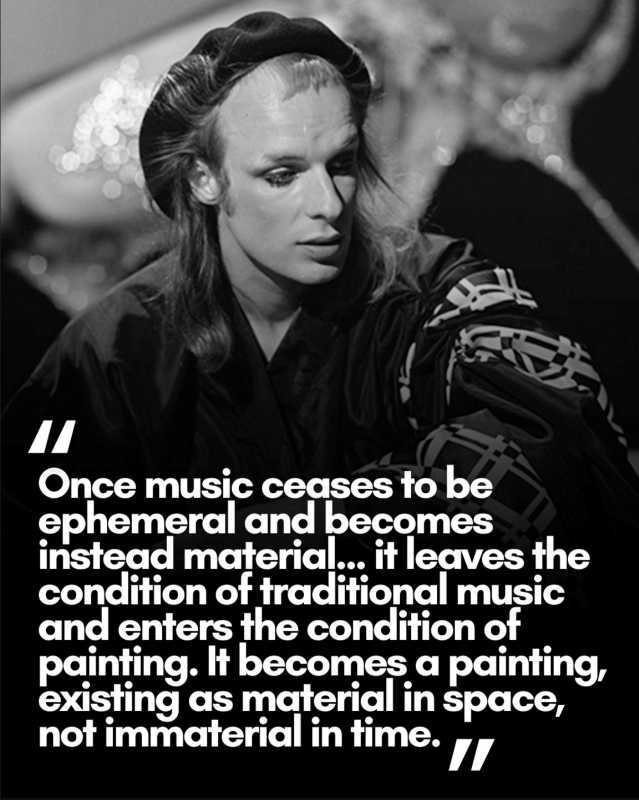
If you don’t recognize the name, Brian Eno was one of the original members of Roxy Music. They were pioneers in what I call Art School Rock. Eno drifted away from Roxy Music after a couple of records, and set up shop as a deep thinker about shallow music. He championed a style called Ambient Music. In some ways, it’s not even music. It’s just roughly organized sounds. It mostly doesn’t have definable rhythm, melody, chordal progressions, and all the things that normal people associate with listenable music. There’s the rub. There’s lots of organized noise in our world, and it can’t all be called music. To give one example, Eno composed this:

Because Windows 95 use was so widespread, Eno might have been the most listened-to composer in the world at the time. That sort of proves his point, that background sounds matter, and should be selected with as much care as the Top 40.

The quote up top is interesting to me, and trenchant:

Once music ceases to be ephemeral – always disappearing – and becomes instead material… it leaves the condition of traditional music and enters the condition of painting. It becomes a painting, existing as material in space, not immaterial in time.

I’ve made this point myself, in my hamfisted way. Eno is talking about all recorded music, I think. The act of recording it makes it A Thing, and a different kind of thing than it was when it was being performed live. The idea for Ambient  Music is older than recorded music, though. Erik Satie called his compositions Furniture Music. He composed music that was intended to just fade into the background, or as he said, become part of the furniture. That was the style, but it still had to be performed live.

Beats the hell out of hearing Bad Company records playing on the muzak speakers in the Walmart.

A lot of musicians besides Eno have given the topic a lot of thought. I’ve heard Donald Fagen, who is one of the most precise (anal, really) composers of pop/jazz/rock material I can think of, express his interest in music that isn’t really music. Jingles, muzak, the bumpers played between scenes on TV shows, theme songs, and that sort of thing.

I think that recorded music has killed music performed live. The ephemeral nature of music is gone, and no one hears very much music that isn’t coming out of a machine. It’s changed what music is for most people, in the way Eno was talking about. I go back to Sgt. Pepper’s Lonely Hearts Club Band. It’s the first record album I can think of that couldn’t practically be reproduced live by the pop musicians who made it, or anyone else for that matter. There are tape loops playing backwards on it, for instance. George Martin and the Beatles were deliberately making an artifact, not a recording of a performance.

That sent the ephemeral quality of pop right out the window. The production values of music trumped every other value of their appeal. They were no longer written to be performed, they were recorded to be played on machines. And as you know, the machines to play the music and other noises so saturate our lives that there’s no escaping them. The gas pumps play music. People wear noise cancelling headphones to drown out the constant ambient sounds and inject their own playlist into their heads instead. We’re not exposed to it; we’re marinated in it. Now that Ai produces the stuff by the metric carload, they’ll be no end to it.

Eno doesn’t mind that music ceases to be ephemeral. He’s arguing that it needs to be approached differently, because it has become different. I do mind, though. I have always liked music made fresh daily, as it were. I used to play live music for mostly live audiences. I watched the entire industry of performing music in bands in front of an audience die on the vine, right as I was doing it. Covid was just the stake through the heart and the garlic. It was already dead. Now there’s no place to play, and precious few people who can be entertaining live, anyway. I discount arena concerts out of hand. It’s not really a live performance. The equipment to fill an arena is so complicated that the noises that reach the audience have only a passing resemblance to the sounds the musicians are making. Milli Vanilli were honest compared to the audio spackle and pitch correction arena bands rely on.

Even if the bands could play something real, the audience doesn’t treat it like an ephemeral, enjoyable experience anyway. Look at any notable arena performance, and every single person in the audience is doing the Steve Jobs Hitler salute with their phone. It’s not real to them until it’s recorded.

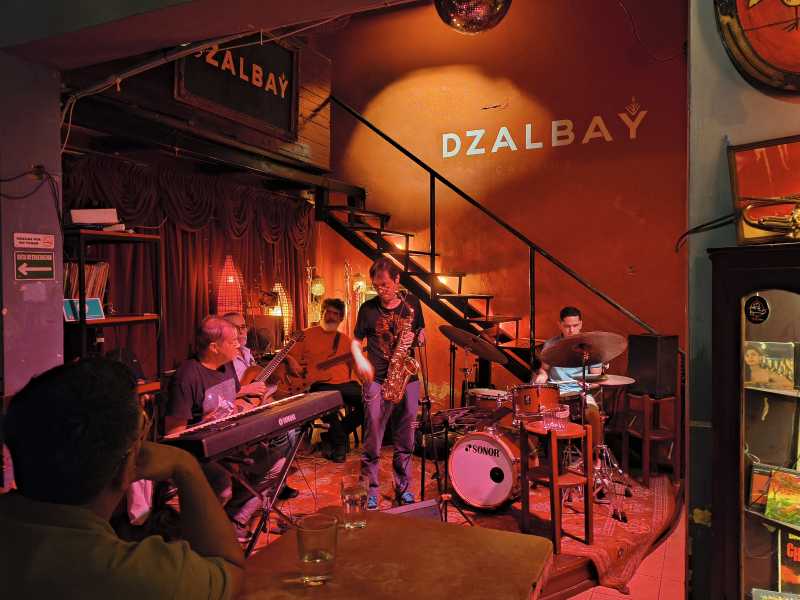
We went out on Sunday night. The local corner cantina, the Dzalbay, had a jazz jam session. In the US, they have open mike nights of the same stripe, and they’re generally horrible, one step past karaoke. The people who participate simply want an audience that can’t leave, because they’re also waiting to inflict their favorite song on anyone deaf enough to stay and listen to it. The Dzalbay ain’t like that.

Man, everybody who played was a stone cold monster. It was a cutting contest  without a hint of cutting. Not a lot of showing off, just an attempt to make music together, fresh, ephemeral, right in front of you. Music played live with no gimmicks is like watching a tightrope walker. You’re tuned in, maybe rooting them on, perhaps a little anxious, wondering if they might fail.It lends a sense of excitement that’s missing when guys are just spinning records.

Like everywhere we go in town, it’s free to get in, and the beer is cheap. I hated the guitar player a little, because at first I thought he was looking at a chord chart on the floor while he was blazing away, but my wife pointed out that he was just looking at the floor, because the supercharged version of Autumn Leaves, and some Ornette Coleman weirdness didn’t require him to look at his hands or anything. Then the fellow sitting next to me told me that the guitar player was also a luthier, and had made his own guitar, and I really had to hate him then, out of mad respect.

L. P. Hartley penned the semi-famous line: The past is a foreign country; they do things differently there. I think he got it wrong. I’ll fix it right now: The foreign country is the past; they do things the way I remember them.

What Ten Thousand Commandments and Flock Cameras Can’t Accomplish

We’re renting a house in Mérida, Mexico. The clothes dryer was busted. I pretty much knew what was wrong with it, and probably could have fixed it, but I’m not allowed to fix anything. I’m supposed to call the property manager and tell her what’s wrong, and she arranges to have it fixed. They don’t trust occupants to fix stuff.  It’s a hard and fast policy, in writing on the lease.

I can’t say I blame them. These days, the average person is capable of breaking things further, but not fixing much. In my case, it leads to entertaining conversations when the property manager, who is a little girl (I’m getting old), asks me amusing things like, “The clothes won’t dry? Are you sure it’s plugged in?” I once made guidance systems for NASA and the Department of Defense, and I learned to check if the accelerometer test bed was plugged in, so I felt like I had that type of eventuality covered, but I didn’t mention it. And BTW, it’s a gas dryer. She sent someone out to fix it.

The repairman came. He spoke no English. That’s common around here. The Yucatan is barely Mexico, never mind an ersatz suburb of the US. Many people still speak Mayan here along with their Spanish. Learning English is way down the list of things to do. My Spanish is rudimentary, but I could manage a greeting and to tell him where the dryer is located (Adelante, arriba!). He got to work.

There’s a giant rubber band on the back of the drum that had snapped. The fellow had to take the whole thing apart from the front, which was a PIA, but it was a simple fix once he could get at the problem. He was a thoroughgoing type of guy, and cleaned the whole apparatus, and removed the exhaust vent pipe, which is one of those accordion metal things, and cleaned out all the lint in that, too. He was working in our cuarto de lavado, a hot, cramped little room for laundry, cleaning supplies, a few termites, and the water heater. I gave him a Coke while he worked, which he treated like a winning lottery ticket. It’s 95 degrees every day, so I could see his point. When he was done, he left in a cloud of English encomium.

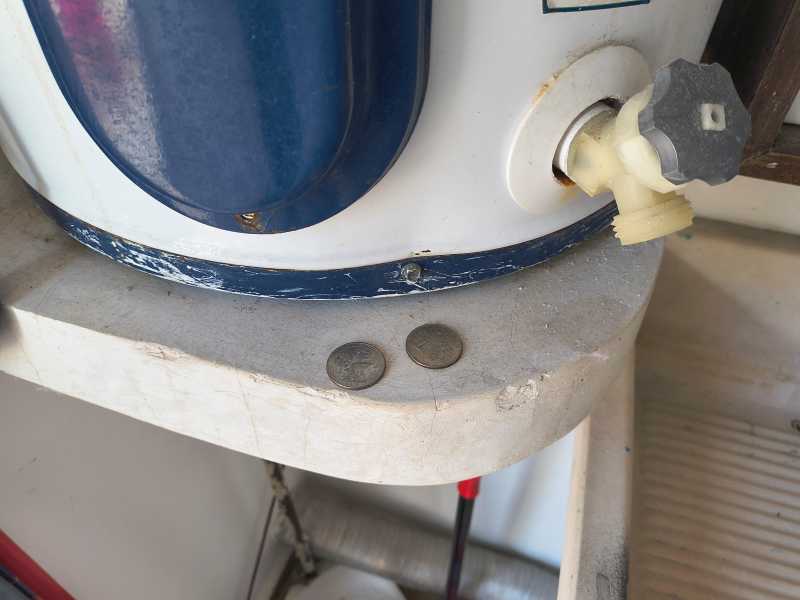
The next day, I noticed two US quarters on the shelf next to the dryer. They weren’t ours, we deal strictly in pesos here. They’re the residue of tourists past, people who forgot them in their pants pockets. The fellow who fixed the dryer found them inside the washing machine’s drain, or maybe the dryer’s exhaust while he was cleaning it, but would not take them, because they were not his.

Think of that. Fifty cents is real money to people around here, almost ten pesos. I can buy a loaf of bread from the panaderia next door for eight pesos, for example. Fifty cents is not like a penny in the street in Boston, one that no one can be bothered to pick up. But even though no one was looking, and the money was actually a motherless child, and no one would be the wiser, he would not take it.

I’d aver that I’m as honest as the next guy, but nowadays, that’s faint praise indeed. I’ve seen the “next guy” who’s abroad in the country of my birth, and he’s basically feral. The fear of being caught is the only stumbling block for about half the population of the United States. The other half isn’t even afraid of being caught anymore. The idea of not taking something because it doesn’t belong to you is totally squaresville, man. Flock cameras have mostly replaced the role of the conscience, and bodyworn police cameras cover the rest of the waterfront. For the vast majority of people in the US, there is no internal check on their behaviors, and precious few external checks, at least if you watch YouTube arrest videos right through to the end to see all the charges dropped.

He would not take them because they were not his. It’s that simple. I doubt he even hesitated over it. I meet a lot of people like him here. They are what they is, as we used to say in the vernacular. Their behavior is not a veneer. It goes all the way through.

As Chesterton said, “If men will not be governed by the Ten Commandments, they shall be governed by the ten thousand commandments.” The United States is now in the thrall of the ten thousand commandments, courtesy of the opinions of millions of Karens, with more on the way. But ten times ten thousand commandments will never be enough to make two quarters appear on the shelf in your laundry. Ten might.

Happy Colon Day (2026)

I remember Columbus Day because I used to play music in a hundred and one bands anyone that would have me and try to make money to eat and get cigarettes and I don’t smoke and there still was never enough money and I played at a tee-totaling biker association party for two members’ wedding not gay a man and a woman that arrived on a motorcycle with the woman I think wearing a white Wedding Dress and no helmet and we played for one hundred sober bikers and ninety-nine of them were like accountants and one was like a serial murderer but they all looked exactly the same so you had to assume they all would kill you if they got the chance instead of the more likely thing that they’d do your taxes if you asked nice and I never played Born To Be Wild for a Wedding Song before and the bride’s father was in jail I think so she had to dance with the groom twice and the whole thing was held at the Italian-American Club on Gano Street in Providence but everybody calls it Guano Street for a joke haha and it’s a real long time ago but it might have been the Portuguese-American Club I don’t remember but I do remember it was Columbus Day and I went into the bar to get away from the sober biker accountants and that one serial murderer that were in the function room and it didn’t matter if it was the Italian-American Club or the Portuguese-American Club or the Knights Of Columbus Hall haha that would be funny but I don’t really remember but I distinctly remember a guy with a knife a real knife not a just a knife a dagger that came to a perfect point and didn’t fold or look like you could do anything wholesome with it it just looked one hundred percent like it was designed and made to gut a bass player and that guy held that knife right under my chin and explained to me in Portuguese that Cristobal Colon was Portuguese and don’t you forget it and my Spanish was very sketchy and Portuguese sounds like Russian to me not Spanish anyway but believe me I understood every damn word he said and I advise you all to answer the question did you know Cristobal Colon was Portuguese in the affirmative at all times.

The end.

Month: October 2026

Find Stuff:

Archives