Hydraulic License Rock

The quality of this YouTube feed is better than most. The quality of the music is too:

That’s Cream re-united and performing “White Room,” probably their best known song. I’ve watched it many times. It occurs to me that it explains a lot about rock music.

Those are old men. Eric Clapton, playing the black stratocaster, has his hair mussed just so as a sop to youth, but they’re old farts. Old farts playing rock music are lame. Cream is not. Here’s why:

The term rock music has been twisted and stretched to cover just about any set of noises organized to sell discs. It’s as if forty or fifty years ago a religion was founded, and you had to get the A and R rabbis at the record companies and radio stations to announce you were kosher, ie: rock and roll, to be consumed.

If there’s anything lamer than old, bald men in spandex still yelping about the discontents of teenagers as if they were still in junior high, I haven’t seen it. “Hope I die before I get old” only stirs the blood if the blood doesn’t require Geritol. You’re not allowed to pick that gauntlet back up and complain about your backache while doing so, too.

Performers used to acknowledge that their shelf life as young rebels “fighting the man” was short, and if they wanted to keep performing afer it expired, they’d have to become part of the nostalgia industry. Listening to Peter Frampton in 1976 is excusable. Listening to Peter Frampton to remind you of 1976 is excusable. Listening to Peter Frampton as anything else is kinda silly.

Cream is a part of a tradition of adult music. they listened to music from America’s black musical tradition, where it is was plenty acceptable to be an adult, and consider adult themes. When they were young, they were striving to be old. Now they are old, and need not strive.

I watched them, and knew that I had seen their like before; but not where you’d think. They were operating their machinery, and I had seen men operate familiar machinery before. I’ve known many men, skilled in the rough arts: masonry and concrete finishing and excavation and demolition and blasting–men past their physical prime, but still tough as nails, and wise; and able to leave any three youngsters in their dust.

They sit in the chair in the excavator, and their knobby hands move the levers just so, and they move the bucket with the delicacy of the teaspoon. They wake up tired, and yet they never tire while working, because they husband their energies where the young and strong and dumb flail away and drop out.

They stand in the shade whenever possible, and rest when it is offered, but do not flag.

And they smile at one another at the end of the day’s work, exactly the same smile exchanged at the end of this song; a knowing smile among those who have earned the respect of a fellow adult man.

And the young men watch them and learn.
I Know That Smell

By god, how I know that smell. Old plaster and dirt and corruption and mildew and rockwool insulation and nasty fibrous plaster; the smell of grandma’s grandma’s attic. The smell of grandma, too.

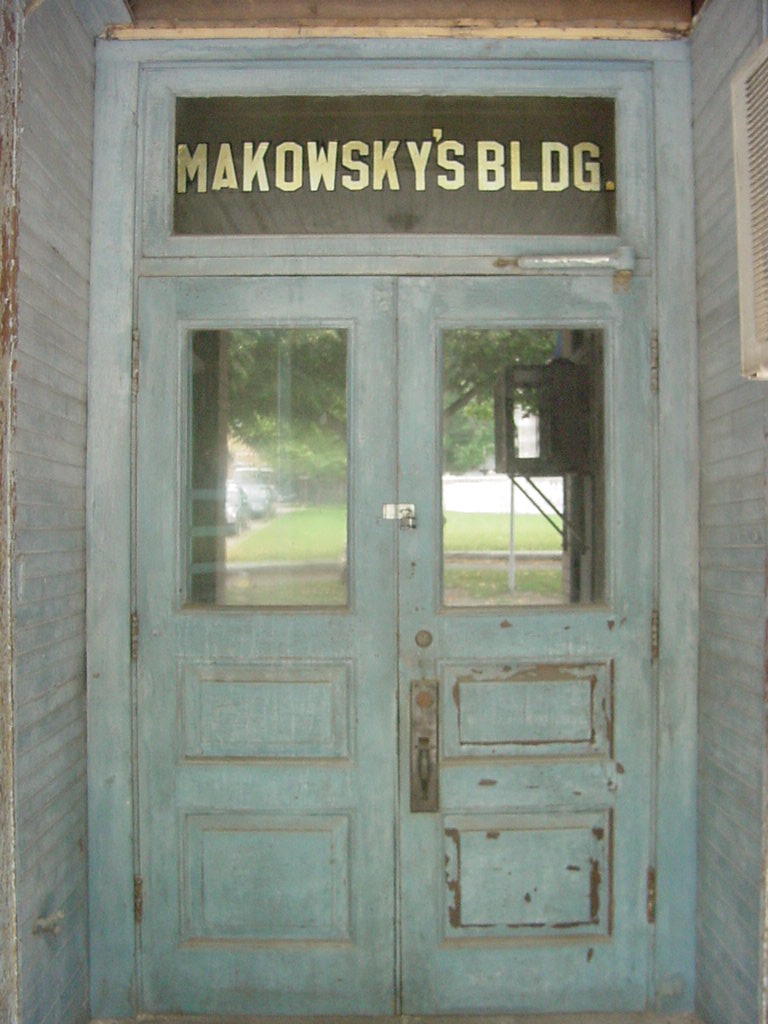
We walked past this doorway in Bristol, Rhode Island. It’s the entrance to a vacant turn-of-the-twentieth century single story retail business building. My wife commented on what a neat place it would be to sell my furniture. I’ve done that sort of mental arithmetic a million times, for myself and others, and I know anyplace cheap enough for me to buy is generally cheap for a reason. If it was easy, someone would have done it already.

That little padlock you see is to “keep the honest people out,” as we used to say. It’s probably there to protect the valuables of the people working on the building, not the building itself. Some sort of demolition had happened, and the woolly interior of the walls and ceilings was partially exposed, but there was no sign of anything but the most desultory activity. No Coming Soon sign. No building materials. No people.

Now, I told you I know that smell. I’ve worked on buildings and/or their furnishings for my whole life. And I’ve seen most everything at this point. I’ve seen wooden plumbing and DC electricity and steam piped in by the city for heat. I’ve seen vestigal carbide gas works and elevators with accordion doors,and secret rooms. I’ve seen ranks of identical rooms — whole closed up floors of them– one bed, one window, one dresser each, for the long dead live-in servants of the ghosts of the mansion’s long dead original owners. I’ve seen the cubbyholes where settlers hid their children during King Philip’s War. I’ve repaired houses sheathed with 24″ wide oak planks 1-1/4″ thick and as hard as a banker’s heart. I’ve seen more lead paint than a Dutch Boy.

That smell used to be common thirty years ago. It was a building that had gone to seed, but with hard use, over a long time, and barely altered. It wasn’t continuously fiddled with, with only a vestige of its original form showing through the years. It was old, and a wreck, and wonderful, and had potential — and nobody wanted it.

Everybody wants everything now. I caution persons slightly younger than me that life was not always as rosy as it has been for the last 20 or 25 years, at least for the most part. There was a time when it was very difficult for a hardworking family to get by, and you jumped on any work situation that promised even a modicum of stability. With both feet. You’d accept work situations that would look like indentured servitude now, more or less. You never ever ever quit your job before you had another one. Never. And it took real nerve to buy a rundown building like this and turn it into something.

My elders warned me about the Depression. It led them to certain habits which seem like madness now — overreaction and paranoia. When you hear about honest people hoarding cash outside of banks, saving newspaper and cardboard and scraps of this and that, never throwing anything away, always afraid that all prosperity is ephemeral — that’s the Depression talking.

Twice in my working life, unemployment in the construction business has exceeded 25% for a substantial stretch. That might be news to you civilians, but the reason you can’t find anyone to do anything for you that involves heavy lifting, hammers, and speaking english, is that everyone but the hardiest souls and people with nothing but a strong back were driven out of the sector for sunnier economic climes. Everybody bailed out if they could manage it.

Well, I’m not going to warn you about the Depression. Preparing yourself for a cataclysm that never comes is a form of unpreparedness, really. But recently, I hear that certain ex-government officials have gotten the idea in their heads that 1970 was swell, and had just the right ratio of carbon dioxide and economic activity, and we need to return there, pronto.

I know that smell. It’s the smell of the cake I’m going to be allowed to eat, when there is no bread.

I Go I Do

There’s a local guide with Walking/Historic Tours marked out on it available most everywhere in Bristol Rhode Island. My wife grabbed the local guide in a restaurant, and I’m referring to it now, so I can tell you that’s a picture of the Rockwell House Inn on Hope Street. We didn’t look at the guide while we were in Bristol, because we’re strange.

If I wanted planning, I would have stayed home and made a gantt chart. I wanna wander around and see stuff. I don’t want to be harangued, or shepherded, or queued, or itineraried, or reserved; and I don’t want to be told anything. I want to find things out. Am I strange? I don’t know. You decide.

My poor children. When the oldest was four or so, he used to play a computer game called Roller Coaster Tycoon. It’s a funny and smart little building game where you open an amusement park and assemble rides and kiosks for refreshment and gather all the other appurtenances of a theme park on the screen, and try to populate it with little customers. It’s smart, and funny, and has an interesting and captivating visual and musical style. After playing this game for six months or so, my son asked me: “Dad, is there a place, you know, in the world, the real world, a place with rides and candy clowns and funny buildings and things like Rollercoaster Tycoon?

“No. “

I know, I know. But waiting in line is a not an amusement, and I can’t bring myself to do it very often, even to allow my kids the same anthropomorphic-mouse-in-the-swamp thrill considered mandatory in polite society these days. Hey Walt: If the phone don’t ring, it’s me.

But you can just walk around in Bristol, and amuse yourself, if you’re an adult with certain pedestrian interests, or a three year old:

I’ve said it before: A three year old is the perfect companion. He will go anywhere, and look at anything.

He’ll look at flowers, or dirt in the gutter, it doesn’t matter. Just keep going, and keep looking at things, and you’ll be fine. And until hunger or sleep beckons, he’s relentless. Why would we need a map? He won’t hold anything but his mother’s hand, and he won’t read anything because he can’t, or he won’t. He has no pockets. He’s ready to be friends with each and every man, woman, and child he sees; and come to think of it, most other creatures, and some inanimate objects.

“I go I do,” he says occasionally. It’s all one word — one syllable really — when he says it: “IgoIdo.”

Yes, son; can we come too?

Back Back To Bristol

It’s been a year since we traveled to Bristol Rhode Island and wrote about it. Since we’ve all forgot everything from last week, I assume it’s safe to just start all over again.

Bristol’s a nice little town, hard by the waters of Narragansett, and Mount Hope.

Bristol has a long and proud tradition of backing the weak horse. Backing the dead horse, occasionally.

It used to be called the Mount Hope Lands, and was home to Metacomet. Metacomet is known also as King Philip. In these parts, that’s a very familiar name. We name high schools after King Philip, to further embarrass him with low SAT scores and unattractive football uniforms.

Metacomet decided he didn’t like those Britishers hanging around anymore, united a bunch of tribes, and burned 600 houses or so to the ground. Sort of the ELF for the 17th century. After a few weeks of rape, murder, and assorted other frivolity, some of the local inhabitants of those ashy spots where the houses used to be went looking for Mr Metacomet. They didn’t go looking as the term is used in birdwatching, either. Mount Hope Lands started over.

Bristol was settled, and they started shipping like all get out to the British Isles, as the water at their doorstep led straight to Old Blighty. What could possibly go wrong?

There was some unpleasantness in the 1770s, as you recall, and as navies tend to do when they’re looking for people to make examples of, the British navy decided not to exert themselves overmuch by bothering the inland natives, and took turns looting, annoying, and burning Bristol.

Bristol sifted the nails out of the ashes again, and knocked together some more shacks to wait for further trouble in, and started their newest attempt at prosperity: taking up one side of the rum/molasses/slave triangle that needed ships to serve it. Happy days were here again, sorta.

In 1825, slave trading became illegal, and Bristol went down the hole again.

They wandered into the Industrial Revolution after that, waiting for North Carolina, and Japan, and then China to run them out of business this time.

So now what? What do you do when all you’ve got is history? You sell it.

Bristol has the oldest continual celebration of the Fourth of July in the United States. We walked aroung there on July 15th, and the red white, and blue bunting was still hanging all over the place. The parade route is painted right on the street, so I figure they’re serious. I’ve never seen the parade.

Bristol has a lot of commemorative parks, many which are going to seed. In general, a plethora of commemorative parks commemorate local politicians giving construction contracts to their brother-in-laws in lieu of allowing real economic activity to happen. I always picture soviet style speeches being made at them; “Funds are just being released for this now;” “The proletariat will bask in the glow of the contributions of others;” Is not the five year plan bearing fruit, comrades?” Oh well, our kid likes the swings, even if they are broken.

At any rate, it’s a very pleasant place to stroll, and has lots to look at that requires no admission, and lots more that does; the businesses there have the friendliness to strangers that comes from not knowing if bankruptcy will come tomorrow, and local malingerers in the street are just like you, hanging around for the joy of the place, not to annoy others who come there from distant places. A gang of toughs walked by us in a cloud of cigarette smoke and cell phone chatter, and the most menacing looking one made a googoo face at my toddler and cartoon waved at him, to his delight.

It’s a friendly sort of place.

More Thoroughly Unmodern Millie


It occurred to me today just how lousy the photos of the Millicent library I’ve been posting are. Well, there’s nothing I can do about it now. You’re going to have to put up with them. They’re all we’ve got, and the subject matter will carry the day, anyway. Think of them as snapshots, not photographs, and we’ll all be fine. You try taking photos with a camera with a four secong lag between depressing the button and making an image, with a three year old clinging to you like a rabid monkey because he’s afraid of the life sized baby gorilla stuffed animal in the children’s reading room.

Here’s one from atop the book stacks:

The Millicent Library makes the same mistake most libraries do; it attempts to compete in a half-hearted way with Amazon.com and Blockbuster Video, with its only selling point that you pay in advance in your tax bill instead of at a checkout counter — thereby allowing you to imagine it’s “free.” The only analogy I can come up with is a bad buffet. You keep telling yourself you don’t mind how terrible the food is, because after you pay, it’s all free!

I’ m not the sort of person that thinks that no one needs what I don’t want. I am irked by persons that say they are vegetarians, for instance, so no one needs meat, and so forth. The supermarket of life would be very small, if tailored to one person. But you’d need a lot of them.

The library tries to be everything to all people, and so must fail us all. Why do they have Ishtar VCR tapes and Eminem records and Harlequin Romance novels by the metric tonne? Is the library no different than the swap shelf outside the ladies room at work?

Well, there’s worthwhile stuff there too. And if you paw around enough, you can find what the library should concentrate on: out-of -print hardcover books that inform and delight, a true repository of value, not a pile of stuff. Book burning isn’t evil, if the books are worth more as BTUs than information.

There’s plenty of fine flotsam among the quotidian jetsam in there, so I’m not going to complain; especially since you can grab that book and read it in series of rooms like this:

Month: July 2006

Find Stuff:

Archives