The end of July is Summer in New England. There’s no bones about it. The air is heavy with moisture, the heat more like a sauna than an open oven door. The plants get crazy, pushing and shoving in the beds, reaching out to grab at you when you go by. At night, the bugs on the screens blot out the moon.
The ocean is at the foot of the street, mere miles away, and when the breeze tacks, you can catch a whiff of the salt in it. No siren can compose a more alluring sales pitch. It’s delightful to be on the water in July, and there’s always the breeze you need to banish the motor. The sun is like a velvet hammer.
I’m a late summer man. I’m not old, but I’m not young. There’s as much wake behind the boat as horizon in front of it. I don’t mind really. Consider my house.
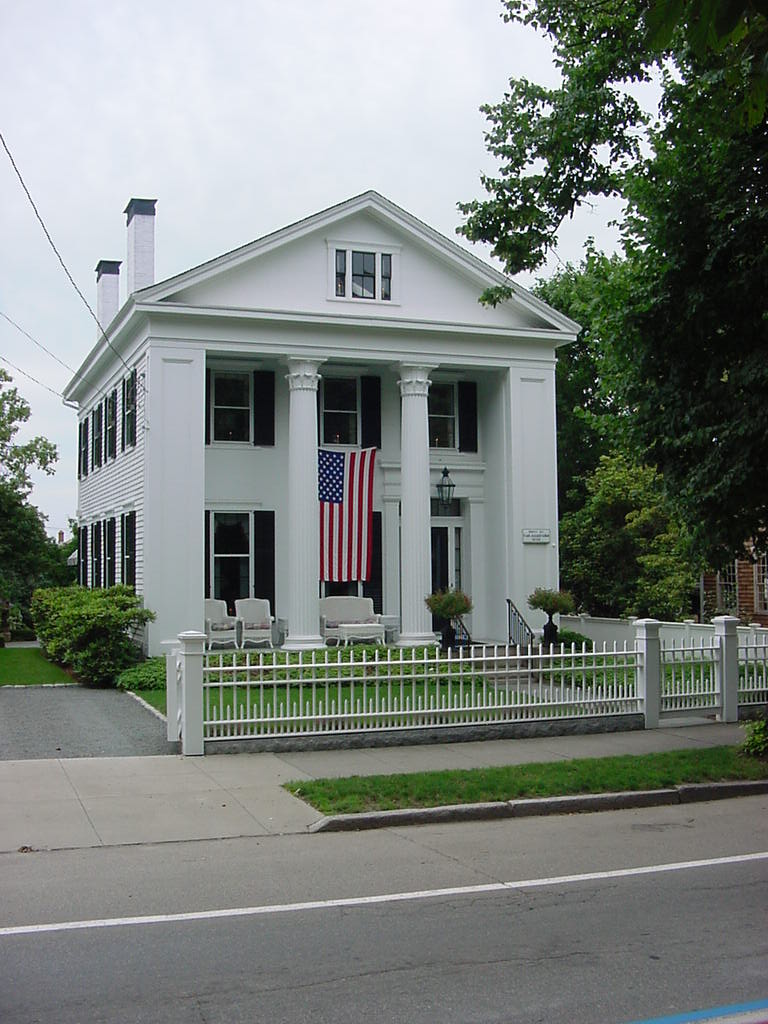
That’s it there, in the picture, this spring. When I was younger, I dreamed of this house, and having the family in it. I had no idea how to get it. I wandered the earth, and had many adventures. And eventually, I figured things out, and did an end around, and made the thing happen. I am happy here.
According to the cult of the adolescent, to which we are all expected to pay obeisance unto death, it’s the wanting phase of my life I’m supposed to prolong as long as I can manage it. I’m supposed to pretend there is no finish line, and simply ask the starter to fire the pistol over and over again, so I can know the thrill of beginning over and over again. I demur.
Life is a career, and then it is over. I do not wish to be an entry level employee until the day I am fired, as it were.
That picture is supposed to encapsulate all that I am supposed to abhor about owning a home. It is no longer new. It requires attention, and effort, to keep it standing and presentable. I’m supposed to want a new one by now, or have covered it with plastic to avoid paying any attention to it. But why would I not want to pay attention to it? It holds everything I’ve ever really wanted. I run my hands over it like a lover, because that’s what I am.
It needs painting. I don’t mind, because I don’t want to go back to the starting line just to hear the pistol.
(Editor’s note: This was written before breakfast this morning, but Blogger absolutely refused to accept the picture upload until this evening. Blogger is owned by Google. Forget Microsoft; Google is evil.) (Author’s note: There is no editor.)
What are we looking at here? The short answer is: what I drive by about a mile from my house, if I head away from the water.
There are a lot of defunct farms in New England. Subsistence farming was the occupation of the vast majority of citizens until quite recently. I remember seeing a statistic that at the outbreak of WW II, the majority of US citizens didn’t have indoor plumbing. That seemed odd, until you considered how many people still lived on farms.
It’s very difficult to grow food in New England. And over time, as transportation improved, the production of food became remoter to its consumers. We routinely eat food that is flown to its destination now. Amazing.
So the farms got bigger, and more efficient, and moved to where the ground didn’t “throw up a fresh crop of rocks every year,” as they used to say in New England. What are we going to do with the land?
For the most part, it’s become forest again, or houses. The houses we notice. The forest part gets overlooked. There’s a lot more forest in New England than 100 years ago. And when you walk through it, you occasionally come across the rubble foundations of the houses where flinty people whacked at the flinty soil generations ago. Their descendants are playing Playstation in a 3500 square foot ranch in a subdivision, and don’t even know where the food comes from. The supermarket, right?
It’s restful to drive past the hayfield. They tried to raise sheep there a few years back, but either the shepherd or the sheep got tired of it, apparently. That’s feed hay in the rolls there; I often see bales elsewhere for construction silt fencing too. There aren’t that many animals to feed, but there is plenty of construction and wetlands around.
The land has become valuable. The farmer who cleared it 250 years ago would have to visit his outhouse when he found out what the city slickers would pay to whack his farm up into houselots. He’d laugh in there, and then straighten his face and come out and get his millions.
I can guarantee you that there will be very heated discussions at town committee meetings and petitions circulated and laws passed and invective hurled when this property is offered for sale for houses to be built on it. The word “development” will be spat out like a curse, and the words “sprawl,” and “pristine,” and “save” and others will be bandied about. Because nobody knows what they are looking at.
That lot is as developed as any houselot. Trees were cleared, the granite boulders, worn smooth and round by glaciation, were stacked along the perimeter, and the farmer had a go. The land is already developed; just not to its full money potential, what they call in real estate “best use.”
What you’re really looking at there, and what I like, is a form of “mixed use.” And every single person screaming at the meetings about developing the land into houses wouldn’t allow mixed use anything, anywhere, in their town, ever — and so are kinda crazy. They just see a house as other people, and don’t care to see any other people, I guess. But more than any more houses, they refuse to see anything that isn’t houses anywhere near their house.
The loveliest places around here are mixed use places. You can walk down the streets, there’s a mixture of commercial, residential,retail, restaurant, government services, parks, and so forth. I take pictures of them all the time and folks write me and say: That’s lovely; “I wish I lived there instead of this nasty subdivision I’m in.” And planners are always trying to invent places like that, but they always turn out like Potemkin Villages. Not real. Because the thing they are trying to achieve isn’t allowed, and you can’t plan that which must arise spontaneously.
My neighbor builds dock platforms in a barn and in his yard. I hear him banging away over there occasionally, or the sizzle of a welder. At night, I hear the coyotes ranging through the woods; but I also hear the pumps in the not-too-distant cranberry bogs. My neighbor grows herbs for sale to restaurants and a small local clientele. We’re too spread out to comprise any sort of village, but the mixed use part is there, if imperfectly.
Someday, somemone will complain about all that stuff, and zoning laws will be enforced, and the NIMBYs will triumph; and this place, where people say 24/7 they don’t want sprawl, will have nothing but.
My good friend Steve is an excellent father to his two boys. His older son, Flapdoodle, is twenty years old, and wishes to follow in the old man’s wake a bit and play music with his friends. My avid readers will recall that Flapdoodle is Mr. Pom Pom’s brother, whose brush with death and musical greatness we recounted here before.
Now, I’ve known Flapdoodle since he was a wee bairn. He’s always been a nice kid, and afflicted with a kind of adult poise from a tender age. He was “born old,” as we say. And every spare minute, he’s been plunking on his guitar to learn how to do it. And he’s got college age friends now, who are similarly thoughtful and fun and dedicated to making music for the amusement of others.
“Making music for the amusement of others” is more than just learning how to play Stairway to Heaven, halfway through, in your basement. Everybody wants to be a rock star. But the local bar don’t need no rockstar. It needs you to learn how to play your instruments properly, gather the proper equipment, figure out what the audience would want to hear, and show up on time and work hard. And I can assure you, all that’s rarer than hen’s teeth.
Father Steve is both mildly demanding and helpful. Flapdoodle goes to college now, and spends his summer working at a beachside restaurant/nightclub, working hard in the kitchen. Steve used to play in that same nightclub twenty years ago. When Flappy’s done, he comes home to the apartment over Steve’s garage that heand his musical compatriots rent from Steve.
I’m not sure, but I don’t think Steve is getting wealthy off the rent.
Steve cleared out half the basement in his house, painted the floor, and they cobbled together the equipment needed to simply go down there, pick up instruments, and bang out a four chord song. It’s much more marvelous for not being lavish.
Steve tells me the band works down there every spare moment, and he’s gratified to hear them really applying themselves and trying to get better in an organized and intelligent way. They don’t make the mistake most aspiring musicians make –to just plunk away indefinitely at the same old thing, never really learning it, never giving much attention to the wants or desires of any prospective audience. Rock music suffers from festering self-absorption enough without adding any of your own on there. It’s not rocket science. But it ain’t that easy to be entertaining, either. Steve helps them when he can, and mostly helps them by not intruding much. He always seems to be around when they can’t remember the end of “Light My Fire,” though, and the door opens up a crack while they argue over it mildly, and Steve says F C D and they’re back at it again.
They were going to get their chance last weekend, until nature intervened. Steve’s old band was dragged back from semi-retirement to perform at an annual outdoor party, on the water’s edge, at a fine little community called Far Echo Harbor. It’s along the shores of the gigantic Lake Winnepesaukee in New Hampshire. Steve’s got a summer home there, and helps put on this entertainment as a gesture of neighborliness and goodwill. It’s become something of a tradition. And Scrambled Porn, as Flapdoodle’s band calls themselves, was going to play for an hour in the middle of the old man’s performance.
That’s perfect. Big, ready made audience. Instruments already set up. Familiar friendly faces in the audience. The only pressure was the internal kind, the desire to do well and entertain. There’s a lot more pressure when you’re professional. Money changes everything.
There was a problem. It rained like the first ten pages of the Bible for twelve straight hours. There was no venue large enough to hold the audience and the bands indoors, and it had to be cancelled. Long faces.
But sometimes, marvelous things happen, and minor disappointments only make the story flow better. They had the tent set up for the caterer, and he served that food anyway, and as a hundred or two of us huddled under the tent in the rain and watched the kids splash in the puddles just outside it, something coalesced amongst the disappointment.
The caterer ran a roadhouse restaurant right down the street called the Bad Moose. It’s a great place, haunted by locals and tourists alike, serving food in the afternoon and bluesy music and beer at night. That man had hired a band to play on Saturday night. And they didn’t show up.
So here’s your chance Flapdoodle and friends. First you have to convince Old Steve to let you. He’s wise, your father; he didn’t say yes right away. He went there first to take one look at the crowd and see if things would be thrown at you if you faltered. Because you were about to be among strangers. And entertaining strangers is … different.
The Bad Moose crowd at night is prone to motorcycles and tattoos. There are very few drinks with umbrellas in them in evidence. There is a contingent of very large males prone to high-fives and bottled beer, and some women who might have danced around a pole previously. The bartender works alone,whirling like a dervish, is dressed like a vampire, has some metal in the face and tattoos on the skin, and could probably clear the room in 15 seconds flat. And she’s a girl.
There is a lot of commotion and confusion as Steve and I tried to set up the instruments and PA system for unfamiliar idiosyncracies in a crowded bar. The crowd was restless. The manager of the bar looked at the childish faces of the band, old enough to work in a bar, but not old enough to drink in one, and I saw a moment of doubt flash over his face. And after we sorted out all the cables and applied all the necessary duct tape, those young fellows let it rip.
Steve and I crouched by the door, winced a little, and prayed or something. I went to Catholic School for seven years, but I couldn’t remember for the life of me the name of any Saint that would be the Patron Saint of Bar Fights, so the the prayers may have been of doubtful utility.
And…
They were great. Not polished, but not so’s you’d notice. And after about five minutes, you could feel it — the audience wanted to like them. And when they faltered, the audience picked them up and carried them to the next passage where they knew the way better. There was lots of wild abandon on the dance floor, which is just the same scoured pine planks the band’s standing on. And the audience whooped and hollered and beat their spilled beer to sea foam in front of the manchildren drinking water and smiling like they’d just won the world series — when they got the nerve to look up from their strings. And when they ran out of things to play, the audience made them play it all over again.
The next morning, an emisssary came from the Bad Moose. The boys were asleep still, crashed out on every couch and bunkbed in the little summer home like some invading army. Steve was awake, and the fellow pressed two damp and wrinkled fifty dollar bills in his hand. Give that to the boys and tell them they can play there anytime.
It’s been a long time since a day went by without a Sippican Cottage blog entry. I’m traveling without a computer, to where there are no computers. This does not compute.
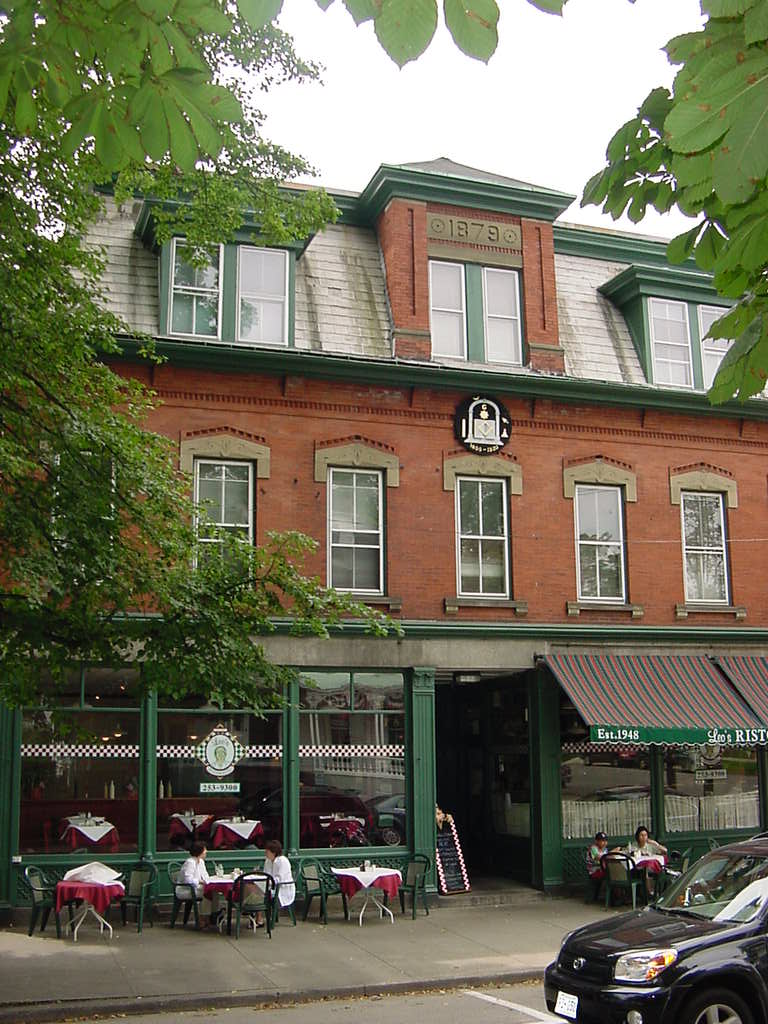
Here’s some more pictures of Bristol, Rhode Island, to tide you over until Monday:
There was a hackneyed theme in movie entertainment sixty or seventy years ago. Mickey Rooney or some other homunculus would turn to Judy Garland or some other soon-to-be-drinking-right-from-the-bottle starlet, and exclaim: “Let’s put on a show!”
Of course they’d get up a stage made from packing crate lumber and bedsheets, and sing and dance, and have some good old-timey fun; and they’d save the orphanage from the evil bankers who wanted to foreclose on the mortgage and turn it into a Dickensian factory. With the orphans chained to the machines, no doubt.
The only problem with the theme was that it wasn’t real. The essence of entertainment is to make the difficult seem easy, or better –effortless. When you see Gene Kelly splashing in the puddles, he’s always got that huge beaming smile on his face. Four minutes and fifty seconds in to the routine, he’s still got that smile pasted on there, even though I imagine his lungs are on fire and his knees are groaning and his lower back is barking at him and his stamina is tested like a marathoner 1000 yards from the finish line.
You’re not supposed to see the effort he put into it before the cameras were turned on, or the pie plate with stubbed out cigarette butts atop the battered piano in the third floor walk-up in Brooklyn where the song was written. You don’t want to hear about the splinters suffered by the crewman making that packing crate stage to hold Fatty Arbuckle.
But all the apparatus that makes self expression possible is getting easier to get your hands on all the time. And there are still a lot of kids in straitened circumstances with a lot of time on their hands, and they still decide to put on a show. And the internet and the digital world it represents makes room for the amateur — he who does it for love– to compete ably for your attention with the mighty professional.
Hail to you, whoever the hell you are, because you were down in your mother’s basement, and said to yourself: Let’s put on a show!:
Month: July 2006
sippicancottage
A Man Who Has Nothing In Particular To Recommend Him Discusses All Sorts of Subjects at Random as Though He Knew Everything.
.jpg)



Recent Comments