Mrs Cottage and I Have a Date


Mrs. Cottage and I had a lovely afternoon yesterday. I worked all day Sunday, and like a madman on Monday morning, to set aside the afternoon for a little excursion. We ditched our kids with their grandmother, and set off to Newport, Rhode Island.

Newport’s a lovely place. It’s a town made of wood, and I find the colonial architecture melded into a lively modern scene a tonic for the senses.

There are flowers everywhere. The roses reach out their arms to tap you on the shoulder and cadge you for a look. Their thorns buttonhole you like an importunate hawker at a carnival: Look at me! I’m fabulous. Step right up and see me. You find yourself turning around to look back at what you just saw ten feet before –did I just see that? Was it really that pretty? Just like the housepainters did when Mrs. Sippican walked past.

There’s an impression many people share for a kind of ideal city living: Quiet streets, old houses fronting right on the sidewalk, little plots of land with well tended but unfussy gardens, common areas of greensward appearing regularly to break up the houses and exercise the dog. People are busy but not frantic, there is street life but not clamor, and there is something to do, some peg on which to hang the whole thing, that informs the visitor what the ultimate essence of the place is —raison d’etre.

Newport comes as close to this ideal as I can muster. And the raison d’etre — the Atlantic Ocean– makes it especially lovely. Only Florence Italy beats it, and they had Michaelangelo and Leonardo Da Vinci on the payroll there; it’s like cheating, really.
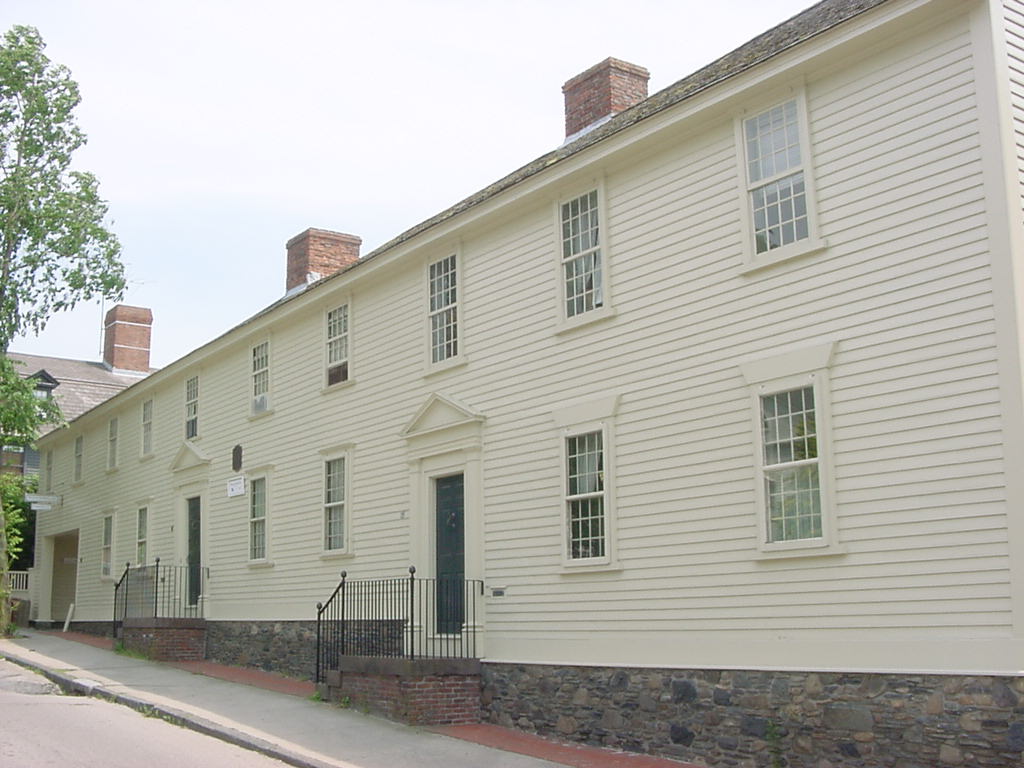
We go places, when we go there, but it’s really not necessary. You can just wander around and gape at the quotidian. I’m not normal, and have a greater than average interest in such things, but I find myself examining the heads on the wrought iron nails used to affix the clapboord siding to the three hundred year old houses, until my wife yanks on my arm and says: Hey loser, look at the flowers.

Completely by accident after lunch, we came upon the Samuel Whitehorne House Museum. It’ s not as well traveled by tourists as the big attractions of the Gilded Age Mansions on the other side of town. The museum’s right in the middle of the bustle of the barrooms and other plebian haunts, and there’s a working wharf across the street, still visible out the upper story windows.

We went in not hoping for much, but were rewarded amply with what I can only describe as a kind of furniture porn. The house was saved from demolition in the 1960s by Doris Duke’s cigarette money, has been ably restored and cared for, and is filled with furniture made by the two conjoined twin families of the specifically Newport and generally American Townsend and Goddard furniture makers.

Want to know what the fuss is about Goddard and Townshend furniture? Go into any antique store and tell them you found some in your attic and it’s kinda gloomy what with the ball and claw feet and nasty mahogany and you want to unload it. Watch the proprietor wet his pants and clutch his chest. They just fight about which museum the stuff goes in, at this point.

The difference between seeing the pieces of furniture they made in a restored colonial manse and seeing them in a sourcebook for furniture geeks is like the difference between a Victoria’s Secret model’s picture, and a Victoria’s Secret model’s phone number pressed into your hand at a nightclub. Sometimes the theoretical isn’t enough to fully appreciate the situation, as it were.

There were only five people on the tour. The poor docent, who was a lovely elderly lady with an aristocratic Austrian accent, must have thought I was an off-duty second story man casing the place for a robbery later. I could feel her eyes on me as I lingered in each room looking at each piece of furniture while she was talking about the wallpaper in the next room.

Come to think of it, I did rob the place. I steal with my eyes.

You Say It’s Your Birthday

I’m forty eight years old. I don’t care.

I’ve cheated death a few times. I’ve had good fortune, and I’ve been royally screwed. I’ve had money, and I’ve had none. I’ve gone hungry for a little while.

I’ve been simultaneously propositioned by one woman while being assaulted by another– both strangers. I’ve signed a few thousand autographs. I’ve been recognized on the street by passersby, confusing my companion. I’ve gone unrecognized on occasion by my own relatives.

I blinded everyone in my chemistry class in high school. I counterfeited money in shop class for a lark. I was nicknamed “The Phantom” by that chemistry teacher, because I was constantly truant. I was a National Merit Scholar.

I’ve performed dangerous backbreaking labor. I’ve been paid to teach frisbee.

I’ve been a welder in the desert. I’ve had pretty secretaries bring me coffee.

I’ve saved a few people’s lives. I’ve seen a man murdered.

I’ve worked for charities. I’ve committed vandalism. I’ve been robbed a half dozen times. I’ve stolen things.

I’ve been thought a clown. I’ve been considered dreadfully serious.

Half of the employees at my last job called me Mr. Rogers. The other half called me the Prince of Darkness. They were all correct.

I’ve been picked on like a sissy. I’ve knocked a man senseless–that struck me first– with one blow.

I’m very polite. I have a terrifying apoplectic temper.

I’ve worked with people for four years and never said a word about myself, despite the fact I talk all the time.

I made a joke, in a foreign language, in a foreign country, and people laughed. I’ve been booed, loudly, before.

There was a stretch of my life, lasting one third of it, where I was profoundly unhappy all the time. I doubt anyone knew that.

If I could live a thousand years, I wouldn’t change a goddamn thing, if it meant one fewer minute of sitting at a table I made, in a house that I built, across the table from the wife I won, watching the children we made smear their dinner on their faces.

The Real Deal

Working today, but I don’t mind. Sometimes the smell of the wood shavings and the gentle sigh of the teeth of the saw in the cut make up for the time taken from leisure.

This guy’s likely currently demonstrating the adage: “I’ll sleep when I’m dead.” His hard work is remembered, though. How many people reading this know how to use that drawknife he’s got, or has ever seen that “dumbhead” shaving horse he’s sitting on? Those shingles he’s making by hand come in a big cardboard box now, neat as pins, fashioned entirely by machines, and ready for your house.

It’s unlikely the modern fellow applying them to your house is wearing a fedora. Money ain’t dignity.

Hammer Time

My older boy is ten. He’s infinitely interesting, and not just to his parents. Like many of his peers, the best description of his personality is born old. That is to say: he’s preternaturally sophisticated, and is endlessly interested in adult things, without ever losing that joie de vivre that we all envy the young. It’s interesting to field questions from him now, and try to figure out what’s happening just below the surface of the inquiry. There are no easy questions anymore. And sometimes I wonder if he asks me things just to see if I’ll run out of answers. And the time for making stuff up is over. The world’s not that mysterious to him any more.

We have him help out with the family business a little. Once a week he empties out the various vacuum cleaners, sweeps the floor, bundles the trash, and totes that bale a bit. He gets paid, and tracks this payment on a spreadsheet to determine how much he’s earned. And he cashes it in when he wants something bad enough. It’s a testament to how much times have changed, that often as not it’s software he wants. Sheesh.

He really isn’t interested in what I do. He’s dutiful, and a joy for his company, but he’s not handy. Strangely enough, I’m not really handy either, and have worked my whole life to counterfeit other’s easy ability with tools. In boatbuilding, they use an expression: His mallet don’t ring. What they refer to, is when a man would caulk a wooden boat, he would strike a metal iron with a wooden mallet to set a string in the seam that seals the planks from leaking. A good caulker could gently rock and strike the iron to set the seaming cord almost effortlessly, and the mallet would “ring” as he struck it. It’s like watching someone play a stringed instrument well. For the rest of us, it’s like trying to shove a snake up a drainpipe.

His mallet don’t ring. It’s not pejorative. It’s an assessment. It means effort is required to accomplish the same thing that comes easily to others. It has a tone of awe, sometimes, to acknowledge greatness, born greatness: His mallet rings.

My boy’s mallet don’t ring. But he soldiers on next to his father, and counterfeits ability with effort. Someday he will find the thing that makes his mallet ring. But I shall be prouder of him for the effort he puts in on the things that must be done, than whatever he accomplishes doing what he’d care to do. An Olympic Gold Medal is nothing compared to a Silver Star, after all.

Month: June 2006

Find Stuff:

Archives