Happy Birthday, Mrs. King
[If you just stumbled in, or have very poor short term memory, I am recounting the story of a free clothes dresser we rescued from the curb during our town’s Festival of Trash]

My wife’s abandoned dresser didn’t stay on the lawn very long. An old feller pulled up in a pickup truck while the boys from across the street were still carrying bits of it out of the house. He tried to mangle it into his truck by himself. He thought he was in luck when the kids helped him load it, but of course he had no idea that the dresser was made in Beelzebub’s Country Classics Furniture Factory. My wife, bless her soul, tried to warn him that all that glitters isn’t glitter, but he wasn’t interested. He was a man newly smitten who wasn’t appropriately curious about exactly how the new object of his affections became someone else’s furniture version of an ex-wife. Good luck, my unwary friend.

A sense of urgency had now crept into the proceedings. My wife’s clothing collection is somewhat meager, but it looked much more extensive now that it was on the loose in our bedroom. Steps must be taken. Her new bureau must be pressed into service sooner than later.

The boys had deposited the old ark in my basement workshop. It was already after lunch. I began to take a real interest in the thing, mostly because I had to. It couldn’t be one of those projects that lingers languidly over the years, waiting for a supply of free time to make its appearance. I once had free time, back when Johnson was president, if memory serves. You’ll be glad to learn it wasn’t Andrew Johnson.

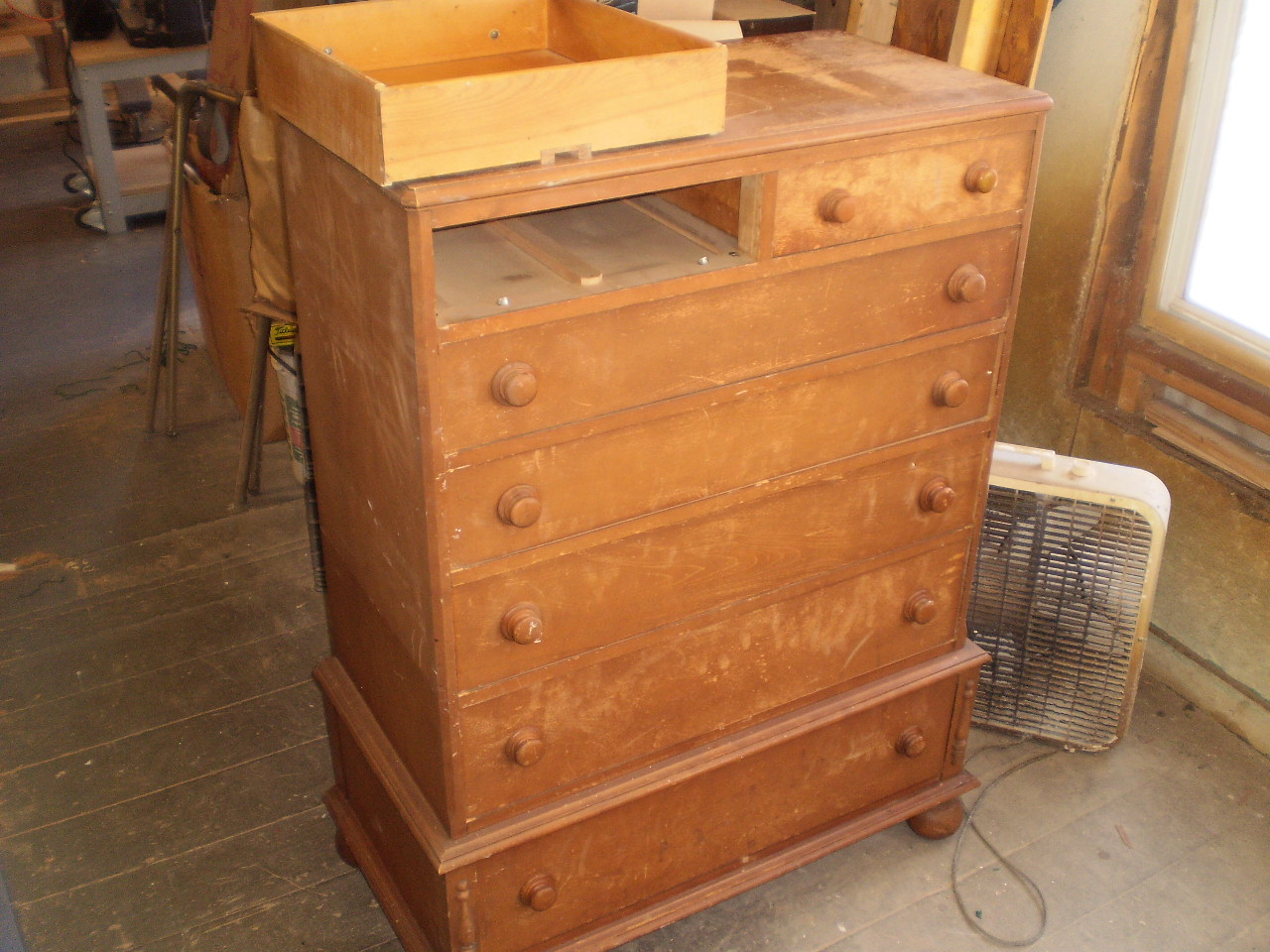
I needed to understand this wooden beast properly, or I feared I’d end up like the guy who was currently listening to the shrieking drawers in my wife’s old dresser. I looked for clues. The drawers were lined with newspaper from 1960, which were a hoot to read. That sort of clue works on TV, but in the real world it just means the dresser was at least that old.

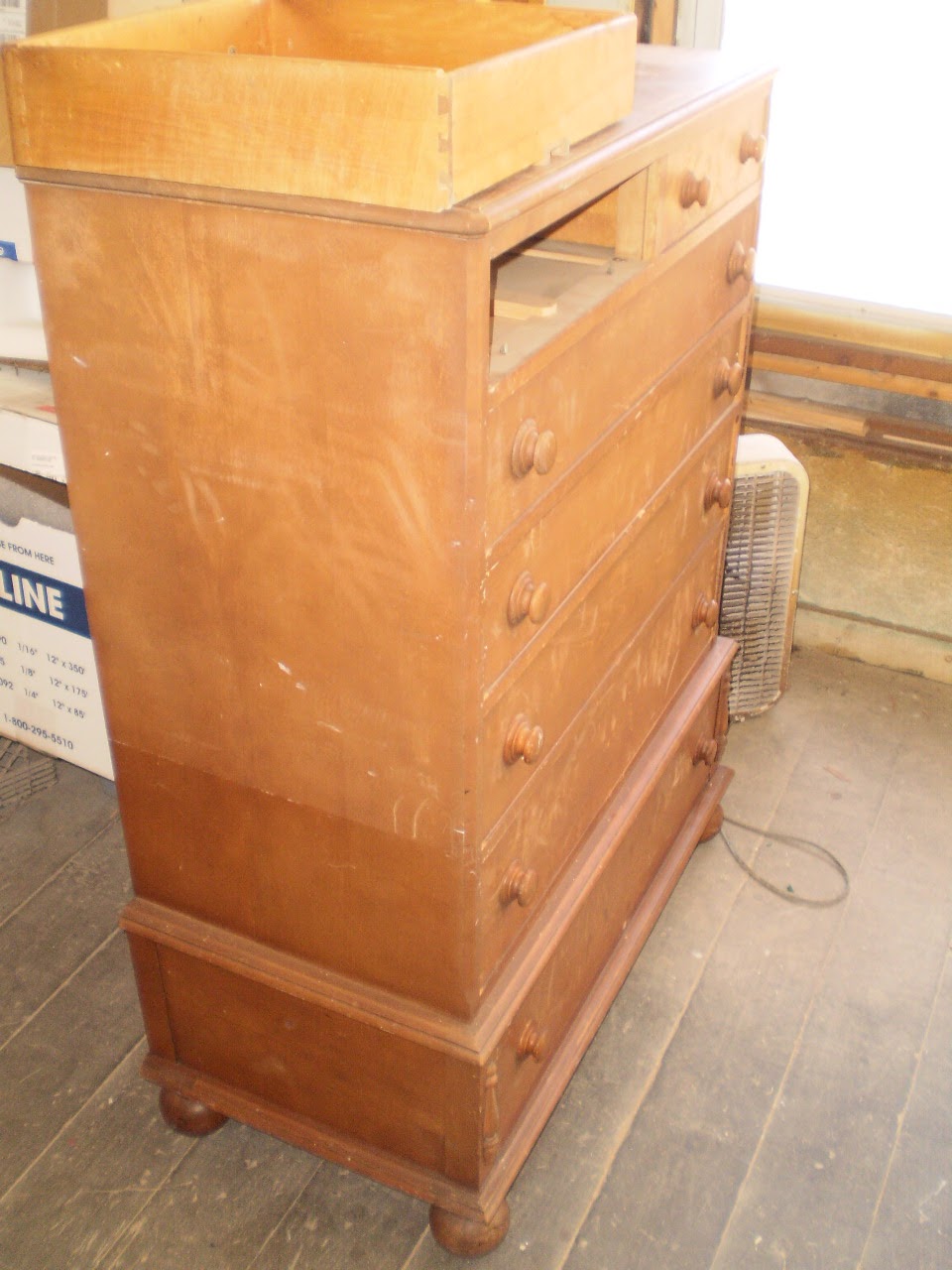
The style looked postwar to my eye. It was sort of colonial without being slavish. The grain was mostly obscured by the muddy brown finish, but it looked like maple, which has bland grain. It was stupid heavy, though, so I knew it was birch. Birch was cheaper than maple back then, and got used in normal people’s furniture a lot. The dresser was made in a factory, but not a modern sort of factory. More like a workshop with a bunch of people in it. It still looked like humans had made it.

The drawers were dovetailed front and back. That’s pretty old school. I decided to stop using my spider sense to determine the age of the thing, and looked in the drawers instead. I found the spot where my neighbor’s big brother had written his name and the number 1943 in it. It might not have been brand new in 1943, of course, but hey, close enough.

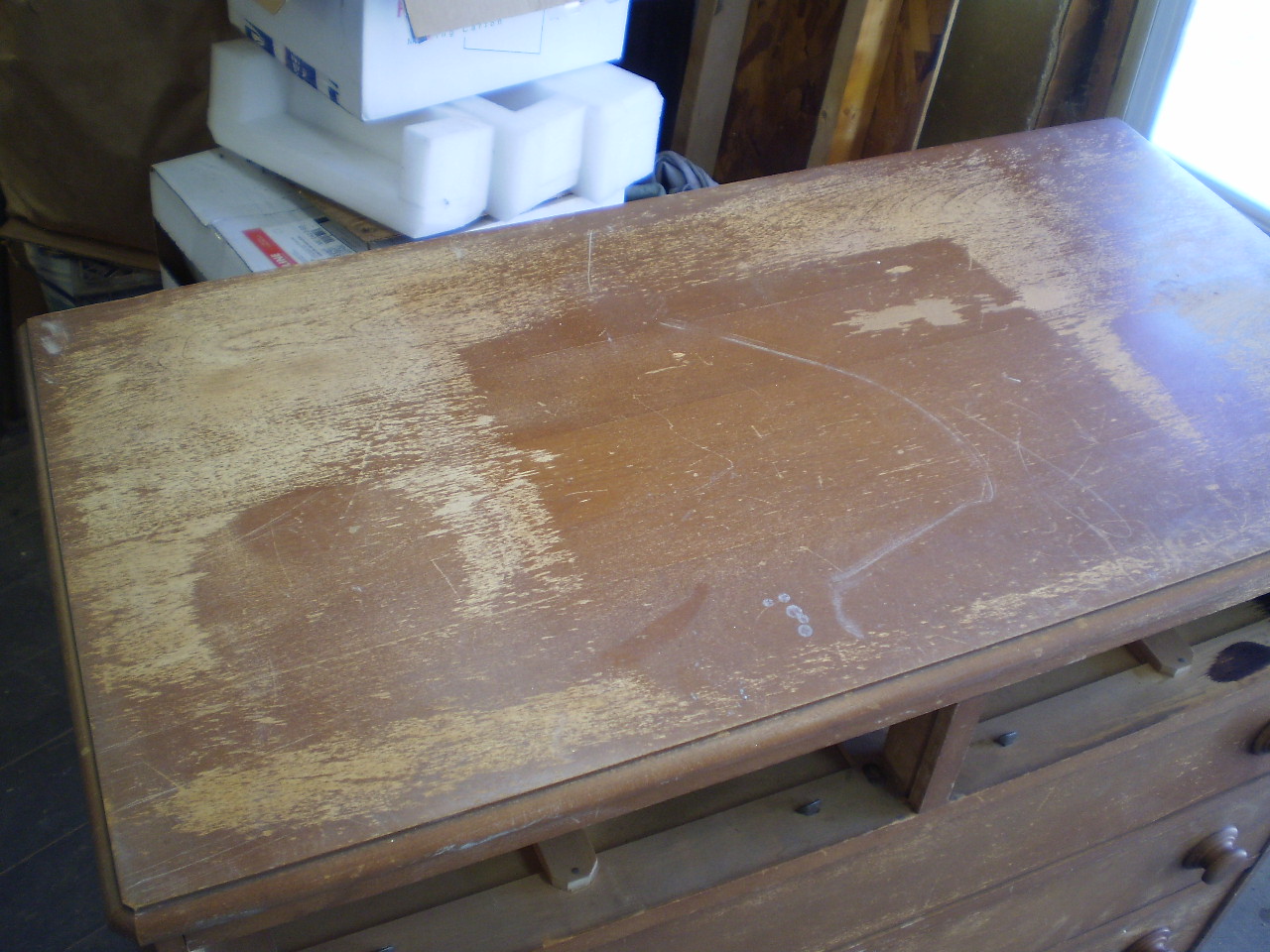
The finish had been subject to extremes of sunlight and temperature and humidity. Not left outdoors, but I figured an attic or something. My neighbor later told me that it was left on an enclosed porch for many years. Bingo. The finish was missing here and there, but what there was looked like suede when you ran your finger across it. It was completely crisscrossed with fingermarks going every which way. I pawed at it a bit, running through the rusty filing cabinet of my mind to figure out what I was looking at. It came to me in a vision — all at once.

I knew it was shellac. Of all the dumb luck. No one had “fixed” this piece of furniture in 75 years. It didn’t have any new, improved finish that wouldn’t last but couldn’t be fixed. It wasn’t “eco,” another word for wasteful useless disposable plastic crap. The finish was made from the nasty ooze that comes out of a lac bug and dries on a tree branch. Your favorite Hindoo used to gather the stuff by putting tarps on the ground under trees where the lac bugs congregate, and then beating the limbs with sticks to make the amber flakes rain down. When you mix lac leavings with alcohol, you get shellac. It’s wonderful stuff.

Shellac sticks to anything. Anything sticks to shellac. Shellac can be diluted till there’s barely a whisper of lac left in it, but it still makes a coherent film. It seals knots. Shellac can be polished to mirror shine if you want to. A technique called French polishing is the finish you saw on Baron Percy Devonshire Smythe XXIVth’s harewood and mahogany gaming table back when King George was still gibbering on his throne. You can make shellac look like anything you want. Our dresser had pigment mixed in with it to make a kind of varnish stain that could be sprayed on in one coat as an all-purpose stain/finish.

Shellac is so safe for humans to handle that you can eat it, and you might have. They used to make the capsules that drugs and vitamins come in out of shellac. And the greatest thing about shellac, at least for me, is that no matter how old it is, it immediately dissolves and gets loose in the presence of alcohol, just like everyone at your office Christmas party.

My wife and I play a game. We talk about what we might accomplish if we had twenty-five bucks. I always come up with things like fixing one of many leaks in the roof with one bundle of shingles, while her mind wanders to a new shower curtain and rod, or something of the sort. We put our ideas into practice whenever fortune favors us with a quarter of a C note. It’s amazing how much pleasure you can bring into your life with a little sum if you set your mind to it. I set my mind to it.

I brought my 13-year old to the hardware store with me. That makes it a pleasure excursion instead of a chore. He made me stop on the way home at the waterfall, where we sat on the battered bole of a 75-foot tree that had drifted down the river and washed up on the granite ledge. We watched the water roar for a happy moment, and it didn’t even eat into our twenty-five bucks. Here’s what we bought:
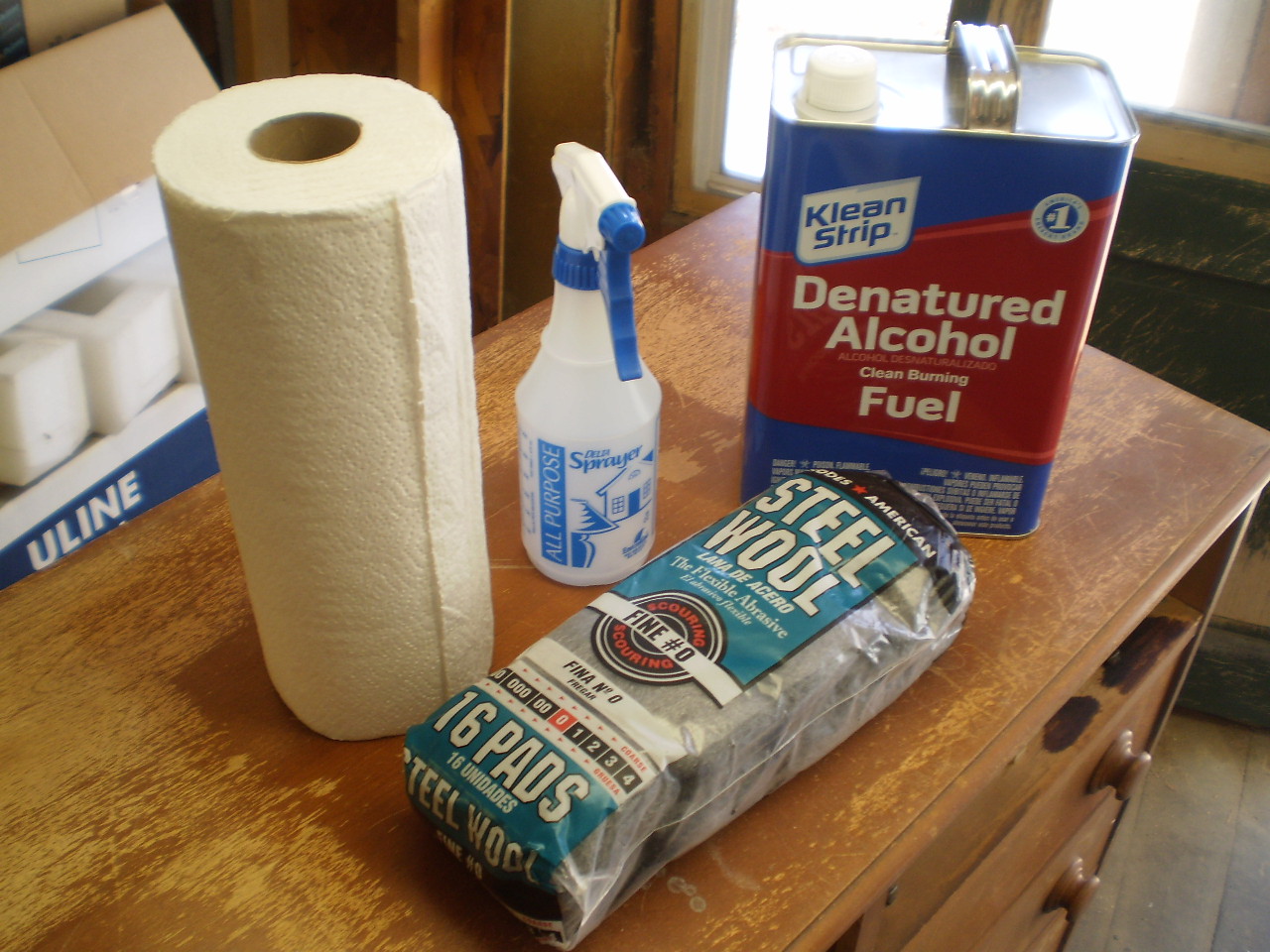
That’s about all we would need. I could scrounge whatever else was necessary from around the house. I let my boy remove all the knobs, so that he could be part of his mother’s gift. Then we got to work. I poured alcohol into the spray bottle, misted the top of the piece of furniture, and then misted it again until it stayed wet-looking. Then I unwrapped a piece of steel wool, re-wrapped it into a flat pad, and went back and forth on the surface. The shellac quickly became a kind of porridge, which I wiped off with the paper towels. In a few minutes, the top was clean.

There was a lot of elbow grease involved, but it was easy work because it was effective, and showed continual progress, which is important to avoid discouragement. I went over every surface, laying the furniture down flat whenever I could to make a very shallow swimming pool for the alcohol instead of a waterfall. Keeping it wet is important, because alcohol evaporates very quickly, and when it does, you’re back to the beginning. After an hour or two, here’s what it looked like:
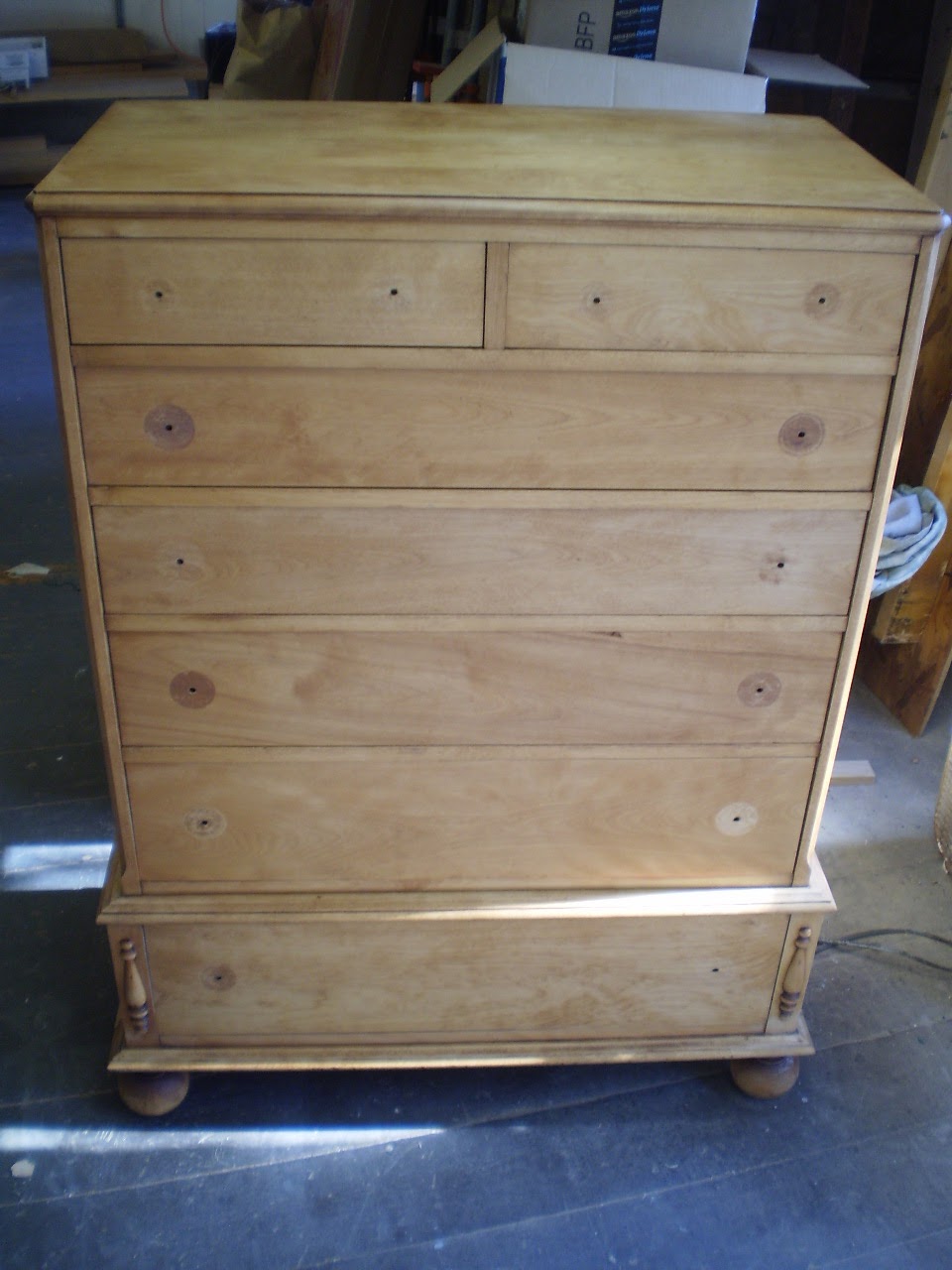
It looked kind of blah, of course, but it was clean. If you refer back to my comment about shellac retaining its ability to cohere no matter how much you thin it out, you’ll understand that even though the dresser looks stripped, it’s really just very thinly shellacked. It’s sealed enough for a coat of finish, if that’s the way you wanted to go. I could stain (dye) it if I wanted, but that would add days of work I didn’t have. I put my thinking cap on.

Now is the part of the proceeding where the expert on TV mumbles, “And then a miracle occurs,” and then shows you the finished product in the next scene. Well, I might own next to nothing, but everything I do own is useful. I went rooting around on the shelves, and found this:
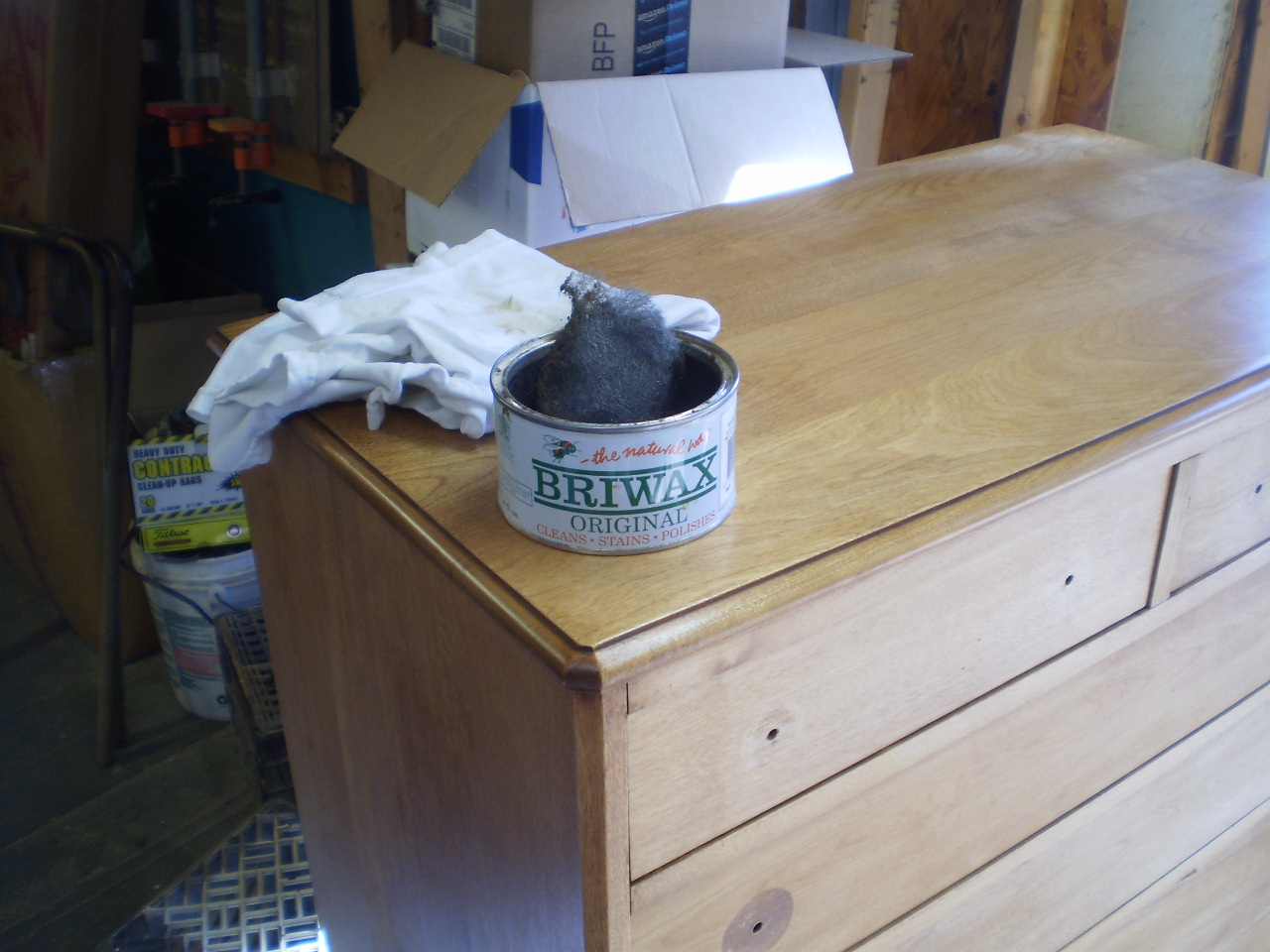
I bought this tub of Briwax in 1986. I was working for a rich A-hole on Cape Cod at the time. His carpenters had installed the kind of elaborate built-in closet interiors that are common today but mostly unknown then. They were fabricated in place from birch plywood and solid maple trim, and then finished with varnish. They were as rough as sandpaper, and he wasn’t happy. Like an idiot, they asked me how to fix it, and I told them to sand with emery cloth and then wax with fine steel wool applicators. Lucky me, they let me put the rich guy’s money where my mouth was, and I spent half the summer rubbing the insides of closets. I still had a half empty container of the pigmented wax I used. Golden Oak, if you’re interested.

The stuff never goes bad. I rubbed it all over using fine steel wool, and then buffed it with an old t-shirt. There was prodigious elbow grease involved, but the work wasn’t really difficult. This is what it turned out like:
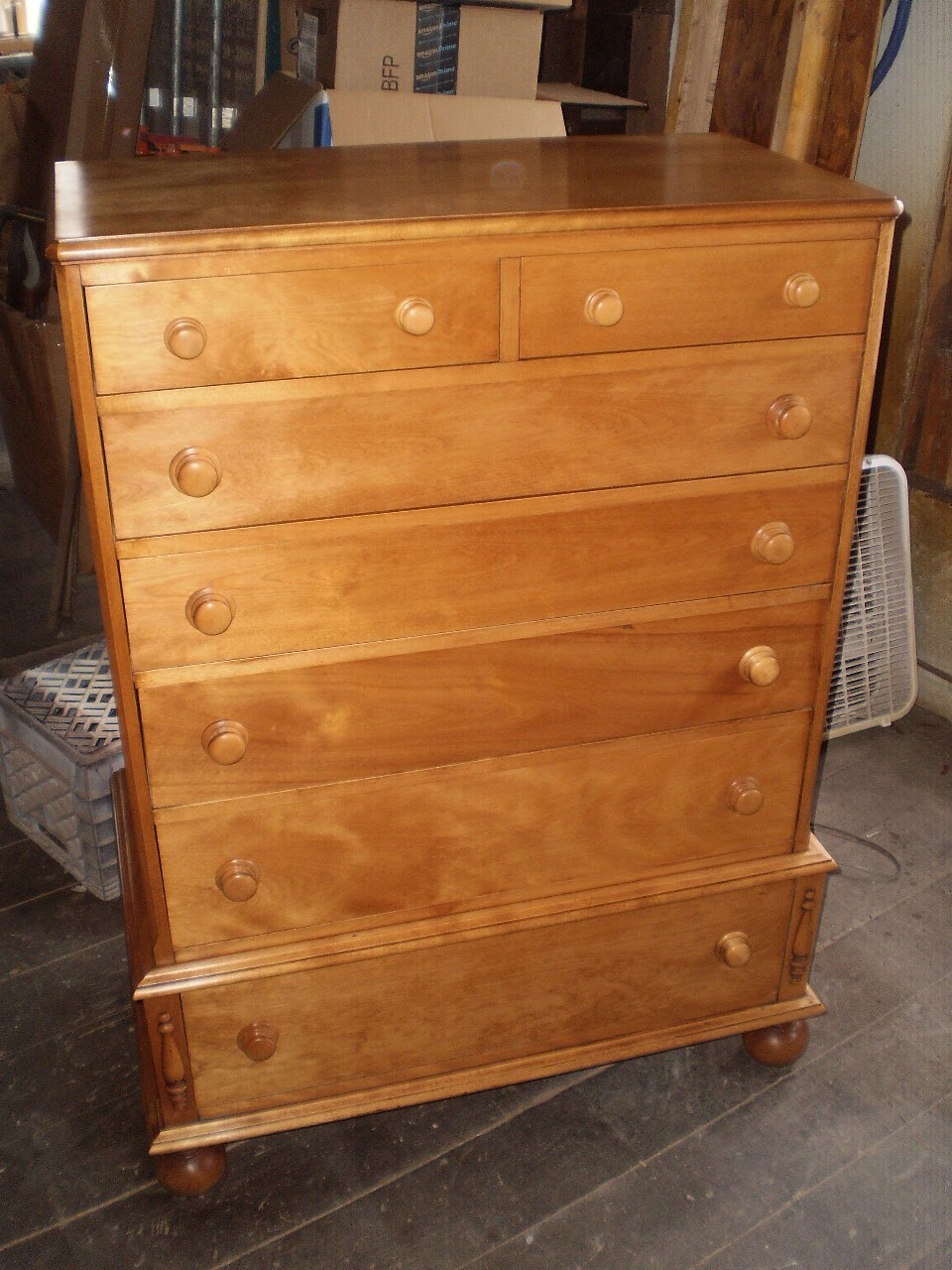
I replaced a couple of drawer stops that were rattling around under the drawers, banged in a couple of nails that had worked loose, waxed the drawer runners with regular wax, and washed the inside of the drawers with Windex. I started the project after lunch, and was done at dinnertime.

The thing smelled great, in addition to looking right smart. Shellac and wax is one of the oldest finishing methods for furniture there is, and one of the best. The next day, my older son and I carried the dresser upstairs in time for the birthday party, and we had a feast and a cake.

Happy Birthday, Mrs. King.
Grass Is Good as Carpet, Anyplace Is Fine

When I mentioned that the Festival of Trash saved my bacon, I wasn’t kidding. It’s my wife’s birthday, and I gots no moneys. I don’t even have a money. What was I going to do?

People used to say, “The Lord will provide,” and mean it. That led morons with opinions to deduce that the Christian religions consist of pulling a lever and out pops the candy. If no candy showed up, you’d lose your faith, or Richard Dawkins would call you a rube. Simple faith doesn’t work like that.

“The Lord will provide” really means that you’re supposed to do everything in your power to help yourself, first and foremost, and then trust that the universe isn’t entirely malignant, and maybe you’ll catch a break. Assume the world is not entirely carpeted in banana peels. Don’t expect every apple to have a fishing supply store in it. Don’t mistake every pineapple for a hand grenade.

The operative part of this faith that the world isn’t out to get you in particular, just in general, brings a duty, not a benefit. Saying, “The Lord will provide,” means you have to be on the lookout for good fortune that might come your way. You have to recognize it as an opportunity. It might come in disguise. It might come dressed up as a battered dresser:

This is what the festival of trash offered up as my salvation. It might look light an old dresser to you, but it looked like redemption to me. One of my nearby neighbors, who is a hell of a guy, put this dresser out on the curb for the Festival of Trash. He also put out some easy chairs with a substantial mixture of duct tape in their DNA, a semi-lethal crib, some skis you could stand still on, and assorted other items jetsamic. My wife and I were standing in front of our house, unloading shipping pallets from my truck to leave as my offering for the Festival of Trash. My wife’s nose went into the air like a wild animal on a scent. “Hey, lookit that.”

She made a beeline across the street. She’s wanted a dresser. She’s wanted a dresser, bad. She’s wanted a dresser, real bad. She’s wanted a dresser, real bad, since her husband bought her a real bad dresser about a dozen years ago.

My wife had always done without stuff. Our life was always spent crawling upward and onward out of the primordial poverty ooze, and generally being pushed back in by people that can’t be bothered to worry about every undercapitalized business in the country. We never really had any disposable income we could trust. I was self-employed, and worked day and night, but there was never any surety in it. We never bought much of anything, it seemed.

Then I got a job, a real job. It lasted four years. I went from the lowest man on a very big totem pole to a division manager in three years. Just like now, my income started with a 1, but it had an additional zero for a change. It was time, finally, to buy my wife something.

I bought her a dresser. It was a very expensive dresser, at least by my standards. I went to what I considered a fancy-pants furniture store, Ethan Allen, and bought a cherry Shaker dresser for my wife’s birthday present. It was fool’s gold furniture.

That dresser was never right. I paid for delivery. They scratched it, which I wouldn’t have done if I did it myself. I always seem to be paying people to do what I wouldn’t do, but not in a good way. This is the basis of government and furniture delivery. We were faced with sending it back and waiting for them to bring a new one to scratch again, or putting up with it. Oh, it’s not so bad, we lied to ourselves.

I looked at it every day when I woke up, of course. I didn’t make furniture then, but I knew what a Shaker chest of drawers should look like. I began to notice this one was stretched a bit. Too low, too long to be considered in proportion. It had the kind of drawer glides that you see in kitchen cabinets. They began to malfunction. The drawers got harder and harder to slide in and out. Unlike all our hand me down furniture, there was no way to wax the runners or anything. They were no-maintenance. That means “disposable” if you’re telling the truth.

The dresser was heavy without being strong. It was made from particle board covered with a thin cherry veneer. The finish was sprayed on to make the exact same boring reddish tone all over. The grain was obscured. It wasn’t pretty at all if it got a mark on it, and couldn’t be effectively fixed. And it came with a mark, remember?

The top was very strong, but not stiff like solid wood would have been. The design was too long for the four legs, so it began to sag in the middle. I’d been to architectural school for ten minutes, so I knew all about “creep.” The top became swaybacked, and the drawers began to have a lot of trouble going in and out.

My wife wrestled with that stupid, expensive dresser for a decade and more. It was her nemesis. She never complained to me about it, but I would hear the shriek of the drawers as she shoved them home, and the little grumble that followed. She would never say it, but I knew that I had gotten one chance to delight her, and I had fumbled it.

So here it was. The Lord, or my neighbor who had too much furniture, would provide. It’s a testimony to my wife’s good nature that she would have put that battered dresser in our bedroom, just as you see it, and used it. She just wanted to keep her clothes in something that didn’t shriek at her.

My good fortune continued. My neighbor is minding two high school exchange students. One is from Denmark, and one is from Germany. You can tell they are foreigners because they are polite and speak perfect English. My neighbor directed the kids to carry  the dresser over to our house. This was beginning to look like luxury to my eye. I was standing there on my neighbor’s lawn, socializing, when those two foreigners appeared from my front door, following my wife. They were carrying that shaky Shaker dresser, and they plunked it on my lawn.

My wife knew that sometimes the Lord provides a pretext, and that’s as good as a reason.

[read the conclusion of the story of treasure among the trash here]

How The Festival of Trash Saved My Bacon


Most years, our little town has a Festival of Trash. They don’t call it that, of course. If they called it The Festival of Trash, it would be more interesting, and become more popular, eventually turn into a rock-solid tradition, get famous, and make the town notable. Boosters of all kinds are continually trying to make the town notable with unfun fun runs and unjolly holiday fetes and parades with more people on the floats than the sidewalk. No one understands the organic nature of a successful tradition anymore. The Festival of Trash has potential. No one sees it but me, I guess. That’s not an uncommon sensation in my life.

Anyway, I like the Festival of Trash. Once a year, the public works department instructs the citizens to deliberately place threadbare sofas on the lawn on a specific day, instead of simply placing them on the front porch and sitting on them like the rest of the year. They suggest you place old mattresses, car tires, metal, brush, wood debris, and other similar detritus out on the curb as well. Town workers come around with front end loaders and trucks and so forth and pick it all up, and the town is made incrementally less tawdry.

It’s an early Spring thing. Early Spring is late spring if you’re not in Maine. The stuff can be  put out on the curb for up to a week before the appointed date, but most people use only the weekend before Festival of Trash Monday. It helps to generally declutter yards and homes in preparation for the impending good weather. I’ve lived here for 6 years now, and the good weather continues to impend. I’ll be ready for it when it pends.

Very little is ultimately left for the trash man, because everyone turns the occasion into a gigantic swap meet. It’s considered very bad form to try to sell anything during the Festival of Trash. A few people have yard sales to coincide with the event, but they get snickered at. Why buy the cow when you can get the milk-stained couch for free? A kind of general reckoning happens. Like water finding its own level, vaguely useful things find vague uses in the eye of the beholder, and they get swapped without deals being struck. If you see it, you take it. Things that are no longer useful to one household get picked up by other households and put to use. I think it’s grand.

I find treasure, every year. We’re stupid poor, so it’s easy to find things we could use sitting on other people’s curbs. The whole town is poor, so you don’t find Faberge eggs or anything, but if you know how to make use of raw materials, there’s always something.

There are hardcore people that cruise the town in battered pickups towing rusty trailers. Some pick up anything metal, and bring their booty to the scrapyard for a meager payday, I imagine. We put out eight wood pallets left over from a year’s worth of heating pellets for our stove. They were gone in about five minutes. If you live in wealthy suburbia, those pallets would be repurposed and upcycled into home and garden projects only slightly less useful and attractive than the pallets themselves. Here in Uppastump Maine, they’ll be broken up and burned for heat, or burned in jolly campfires in the summer. I used to burn all the pallets I could get my hands on in my own furnace, but I don’t burn firewood anymore, so I gave mine away to an anonymous someone who will get some use from them.

In years past, we found a perfectly good 8-foot tall turned porch column. We used it to mount a birdhouse I made, and placed in our garden. Tree swallows have used it for three years running, and made our lives more interesting. A couple of years ago, we discovered four kitchen chairs out on someone’s curb. My wife said she was tired of dragging chairs from the dining room into the kitchen whenever she wanted to sit down at the kitchen table. The chairs were cheap wooden things popular in the 1930s and 40s. They had a sort of Art Deco veneer on their flat backs, and disreputable padding and cloth on their slip seats.

I put them in the car hole “for later,” and the moisture down there made all the veneer peel off. One Christmas season, I sneaked them into my basement, re-glued the veneer, sprayed them with shellac and varnish, and reupholstered the seats with jolly coral-colored cloth with a bit of crewelwork on it. I had to complete the whole process in little bits and bytes every time my wife went to the supermarket, and hide everything in the interim. I eventually put them under the Christmas tree as a present for my wife, who never suspected a thing. We sit on those chairs every morning and look out the window at our tree swallow house, and know the pleasure of possessions that are part of the fabric of your life, not just stuff.

I’ve made local handymen happy by putting out a busted tablesaw, and a broken compressor, and various other things that seemed valuable if you didn’t know better, so I feel I’ve done my part. I must say, however, that this year’s Festival of Trash made our lives better than I could have imagined. The Festival of Trash saved my bacon.

[continue reading about treasure from the Festival of Trash here]

Interestingly, ‘Byzantine Forest of Metal Columns’ Is the Name of My Supertramp Tribute Band. But I Digress

    This is Sippican, tattered and torn
    That kissed the missus all forlorn
    That flushed the toilet one fateful morn
    That flooded the floor and smelled like scat
    That filled the blog with a monologue
    About fixing the house that Jack built.

I don’t know who built my house. I imagine it was constructed by a great big crew of rough-and-tumble guys. In 1901, power tools were scarce, and ‘strong backs with weak minds’ were plentiful. I’m sure any number of them were named Jack.

Of course the old expression about ‘strong backs and weak minds’ doesn’t really hold in this case. When I began working in construction, back in the dark ages of the ’70s, that appellation was reserved strictly for young people fresh on the job. The old guys knew plenty, and could do more math in their head than you can manage with a calculator.

The jobs reserved for we newcomers, luxuriant of hair but challenged in all other areas, were always pretty simple : Dig a hole here. Roll this wheelbarrow full of concrete over 100 yards of rough ground and dump it in the form by the back door. Take the bundles of shingles off the truck and put them on the roof. Don’t fall off the roof, it makes a mess. That’s the only sort of direction you’d get.

The payoff was that you got to work with people who knew their arse from their elbow. You would receive a certain amount of instruction. This instruction was supplied in the form of abuse, delivered in vibrant Anglo-Saxon, accompanied by a threat to be fired if you did whatever it was you did again. For the most part, you were required to be cautious, quiet, and “steal with your eyes” if you wanted to learn things. You would work right next to men who were very accomplished carpenters, painters, roofers, electricians, plumbers, landscapers, stonemasons, concrete finishers, or skilled at various other trades. They were also very accomplished drunks, and could show you a thing or two about getting yourself outside a quart of Four Roses while still being able to show up early for work the next day. They accomplished marvelous things, if you loved single-family houses the way I did, and if you paid attention, you could learn how to do it yourself.

In theory, this monkey-see, monkey-do method is how home and garden shows on TV are supposed to work. There’s a problem. The people featured on shelter shows are chosen because they are most likely to be entertaining to the viewers. The work is an afterthought. Even the venerable and useful This Old House has succumbed to this affliction. They spend fifteen hours picking out drapes, and fifteen seconds placing the foundation. The actual work happens in a blur in the background. You can’t steal with your eyes by watching competent people, because there aren’t any in front of the camera. If you watch Home and Garden TV, you might learn what is required to become a host on Home and Garden TV. That’s about it.

The ‘steal with your eyes approach’ eventually cultivates an ability to puzzle things out when confronted by a construction and maintenance problem, if you don’t fall off the roof holding a bundle of shingles before you learn everything. If your view of the whole thing is informed by a long series of small glimpses of the underlying structure, you get a much clearer understanding of what’s truly going on overall. This is also the basis of my interest in Victoria’s Secret catalogs.

So we’ve wandered hither and yon in the thesaurus talking about my clogged sewer pipe. It’s long since time to cap the thing off and take stock of the whole megillah. I promise I won’t exaggerate, and as I’ve said a million times before, I never resort to hyperbole. Anyway, here goes: I believe that the recalcitrant sewer line is the entire reason I was able to buy my home for less than 25 grand a few years ago, even though it seemed to be the only thing in the house that functioned, at least a little. It was not one of many things wrong with my house. It was THE thing wrong with my house. My house is a hovel, so that’s saying something. Here’s the theorem, proved:

  1. It has obviously been many decades since the sewer line functioned properly. It’s possible it never did. The vertical Drain-Waste-Vent line went directly into a clay pipe ‘Tee’ fitting underground. That’s not a deal-breaker, but a sweep (a gently curved pipe) would have been better.
  2. The Tee had a cleanout a few inches from the spot where the vertical pipe meets the horizontal tee. This cleanout couldn’t be accessed because there was a solid granite foundation wall in the way. 
  3. Some former owners dug outside the foundation when the pipe didn’t work, only to discover the pipe didn’t exit the house that way. That excavation required the demolition of a ground-level rain gutter made from concrete. That allowed rainwater from the roof to filter down into the ground, where it makes a damp spot along the inside of the foundation wall. That made the basement perpetually damp, and it masked the water leaking out of the sewer pipe under the slab.
  4. There was a clean out pipe for the sewer. It was on the opposite side of the basement. To my surprise, that’s the side of the house where the main house drain actually left the building. In the mists of antiquity, someone broke off the clean out pipe underground, plugged it with a series of small fittings, and then installed some sort of sink. Then they buried all their piping in concrete. This made it appear as though the (long abandoned) sink location was at the end of a drain leading back to the main DWV vent pipe. Even if you weren’t fooled, (I was) there was no way to use this clean out anymore. That means it was a practical impossibility to clean out the house drain and sewer line outside the house for forty or fifty years.
  5. Once I dug up the sewer clean out, I used 70 feet of drain augur cable to clean out the pipe, and there was twenty feet of house drain before you got to the clean out. A 4″ diameter pipe that’s 100+ feet long will hold a lot of water (and other stuff). Lots of water would mean lots of weight pushing on an obstruction. If the obstruction won’t budge, that much pressure will blow out all the oakum or tar or whatever was used to seal the joins between the 4-foot sections of sewer pipe. Given enough time, all the water leaked out of the pipe without pushing the ‘solids” along.
  6. The solids continued building up in the pipe. I think the pipe filled from the bottom up at first, with water flowing over the top a bit, and then eventually the only way for water to get by was to seep through the entire 100-foot run of muck. Not very efficient.
  7. The entire sewer line became a defacto septic system. Almost nothing made it past the obstruction to reach the town sewer.
  8. The leaky seams in the sewer pipe let water run out quickly enough so that the house could limp along for decades with the solids slowly building up in more and more of the pipe. 
  9. Once the unsuccessful exterior excavation ploy failed, someone dug up the pipe where the vertical DWV pipe entered the floor (and joined the clay Tee pipe). They broke the clay pipe, and they also lost or broke the plug that went in the unused end of the pipe.
  10. They couldn’t get another clay pipe to replace the one they broke, and Ferncos might not have been invented yet, so they put a wooden disc in the plug end of the Tee fitting, then stuck the broken bits around the DWV pipe, and covered it up with a concrete patch. 
  11. The wooden disc plug didn’t last for long, and tree roots flourished at the now open ended pipe. 
  12. Lots and lots of water escaped the pipe right where it entered the floor. 
  13. The foundation and cellar floor was undermined by the water.
  14. In the winter, the temperature reached 20-below-zero regularly.
  15. The water froze, then heaved the foundation and the floor. 
  16. The original walk-out barn doors in the basement no longer worked as the foundation in the back of the house slumped. 
  17. Someone tried to fix the problem by pouring a makeshift concrete foundation on top of the sinking granite blocks that made up the foundation walls. The water just kept undermining the now taller wall.
  18. The problem accelerated, and the foundation wall in the back of the house between the 8-foot-wide barn doors completely crumbled to dust.
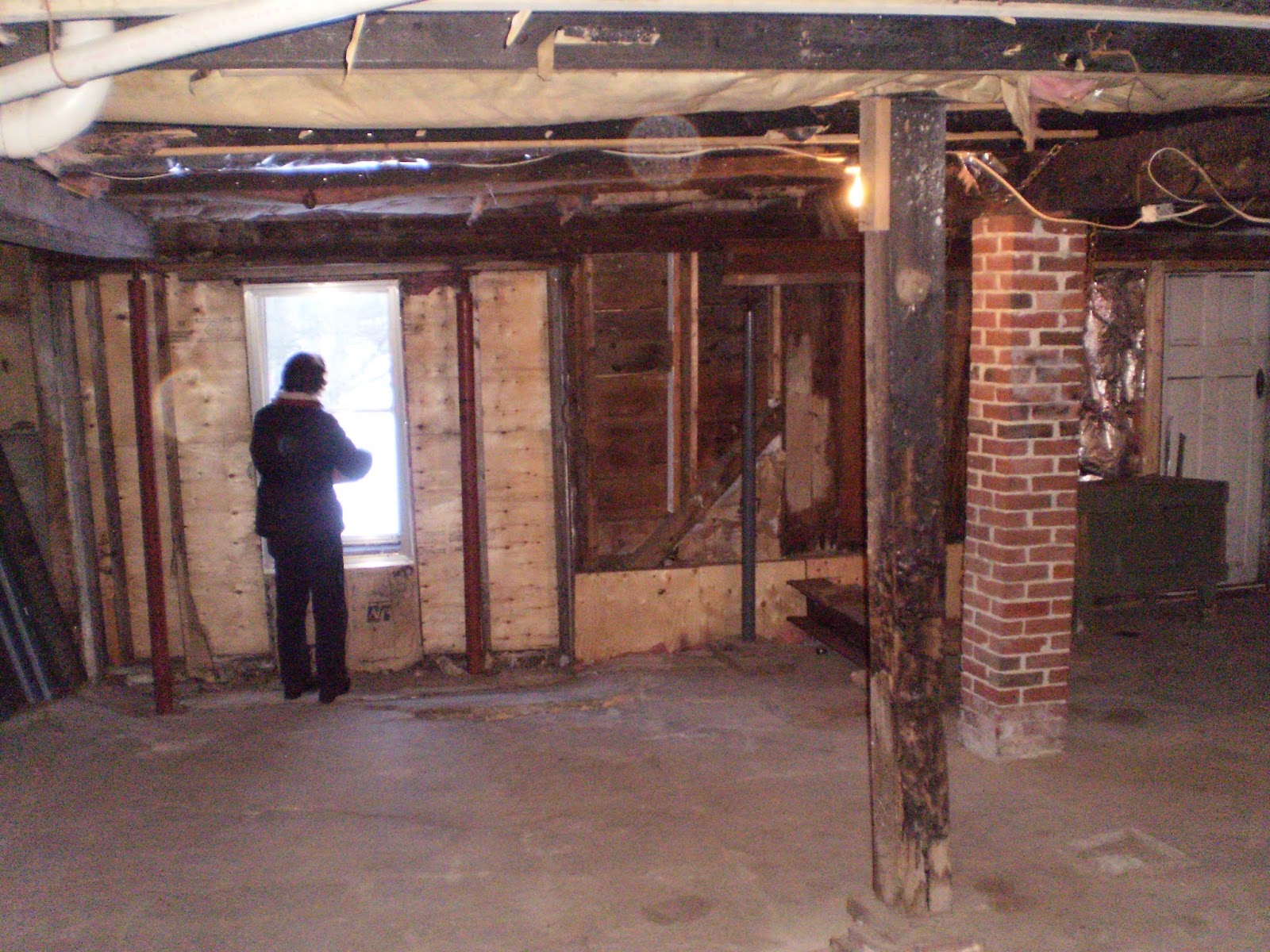
  19. Someone propped up the back of the house with a byzantine forest of metal columns, makeshift wood beams, and a few I-Beams that didn’t do anything. 
  20. They also boarded up the entire back of the house, then insulated it, blocking out almost all sunlight and keeping heat out, while thinking they were keeping heat in. Where they thought the heat they were keeping in would come from is unknown. This accelerated the freezing, heaving, and subsidence of the remaining foundation walls and the floor. 
  21. The forest of hollow metal columns rested on the thin concrete floor, with no footings underneath, and the floor was constantly being undermined, so the columns punched holes in the slab instead of holding anything up. 
  22. This elicited the installation of ever more columns, all accomplishing not much. This coincided with the installation of ceiling fans, a hot tub, and a tanning bed in the house, because people think a house is for adding to, not for taking care of.
  23. Eventually the back of the house dropped between 6 and 8 inches. 
  24. Because of the unusual framing technique used on the house when it was built, (thanks, Jack) the back wall of the house basically became detached from the rest of the house.
  25. When the back wall of the house slumped, the rear roof eave slumped a lot, and the rest of the roof only slumped a little. 
  26. This pulled open the neglected roofing about 3 or 4 feet up from the roof edge.
  27. This allowed water to enter the attic, and flow freely inside the four-story back wall of the house. 
  28. Water flowing inside the back wall destroyed the windows, so they boarded some of them up, too. This made it colder inside, prompting the owners to — you guessed it — install more ceiling fans. 
  29. The rain and snow entering the holes in the roof made the house’s structure even worse. Leaks in the roof became big holes in the roof, which let in bees, hornets, carpenter ants, chipmunks, birds, squirrels, and bats. The holes never got large enough to let in any competent plumbers, however.
  30. Once the owners ran out of light fixtures to replace with ceiling fans, and it was raining indoors regularly, they folded their tents in the night and stole away, leaving the local savings and loan holding the bag holding the mortgage.
  31. Because a bank can’t enter a house while they foreclose on it, all the plumbing pipes in the house froze solid, and were ruined. They were no great shakes anyway. The heating plant was an oil-fired boiler with hot water baseboard heat. All of this was full of water, froze solid, and was destroyed. 
  32. I came along looking for a cheap house. The banker realized there couldn’t be two people as dumb as me walking the Earth, so they sold it to me before I sobered up.

So, there you go, your honor. I hereby testify that someone flushed an unmentionable down the toilet, back when Eisenhower was president, probably, and it got stuck, and that little thing destroyed the sewer system, the foundation, the back wall of the house, the roof, the plumbing, and the heating system in the house. And I bought it. I plead insanity.

So if you’ve been reading right along, you know that my son and I were able to repair the main house drain. If you’re new around here, press on this Plumbing label and read the posts in reverse order.

I’ve been struck by the interest in this project from many corners of the Intertunnel, and the outpouring of support from people near and far, for which I am immensely grateful. It would seem to me that people want to hear more about fixing my house, so that is what I’ll write about every chance I get. I definitely owe Jerry and Michelle a stirring conclusion to the tale of jacking up the back of the house. By gad, I’m going to do it.

A SEWER LINE BENEDICTION:
My son and I cleaned off the nasty cables we used to augur out the sewer line, and then tromped over the snowbanks to load the rented tools into my truck to return them to the tool rental yard. We backfilled all the excavations and compacted the soil. We burned half our clothes, and my wife washed the rest. Twice.

A week or so later, we got a generic notice in the mail from the town government, appended to a utility bill. It read:

IMPORTANT SEWER NOTICE
If you experience a sewer backup, please notify the Public Works Department before you hire a plumber. After hours, call the Police Department. 

But, we didn’t hire a plumber, so I guess we’re all set. Life sure is a lot simpler when no one imagines anyone like you even exists.

[Update: Many thanks to Robert B. from Chicago, Ill. for his generous contribution to our PayPal tipjar. It is very much appreciated]
[Additional Update: Many thanks to William O from Bandera, Tejas for his generous contribution to our PayPal tipjar. It is very much appreciated]
[Yet More Update: Many thanks to James H. from Lees Summit, Missouri for his kind words and generous contribution to our TipJar. It is very much appreciated]
[Still More Updates: Many thanks to Jerry and Michelle V. from Everson, WA for their unflagging support and friendship. It is greatly appreciated]

Interestingly, ‘Unified Field Theory of Neglect’ Is the Name of My Left Banke Tribute Band. But I Digress

My house, just as I found it. The bad news was that Winter was coming

You know, I’ve been talking about this sewer line fix for three weeks or so. One of the reasons I found the whole thing so durn interesting is because the exploration and repair of one problem solved a zillion other problems I’d been turning over in my mind. This busted sewer pipe really was the key to life, the universe, and everything — at least everything to do with my house.

My house cost less than $25,000 when I bought it. I wasn’t expecting a rose garden. As it turned out, I got a lupin garden, but that’s a story for another day. There was a lot wrong with my house, and I knew it. I even knew that the sewer wasn’t likely to be first rate. There was a patch on the concrete floor around the sewer pipe. There’s always a reason why the floor has been patched around a sewer line. All the reasons are bad reasons.

I needed a house six years ago or so after catching the poverty. It was my own fault. I foolishly went to the early-bird special at the Honest Work Buffet, but Wall Street had gotten there before me and sneezed on the warming tray with the regular economy in it. Lyme Disease didn’t help any, either, although I still find ticks less loathsome than politicians.

I believe that a house is the chassis of a competent family. We were broke but it was important to keep us together in a house where we would have some control over our affairs. I looked for a house that was as cheap as the chrome on a Kia, but didn’t have anything wrong with it that I couldn’t understand or fix myself. Our house fit the bill. It had been abandoned, and the bank wanted to get rid of it, badly.

The house was owned by a local bank that held the note from the prior owners, a real rarity back when the real estate leverage world was desolating the landscape. People kept predicting that housing would fall an additional X percent, and then they’d buy. They didn’t realize that the big banks holding the leveraged debt had no interest in the real real estate. The financial institutions were being made whole by logrolling the government. The houses were abstractions to them, and only the paper was real. The local banker had his tit in the wringer over our house. I could reason with him. Either I could live in it, or he could. No one  in their right mind would want to live in my house.

I didn’t want an abstract house. I wanted one with real problems. Mission Accomplished. I tried in vain to make real estate agents understand that I wanted to buy a house nobody else wanted. They kept trying to show me houses that looked like Home Depot had exploded inside them. The current owners wanted me to pay for the privilege of ripping out all the silly stuff they had inexpertly selected and installed. What I really wanted was a neglected house. Neglect is easier to handle than active malice. That applies to real estate and elections, now that I think of it.

Our house had been neglected, that’s for sure. There was a hole in the back roof that I could stick my head through. The wiring was still partly knob and tube. It takes a long time to foreclose on a house, even if it’s abandoned, so all the pipes had frozen and burst while the bank went through all the legal steps to foreclose on an empty house. When we bought our home, it was essentially a poorly constructed shell of a house, not a dwelling.

That’s exactly what I wanted. I’ve stood in the middle of plenty of poorly constructed house shells. I’m certain some were poorly constructed, because I constructed ’em. A half-built house holds no terrors for me. It was a fully-built house that looked like a Kardashian picked everything out and cost a bunch of spondulicks that I had to avoid. I didn’t want to pay for someone else’s ceiling fans.

I didn’t. I bought this house for about five grand more than a plot of land costs around here. It’s funny, but the price of land never seems to change, no matter how much a house costs here. That’s because you can plop a trailer on a house lot in these parts, and no one will bat an eye. My big Victorian house had to compete on price with a house that gets built by a tow truck. The dirt underneath it had no opinion.

So, the roof had big holes, and the plumbing was totally gonzo. Anything might happen when you turned on a light switch, except light. There was no heating appliance in the house that functioned. Heating matters in western Maine. The back of the house was in danger of collapsing. The foundation underneath it was completely gone, and the weird props that had been installed to hold it up were only good at collecting cobwebs, which were the only things actually holding up the building, I think.

These all sound like separate problems. I thought any one of them could be handled by a successful convenience store robbery and some elbow grease. I was wrong. I’ve been banging on this house for nigh on six years now, and until this whole sewer line debacle, I had no idea that there was a central theme to these problems.

I have an unusual disposition. Some people call that being a jerk. I don’t like not understanding things. I notice things. Noticing things isn’t encouraged much anymore. See: Twitter. I must admit, however, that it was almost worth the very real fear of being unable to fix the sewer to finally figure out that there was a central theme to my house’s problems. For the first time since I bought it, my house made sense. I had come up with the Unified Field Theory of Neglect. I understood everything that had gone wrong for the last 75 years or so. It wasn’t a disconnected series of problems. The sewer line had wrecked my roof, and everything in between.

[to be continued]

Tag: Maine Family Robinson

Find Stuff:

Archives