Some old school Country, with more than a few hints of what was to come. Dolly Parton at around 7:00 piled up the hair and sang it straight. She’d wander onto the pop charts, bigtime, a little later, with the crossover sound that fell out of the old country music tree.
Rock music had already worked its magic on country music. Up until the late fifties, pop music was very wide-ranging and catholic. Elvis and his cohort had one foot still in country, for instance, but they started the deluge of rock or nothing that found everyone shifting over from whatever genre they inhabited before. When Bobby Darin starts trying to sing rock music, things have truly shifted for good. Eventually, in 1964, the Beatles wiped the charts clean and scrawled their name all over it. Country music had an identity crisis.
This video is a museum exhibit of the end of the original Grand Ol Opry movement. Shortly after this, the Opry moved to a new venue. It didn’t look down-home anymore, and the acts moved into New Country, and various forms of crossover styles. In some ways, it isn’t a long trip from this video to stuff like the Eagles, or Eddie Rabbitt, or BJ Thomas, or Charlie Rich, or Kenny Rogers, or Dolly Parton’s transformation, or the Bellamy Brothers, but there’s an oceanic gulf between the styles. It’s nice that someone pointed a camera at the dotted line that divided the eras.
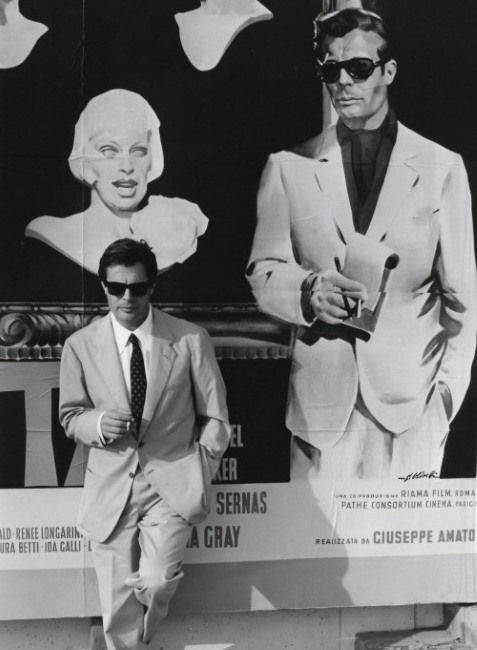
It is, demonstrably, possible to be this cool. I mean, we’re looking at it. Marcello Mastroianni is right there in front of you, being this cool. But since it’s not possible for anyone else to be this cool, it’s certainly impossible for anyone to be any cooler. It’s science, or math, or something.
I mean, Marcello is in La Dolce Vita, being so cool that even he can’t stand himself. Then he stands in front of a giant billboard image of himself being himself, which is like cool squared, or cubed. I never was good with those numbers you had to type by grabbing the roller on the typewriter by the knurled knob on the end of the carriage and setting it halfway between two lines. I’m not that cool.
Marcello is no doubt exuding his own hair gel. Nothing that comes from the store could possibly match it. Cool sunglasses, natch. I’ll bet he was wearing sunglasses when he was born. That must have hurt Mama Mastroianni, but sacrifices must be made for people this cool.
He’s not cold, however. An ex-wife’s lawyer is cold. He is also occasionally slicker than a greased weasel, as well as being cool. How else do you explain this?
Concrete and Clay was a #1 hit in 1965 on the UK Singles Chart. It made it to a respectable #28 on the US Billboard chart. Just popular enough, but obscure enough, to interest someone like Wes Anderson. Here it is, along with a protozoan-era music video:
Ya gotta love Unit 4+2’s vibe. By the look of them, they’re obviously going to do the record producer’s taxes after the session, or maybe do some retirement planning for elderly couples in Tunbridge Wells. It demonstrates ably that the sixties was two different decades wrapped into one. The first half looked like this, and the latter part was all feather boas and paisley shirts and satin carnival uniforms. The song itself is seriously sprightly. It’s got a slightly exotic Brazilian beat, a copious amount of rebar on display in the video, and absolutely the correct amount of cowbell.
The band was called Unit 4 for a while, until they decided they could really use a guitar player and a drummer, hence the +2. The +2 turned out to be Russ Ballard and Bob Henrit. You think you don’t know who those two guys are, but you sort of do if you’re my age. They later hooked up with the keyboardist from the Zombies and made this earworm in the ’70s:
Yes, hair and clothing styles for performers had changed in the interim.
Anyway, let’s get back to Concrete and Clay. I was tickled when my sons started banging it out in their rehearsal space. My brother gave my son a cowbell for Christmas, and they immediately knew exactly what to do with it. I wish I had recorded it before I sold their practice room, mostly because it was attached to the rest of the house. But it was a song with legs, if you ask me. It’s peppy and obscure enough to be interesting, but familiar enough for people to respond to it when you start in with the cowbell.
Right? Isn’t it? Am I wrong here? I have my doubts now. I went looking around for covers of Concrete and Clay, but they’re vanishingly rare on these here intertunnels. Has my thinker upper failed me on this one? Let’s see who’s executing the song on the WooTube:
Whoah. A lot can be explained by the fact they’re German. Our Deutsche freunde are rarely noted for their cooking, but they’re really not noted for their sense of humor. Here’s a German joke:
Judge: So you had a disagreement with your neighbor over a parking space. You accosted them in the street, cursed at them, drove them into a forest, and beat them with a tree limb! Don’t you think that was taking things a little too far?
Defendant: You’re right, your honor. I should have beaten them right there in the street.
Oh well. Let’s head further north, and see How Ilkka & LPX paid homage to the tune:
The late sixties also introduced a lot of people to psychedelic drugs. But WooTube beats magic mushrooms, hands down.
That’s not a joke. That’s the Foundations. They were Britain’s somewhat overmatched answer to Motown, and they hailed from all over. The late sixties were a very fertile time in the music business. Rock and pop bands were making serious money, and producers slapped together bands to cash in on the seemingly limitless hunger for new material from an ever-growing audience. The Foundations fit right in — eventually.
Musicians often have crazy side jobs and obscure backgrounds before they get their head above water in the music biz. The Foundations are a wild bunch, even by music biz standards. Clem Curtis, who is singing (or pretending to sing for the camera) is from Trinidad. He was a boxer, a wrestler, and an interior decorator. Hmm. I don’t think I’ve ever seen those job descriptions on the same resume before. At any rate, the keyboard player, Tony Gomez, was a clerk in a government architectural office. Peter Macbeth, the bass player, was an English teacher — in Singapore. The drummer, Tim Harris, was a deckhand on a cargo ship and sailed all over the world. Mike Elliot, the sax player was 38 years old when the band formed. Tim Harris, the seagoing roustabout, was still only 18, which makes me wonder if they were still impressing cabin boys in England in the sixties. The rest of the band was from all over, too, but were mostly jazz musicians who discovered that pop music paid better.
The Foundations grew out of a profoundly unsuccessful band call the Ramong Sound. It featured Clem Curtis and a guy name Raymond Morrison singing duets like Sam and Dave. Morrison went to jail for one thing or another, so they went looking for someone to sing duets with Clem. They tried Arthur Brown.
If you can’t place Arthur’s name in the musical firmament, this should be enough to give you the general idea:
Arthur used to paint his face, wear a mask, and a don a helmet that he set on fire, but even he thought the proto-Foundations was a little too rough and tumble. He reminisced later that when he walked into an off-hours bar to audition for the band, he found Curtis holding a spear to the drummer’s throat, who was bent backwards over the bar rail. So Arthur didn’t work out. The band auditioned Rod Stewart, who turned down an offer to join. They hired his girlfriend to do clerical work, however, so it wasn’t a total loss. Eventually they just went with the lineup they had, changed their name to the Foundations, and had a Number One hit with Baby, Now That I’ve Found You.
The band started touring with lots of big name rock acts. Success of a sort went to everybody’s head. As soon as any band starts making any money, it’s considered poor form not to start fighting over it like Kilkenny cats, and the Foundations were no exception. Curtis left to try his hand at a solo career after demanding that the band be named Clem Curtis & the Foundations, and being told to pound sand into a rathole by the other members. Morrison got out of prison and sued everyone. It took a judge only three hours to decide that it was unlikely that he was responsible for the band’s success while he was in prison.
But don’t call the Foundations a one-hit wonder. They got a new lead singer from Barbados named Colin Young, and became a two-hit wonder:
That one made it to #2 or #3, depending on what version of English the chart was being compiled in. Buttercup was a hardy perennial in the cover band circuit. I freely admit to playing in a band that performed the song twenty-five years after it was recorded. Of course we changed the words to an NC-17 version to freshen it up for a new audience.
I am led to believe that some version of the Foundations is still poking around, although it’s unclear exactly how much DNA they share with any of the original members. Then again, most old pop groups never die. They simply fade away.
That’s Manfred Mann performing Pretty Flamingo in 1966. Nifty video to accompany it. People have always spent a lot of time on their appearance, and still do. We have recently, however, forgotten that becoming exquisitely unpleasant-looking wasn’t the point of the exercise.
Manfred Mann is a person, and the name of the band. It makes for pronoun trouble, but we’ll carry on regardless. Pretty Flamingo made it to Number 1 on the UK pop chart, and deserved it. It’s a sprightly little tune. Manfred Mann was no stranger to the number one slot. They had already covered The Exciters’ Doo Wah Diddy, and even though it’s a half-step removed from a novelty song. it made it to Number 1. They later recorded Bob Dylan’s Quinn the Eskimo (The Mighty Quinn), another odd but interesting choice, and had another number 1.
The band was one of those nurseries for other bands. Cream’s Jack Bruce, and Klaus Voorman were Manfredians. Voorman is just about the most famous person you never heard of. He played the bass. He was friends with the Beatles, and lived in their shared flat for a while. He ended up playing on many of their assorted solo records after everybody met Yoko Ono. Klaus was an artist, too, and designed the LP sleeve for Revolver, among many others. He had more offers than he knew what to do with. The Hollies and the Moody Blues tried to hire him to no avail, although he appeared with the Hollies on TV a couple of times. He could play the flute well enough to be recorded, too. Versatile? Hell, he appeared as Von Schnitzel the Conductor in the movie Popeye. Mad Magazine hired him to draw the cover for one of their issues. He collaborated, one way or another, with everyone from Howlin’ Wolf to the Bee Gees.
None of the members of Manfred Mann wrote Pretty Flamingo. If I asked you to guess who wrote it, and stood on one leg and held my breath while you took a stab at it, I’d fare worse than Yoko Ono’s audiologist. Mark Barkan wrote it. Who? Well, he was American, and he also wrote this:
Not exactly Ode to Joy, but I dare you to get it out of your head by the end of the day. Sorry.
Pretty Flamingo is one of those songs that has legs, as we used to say in the cover band business. It’s recognizable enough to elicit a kind of enthusiasm when you start playing it. It’s also obscure enough to seem like a potent re-discovery.
The song is pleasant enough and interesting enough musically to make even a bad rendition of it pretty good. Or a good one:
Tag: 1960s
sippicancottage
A Man Who Has Nothing In Particular To Recommend Him Discusses All Sorts of Subjects at Random as Though He Knew Everything.
Recent Comments