Chuck Berry Has No Particular Place To Go

Chuck Berry’s dead. He was 90. Bonne chance at Saint Peter’s gate, Chuck, you’re going to need it. You were a magnificent mean weird wonderful hack genius AMERICAN.

He was all those things, surely. He wasn’t American. He was AMERICAN. Only America could possibly produce him. The rest of the world loved him, as you can see by watching this video from France in 1965. Europe loved him, but they could never cobble a guy like that together. The important part of his career was already over when this video was made, though few knew it at the time, including Chuck. Europe was already an off Broadway production.

Europeans sent us a bronze broad to stand in the granite harbor outside Ellis Island. It was allegedly a gift, but I suspect they sent it so they’d have something familiar to look at after they bolted the doors on their dusty museum of cultures and fled. We sent them Chuck Berry records in return as a way to show them This is how we roll.

To Europe, America has always been a bad man. The pecksniff attitude their governments have always heaped on us has a dash of cowardice in it. Chuck was a bad man. It made him all the more American to a toff, I imagine. I don’t mean he was a bad man in just the figurative sense, though. Chuck was a real live criminal. If you read Chuck’s bios, you’re bound to find fans desperately trying to pooh-pooh his criminal background. The gun he used in a carjacking was broken, so it doesn’t matter…

Don’t buy it. Chuck was what he was, and he never really made any bones about it. He really was kinda mean, edgy, hypersexual, pushy, grasping and grabby. Who cares? He went to jail occasionally, and that was that. Chuck had a chip on his shoulder after he got out of jail, but then again, he had one before he went in.

Chuck Berry was important in the context of the 1950s. He was a big star for half of the 1960s, too, but after Nadine, he mostly traded on the fact that a whole lot of British Invasion bands adored him. He made a little money in the seventies by making a damn fool of himself with songs like My Ding-A-Ling. It was simply dreadful, and not very fun for a novelty tune. After a while, Chuck just showed up to his gigs in varying states of sobriety with an untuned guitar. He plugged it in and started blasting away without first bothering to count four with an endless procession of ad hoc bands he didn’t have to pay or acknowledge. Occasionally it was a few Beatles or Stones, most often a bar band. He didn’t seem to acknowledge the difference. The checks only had one name on them.

But the fifties, man; he defined America in the 1950s. Forget Elvis. Elvis went up the front stairs and asked your big sister to go to the movies. He really wasn’t all that subversive. It was Chuck Berry that came up the back stairs, round about midnight, and asked your mother if your father was home. He went up the back stairs of the whole damn world before he was through. I offered that video with the underwater sound and the band that doesn’t know the arrangement to show you what the fuss was about. Look at Chuck. The stage is too small for him, even though the world is his stage.

America was the most important thing in the world at the turn of the twentieth century, but no one knew it yet. It took World War I to demonstrate what paper tigers the European empires had become. America flipped the 19th century script and went to Belleau Wood with all the fury of a father turning the car around. When it was over, we shirked the big mantle and went back to our cornfields. We avoided the responsibilities of a great power until the hakenkreuz and the rising sun were waved right in our faces. We shrugged and rolled up our sleeves and pounded the world flat again, because that’s the way we liked it. It’s easier to drive on.

Then came the fifties. The Soviets stood there, leering over half the globe, and said they would bury us.

We yawned. We had the sobriety of Eisenhower on our side. We had the muscle of finned cars rolling off assembly lines uncounted with a sunburned arm out the window on day one. We minted legions ready for the next version of America from public schools with the mortar still setting. Jonas Salk and a thousand others like him beat not only microbes, but fear of sickness itself. Hollywood gilded the country in pictures, and then gilded itself. Something raucous or fun or serious or thoughtful came bubbling out of our radios, projectors, and TVs in an endless stream. Broadway shone like a thousand Folies Bergere.

And then came Chuck Berry, from Saint Louis, the center of our universe. He stood up like a man and looked you straight in the eye. He was full of the optimism of a card sharp and his own unsavory brand of charm. I’ll strut, thank you, like the peacock I am. He didn’t wink or pinch. He winked and pinched, and he meant every one. There were no idle threats, no meaningless boasts. Chuck don’t flirt. Chuck asked for what he wanted, flat out, with a twinkle in his eye and an angel on his shoulder and the devil in his heart. He’d put up his fists if you wanted it, and laugh with you afterwards, too — when you’ve said you’ve had enough.

Chuck Berry outlasted the Soviet Union by a quarter of a century. Bury us? We Berryed you.

Disneyland 1956

Before my time, but not ancient to me. I remember Old Walt holding court on Sunday nights on TV when I was a kid. For some reason, I mostly remember his clothes. He seemed to be nothing more than a delivery system for exactly 1/2″ of white cuff showing and a pocket square, pure white.

The park was always an abstraction to families like us. It was on the other end of the continent. That sort of vacation was foreign to us. It was something for really wealthy people, you know, like plumbers or car salesmen.

The kids in the video all grew up and completely rejected the culture that produced them, and that built that park. Their children all go to the park. I assume they go alone, because they don’t seem to have any kids.

Torn From the Virtual Pages of the Maine Craigslist

The Maine Craigslist is a hoot. It mostly features stuff for sale that the owner would be hard pressed to give away. In general, the prices look slightly higher to my eye than if the article in question was new. More than a few things look like something you’d have to pay folding money to get hauled away, so the owner is selling them instead.

Maybe Craigslist is like that everywhere. How would I know? We mostly give away things when we don’t use them anymore. It’s not because we’re wealthy. Just the opposite. Poor people, by definition, can’t be cheapskates. There’s nothing to part with, so there’s nothing to part with grudgingly.

Of course I featured the Most Maineiest Maine Thing in the Maine Craigslist already. It was a tank.I don’t need a tank, so I’m out of the running. Don’t get me wrong; I want a tank. I just don’t need a tank. But I bet someone did. There’s a butt for every seat, as they say.

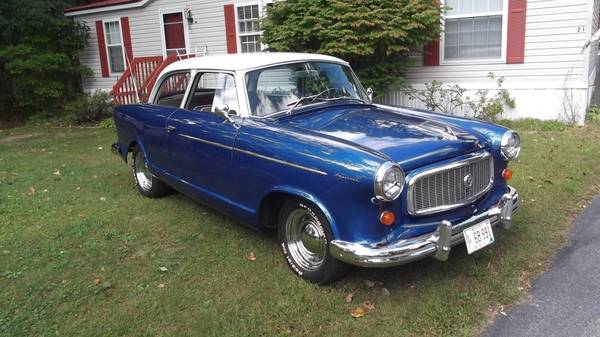
This is in Craigslist today:

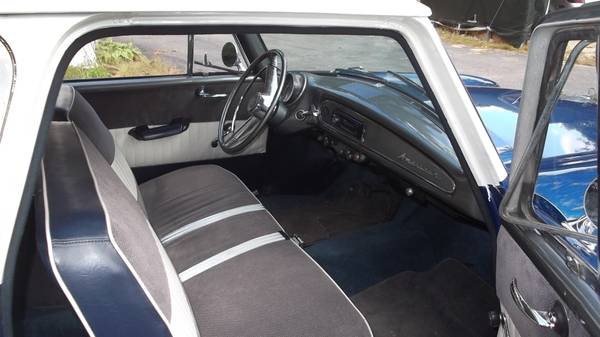
That’s a 1959 Rambler American. When I was little, my parents toted us around in a Rambler American station wagon, and I have a soft spot for it. I want that more than I want a tank.

There’s lots of reasons I want it. It’s only 5 grand. I don’t have five large, but it’s not IPO-type money or anything. The number hangs around in my mind in the future cardfile, not the hereafter microfiche.

I can fix that car. It doesn’t need fixing right now, but if the ballast resistor blows, I know where to look for it. You can sit right in the engine compartment and work on the engine. In the winter you can leave it running while you bang on it. That’s cozy.

It’s blissfully free of encumbering devices like seat belts. Fine with me I don’t want to linger. Most of all, I want it more than a tank because there’s more steel in a ’59 Rambler than in a tank, so it has higher scrap value in the long run.  

Samba de Uma Nota Só

My two sons, AKA Unorganized Hancock, are back with their version of One Note Samba.

One Note Samba is a part of a profoundly influential series of songs from the 1960s by Antonio Carlos Jobim. Bossa Nova doesn’t translate well into English, but it means new wave, more or less. It certainly was that. There have only been three BIG THINGS in music in my lifetime.

1.The Beatles making rock music important, then self-important, then self-absorbed, and then self-destructive, then atomized.
2. I remember the first time I heard Desmond Dekker very clearly. It was a revelation.
3. Bossa Nova.

As usual, the sixties get the credit for all three, but all of these things were born in 1950s culture. The fifties were supposed to be this sterile uptight time, but that’s a joke to anyone that can crack a book. If you know what a wandervogel was you know that being a hippie wasn’t anything new. Anyone that knows who Mies was knows that sixties modern was really twenties modern –the twenties being another maligned decade when everything happened while nothing was supposedly happening. No, it was the fifties that gave birth to those three things, and everyone just noticed in the sixties.

My children are homeschooled, but they receive very little musical instruction from me. For the little drummer, his lessons are an afterthought, the same as any extracurricular activity would be in a public school. If the public school had the slightest idea how to teach anyone anything, results like these would be possible with almost any kid who gave good effort. But more important than instruction is guidance, and with music, knowing what to avoid paying attention to is as important as any aspect of learning.

There isn’t a dime’s bit of difference between one rock group and another, more or less. Metallica sounds about like The Bay City Rollers if you look at it dispassionately. The format is banal, and easily understood. You have to be pretty sophisticated to play ol’ One Note, though, and know why it’s important.

[Update: Many thanks to Kathleen M. in Connecticut, whose constant support of my children’s efforts via our TipJar is remarkable]
[Further Up The Road Update: Many thanks to Sarah R. for her kind words and generous visit to the TipJar!]

The State Of The Art In 1959: The Ahmad Jamal Trio

Ahmad Jamal isn’t as famous as he might be. He’s not obscure, exactly; he’s just not universal. Maybe he made the mistake of being too accessible. You didn’t have to attend night school while smoking Gauloises and wearing a beret for a decade to listen to what he’s doing. It’s hardly unsophisticated, but it’s not as challenging to listen to as Village Voice writers might like. Many of his contemporaries decided that being deliberately too obtuse and atonal for the general public was the way to make their name in jazz. But honestly, you’re only displaying those Ornette Coleman lp’s from the seventies next to your mid-century modern hi-fi to impress people, aren’t you? There’s no way you’re listening to them.

He’s still young enough in the video to be considered a phenom. Twenty-nine. Started playing the piano when he was just three. It seems fairly common for minds like his to exhibit themselves early. He’s still working now, at age 83, and looks twenty years younger than he is. Clean living. The music business has flipped 180 degrees in his lifetime, and he led the charge a bit. It used to be that the bandstand was filled with disreputable drunks and drug addicts, womanizers, and plain bums, and the audience was filled with staid drones, dressed for Easter, who instructed their teenage daughters to stay away from musicians and marry a nice accountant, maybe. Nowadays it’s more likely for the audiences to be filled with disreputable cave people, higher than a kite and all dressed like a roadie for Metallica, while the stage is filled with the hardworking, sober people. And the only work for an accountant these days is counting a musician’s money. No one in the audience knows where their next meal is coming from.

Lots of cool cats in attendance in the video. Music used to be more intimate like that. The world would be a better place if you could get dressed up like you’re going to be buried, take the chariot down to a supper club, slide into the banquette, and listen to jazz made fresh daily over the sound of your glasses clinking. It sure beat today’s version of a concert: getting groped by amateur TSA diddlers, then standing three hundred yards from a stage, looking at the TFT side of ten thousand crummy phones pointed at the replacements for the bandmembers that died in bizarre gardening accidents.

Ahmad even smiles from time to time. I don’t think that’s even allowed anymore.

Tag: 1950s

Find Stuff:

Archives