The Alamo May Have No Basement, But You Can Stand Across The Alley And Listen To The Quebe Sisters

Across the alley from the Alamo
Lived a pinto pony and a Navajo
Who sang a sort of Indian Hi-de-ho
To the people passin’ by

The pinto spent his time a-swishin’ flies
And the Navajo watched the lazy skies
And very rarely did they ever rest their eyes
On the people passin’ by

One day, they went a walkin’ along the railroad track
They were swishin’ not a-lookin’ Toot! Toot!, they never came back

Oh, across the alley from the Alamo
When the summer sun decides to settle low
A fly sings an Indian Hi-de-ho
To the people passing by

Across the alley from the Alamo
Lived a pinto pony and a Navajo
Who used to bake frijoles in cornmeal dough
For the people passing by

They thought that they would make some easy bucks
By washin’ their frijoles in Duz and Lux,
A pair of very conscientious clucks
To the people passin’ by

Then they took this cheap vacation, their shoes were polished bright
No, they never heard the whistle, Toot! Toot! they’re clear out of sight

Oh, across the alley from the Alamo
When the starlight beams its tender glow
The beams go to sleep and then there ain’t no dough
For the people passin’ by

Lovely close-harmony singing to go along with the bluegrass fiddling around. That’s an old Bob Wills and his Texas Playboys number as I recall.

Written by Joe Greene from Spokane, according to Texas Monthly in 1984. Joe said he’d never been to the Alamo, and he wrote the song while he was asleep with a broken arm. I’ll have to try that method. Yields results. It reminds me of a story I heard about a woman with a wooden leg named Irene. I regret that I can’t remember what her other leg’s name was.

The Quebe sisters website. 

The Quebe Sisters on Amazon


It’s Disheartening To Consider We’ve Used Up These Proud Giants And Brought Them Near To Extinction

What? No, I’m not taking about the trees. There’s plenty of trees. I live in western Maine. A tree is a weed. I’m talking about the men. Those men you see working there in the video. They’ve been hunted nearly to extinction as far as I can tell. They were marvelous.

The forests shown in this film are filled with sequoia sempervirens again, planted by the same men we just watched cutting them down. There are currently around 900,000 acres of redwoods being “actively managed,” a modern euphemism for being logged and replanted. They do it more intelligently than they once did, I guess; but there’s currently plenty of forest on fire out west that was being “intelligently managed,” so that’s no guarantee that intelligence involves any wisdom.  It’s a dirty little secret that you can cut down the trees and use the wood for something useful for people every once in a while, or wait for nature to supply bugs and fires to get rid of them — but one way or the other, they don’t last forever.

They’re cutting second-growth trees in California now. 900,000 acres is 1.35 Rhode Islands, for those of you keeping score. Rhode Island isn’t that big, you might say, but I wouldn’t want to rake it. They leave a bunch of gigantic sequoias alone in National Parks now, so we can go look at them, which is as good a use for them as building another split-level ranch to get foreclosed on, I guess. I don’t know where you go to look at men like the men in the video now. They’re probably panhandling in San Francisco and drinking mouthwash.

I noticed some inconvenient inconvenient truth at around the six-minute mark. I’m sure they’ll airbrush that out of there next time.

Tango D’Amore

Sit and drink and sit and drink and sit.

If she doesn’t show up soon, I swear I’m going to wear this guy’s guts for suspenders. I’m going to take this place apart brick by brick. That’s not much of a boast. The bricks only have a passing relationship to each other anyway. The mortar looks like it was mixed from the stuff in funeral urns and mouthwash. The spiderwebs are structural, installed in the 17th century. The spiders have long since moved to a nicer place, like a sewer or the bottom of a shoe. Columbus’s dandruff is hanging in the stuff.

I grew up in the street and turned out as tough and smart as any hydrant, but around here I’m like a clockmaker. They come and go as they please, and setting a date or a time on something is like lighting candles in church. Might work; who knows? I like the churches here better, too. There’s guys on the walls eating people whole and stabbing them with pitchforks and cooking them in pots. I go in there when the monk’s off and sit among my own kind.

The waitress ain’t half bad –more like three-quarters — but all these dago women sure got some melons in their sacks. I swear they wear brassieres to hold them down, not up. They’d just as soon stab you as tell you to take out the garbage, but that’s half the fun in it, ain’t it? But sleeping with one eye on the door and one eye on the kitchen knives wears a man out after a while. I wish the Germans were still here so I could kill someone and not get yelled at.

Sounds Like Sexist Xenophobic Bullying To Me. Better Ban It

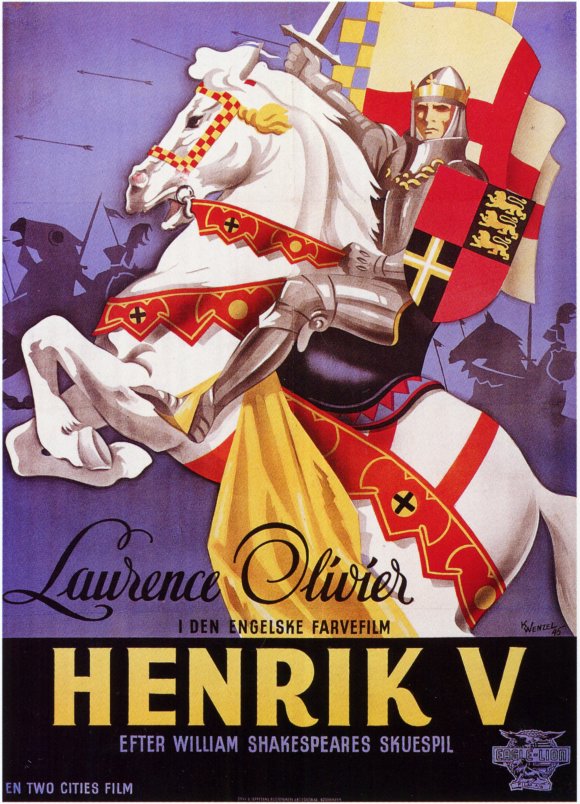
I recently saw (again) the 1944 version of The Chronicle History of King Henry the Fift with His Battell Fought at Agincourt in France.

It’s a charming piece of work. Laurence Olivier is famous enough, I guess, but not as notable for his real talent as he might be. Shakespeare drops like ripe apples from his mouth.

The movie makes a mockery of so many who have tried fantastical juxtapositions of real and cartoonish in movies since then. It’s filmed like watching a Bayeux Tapestry or a child’s storybook get up and dance around, and throws in a view from backstage, too, to show just how far down the rabbit hole they can take us.


It’s fun to imagine a British audience, worn out with years of blitzes and the terrors of telegrams, sitting rapt in the theater and seeing their island race triumph in a tight spot. There’s a great scene where Olivier is backstage, and looks a little round-shouldered and wan, and coughs a bit in an offhand way, and then strides out onto the stage in front of the Globe Theatre crowd, and is immediately transformed by the words and the moment into the majesty of Henry Vth. Olivier knew that the play’s the thing that makes a man great, not the other way around.

Old Bill knew how to put words in women’s mouths, too; another art long since lost to the playwright. Catherine is made more charming than any sovereign could hope to resist in the blink of a French eye in her garden. Do you need to know French to get it? I don’t think so. Flummoxing up “bilbo,” a flexible sword, for “elbow” is a nice touch. I can’t remember if it’s written into the text or a happy accident.


The women are feminine but decide all in their sphere and the men kill one another over insults and geopolitics alike, and your countrymen are your brothers that you’d defend to the death against all comers. In hours, roughly, how long until Shakespeare is banned in public school?

Chicks Dig Guys With Skills. You Know, Like Nunchuck Skills; Bowstaff Skills; Computer Hacking Skills; Pinstriping Skills…


They’re building Royal Enfield motorcycles:
 

That’s a very cool bike. The company was founded in England in the 1850s; they originally made sewing needles. Then came boneshakers, springs for seats for “safety bicycles,” and then bicycles themselves. Then rifle parts –that’s where the “Enfield” moniker came from, and their slogan for all their stuff: Made like a gun. Then came motorcycle precursors: tricycles and quadricycles with small engines. They tried making cars around the turn of the twentieth century. They looked like lightly armored personnel carriers and had eight-horsepower engines, not considered enough to mow your lawn while sitting down nowadays. They got over that urge and started making true motorcycles, and sold a bunch to the army for World War I. They had a neato one with a stretcher sidecar.

The company was a pioneer in using the saddle tank (a fuel tank that sits atop and straddles the frame) which you see the fellow in the video striping so ably. In the late forties, the company opened up a shop in Madras, India, to supply motorcycles to the Indian army.  At first they just assembled parts sent from England; they eventually made the whole thing themselves. They made one design, unchanged, for thirty straight years. England gave up manufacturing pretty much anything in the second half of the twentieth century, and started importing the bikes from India.

Hand skills like that fellow in the video displays are always show-stoppers in any manufactory.

Tag: 1940s

Find Stuff:

Archives