This Incredible Flip This Old House Hunters Wife Swap Fixers

You’ll have to put up with a fair amount of time warp-age here. You’re going to see pictures of this dining room renovation, and notice the kitchen isn’t fixed yet in one picture, and then in the next picture it’s immaculada. How did that get done? When? Why? I assure you that there’s a method to the madness, even though the madness is holding a gun to the method’s head at all times. You see, all these projects are related, and rely on parts of other projects to get finished, or even started. A rising tide lifts all boats, as they say. Perhaps more to the point, a sinking boat drags everyone down with it.

The sinking boat analogy is a common outcome in renovations where the renovators are living in the house while they’re banging on it. In a better world, a project like ours would have a budget, and a time frame, and plenty of subcontractors, and a place for us to live far away from it while the work was being performed. We’re pretty far removed from regular, sane construction like that, simply over the budget. Come to think of it, I’m not sure what a budget is. Some kind of canary, I think.

So you might remember that the former denizens of our house took out a wall between the kitchen and dining room. One that they shouldn’t have. This caused the floor upstairs to sag quite a bit. Before we fixed the dining room, the wall in the kitchen would have to be repaired. Like this:

Of course, you could think of it as before the kitchen could be fixed, the dining room wall needs to be constructed. That’s basically how it worked out. The refrigerator needs to be relocated to a niche formed on one side by the dining room wall, and it wasn’t there yet. This house is like a giant Mousetrap game. All the pieces have to be in place before you can use the apparatus to catch a mouse.

Hey, leave me out of this. And my name’s not Apparatus.

This interconnectivity is the reason why you see so many old houses for sale that are halfway destroyed inside and ten percent put back together (badly). The owners watched This Incredible Flip This Old House Hunters Wife Swap Fixers, figured how hard could it be, and found out exactly how hard it could be. The building materials stacked in the gutted kitchen convey with the house, usually. You have to have a certain amount of flexibility, married to stick-to-it-ive-ness, to prevail.

So we finished this wall and adjacent corner first. We added about two feet of wall to the existing, and framed an opening. I made the oak trim out of some 3/8″ thick oak boards I bought twenty years ago from a lumberyard that was going out of business. They didn’t know they were going out of business at the time, but who did in 2008? Lumberyards generally don’t stock 3/8″ thick wood of any species for a reason. It’s not much in demand. I bought a big pile of 3/8″ and 1/2″ lumber of all kinds for less than the cost of firewood, and figured I’d do something with it sometime. This is something, and sometime, I guess.

In regular carpentry, the door trim and baseboard would be 3/4″ thick. You’d rabbet out the center of the back of the lumber to keep if from curling, and to make it bridge the join between the wall and the door jamb. If you looked at the end of the boards, it would have an upside-down “U” profile, flat on the face, and hollowed out on the back.

Instead of doing that, I cut 1″- wide strips of the 3/8″ thick oak, and glued them to the left and right sides of the door frames blanks, and the top and bottom edges of the baseboard. Then I ran them through a jointer to get the edges nice and flat and smooth. It worked fine, and since we couldn’t afford to buy oak lumber, it made the project possible.

So this was a little milepost along the renovation way. We finished this nasty corner more or less completely, and made a half-decent spot for my wife to sit at and swear at her computer. It’s important to finish certain areas of ongoing renovations like this, little oases of calm in the maelstrom of demolitions, to keep from being presented as a cautionary tale on This Incredible Flip This Old House Hunters Wife Swap Fixers, followed up by a short stint on Divorce Court.

[To be continued]
The Dining Room Real Estate Fandango

Well, I’m tap dancing now. I’d like to show you some action shots of my homebrew insulation blaster, but I can’t get a quorum. It only takes two to do the insulation tango, but we need a band, too, or in this case, a third person to hold the camera. The spare heir is taking midterms and the heir is out doing adult-ish things and can’t come over. But you fine folks deserve some sort of renovation debacle to look at. I guess I’ll need a totally new project to get you scratching your collective heads and wondering why we bought this hovel in the first place. Lord knows I’ve worn a rut in mine scratching and wondering.

Speaking of ruts, how about the dining room? It’s a more recent vintage of renovation project. I think I still have a splinter and a bruise or two left over from it, so it’s got to be from this year, at least. We didn’t plan on doing much how-to pontificating about it on the intertunnel, so the pictures are a little spotty, but they’ll have to do.

Say, what did it look like when we moved in? Here you go:

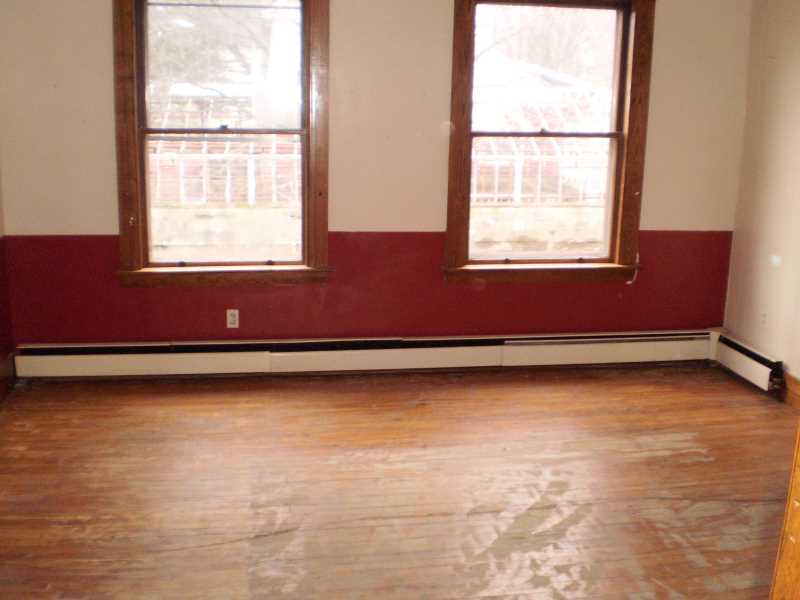
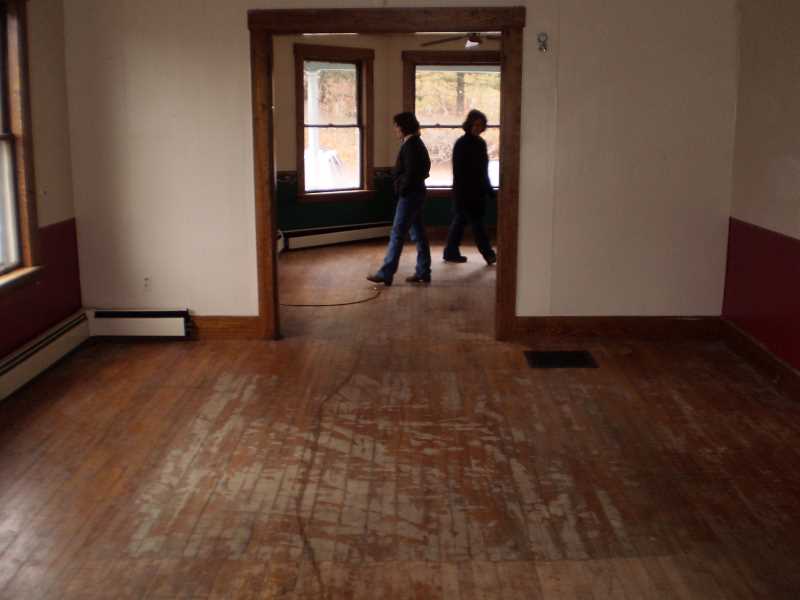
Whoa. We didn’t even own the place in this picture. My wife and the real estate agent are wandering aimlessly in the living room, while I take a picture of the dining room. This is the end stage of the real estate process where the agent is staying fourteen arms-length away from me at all times. She’d tried to perform her real estate fandango on us several times, waving her arms and extolling the virtues of licks of paint and ceiling fans, while intoning, sotto voce, that there was a polymath handyman interested in this house, too, just like the last house she showed us, and the house before that, so we’d better jump on it right away. I said, “Great, what’s his phone number, I’d like to hire him,” and that shut her piehole right quick. Her bandaged finger wobbled back to the real estate candle a few more times, but after a while she’d just let me look around in peace.

There’s lots to love in the last picture, besides my wife. Someone wanted something heavy and oily from the basement, and dragged it all the way through the house, leaving a minor trench in the birch strip flooring. I’m sure the apparatus was worth ten cents, and they wrecked 300,000 pennies-worth of flooring to get it, but then again, they got the thing out, whatever it was, and they’re not dumb enough to buy this place (again), so the gouge in the floor is filed under: Accounts Payable – Never.

Turn to the left and look through the milky sunshine at an abandoned greenhouse in the neighbor’s yard. It was a ruin left from a florist who had decamped long ago. The glass was mostly gone, and in the summer whatever plants that could take the temps around here had naturalized and blended in with the local stuff. Very picturesque.

That baseboard heater was also a ruin. Like all the other heating stuff in the house, it was left with water in it, which froze, and burst the pipes. It would all have to go.

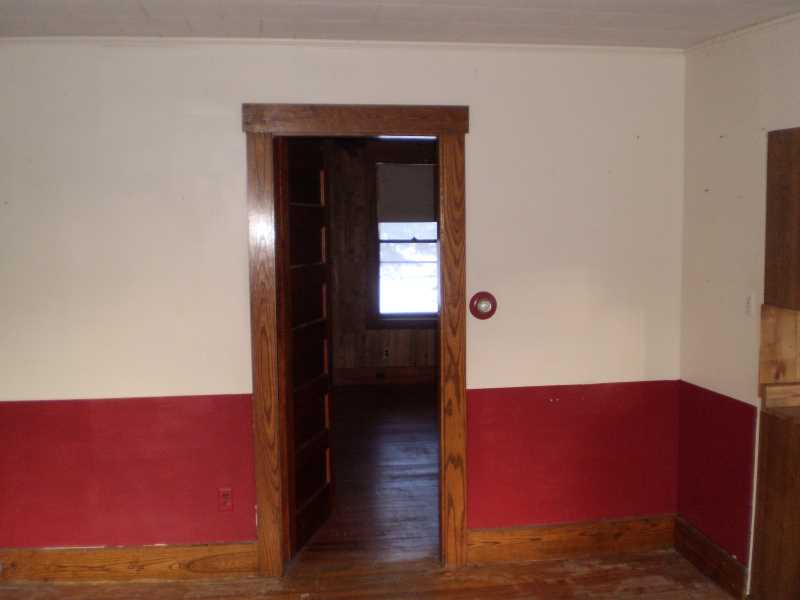
Turning to the right, you can see the entry to the master bedroom. If you have keen eyesight, you can spot shingles on the far wall in there. The two largest walls in there were shingled. I have some theories about what prompted the former denizens to do such things, and they involve Timothy Leary and Johnny Walker in equal measure.

Hey look, there’s a thermostat on the wall. You know what that means. Right! Absolutely nothing. We didn’t get a thermostat that does things when you operate it for another ten years. I left it there anyway, to mock my dreams of heat, and because it covered a hole, which is not nothing in my world.

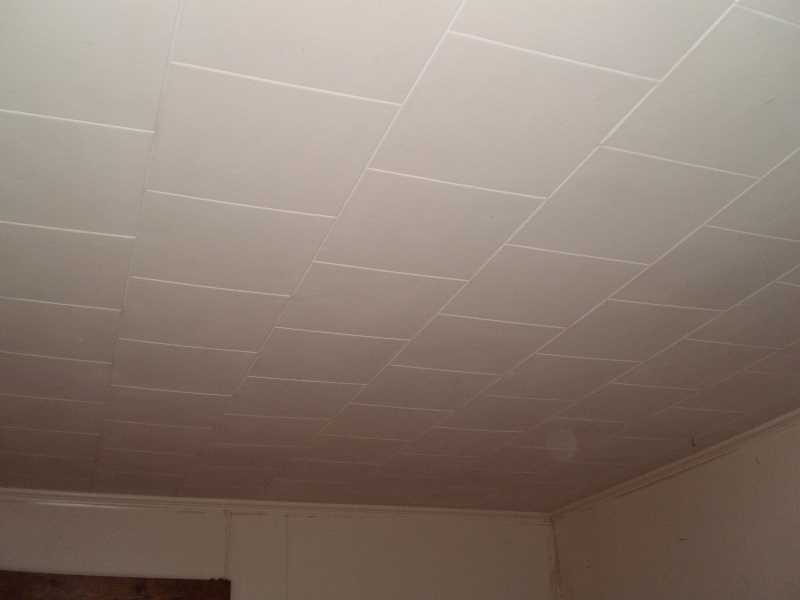
Here’s the ceiling. Those are cardboard tiles. I measured the distance from the floor to this ceiling, and then compared it to the living room ceiling, which was the original plaster. It was several inches lower, so I knew the ghosts of ceilings past was still living above it.

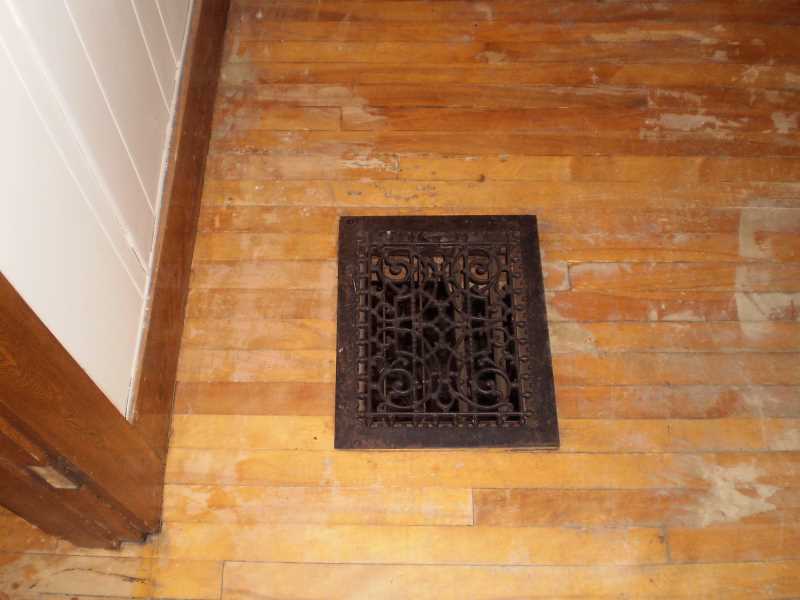
You might have noticed this in the floor earlier. It’s a very heavy cast iron grate. The old oil-fired boiler was located underneath this spot in the basement. Most people assume that grates like these are to let heated air pass upwards through a house. Most people are mistaken. It’s nearly impossible to get any substantial amount of heat to go through a vent like this. Heat rises, it’s true, but it’s like a heavy woman trying on jeans. It fights to continue its convection loops, and doesn’t like to be forced into small spaces. That’s why there’s a big fan on a furnace. To force the issue.

That’s a cold air return. If a furnace makes hot air, and pushes it around, it needs a way to gather the same amount of air back to heat it again. Otherwise, it’s like trying to blow up a balloon that won’t expand (your house). It draws air back to itself, reheats it, and sends it back in a continuous loop.

But this house had an oil boiler. That’s a closed system, and air is heated by passing over pipes and fins in the baseboard units. What’s the return air for, you might ask? Well, the boiler is (was, it was toast) burning a mixture of oil and ambient air, and then sending the smoky remains up the chimney. The air has to come from somewhere, and if you suck it all out of the basement, the only way for the basement to get more is to pull it in from outside, where it was currently just above zero when these pictures were taken, if I remember correctly. That’s because it wasn’t winter yet, when it really gets cold.

I’ll leave it to you whether it was smarter to pull heated air out of the dining room to burn in the boiler than getting it from the basement. I imagine that the previous owners didn’t think about it very much, and simply cut a huge hole in the floor because the boiler downstairs felt hot, and maybe the heat from it would go up through the grate, and ended up colder than before for their troubles. Me, I’ve got other plans for that baby.

[To be continued. To support Sippican Cottage, feel free to leave a comment, tell a friend about us, buy a book if you already haven’t, or hit the Donate button. And thanks!]

Great Moments in Maine Real Estate. Part 3

Well, it’s time for another installment in our ongoing series of Great Moments in Maine Real Estate. Buckle up, cowboys.

Of course it would be fair to observe that my own house would have made a great entry in the Great Houses series. For instance, here’s a bedroom at our place, just as we found it:

But honestly, just because one wall in your house would make a pretty fair Max Headroom backdrop, you really shouldn’t enter your pad into the sweepstakes, and I know it. There’s some tough competition out there in Maine.

By the way, doesn’t it bring a tear to your eye to remember Max Headroom? Well, back then, it seemed a minor scandal that Max was a real person being presented as a computer-generated bot to fool a gullible public. Things certainly have come full circle, ain’t they? Now all we need to find are singers who aren’t auto-tuned or lip synching to finish the transformation.

But I’m getting off the beaten path here, and in Maine, the path takes quite a beating as it is. So on to the real estate!

See, this is what happens when you fire your interior decorator before the job is complete. She would have made you paint the closet bifold doors and the window sash gray, too. Never interrupt a visionary when they’re really percolating.

Maine has bears, and likes bears, and this bears repeating, has bears.

Some folks are Stoics. It’s a popular ethos these days. I espy people reading dogeared copies of Epictetus in coffee shops, and wearing Marcus Aurelius slogans on their T shirts, although these folks generally look more like “Neiman Marcus Aurelius” than true believers to me. Devout Catholics are no longer thick on the ground, but you can usually find a quorum in church on Christmas and Easter. Maybe they know a little Tommy Aquinas by heart. Millions of people quote Nietzsche on the internet, and I’ll bet several of them actually understand some of it. You can examine your yins and yangs during your hot yoga class if you like, at least if you’re flexible enough to see your own yang without a mirror.

But let’s face it. Plato, Kant, Descartes, Mill, Foucault, Sartre — the whole lot of them, can’t compete with the concentrated firepower that Carly Simon brings to the dining room.

I’m trying to remember the name of the book. Something about the “madness of crowds.” It was a dusty old tome, written by some cranky periwigged guy I’m sure, trying to explain why everybody seems to do the same crazy things all at the same time. This kind of behavior usually burns itself out after a short, frenzied period, usually until the public is whipped into a frenzy about the next big dumb thing. So we won’t dwell on this overlong here.

But I have to ask one question. Why, all of a sudden, does every shelter show, home center, and plumbing supply manufacturer want every homeowner in America to come downstairs in the morning and be greeted by a sink that’s giving them the finger?

Ah, this is one of my favorites. This is a “bonus room.” It’s the payoff for building a snouthouse. If you’re not familiar with the term “snouthouse” it refers to the architectural practice of stapling your actual house on to the ass end of your garage, instead of the other way around. This room is generally unfinished space over the garage, but these fine folks have certainly finished this one off, haven’t they? Cheery, ain’t it? The layout, the hominess, the color scheme, and the finishes seem familiar, but I can’t quite place them. Something is missing.

I know:

Open the garage bay doors, HAL.

Misinformation Followed Us Like a Plague

Well, I can see from the comments that my loopy descriptions of my home-brew insulation contraption have some people confused. I love confusing people. I’m on the internet. Confusion is about the only product on the web worth mentioning, coming in a close second to straight-up lies. I stick to confusion because I’m a terrible liar. Why I remember back when they tried to give me a Nobel Prize for Literature. I told them, I can’t lie, I have to turn it down because the medal will just clank against that Legion of Honour doodad the French gave me for a little dustup I got them out of in North Africa. True story.

Anyway, someone already hired someone else to bore holes in the outside of my house and blast loose insulation into the exterior wall cavities. I’m not doing any of that. That’s accomplished with a very big blower, which I don’t have or want. You have to bore a hole at both the top and bottom of each stud bay to get a good result, too. My house has enough holes in it without making more, thank you.

My apparatus is handier to make my way around my house on the interior and get everything they missed, which was a lot. There was no insulation in the carhole walls and ceiling, or the basement ceiling (the floor of the first floor of our house). There are dozens of opportunities to add insulation in my old barn. They’re all over the place, which is kind of the problem here.

You see, everyone involved treats everything as one big job. If you buy X-number of bales of insulation, the Orange Place will give you a free one-day rental of a blower. It won’t be there when you show up, and if it is, it will be broken, and if it’s not, it won’t work very well anyway, and it will due back one hour after you get it running, and you live an hour-and-a-half away, and the place closed 15 minutes ago.

Look at my ghetto rig again:

It’s just a box and a barrel and a hose. I can bring it anywhere in the house and use it. If you set it up anywhere near where the work is, the fifty foot hose reaches everything. When I’m not using it, I coil the hose inside the barrel and slip the plastic wands and the mixer into the center of the coil and it sleeps contentedly in the basement until I find a few spare minutes and a few errant shekels to insulate something.

So, how does it work, you’re asking? It’s simple, I’m telling you. You just need these two things to get going:

The insulation fabric is interesting. You can sorta see through it, but it’s pretty tough stuff. It doesn’t tear easily, so the staples hold it in place firmly. It’s not a vapor barrier, which is good. Insulation advice gets really weird on the topic of vapor barriers, In general, no permutation of them works very well, and if it does, it causes moisture problems somewhere you didn’t expect.

You’re not going to come out of this insulation battle alive without some help on the staple front. A regular hammer tacker would wear you out in no time, and using a lever operated staple gun would probably kill you. Well, the blisters on your hand would drive you to take your own life after an hour or so, which is much the same thing.

It’s hard to find anything online that shows the way the fabric gets installed. Anything that’s to the point, I mean. These fellows give it a go. We’ll start at the 5:49 mark, to skip the opening ceremonies:


He’s using a pneumatic stapler. He apparently owns stock in a big staple conglomerate, and it trying to pump up the stock price, I assume. I’ve found that you don’t really need that many fasteners to get a good seal going. And I’m not interested in dragging another hose around.

It’s even harder to find video of someone blowing in cellulose like I’m doing. Here’s the venerable Bob Vila presiding over a fiberglass version of the same sort of process I’m using for cellulose. Once again, I skipped the almost four minutes of opening folderol to get to the process itself:


Note that you cut X-shaped openings in the fabric, slightly larger than the hose. You’d think muscling the hose, and in our case, a hard plastic wand, through the hole in the fabric would tear it, but it doesn’t. We filled all the wall cavities in our carhole basement just like this fellow was doing. First, you push it down into the bottom of the bay, fill it up, and then reverse the direction of the wand and fill up the top half. We have to go slower than the last video shows because the leaf blower is powerful, but nowhere near what their pro blower puts out.

Here’s our carhole ceiling, with the insulation blown in. There are no holes visible, because I staple strips of leftover fabric over the holes to keep them from raining a little cellulose down if someone decides to rumba on the floor upstairs.

We did an experiment to see if this stuff was really dense-packed. We peeled back a section of wall, and pulled out some of the lower part, and the insulation above didn’t budge. We tried it again in a ceiling. If you remove the fabric, the insulation stays put. If you run your hand over the surface while you’re filling up the bays, you can feel it when it’s full. It feels like a very firm mattress if you do it right. The blower makes a different sound when it’s full, too. You learn pretty quick when to back off a little and fill somewhere else.

You have to box out around various obstacles, like this DWV cleanout, but it’s not hard. That pipe in the next picture is tied into our former Geyser of Excrement, by the way, and serves the kitchen and a bathroom upstairs.

As you can observe, we nailed strapping onto the joists and then drywalled the ceiling after it’s insulated. The walls get covered with OSB. The place is starting to look borderline orderly. You have to work around stuff in a basement, though, and the spiders are really angry about the whole affair.

These insulated pipes carry refrigerant to and fro to the heat pump. We removed the hangers gingerly, slipped the fabric behind them, and then put the hangers back up. That section of the ceiling isn’t filled with insulation yet. I’ll try to enlist some help and grab some video of us filling the joist bays when we do it.

[Thanks for reading and commenting at Sippican Cottage]

A Blunderbuss, Not a Rifle

Alright. Let’s get down to it. I freely admit I lied yesterday when I said I was going to use a leaf blower to insulate my house.

I do own an electric leaf blower. It was “free” when I bought two very expensive lithium-ion batteries to resurrect my old cordless ni-cad tools. I use it to clean the workshop. You just blast all the dust off of everything, and then run out of the room before you’re asphyxiated. The sawdust eventually ends up on the floor and you sweep it up. That’s thing’s a toy. For homebrew insulation tasks, you don’t exactly want a leaf blower. You want a blower/vacuum/mulcher. It’s not precisely the same thing. I got this thing:

I can’t remember if I cared that it made a 260 MPH breeze or huffed 340 cubic feet per minute of blower bad breath. One of those statistics, or both, gave me the idea that it was big enough to achieve the coveted 3.5 pounds per square foot dense-pack. This model had a metal impeller that you can see in the +6 image on the left. That baby’s gonna get a workout, so you don’t want a plastic one.

First, you remove the screen cover that protects you from sticking your finger or something worse into the impeller while you’re doing lawn cleanup. Then you replace it with that trumpet shaped tube. That’s the attachment for the vacuum/mulcher operation this thing excels at. We’re going to feed cellulose into that tube, and blow it out the black snout. With mucho modifications, of course.

First you get a big, heavy duty cardboard box. Like this:

It has to be heavy duty, because it’s going to get battered. We screwed the box to a scrap of OSB plywood. We cut a hole in the box the size of the plastic mulching tube, and pushed it through to click into the blower. Then we zip tied the handle of the blower to a 2×4 block which is screwed to the OSB as well. Pretty solid like that. The inside of the box looks like this:

We fill this box right up to the top when we’re really going. One person turns the blower on and off, and also pushes their arm through the insulation in the box to keep it feeding into the pipe. The blower is strong enough to suck in the insulation without any help, but it clears a hole around the pipe and then starves for material. You have to feed it, because it goes fast.

Here’s everything put together. We used three plastic wand extension attachments from shop vacs, one duct taped to the short nozzle on the snout of the leaf blower, and two on the business end of the long, reinforced hose. I’m not proud of the duct tape, but it’s an oval snout with a circular tube rammed over it. The duct tape made for instant air sealing. We used hose clamps to seal the hose to the plastic wands. You can buy hose like this online in lots of places.

The hose doesn’t work well when it’s all twisted up like it is in the picture. You have to stretch it out and make sure you only have gentle curves in it. And here’s where you can come a cropper if you’re not careful: Everyone in the videos I showed you yesterday wants to increase the pressure in the hose, and accomplishes this by stepping down each length of the apparatus until it gets to a very small whip hose at the end. That’s a recipe for constant clogs. It’s smarter to have the same diameter hose the whole way. At the end of the line, we put the last two plastic wands on backwards, so that the end flares out, like a trumpet. It’s a blunderbuss, not a rifle. We hardly ever get clogs that way, and never at the end.

The insulation comes in heavily compressed bales, so you can’t use it right out of the package.

We take the big barrel, and put about a third of a bale in it. Then we chuck a big mixing attachment into a big drill, and plunge it into the barrel.

We bought that one because we have a big drill with a chick big enough to handle it (oops, I meant chuck. My wife’s kinda petite), and it’s long enough to reach into the bottom of the barrel. If you were smarter than me, you could get a less hefty one and keep the carps out of your tunnels.

The paddle  loosens the packed insulation very effectively and quickly. It fluffs up nicely, making a full barrel out of the less than half a barrel you start out with. Then you dump it in the box. We have two big barrels standing by, and the box full, before we begin, because the work goes fast, and it’s tedious to stop and mix up a batch every few minutes. As you can infer from the duct tape on the side of the barrel, that mixing paddle beats the living bejeezus out of the barrel when it really gets going, and it will break your wrist if you’re not careful. But it gets stuff done.

[Tomorrow, we get stuff done]

Month: October 2023

Find Stuff:

Archives