Still Dead Not Fat Elvis
You see them at every Tennessee Titans game. Every Vegas shindig. Every Halloween and costume Karaoke. Fat Elvis.

He’s iconic in that iteration. You could draw it from memory unless you’ve been under a rock for thirty years — the white spangled jumpsuit, the prop guitar, the greasy piled-up pompadour and the sideburns. Glasses that could stop gamma rays with frames that could stop a sequin bullet–and have. It’s been odd to see that version of Elvis become the default, because I was alive back then, a little kid watching him on TV in the late sixties and early seventies, sweating gravy and mumbling a handful of lounge numbers while doughy matrons with bad teeth and beehive hairdos in some Vegas audience threw their granny panties at him. He was a joke. A bad joke. And when he finally died, his heart hopping out of his chest after only forty-two years, bloated and drugged in his bathroom, I figured he’d go away and stay there. Wrong.

The Fat Elvis costume has become as recognizable as Santa Claus or the Easter Bunny. Hell, Uncle Sam. It screams: AMERICA. And not fussy America, or political America, or The New York Times Book Review America, either. He’s strip mall/chrome fin/corn dog/hayseed/ghetto blaster/swimming hole/fried chicken/AM radio/concrete block church/Vegas whore America. He’s the whole ball of earwax in Jesusland.

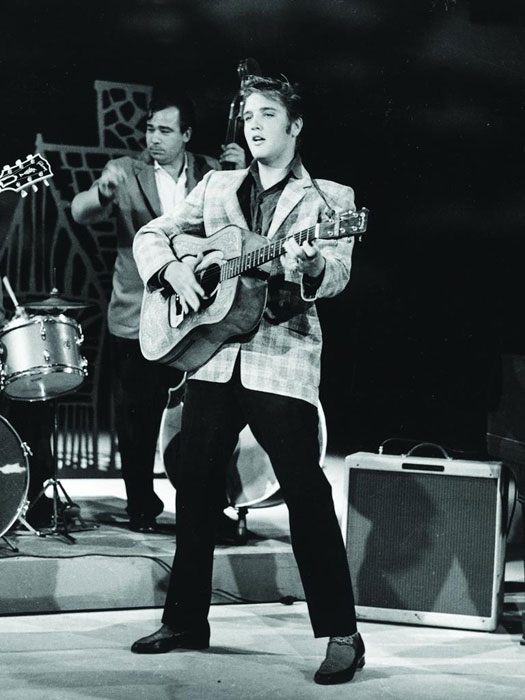
But I knew Elvis because I knew rockabilly. Elvis Presley arguably invented it; at the very least he personified it before he went Hollywood. He was the sun around which Sun records revolved in the fifties. Long before Elvis become the guy that showed up in adjustable waistbands and spangles, and was Elvis, he was great. Not just great. Important.

I knew those records, right from That’s All Right. Scotty Moore’s clean and nimble guitar, Bill Black’s percussive upright bass — it was the most maddening and infectious beat I ever heard. Real rockabilly beats send everyone to the dance floor, where they look at each other and wonder what the hell happens now. Country bumpkins knew because it was cooked up in the hidden still of their culture. Elvis was great, and a good singer, and an important synthesizer of a new style. But he was much more than that, long before he became a caricature of himself. He didn’t start out a caricature, but a comic book super hero, simultaneously absurd and wonderful. He was vital then.

I got Image/SOFA Entertainment’s 3 DVD set of Elvis’ appearances on the Ed Sullivan Show, and it’s wonderful. I began watching it thinking it would be a kind of dumb fun — the best kind– but I realized I was watching something else too; something that I never would have seen because I wasn’t alive yet. I saw America’s, and the world’s odometer turn over.

The DVDs are the whole shows. Three of them, from late 1956 into 1957. It’s fascinating stuff, even the dreck, because it’s the context. It’s the whole America-centered world as it sat– confident, salubrious, muscular, on the go, the engine of the world with the Marshall Plan and Soviet containment carried lightly on its back. At first Ed Sullivan assembles it willy-nilly and points a camera at it. Then Ed rolls an Elvis grenade into the middle of it.

There’s a long succession of artists and performers you can point to that encapsulate the zeitgeist of their times. Their replacements show up long before they’re ready to leave the spotlight, generally, and they hang around long after they’re hip. They become… well, Fat Elvis. I remember disinctly watching the Beatles on Ed Sullivan when I was a child, and I imagine Elvis knew that he was good for broads and booze and pills and Vegas shows and B movies until the day he died, but he wasn’t the lead dog anymore. He knew it because he had done it to others himself.

You watch the luminous black and white TV dubs of the shows, and you’re struck by the encyclopedic nature of the proffered fare. Ed is a newspaperman still, jarring in itself — TV is second fiddle! — and like some bizarre librarian in the school of uncool. He’s the Noah of TV, rounding up a couple of everything, and floating it on the public.

It’s all there, all the things that faced Elvis like a wall to get over: vaudeville acts; European music hall ginks; Broadway singers and ballet dancers; dogs and ponies, lounge singers and clowns; eccentric actors; semi-exotic performers from anyplace that didn’t have the big red boot on their face. If it wasn’t hackneyed enough, there was half a dozen assorted acts straight from the circus, and the circus is entertainment straight from the middle ages.

The artist of the age that superseded the middle ages carved his David, to tell the Doges the world belonged to man. In 1956, our own hillbilly David climbed down off the pedestal and sent his ration of squares to oblivion. You’ve heard so much about Elvis and the frenzy he engendered, but when you see him there, in front of a phalanx of Jordanaires in checked coats, Elvis seems like everything and nothing. You can’t tell if he’s so self assured he’s bulletproof, or so self-conscious he can’t get through the song without laughing at himself. He tosses that impossible shock of a shock of hair, the girls scream, and he laughs — at himself, at them, at the whole damn thing — but he’s as serious as a heart attack about the thing too. He seems to be all glass, like a windowpane, but he’s a deep pool somehow, instead. You don’t know why he’s all that. You wonder if he does.

I pictured the Conn and Mack tap-dancing duo watching Elvis from the wings for a while, and then going out in the alley to find a pay phone and see if their brother-in-law still had a job opening or two at his dry cleaning store.

Get Elvis – The Ed Sullivan Shows, and watch empires crumble into the sea when Elvis twitches.
Want Socialized Medicine? Great. I’d Be Dead

I am exaggerating a little. It’s very unlikely I would have died. Bankruptcy and permanent physical incapacitation to some degree was much more likely. And all over thirteen dollars.

You see, we do not yet have real socialized medicine. I live in Massachusetts, and am being fined and hounded by the government because I cannot afford paying for all my medical care in advance, plus a huge cushion, which is what non-catastrophic insurance really entails; but I am still allowed to purchase medical care from whoever will sell it to me. It’s unlikely that would be the case if it was socialized. Sooner or later, it’s always rationing and a diminution of rights and choice to the point of denial of care on a capricious basis. More or less, with all the meddling in the medical market already, we’re halfway there.

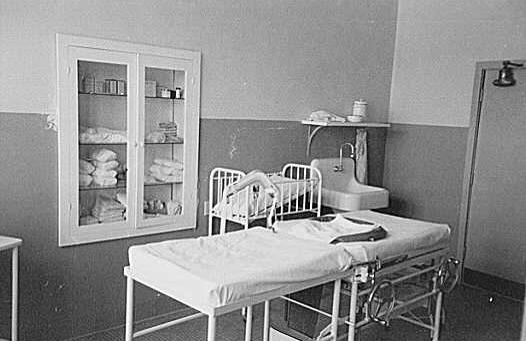
I have Lyme disease. It’s no big deal, really. That is, if you treat it in a timely manner. The effects of it can be very severe and last you your whole life long, if it goes untreated for any length of time. What length of time constitutes “any length of time,” you ask? Don’t ask that question at Tobey Hospital in Wareham, Mass. You’ll suffer until they’re good and ready to treat you. They’ll insult your intelligence in the interim, repeatedly. And then repeatedly after you find someone elsewhere — someone competent– to help you.

I went to the emergency room. I know that people treat the emergency room like their own private nursemaid now, but that’s not me. I had a very high fever, intermittently, for over a month, and when it returned again I knew that I was very sick, and if I didn’t act immediately, I was in a lot of trouble.

I do not have x-ray vision and a crystal ball. I did not go to the hospital and tell them I had Lyme disease. I looked up all the symptoms I had, and what they might mean, so I could speak with some sort of intelligence about my situation. They were not interested.

The doctor was interested in all sorts of diseases I manifestly did not have. He told me, at 6:00 pm, that he was going to give me a broad spectrum antibiotic in any case, and so I put up with an enormous amount of discomfort and wasteful foolishness because I knew that no matter what version of a bug borne illness I had, the treatment for it all was the same. Immediate treatment with an inexpensive antibiotic.

Six hours later, he wouldn’t give it to me. He never did give me any believable reason why he would not. I had an infected bite on my ankle, and he was testing me for Lyme, along with all sorts of other tick borne illnesses. Ipso facto he suspects it. But those tests take a lot of time. He told me to visit an outpatient facility the next day. I assumed he meant that was where I would be given the medicine and could get ongoing outpatient care. I had a very high fever and was exhausted. I surrendered.

I went to where he sent me. Two doctors there said that if the doctor that sent me would not give me any treatment, they would certainly not. One doctor lied right to my face and said antibiotic treatment for Lyme disease without a positive test is always withheld.

If there should be suspicion of disease, then a course of Doxycycline should be immediately given for ten days without waiting serology tests which only yield positive results after an interval of one to two months.

Another doctor from Tobey hospital called me the next day and refused to give me the prescription, and also lied or was incorrect, what difference does it make, and said treatment for suspicion of Lyme disease always waited for the test to come back. Then she wanted to schedule me for a CAT scan of all things. She couldn’t tell me for what reason that was necessary.

I called around to anyone I could think to help me. Our neighbor is related to the local Department of Health official, who informed us that over 2500 people in our area were suffering from Lyme disease right now. There are only 4500 people in the town I live in. 2500 people in Southcoast Massachusetts is a lot. The hospital must know this, or be incompetent.

I called everyone that was necessary to conclude my affairs in business, declare bankruptcy, and sell my house and move away, with a phone propped on my pillow. I had to be prepared for it all. I have never been as sick as I was that week. I could no longer stand unaided; could not read properly; my hands shook too much to even hunt and peck type; and I had a roaring sound in my ears. I had only aspirin and water to treat it. The fevers were titanic.

And then a kind man, a real doctor, gave me the only advice that was any good from anyone. He told me I must find a doctor that knew me somehow, anyone, my wife’s gynecologist, my son’s pediatrician, anybody that would be inclined to listen to me and have pity on me.

My father’s doctor. I take my father to a doctor every three months. He called me back at 8 pm that very night from his home, and agreed to see me first thing next day. It was 2 hours in the car, and my wife had to walk me into the building on her arm. The doctor said:

Do not trouble yourself over those other doctors. It can only make you upset, and serves no purpose. I do not know why they would not do for you such a simple thing. I will give you this right now.

I took the first pill, trembling and sweating in the lobby of the Walgreens, the pharmacist wondering silently why that beautiful woman was holding the hand of that wretched looking wraith of a man.

Four hours later the fever was gone for good. I went back to work, feeble and enervated, but no longer sick, the next week. The prescription cost $13.

The hospital called the following week. You have Lyme disease. You really need a prescription for Doxycycline. Terrible things could happen to you if you don’t get it. Do you still want your CAT scan?

Save the CAT scan for the people who need it, doctor. Examine the heads of people who want to lose their autonomy, their freedom, maybe their very skins, because they are willing to turn over our lives to arbitrary and foolish people and institutions to avoid a lousy ten dollar co-pay.

How much is a thirteen dollar prescription worth, if it’s free but you can’t have it?

No NIMBYS Need Apply


This is Commercial Street in Provincetown in 1940. Way before my time, but I recognize the gist of it. Plenty of Cape Cod looked this way when I started visiting it. None of it does now, as far as I know. Plenty of it is still pretty sweet, however.

Even in 1940, Provincetown was known as a haven for artists. Head down to the sand that Commercial Street fronts, and here’s what you’d see, instead of those off-duty or retired fisherman on a bench watching the bus to the beach and a few cars driving by:

At this point, you’re no longer looking at a few like-minded iconoclasts living out away from everybody because they like the light and the solitude. The artists have made an industry of it already, almost seventy years ago.

The Portuguese fishermen were already yielding their primacy to the big steel boats that would scour the oceans. The town was going from a place where anyone interested enough to go all the way out onto that spit of sand– next stop the Azores– was welcomed by the locals as a familiar, to a place where the unusual was the ordinary, and the old locals faded away with their industries. The tourists have never abandoned it.

Cape Cod, and Provincetown, are very much Not In My Back Yard Places now. It’s hard to do much of anything building-wise. There is no more reactionary person than a wild-eyed progressive who has beaten the forces of the last reactionary, it appears.

I like Provincetown now. But I liked it before, too, as it is pictured in 1940. It is useful for some to remember, while you are hamstringing everything, that if you were around before, the thing you are trying to preserve would never have been allowed to come into existence in the first place.

There is no amber for any of us to hide in. We must swim in the ocean of seconds and minutes, and hope the change passes over our gills of tradition lightly enough that we don’t choke on it. Good luck.

Is There Hay In Your Bed Today?

What did you do yesterday?

Me, I was exhausted. I’m a little enervated by an illness, still. I attended a wedding fete on Saturday, drank icewater for the toast, mostly sat around while everybody else carried on, and my wife still had to carry me home on my shield. I didn’t hold out a lot of hope for Sunday.

It was my niece’s sixteenth birthday. My little brother has big children now. We were invited. I figured I could find a chair there as well as here, and there’s a chair in the car, of course, so I gave it a go. We had a fine time, with interesting and sociable people, and we did the usual thing with the scorched meat on the grill. But there was more.

My brother and his wife like odd plants. A lot of them. Their yard is a mess; the best kind. It’s a riot of disparate plantings, almost in the British style, but not quite, with fantastic blooms and wandering butterflies everywhere. There were garden snakes to delight the tots, and finches to trill to the ladies, and hummingbirds and hawks to make the sky a scene worthy of the attention the whole time. I am not allowed in the sun, so I sat in the shade of the porch and its wisteria vine gone wild, and the bees bumbled around me and the little birds cut the corner and tickled my ear on their way to their nests and the feeders. It was lovely.

Then a fork appeared in the road. The fork is worthy of your attention. The virtual world diverged from the actual one. Tell me which one you’d like to inhabit:

My older son would not come out of the basement. Concrete floor, clutter, dust, an old TV set, and the Guitar Hero video game. All the participants were five years older than him, and wouldn’t give him much of a turn at it. Like many a hangdog younger person, the less they let him participate, the more immovable he became. We had to force him to come up out of there to eat, even.

Our little one, just four, got cabin fever. He adores video games too, and amazed me by performing on the Dance Dance Fever mat they had, and winning the high score over the sixteen year old competition. I had no idea he even knew what it was. But he doesn’t have the stubborn attention span to waste the day in there. He ran down the driveway. Let’s go! Come on!

My brother lives out in the landscape. The roads to his house are sylvan, canopied entirely by massive oaks and ashes and lined with the stone walls, left over from when stubborn yankee farmers still tried to subsistence farm during the three or four months a year when the weather wasn’t all-get-out around here. The houses are few and far between. The road is so little traveled that we felt safe walking right down the pavement, as there are no sidewalks, and no need for them. Poison Ivy and Fisher Cats are all you have to look out for.

My brother said he would accompany my wife and I and the tot. A pleasant stroll.

The eleven year old refused to come out of that dreadful dungeon. We left him. How did it turn out?

1. As far as I know, he never got a turn.

2. We walked down the street a little, and there was an elegant barn up a driveway, and my brother said: Let’s visit Dave and Penny. They’re nice, and interesting. Yes, they were, and are. So we:

  • Marveled at their garden, filled with brown eyed susans and rhodies and tall phlox and… oh my god every damn thing that was pleasant to look at.
  • Sat by their hidden koi pond and watched the bullfrogs watch us chat about nothing and everything, as long as it was pleasant.
  • Went in that barn, to marvel at its elegant and simple construction
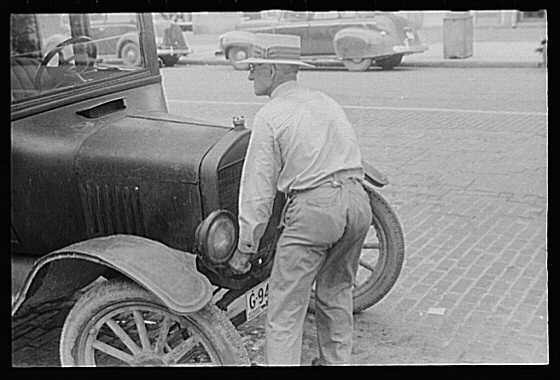
  • Sat in a 1914 Ford Model T touring car until a toot on the Harpo Marx horn terrified the little guy into fleeing amusingly back to the garden again.
  • Laughed when he went right back in because that car was like a magnet and he was a pinball
  • Marveled that there was another half assembled Model T in the other dim corner of the barn.
  • Stood there agog when our host says: How about a ride?
  • Drove around for a half an hour down one green allee after another, my little son under my arm in the tufted leather back seat of that car; a car just seven years short of one hundred years old, with no roof but the trees and no care in the world. It was like robbing a museum.
  • Then we fed the chickens, and they gave us a dozen eggs from them
  • Then my brave little boy held his little hands cupped and trembling and full of little pellets, and giggled uncontrollably as their two llamas ate it with their crazy lips. Yes, that’s not a misprint. Llamas.
  • I made the beasts nervous somehow, as I looked them straight in the eye, perhaps, but the one with the sweet face walked up to my wife and kissed her. My wife has a sweet face too, so I understand the urge.
  • Then the little guy fed the fish in the little pond.
  • Dave showed me every little thing on that car and how it worked, and we talked about the thing and what it represents, which is very profound if you know the item. That was the first thing in the world that the people who made it could afford to buy and enjoy. I had ridden in the birth of the middle class.

Our little boy fell asleep in the car on the way home, and we carried him to his little bower of Spongebob pillows and Pooh bears. When he woke up this morning, we found hay in his bed.

So I ask you. Is there any hay in your bed today? Find a way to get some there. It’s right down the end of the driveway, if you’ll just go.

Old People Talk About Traffic

I’m not going to talk about traffic.

Old people talk about traffic. They continue on about illusory short-cuts to avoid it after. They tell you exactly how much they paid for gasoline, and where that rate is available if you will only burn a gallon and a half of gasoline to go get it. They finish off, generally, by explaining why a meal they got at a restaurant like the Olive Garden was a profoundly enjoyable experience, which is the one thing I’m most likely to think it is not. It’s Sunday, so I’m going to pray: Please God, I beseech thee. Please strike me dead before I talk like that.

I swim upstream, mostly, in affairs of the home and business. Foolish people think I’m profoundly square. If I had skinny little glasses, a few tattoos, refused to marry my wife but had two children and stayed together anyway, watched whatever was on television, read whatever was on the NYT bestseller fiction list, and combed my hair forward, they’d probably say I was not square. Everybody I saw yesterday was all more or less acting and looking the same way. The alternative is now the norm, and part of that whole alternative thing is to stubbornly imagine you’re way different. Just like everybody else.

It’s interesting to participate in mundane things for other people because they are unusual affairs for me. I don’t find them boring. Yesterday was like that.

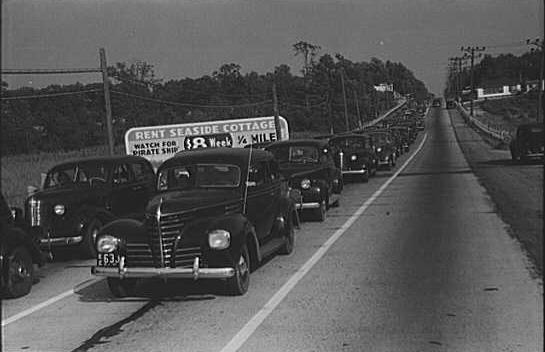
Everybody wanted to get over the bridges to Cape Cod at the same moment yesterday. (Oh Dear Savior, I’m begging you now, please, no talk about traffic) But everyone has been trying to get over those bridges at the same time for as long as I can remember. When I was a child forty years ago, we would sit immobile for hours, in that very spot I was in yesterday, while cars routinely overheated and prolonged the agony almost exponentially. And no one had air-conditioning in their house yet, never mind their car.

Unlike most people, I do not live in the closest suburb to whatever job I can cadge, and then bomb down to the shore on Saturday morning to get to my second house or rental from Memorial Day to Labor Day. I live here all the time, and I almost never go anywhere. But I had to go to Cape Cod during the witching hours, and sit and steam along with everybody else. I found it interesting, because I realized there was no way I could do this much and still want to do it much. Your fun is too tiring and boring for me, all you non-squares.

There was no point in trying to avoid it. I was only trying to get to a place about 10 miles from where I was, as the crow flies. Then I was going 10 miles further, to another pleasant appointment. It took three hours and fifteen minutes to accomplish this.

I’m glad you all are able to enjoy the fruits of your labors, the company of like-minded persons, the ease of vacation, the comfort of your conveyances, which decidedly no longer overheat, even if a few drivers do. I’m glad you all like what you like, and it brings you joy, or at least a sense of belonging.

I just thought I’d mention that if I had to do it two weeks in a row, I’d make a disgruntled postal worker look like Mahatma Ghandi.

Month: August 2007

Find Stuff:

Archives