
The Friday Slog
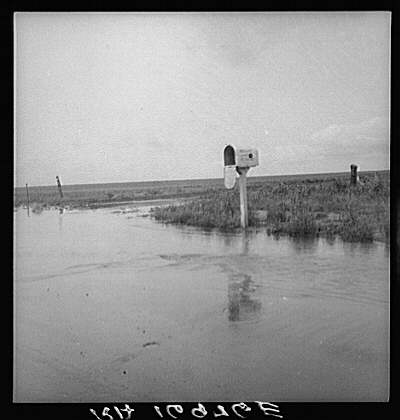
Endless dreary rain.
It was more interesting when it was raging down like a monsoon. Now it’s just limitless, piddling, annoying dismal dripping.
The sky is dishwater, the ground coffee grounds under the sink. The sodden leaves weigh down the branches, and the trees slump like mourners. The birds sleep in.
The ground is sated, and more. Every little seam and pinhole in the basement weeps the water flung on the ground outside a week ago. It’s an assault, but the worst kind; a siege, slowly but inexorably finding the weakness in your subterranean parapets. The sump pump has become the central theme in my life.
There’s often a marvelous moment, late at night, when it first starts to rain. You’re warm and comfortable, it’s late or early, and the rain, gone for too long, reappears with a little sizzle on the windowsill, and then the steady drops drum on the roof, and you drowse and dream of creek, the river, the ocean.
That’s ten days ago. Now the sound of the rain is like the tramp of an occupying force, implacable, smothering, brutal and cold.
The windowboxes are aquariums. The toads drown in the window wells. the mosquitos hatch, and hatch their plots for the summer, when they will remind us of the awful rain long after it’s gone and we miss it.
The grass is as green as Cambodia. Water glints through the underbrush, reflecting the dull sky from the most unlikely places. It seems like it will never end.
And sure as age, and death, and taxes, and the turning of the earth and the rising of the sun, on the day it’s over, I’ll get a postcard from the town, announcing the water ban.
Back To The Drawing Board
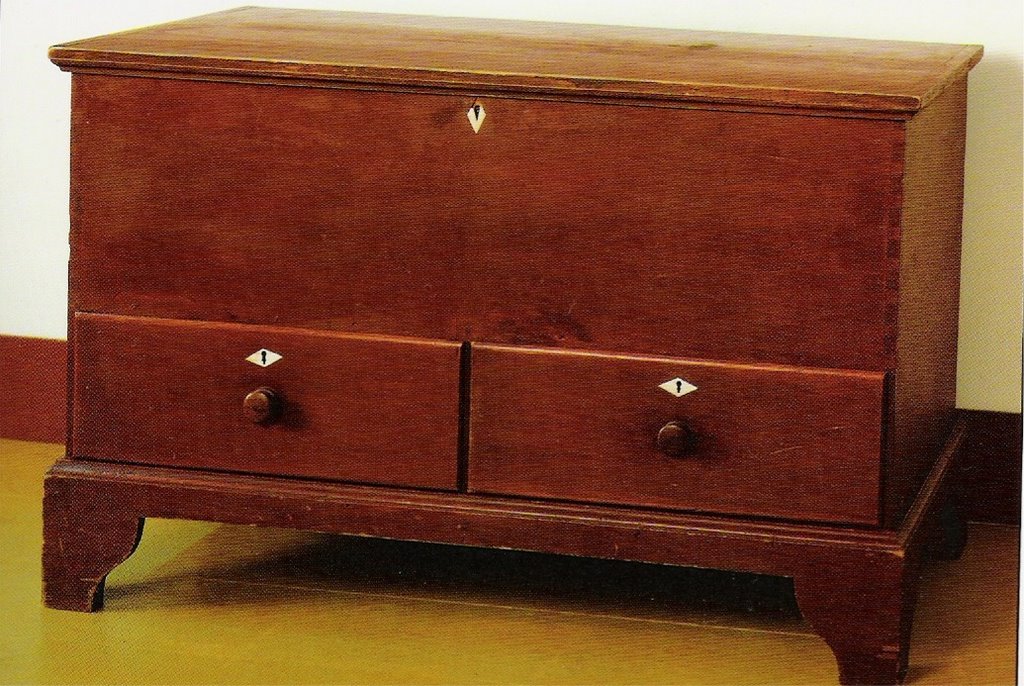 OK, here we are again, making things. Children’s toybox/footlocker things. And here’s a kinda sorta example of just the sort of thing we can use to get the style of the thing. It’s too big. Don’t worry about that. It’s got two drawers. Don’t worry about that. My scanner stinks, and it didn’t capture the magnificent color of the thing properly. Don’t worry about that. It’s entirely through dovetailed along each corner, which will make the box more expensive than starting a laboratory, doing biological research, reanimating the corpse of a Shaker, and asking him to make it. Don’t worry about that either.
Don’t worry; be happy. These are all modest problems. The part we don’t have a problem with trumps them all; the thing is sublime. Marvelous. Neat-O. The rest is conversation.
To review, the picture is from The Encyclopedia of Shaker Furniture by Timothy Rieman and Jean M. Burks. It’s a coffee table book that weighs more and costs more than a coffee table. It’s chock-a block full of marvelous pictures of Shaker furniture and the Shakers themselves. It weighs about twenty pounds. You can buy a copy right here, if you like:
There’s a sort of decaffeinated coffee table version of the book too, if you’re not feeling flush, and want to save some money to spend, on, oh, I don’t know, Sippican Cottage furniture or something, here’s a link for it:
The notation in the book mentions that this Shaker piece looks vaguely non- Shaker. The diamond shaped escutcheons for the keyhole and the dovetailed box are considered “worldy,” details. Shakers called the rest of us “the world.” It’s a fine example of american country furniture style, however worldly it might be. Let’s monkey around with it.
First, we’ll make one drawer. That’ll keep the cost down, and two aren’t really that important. We just want to keep the bottom of the thing from being where little toys go to languish and die the death of being ignored.
Second, we’re going to lose the dovetails. They’re expensive to execute, and they’re overkill in this instance. Dovetails are part of a tradition of woodworking that goes back before high quality glue was available. They form a mechanical bond that holds together well without any adhesive, hence their appeal. And they look neat. But the thing we”re making need to be affordable, and not too fancy. We’ll dovetail the drawer sides, to impress the neighbors. We’ll use simple rabbett joints at the corner of the box itslef for strength with simplicity.
We’ll change the dimension from the original 26″ high x41″ wide x 22″deep. It’ s too big. The original is not for a child. The Shakers raised children but didn’t have any themselves, hence the scarcity of Shakers these days. We’re in the know about chldren so we can make this a better size for a kid’s needs. Let’s try 22″high x 36″ wide x 15″ deep.
We’ll monkey around with it some more tomorrow. Ow! Paper cut. Woodworking sure is dangerous. I’m going to go use the table saw; it’s safer.
Pay Attention To The Smile Coming Out Of The Radio
Billy Preston died yesterday. There’s bound to be a little frenzy around his name today, and then he’ll drift into a kind of trivia question obscurity. Occasionally one of his songs will waft from the radio, and amuse or annoy you according to your tastes; he was alteratingly trivial and silly and funky and soulful and bubblegum and gospelish. You’re bound to entertain at least some people, blasting all that into the ether; and the popularity of his friends, the Beatles, and the songs he played with them, will ensure that whether you know his name or not you’ll hear him for a long, long, time.
Billy Preston was born in 1946, and never really did anything but play music, right from the first. I’ve seen the odd picture of Little Richard in his prime, touring some godforsaken and forgotten place, lounging in a cheap hotel room between shows, his band crashed out on every horizontal surface; and there’s Billy Preston in the corner, probably no more than fifteen years old, out on the road with the men. Wild men, at that.
Little Richard made friends with the Beatles, and they made friends with Richard’s phenom sideman, and when Apple records was formed by the Beatles to ostensibly allow them to escape from the music business, Billy Preston cut the first version of My Sweet Lord, George Harrison’s lovely little paean to gospel songs. It was a flop. But Preston’s version is so much better than Harrison’s; it informs it with the soul that George could write, but didn’t have the easy talent to perform. Listen to Preston play it:
There was a period in the early seventies where you couldn’t go ten minutes without hearing Billy Preston come out of the radio in one form or fashion or permutation. He played with everybody. The Beatles. The Rolling Stones. The aforementioned Little Richard. Sly and the Family Stone. Bob Dylan. Hell, he hung on long enough to play with the Red Hot Chili Peppers. And on top of all those snippets of him, you could hear him play his own lively disposable pop numbers, all huge hits, one after another:
I Wrote a Simple Song; Outta-Space; Will It Go Round in Circles; Space Race; Nothing from Nothing. He won a Grammy for Outta Space. From 1972 through 1975 he seemed to be on the radio all the time.
Like many people in the entertainment industry, Billy Preston succumbed to drugs and booze, and was profligate with his money. He eventually got caught trying to burn down his house for insurance money. He was addicted to cocaine and booze, and pleaded no contest to assault. His life was a wreck, and then his health was a wreck.
He eventually seemed to straighten himself out, and began playing again. He was still immensely talented and well regarded. But his earlier abuse of his body seemed to overtake him, and got him in the end.
Sometimes it seems that demons attack the most vulnerable souls. It was nice that Billy Preston could make our lives a little sunnier. I hope a little of that sun shone back on him, and he could feel its reflected warmth on his face before he left. After all, we all knew him as a smile that came right out of the radio.
Now What Do You Want To Do?
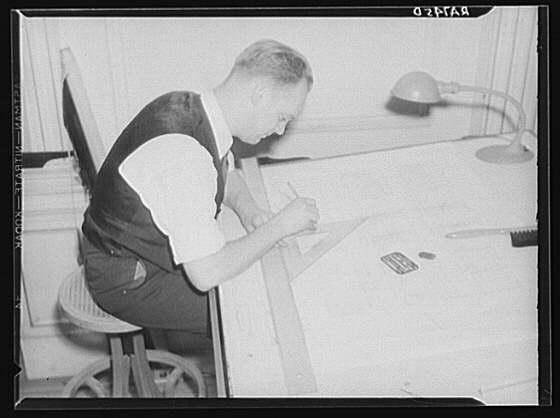
OK, we’re making something. Here we are making something. We are so making something.
What the hell am I going to make?
It’s really not that difficult. As they say about writing, you just stare at a blank piece of paper until drops of blood form on your forehead.
Well, when in doubt, sweep the floor, I always say; let’s examine the process first. Here’s the criteria for a piece of furniture:
- Will anyone want one?
- What is its function?
- What style is it?
- Can I make it?
- Can I make it in a cost effective way?
- How big is it? Can I ship it?
- What makes it special?
- Can I find examples or comparables?
- What will it cost?
- What time is lunch?
1. Will anyone want one? Is easy generally. People tell me all the time the kind of stuff they want me to make. I’ve got lots of stuff in the catalog with suggestions for improvements from customers integrated in them now, or the idea itself born of suggestion. The ideal suggestions come from my wife. She never says anything for months at a time, being of a taciturn nature, then says a thing like: “If I trip over on more pull-back car in the middle of the night in our child’s darkened bedroom, I’m going to put poison in your cornflakes.” Hints such as these let me know that children need places to put their things that exceed the wildest ideas of parents and architects alike. OK, we’ll make something for the tot’s toys.
2. What is its function? I told you once already: I don’t want poison in my cornflakes, and the kid has lots of stuff that has no natural home. It needs a bin for it until he goes to college and we can try to throw it all away and fail miserably and simply weep over each and every Happy Meal toy like some holy relic. So it’s got to be built to last.
3. What style is it? The paradigm for children’s things is the footlocker. The lidded box is king, let’s make one. Sort of a seaman’s chest, or a stage box, as they called the thing you gave to the highwayman when they held up the stagecoach. We’ll batter it up front because it’s going to look that way anyway right quick. And it really shouldn’t look like Sesame Street anyway; it’s furniture, and if it’s useful and handsome they can use it forever, even as adults. I’m useful and handsome, and I’m still going strong, for instance.
4. Can I make it? I can make any darn thing, thanks, but this is particularly suited to my shop. If I can’t make a box with a lid, I’m ready for a bed with a lid.
5. Can I make it in a cost effective way? The thing has to have value added; that is, a toy box is nothing special. And “Nothing Special” can be made in Indonesia for pennies and I can’t compete with that. So we’re gong to make it like something a person would treasure and give to their own youngins when they grow up and make the same mistakes we did. And we’re gong to make it out of solid wood, and right there it’s better than 99% of the other examples out there — everybody that has the child safe particle board toy box from Poverty Barn knows it takes you kids fifteen minutes to rip the screws from the pneumatic child safe closer on the lid, and that particleboard won’t hold a screw. SLAM!
6. How big is it? Can I ship it? Sizing this thing is easy. Most toy boxes are all the wrong size. The sides are too high for little ones. They’re too big front to back generally, and the little ones end up climbing in them to reach things in the back. It tips over and the lid comes down. That’s bad, right? Skinnier, longer, and less deep makes for good proportions for such a thing, and the shipping companies will accept it too.
7. What makes it special? Here’s where we go down in the annals of design: We’re going to put a drawer in the bottom. Everything in the bottom of the toy box goes there to die. Your poor children break toy after toy trying to get to their little treasures in the bottom, but they can’t do it. We need a place for puzzles and little things that get lost in there, that they can get to without climbing in the box after it.
So we’ll mimic the first step in the long process that started with a lidded box, then slowly added drawers from the bottom up, one over another, until the whole thing was drawers and they just nailed the top on. You knew that was how we got the modern chest of drawers, didn’t you? Well, you do know.
8. Can I find examples or comparables? Sure we can. I found a lovely picture of a lidded box with one drawer in The Encyclopedia of Shaker Furniture by Riemann and Burke. There are two examples, actually, and strangely, one is Bog Red, and one is Delft Blue, two Sippican Cottage Furniture colors. I say “strangely,” because I bought this book last autumn, and I’ve been selling things painted those colors for four years now. That’s why you go about things in a sensible fashion. When reality catches up with you, it matches up with your fiction. The boxes are too big, they are designed for adults, but the form and proportions are sound. The book costs more than the furniture we’re making, by the way.
9. What will it cost? We’ll make one to see what it costs. Offhand, drawers cost money. They’re very labor and material intensive. But there’s only one. There’s a substantial amount of wood in this thing too. Three or four hundred dollars maybe for the whole enchilada.
10. What time is lunch? Lunch is at 11:00. When you start real early, that’s noon.
(more tomorrow)

Recent Comments