What Did You Know, and When Did You Know It?
 An extraordinary, terrifying, and wonderful thing happened yesterday.
Sunday afternoon is generally pleasant. We tinker with projects around our house, in a desultory fashion generally. “I help! I help!” is welcome, of course, but it’s the harbinger of many attitudes, few of which look like efficiency. The trip can become all journey and no destination. Then again, the Sunday Drive of my youth was just the same. To wander with intent but not purpose — delightful.
My head was jammed inside a cabinet, trying to reconfigure the components to play more than Scooby Doo VCR tapes. Occasionally small feet would trod on my legs, and now and again the flashlight would be withdrawn, unwonted, and its gradually weakening beam would play wildly over the living room ceiling, herky jerky, and then be returned to me the way Jim Lonborg would “return” the baseball to Elston Howard. Like a Brobdinagian in Lillliput, pinned down and annoyed, I soldiered, and soldered, on.
My two sons are seven years apart in age, which elicits much conjecture about the compatibility of their interests. Let me assure you their interests are much the same; whacking on each other, stepping on their father here and there, and delighting and tiring out their mother. And the older looks out for the younger better than if they were more contemporary in age. We do not worry much, when they are together.
But a sound came from their room. My wife and I know all the sounds. Having children is like having a bowling alley installed in your head, said Martin Mull. He didn’t know the half of it. He spoke too soon, likely never dreaming that the older half of the bowling alley would take up the trombone to drive home the point.
But this sound fit in no slot in the catalogue of tintinnabulation we had stored in our heads — all the possible permutations of din available to two young boys. It sounded wrong, and desperate; we knew that immediately.
My wife sprinted up the stairs to the ten year old’s room. I couldn’t extricate myself; I struggled to get to my feet. I arrived maybe fifteen seconds behind her. We didn’t use ten stairs between us.
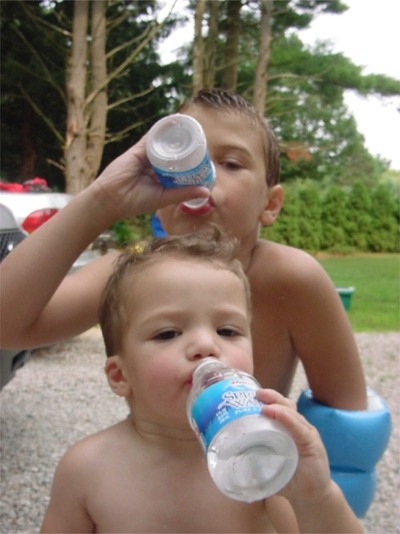
The little one, barely three, stood in the middle of the room, eyes glassy, hands at his neck, face darkening, and with his ten year old brother behind him, arms clasped around his brother’s chest from behind, trying to squeeze him — trying save his little brother’s life.
Your mind does not wander at such a time, exactly, but certain possibilities occur to you, so dark, so treacherous, so dreadful, that to picture them is to look into the abyss. Be careful of that, Nietzsche says; eventually the abyss looks back at you.
As I said, the mind does not wander. But your mind does become a sort of filing clerk — inefficient, disorganized, not lazy but hardly a help sometimes — and goes searching through everything in that dusty old heap of half remembered facts, prejudices, and habits we call our intellects.
Grab the boy. He’s limp now. Turn him around. Sweep your finger through his mouth. Far too late for that. Right hand, thumb cocked in at the knuckle. Place it beneath the breastbone, thumb knuckle in. Left hand grasps right wrist. Bend slightly forward. Then sharply pull up and in, hard enough to work, not hard enough to break him. One. Nothing. Two. Nothing. Three. Nothing. Four.
Hungry Hungry Hippos. The perfect white plastic sphere appears, covered in spit.
He’s upset, like a boy barely three often is, and wants a drink of water. His ten year old brother is upset in a different fashion, and is consoled by his mother. I — I’m grateful, I guess. The little one begins to eat crackers from his lunch plate, and watches Felix the Cat.
There have been times in my life when if I failed, I’d get a D on my report card, and a stern look from my father. Other times, if I failed, my leg would be broken or my tooth knocked out. Later, if I failed I could be booed and jeered in front of hundreds of people. Perhaps if I failed, people would have to look for new jobs, including me. I’ve failed ten times before breakfast, as the saying goes, but I’m not sure I’ve ever been faced with the life I pictured, just for an instant, in my mind’s darkling eye, with my boy in my arms — if I failed.
What do you know, and when did you know it?
We found the big brother in the bathroom late that night, weeping. I sent his mother away, and put him to bed. I asked him: how did you know how to help your brother?
I read it in a book in the library.
Who gave you that book?
I found it myself. But I couldn’t do it.
Your brother is OK. You helped him. You saved him. Just like you saved your father seven years ago, though you do not remember it. You found me, unconscious on the floor in my room, the stingers of the deadly bees still hot in my leg, found me gasping like a fish on the beach, and you got your mother and you saved me. You saved me, to help you to save your brother.
You are not a little boy any more. I can tell you now, that all any man wants is to be able to think, in a moment of repose, that his son is a better man than he. You are, and I am content. Go to sleep, and dream of your brother and you in the playground.
He slept soundly. I laid in bed for a long time, wondering: What do I need to know, and when will I need to know it?

Recent Comments