Pure Pop For Then People — Crowded House

Neil Finn’s entry in the “Men that look like old lesbians” sweepstakes. He’s been going to the beauty parlor with Ron Wood and Jeff Beck, I see. Neil’s fronting the current iteration of Crowded House in the video. They were semi-big in the eighties. Big enough to still be working, at any rate. They’re from New Zealand and Australia and other upside-down places.

He can still sing, I also see. Before Auto-Tune, if you wanted to make money in pop music, you sort of had to be able to sing. It wasn’t absolutely necessary, of course. You used to be able to mumble into a microphone, then the producer would put all sorts of sturm und drang all around it, and you could have a hit; see: Don’t You Want Me Baby, by Human League. But crooners have an easier time of it, and have less trouble having more than one bite of the top forty apple.

Crowded House was one of those eighties bands — A Flock of Seagulls;  ABC, The Bangles; Thompson Twins; Duran Duran; Escape Club; The Fixx; Simple Minds; Simply Red;  Howard Jones; XTC; Dan Hartman; Icehouse; Level 42; Psychedelic Furs;  Hair Cut 100; Tears for Fears;  Wang Chung; World Party — bands that are growing interchangeable with the decades slipping by. If you put them all on the same bill, and they all wore matching suits, they could all play each other’s tunes and not many people would notice. But you always notice when people sing well.

El Jefe

[The end of a saga. I was a welder in the desert back in the day. I’ve been trying to explain how I got into that predicament without sounding stupid. It’s not working]

The tribe wasn’t talking, at least not to me, and not in English when I was nearby. Larry the foreman wasn’t interested in holding my hand. His hands were full of index cards with pencil runes scrawled on them. Hitler’s stunt double, and Irwin Corey’s red-headed nosemining love-child, seemed of doubtful utility. The girl from Flashdance wasn’t going to show up anytime soon and show me how to weld between dance numbers. I was going to have to, as Peachy Carnehan says, “brass it out.”

Nowadays, dorks on the Internet enjoy playing the The Dunning-Kruger card in blog comments at 3 AM to try to settle things, but the concept isn’t useful out in the real world. It wasn’t a useful thing to know before the Internet, either. Everyone in the Dunning-Kruger experiment was a college kid — i.e., someone full of themselves for no reason. Saying that stupid people think they’re smart, and smart people think they’re stupid, is simply a way for people with an IQ of 105 to attempt to sidle up to people forty points north of that and say, “Isn’t that guy with an IQ of 103 a dolt?”

The people educated people think are really stupid — people with dirt under their fingernails –don’t “think” they’re smart. They are smart in the only way that matters. They know what they’re about. They don’t go on Jeopardy and expect loading dock questions. Conversely, if you’re a welder and can’t weld, your enthusiasm for French poetry or something equally useless wouldn’t enter into it. So I might have been the smartest person to ever enter the zip code I was in, but I most certainly was the dumbest fool in the room. There’s only one way to keep score. Style points can’t weld things. So I hitched up my britches, got in line at each work station, and when in Rome…

I did as the Romans did. Badly. I couldn’t pass for Roman, but I could have at least ridden the short bus to an Etruscan elementary school after a while. At first I couldn’t get the electrode to spark, then I welded it to the brass fixture. I used ten pieces of filler rod to everyone else’s one. My work had more bubbles in it than a frappe, and was more lopsided than an election in a dictatorship, but I stuck with it. I drove home every afternoon in a trance, then slept in my dirty clothes on top of my bedclothes until the next morning. That’s when I discovered that a little help would have gone a long way.  I woke up on fire. And not the good kind of fire that can be extinguished, either. The sensation was the same, though. I went to the bathroom and pulled off my shirt.

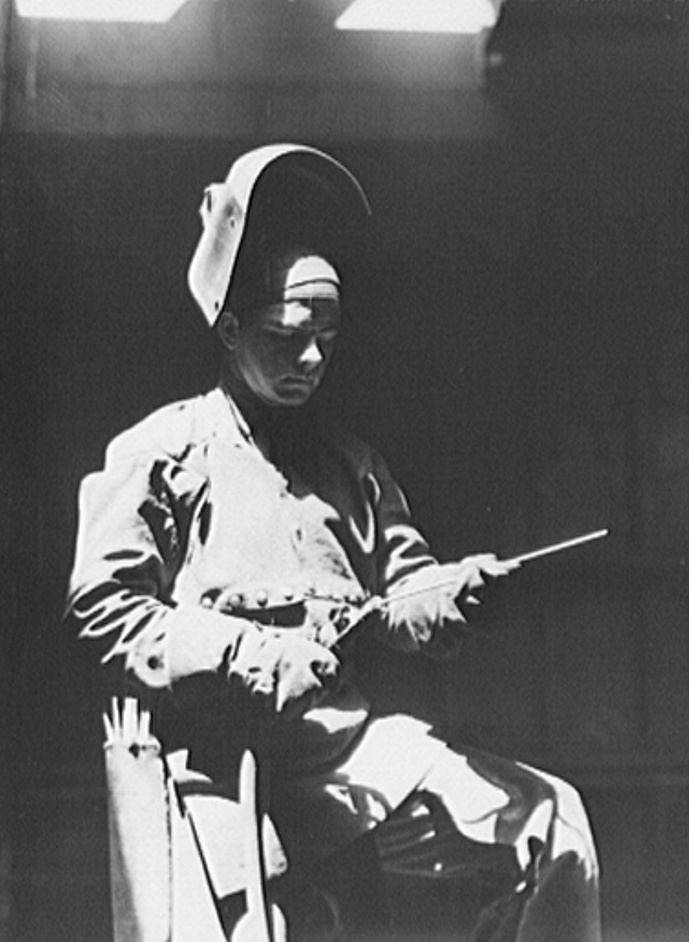
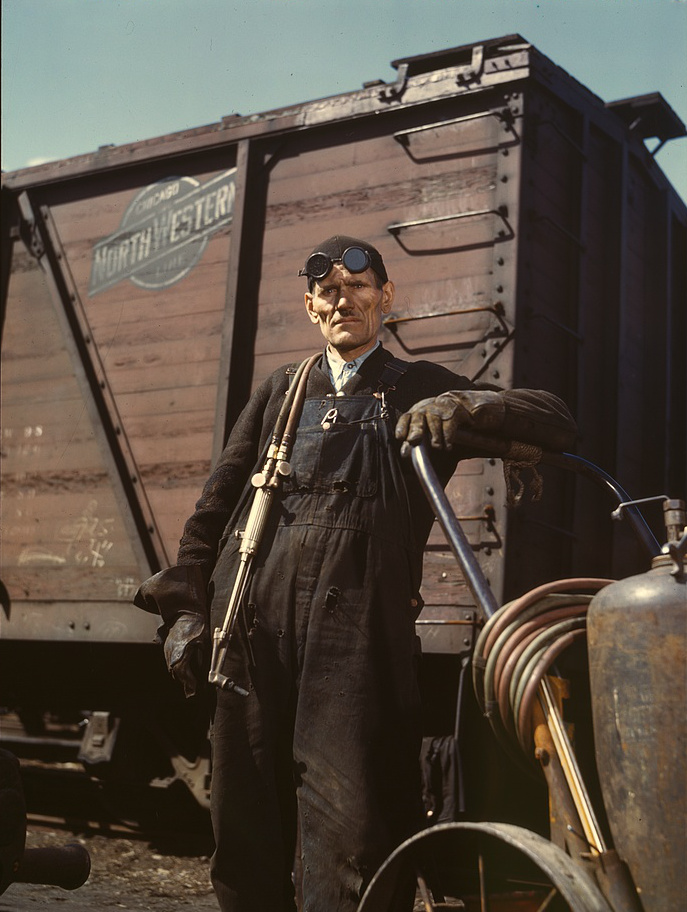
I’d worn a long sleeve shirt — cotton; even I knew that any sort of polyester version would ignite if welding sparks hit it, cotton just smolders —  a welding helmet, and leather gauntlets. But I didn’t know enough to button my shirt all the way to the top. I’d left a triangle of flesh exposed to the ultraviolet rays that welding likes to bless you with without you noticing, and I’d burned a big Bass Ale logo onto my chest. It hurt like taxation, with the lemon juice of sheepishness ladled on it. I buttoned my shirt over my own personal superman logo, and slowly abraded it off over the next couple of weeks. I swear I can still make out its outline all these years later, whenever I’m shaving that fool’s face in the bathroom mirror.

Day in, day out, I hung in there, no more than that, and no one talked to me in any meaningful way. Amish couldn’t have shunned me more effectively. At lunchtime I sat alone and ate my pasty sandwich at my shabby desk while the easy laughter of the other men drifted in through the open door as they stood out in the blazing sun and ate burritos from the “roach coach” that pulled into the lot every day at lunchtime. I slowly morphed from a gibbering Irishman into one of those fellows that lives in a barrel and eats thistles and drinks from puddles and waits for wise men that never show up.

Like all places with a rough and tumble workforce, everything worth a farthing was locked in a big cage, which was lorded over by a human guard dog. There was a very calm and quiet young fellow in charge of the place. He was a short Messcan. There were tall, lordly Messcans about, too; they looked like Andalusian Senators or something. But he looked like Mexico before the Europeans showed up. He was dark and doe-eyed and taciturn, and had been trying to grow a moustache unsuccessfully since he was born. He sat at the neatest desk in the building, knew the protocol for everything without hesitation, and spent most of his time reading. He was not required to do anything except hand us stuff, and keep track of it all. All of a sudden, I was informed that he’d been keeping track of me, too.

“Do you know why they don’t like you?”

I briefly considered feigning ignorance of this Everest of quiet contempt I’d scrambled up and down every day, but I thought the better of it and just said, “No.” Which was the truth.

“They don’t like you because you took their cousins’ job. Their brothers’. Maybe their fathers’. Who do you think all those cholos in the lobby were when you came in here? They need to weld. You don’t need to weld. You don’t even know how to weld. You could do what you like. You took someone’s place.”

I was sort of stunned. I’d been in unions that cared less about whether you were part of their brotherhood. 

“They would have gotten over that, I guess, eventually, but they know that you hate messcans, man.”

“Whoa, whoa, whoa. Who says I hate Mexicans?”

“You think we all steal.”

“What the fuck are you talking about?”

“Every day you bring all your tools home. We see it. Every day. You think we’re all thieves.”

There was a long pause while I processed this information. I imagine I had a look of wonder and astonishment on my face that wouldn’t be equaled until much later in my life, when another, smaller version of me appeared, coming out of my wife.  That would be quite a long time, as she was currently in ninth grade.

“Do you really think that if I could do something else — skin diver for Roto-Rooter, rottweiler dentist, anything —  that I’d be a welder in the desert? You must be crazier than I am. And let’s get one more thing straight. I bring my tools home every night because every single goddamn day I figure today is the day that I can’t take another minute of this godforsaken filthy oven, and I’m never coming back here. Every day I bring my tools home because I might need something fairly sharp to kill myself with when I get home. If I thought you’d steal my tools, I’d have left them here and prayed you’d steal them, if it meant one less day working in this dungeon.”

The next day, they came in a gang, and dragged me bodily out into the late morning sun, the parking lot shimmering with the heat like a cookie tin from the oven, and they hugged me and bought me burritos from the roach coach, so spicy that they made me shiver, and after work they hauled me all over their town and got me drunker than a fiddler’s whore, and the next morning I threw up chicken mole and Tecate in the john, and the man in the cage said, “Now you’re one of us, jefe.”

Steal With Your Eyes

[If you just came in, I was a welder in the desert back in the day. I’ve been trying to explain how I got into that predicament without sounding stupid. It’s not working]

You can bluff your way through most any circumstances if you’ll simply pay attention. “Steal with your eyes,” it was once explained to me. But paying attention to what? That’s the big question. First day on the job, first date, whatever. What do you pay attention to, and to whom? Who’s a sage, and who’s a doofus? I swear this is the only kind of wisdom you can pick up in this world. You tune out one thing after another, one philosophy followed by another, stop reading bad books, stop wasting your time caring what flavor of imbecilic pop songs comes out of someone else’s radio. To live in this world is to be an editor, not a writer.

So I’d promised them I was a welder, and I needed to be a welder, and I was determined to be a welder right quick. I looked around furtively early on, and tried to espy anyone giving off a Stakhanovite vibe, determined to shadow them to see what’s what. Grand Theft Eyeball.

In these situations, it’s my experience — hard-won — that the first person from any insular group that tries to strike up a friendship with you, the new guy, is invariably either a ne’er-do-well or an incompetent. Usually both. Everyone else in the building already knows of, and is tired of, his schtick, so he tries it on the new guy. You can generally learn how to get fired, immediately, from this person.

But I was young then, and didn’t have this sort of information in my head yet. I was a lamb for any stray coyote to get ahold of. I’d be friendly with anyone that would be friendly back. This place presented a problem. No one was friendly. No one even looked at me, except to glare, and precious little of even that. I immediately got the impression I was a seal on an ice floe with a dozen polar bears, and the bears did nothing but whisper to each other, then look over their shoulder at me from time to time. I didn’t get the impression they were planning a surprise party for me. My attitude toward them didn’t matter, so I relied on my grade school education to see me through. Who was the nun in the room? They’ll have to talk to me. Larry, the happy Hawaiian with the fantastic aureole of frizz around his head, was the nun. He was in charge. He’d have to help me, surely.

This simply presented another problem. Larry was sort of silly. He smiled all the time. He smiled when things went badly. He smiled when things went well. He smiled while he was being devoured by crocodiles. OK, OK, but he would have, I’m sure of it. If you asked him a question past where’s the john you flummoxed him. He smiled when he was flummoxed, especially.

But it was me, of course, that was truly flummoxed, not Larry. Larry wasn’t going to be fired if I couldn’t weld. Larry would smile and wave to me in the same way if I was run out of the town on a rail, or picked up by limousine to go get my Nobel Prize. I was in a strange place among strange men, doing a strange thing. They all belonged there. I didn’t. But I had to. My back was against the wall and the cigarette was almost out.

There was a work room separate from the big shop area. Everybody got a metal desk that looked like reform school, where you could solder things, or eat your lunch, or solder your lunch, or eat solder, or do any number of other interesting things. Larry pointed out mine, towards the back. I sat down and looked around. To my left was a voluntarily mentally retarded young man with Professor Irwin Corey’s hairdo, thick glasses with bent frames, and skin like the Sea of Tranquility. I tried watching him, first. I watched him mine his nose, and add the contents to his diet. I did not get the feeling that he was reading encyclopedias at home by the hour for amusement. My eye wandered on.

In front of me there was what appeared to me to be an immensely old man, probably four years younger than I am now, with a bucket-shaped head, a haircut that was obviously the denouement of some sort of bet he’d lost, and a moustache that had gone grey mostly on the sides, so that only the portion of his cookie-duster directly below his philtrum was black, and so rendered him the spitting image of the former chancellor of the Third Reich. He was repeating the same non-joke over and over to no one, just out into the ether. He thought it was funny to hold up a can of Glyptol, a kind of sealer paint, and pronounced it “Griptol,” in a Charlie Chan accent. My eye wandered on.

Everyone else was, in the charming vernacular they all used, “Messcan.” They were a tribe and a family and an army. I could see immediately that in any real sense of the word, they owned the place. And they were inscrutable to me.

[To be continued, if you feel like it]

Strange Adventures In The Fall And Rise Of Sippican Cottage

[Editor’s note: We continue the seemingly neverending saga of Sippican welding in the desert. It was uphill both ways in the snow, in the desert, apparently.]
[Author’s note: The fancy writing dudes always pooh pooh physically demanding things. Mental toughness is a form of intelligence, if you ask me. And there is no editor.]

I’ve read that it’s smells that humans remember the longest, or are the most likely to jog memories. After positing that, the pseudoscientists often talk about Grandma’s cookies. Let me tell you about smells.

It smells like exotic bread is baking near the dust collector when you put pine through the drum sander. You know the fine dust is giving you nose cancer and lung trouble so you’re almost immune to its charms. Almost. There was this smell once, when I had to renovate an apartment a guy died in. He was in there a good long time, too. It’s the smell of the mass grave. That was fun. But nothing can compare to the smell of the abrasive cutoff saw going through steel. It makes brimstone smell like French pastry.

You see, to cut metal like that you don’t often use a saw with teeth. It’s just an abrasive disc, and you send a shower of sparks and an acrid, burning blast of stink up your nose. It’s like snorting sand from the outdoor ashtray next to the door at the place they hold Alcoholics Anonymous meetings. I’ll never forget it.

Work started about a half hour before you were scheduled to go to bed, so there was a dreary weariness writ on everyone’s face. There was a huddle with everyone looking off into the middle distance, while Larry, the Hawaiian guy with the Long Island housewife afro told us what to do. All the work was tracked on little yellow index cards in pencil. There wasn’t a lot to know; outside diameter of the stainless steel tube, length of the finished probe, and what kind of metals were used for the electrodes inside the tube. We made all kinds, but it was mostly J and K types, which are common things made from common metals. By common people, Larry’s aureole of hair notwithstanding.

The raw stock to make the thermocouples was coiled to make it easy to store, and simply labeled with a tag tied to the coil with a letter on it. You’d find the coil, which weighed a bit when it was new but was infinitely more appealing than handling the light remainders of the coils. The guys that had worked there awhile never touched the bits and pieces and broke open new coils all the time. Sooner or later someone had to face the short, stainless steel straw, though.

You had to straighten out the coiled pieces by shoving them through a machine called a desuager. A desuager is just a revolving bend. You feed the SS tube through a yoke with three holes. Input output, and the middle. The middle hole is offset from center. The yoke was spun by a motor, and you have to hold on for dear life to the coil as the revolving bend tries to spin it — and you–all around. It’s easy to hold onto the big coils of small diameter tubing, but the scraps of large diameter stuff were almost impossible to hold. You’d clamp the world’s oldest Vise-Grip to those and hold on for dear life. More about that later.

So you’d straighten the coil out, and use the abrasive saw to chop them to length. 20 ea K 1/4″ 24″ is all the work order would say on it. You didn’t measure, there were rude markings in pencil on the work bench from the first person who worked there, and you’d use them. Then you got the smell.

It was starting to get hot now. The metal roof sorta glowed with it when the sun started rising up in the sky. So we did what any intelligent person would do. We climbed a ladder to get closer to it.

You see, the shop was set up to handle the largest thing we might sell, not the usual two foot trifle, so you climbed a sort of gangway ladder to a tower where you’d weld. You were working on the tip of the thermocouple, and it had to be oriented vertically. To this day, I can’t understand how I climbed up there carrying all the welding stuff and the thermocouples.

The Road Warrior came out shortly after I worked at this place, and I thought they filmed it on location there. It was a barbarous set of circumstances. You’d sit in the kind of chair you’d find at a flea market held outside a torture dungeon, the hot metal roof right over your head. In front of you was a Fred Flintsone looking vise arrangement with brass jaws with a series of holes drilled in it. You’d clamp the thermocouple stock in the appropriate circle, and get to work.

You had to sandblast the insulation out of the tip of the stock to expose the two electrodes inside. And now you had to weld them together. To work, a thermocouple joins two dissimilar metals at one end, sticks that end in the nasty spot full of incredible hotness, and you measure the tiny voltage at the other end with a meter to tell the temperature. The operative term here is: dissimilar.

It’s hard as hell to weld identical metals together properly. Welding dissimilar metals is impossible. You do it, but I stand behind the word: it’s impossible.

It becomes possible because if you falter once, you will be immediately fired and the other 135 guys that got passed over get their shot. It’s possible because if you tarry on the only tower, the other ten guys waiting to do their work while you fumble around will meet you outside after work, and they don’t knit for a hobby. You’ll lose the only job you can find twenty-five states away from the place of your birth and you won’t even have enough money to drive home to be poor there in the snowbanks.

So it’s not even possible. It’s downright easy.

(to be continued)

Tag: 1980s

Find Stuff:

Archives