

Well this kind of weather couldn’t last forever, amirite?
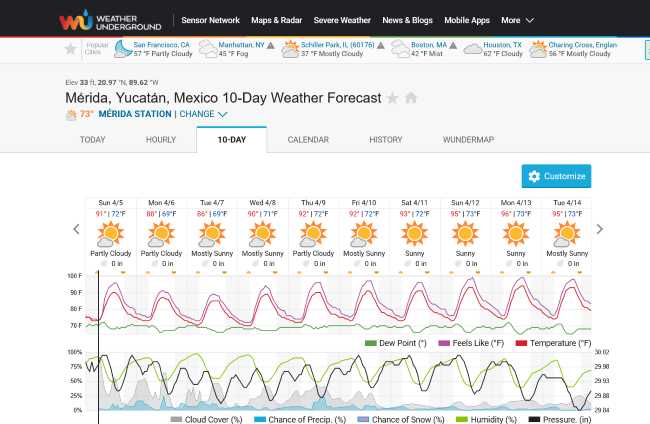
I must admit, for someone accustomed to New England weather, it seemed like forever. Merida, Yucatan shifts its seasons, it’s true. But not while you wait, the way it is back in Maine. Yucatan uses a calendar for weather decisions. Maine uses a clock. Summer in the sun, winter in the shade is a thing back there. Here, it’s always some form of summer.
Forgive us for being lulled and gulled by a weather report that looked like it was painted in oils. We went something along the lines of 45 straight days just like you see there. Egad, Lovie! We have to put more water in the pool every day!

It couldn’t last. The seasons are the opposite of up north. Winter’s nice, summer, not so much. There are only two seasons, just like Maine. Maine is nine months of winter, followed by three months of tough sledding. Here in Merida, there’s summer, followed by the other summer.
The “other summer” is the rainy season. If you want to be pedantic (who doesn’t?) there might be a third season: hurricane season. But honestly, how much worse can it get than the “other summer,” which showed up here last week:
That’s out in front of our house. There’s an eight-inch high curb out there, which is a lot by US standards, but barely adequate here. The city of Merida is the geologic equivalent of one of those pool tables without pockets that require more geometry to play than I carry around in my head. There are no bodies of water, no rivers, runnels, or gullies where the water might go. Either it ends up in the ocean, or the Gulf, the occasional cenote, or your living room.
Obviously this has been noticed by the people who lived here before us. I espied two brackets anchored into the masonry walls outside the only door in and out of our casa. I’m good at architectural hints. For instance, if you remove all the railings on your staircases, because a raccoon-eyed harridan on home and garden TV told you to, I’ll take the hint and fall down your stairs and sue you. I assume that’s expected of me. I hate to disappoint people.
The bracket hint was saner than that. I went hunting around and found a six-inch tall metal weir, a dam that slipped into the brackets snugly. So between that and the curb, we had about a 14″ head start on the rainwater. It wasn’t enough:
Consecutive days of torrential downpours have left the city of Mérida waterlogged, with official data revealing that parts of the Yucatecan capital recorded a staggering 436.7 millimeters (17.2 inches) of rainfall over a single seven-day period.
According to a report released on Wednesday, June 3rd, 2026, by the National Water Commission (Conagua), Mérida has solidified its status as the wettest location in Mexico over the past week. The most severe accumulations were registered in the western sector of the city between May 27th and June 2nd. Conagua noted that the 436.7 mm volume is visually equivalent to dumping nearly 22 twenty-liter water jugs onto every single square meter of land in the area. (link)
They were eager to add several rainstorms together to get that figure. There were days scattered throughout that week when it didn’t rain much, or at all. Most of that 17.2 inches of rain fell in a few hours, scattered over several days. It only rained all day once. I’ve taken showers with less water being dumped on me.
According to the chatbots, 17.2 inches of rain is about half the expected yearly rainfall here. Also according to Chad:
Spread evenly, 17 inches of rain means every square foot of ground received about 106 gallons (400 liters) of water.
Now, I may not be able to play pool with no pockets or anything, but I know when Sam Altman’s turbo encabulator is having an aneurysm. I said, check your math, and yourself, roboboy:
Good catch — that number is way off.
Let’s calculate it correctly.
A square foot receiving 17 inches of rain gets a volume of:
Area = 1 square foot
Depth = 17 inches = 17/12 = 1.4167 feet
Volume = 1 ft² × 1.4167 ft = 1.4167 cubic feet
Since 1 cubic foot = 7.48 gallons:
1.4167 × 7.48 ≈ 10.6 gallons
And since 1 gallon = 3.785 liters:
10.6 × 3.785 ≈ 40 liters
So the correct statement is:
17 inches of rain means every square foot of ground received about 10.6 gallons (40 liters) of water.
The previous figure of 106 gallons would correspond to about 170 inches of rain, which is exactly 10 times too high. I accidentally shifted the decimal point.

Do tell.
For poops and giggles, I asked Chad how much snow that would be, if that much moisture fell on Maine.
Maine perspective
A week’s precipitation equivalent of 17 inches of rain would translate to roughly:
14–21 feet of snow in a single week.
So, about four to six hours after I took the video, all the water in the street was gone except for some puddles. Where it went, only Kulkukan knows. The pool was full. And I didn’t have to shovel 14-21 feet of snow off the sidewalk.
All in all, I’ll count it in the win column.
15 Responses
Possibly, Chad used a slide rule. Magnitude errors are easy to make that way.
The current problem with precipitation is it’s falling in the wrong spots. Maybe the UN could form a commision to work on that; they could pass a resolution or something.
Those cenotes are pretty. Apparently, there aren’t many here stateside. They look like nice places to visit.
Hi Jed- The rain does indeed fall in the wrong spots, if you count Mexico as wrong all over. It rains like hell here, but they’re forever running out of water. Mexico City gets more rain than Vancouver, but they have no idea what to do with it when it falls. They’re wading when it rains, and the taps run dry the rest of the time, while the city subsides as they pump out the aquifer.
The Yucatan has very strange geology. No water above ground, essentially. The ground is 100% limestone, so the rainwater eventually bores a hole through it here and there and you get cenotes. We’ll probably get around to swimming in one this summer.
Much like here in east central Florida. All good until 4-5 inches of rain falls in 4 hours. No hurricane needed. Be prepared or suck it up. I’m not moving back to northern VT, no matter how much water you throw at me!
Hi Ralph-It’s the bow waves of the Toyotas that get you.
Here in NW Wyoming we live in two completely different climates. This is called “basin and range” territory and the ranges are the mountains (cool, snow-covered, and piney) while the basins are basically sagebrush deserts. The only reason non-hunter/gatherer humans can live here are the reservoirs, which store up the water from the mountain snow run-off and parcel it out during the summertime to feed the agriculture industry and the occasional trout fisherman.
At this time of year here in TinyTown™ we can get almost anything. We had temperatures in the mid-90’s last week (but with essentially zero humidity) followed by torrential downpours (but only in 10% of the area). A couple of days ago our low temperature was 37 degrees (that’s F, not C) and a light frost on the roof.
It still beats the heck out of where we came from (Minnesnowta) where much like in Maine there’s about 8 months of winter, followed by 4 months of tropical heat, humidity, and the state bird (the mosquito).
Hiya Blackwing- You know, pretty much everything I know about Wyoming, you’ve told me. You’re like a public service at this point.
I was working in the Guatemalan jungle where in the summer and fall it rained heavily at night. It seemed like an inch or two fell every night, but looking at weather data, it appears that 8 inches in a month was more like it. Whatever the amount of rain, it didn’t stay on the ground. The limestone absorbed whatever amount fell. No mud.
Has water backed into the floors of your dwelling? The University of Houston law library lost some valuable documents stored in the basement, which flooded during a hurricane. But who in their right minds would construct a basement in Houston, where the water table is not far below ground level?
Given its history of earthquakes—I once felt a tremor at night—Guatemala is another place that doesn’t favor basements. But here the danger isn’t from being flooded. It’s from having the ceiling collapse on you.
Hi Gringo- As I understand it, the part of the Yucatan I’m in is considered dry jungle. The part that the southeastern part is in, which keeps going to Belize and Guatemala, is considered wet jungle. I’ve been in Guatemala and you ain’t lyin’ about the rain.
The water did indeed make it into our house the first time. Just moppy problem. We figured out how to put in the little dam and back it up with beach towels pretty quick, and it ceased to be a problem. No power was worse.
An earthquake would flatten this place. Unreinforced masonry all over.
I did a more thorough check on rainfall. The two towns nearest the drilling rig have 95″ of rain per year. Like you say, dry jungle versus wet jungle.
A little farther North in Deep South Texas we have a total of three (3) seasons that we refer to as:
December > January > Summer
Hi SLM-Thanks for reading and commenting.
I’ve met a bunch of friends here in Merida from Houston. When it’s 104 in Merida, they say things like, “It’s not that hot.”
Note that according to the Weather Service, you’ve got a wanna-be tropical system moving through there heading to Campeche.
Possibly helpful links:
http://www.nhc.noaa.gov/index.shtml
http://www.spaghettimodels.com/
Hi Ed- Holy cow, Mike’s Weather Page is quite a thing. It’s like the Ling’s Cars of weather.
I rememeber the girl from New York who experienced her first Houston rainstorm, the first week of my freshman year of college. hot humid hot humid, then torrential downpour like a million fire hoses located just overhead, for half an hour, then an abrupt stop and instantly even MORE humid and hot.
“What the HELL was that??”
“Welcome to Houston, my dear.”
Hi jc- Thanks for reading and commenting.
I had the same sort of epiphany when driving across the US from Boston to Los Angeles. In the parts of New England where I was from, it’s not possible to see the horizon very often. Too many trees and hills. New Englanders are often attuned to the weather, but they feel it coming, not see it. When we got out into the wide open spaces (holy cow driving across Texas) it was weird to actually see weather approaching, or sometimes passing by far on the horizon, never getting to where we were, but drenching someone, and pelting them with lightning bolts. We assumed they were even worse people than we were, for the heavens to single them out like that.