
We’re in Merida, Mexico. Doing the Yucatango. Figuring things out. Mexico decided to be extremely Mexican on Sunday. Forecast: 103. Electricity: Coy. Disappearing puckishly from time to time. No dear John letter, either. Just wait and wonder in the dark.
Now of course there are many things you can do without electricity. Like most people, I don’t want to do any of those things, and I don’t want to hear about those things. I want coffee and air conditioning. Don’t take me alive, otherwise. A ready supply of these things is mentioned in the Geneva Conventions, or maybe the Magna Carta, or perhaps the terms and conditions on Microsoft Office. If they’re not, they should be. I’m no Revolutionary War scholar or anything, so I may be misremembering, but I’m pretty sure the Intolerable Acts threatened no coffee or air conditioning for expats, which I guess Americans were. Or maybe it was tea. It was always about tea with those periwigged weirdos.
It was early yet on Sunday, so we set out on an overland trek. An ankle turner through Santiago, the neighborhood we live in. The eastern end is called Gringo Gulch by the locals. It’s a not entirely complimentary assessment of where most of the expats from the US and Canada live. We don’t live in Gringo Gulch. We live on the western end of Santiago, near the zoo, which is somehow fitting. We are similarly displayed to the regular residents as oddities. Like the zoo, strangers are not expected to feed us, but on the plus side, nobody is allowed to throw stuff at us, either. We’re happier among the locals than we would be in Gringo Gulch. If we wanted to live among Americans, we would live in Maine. If we wanted to live among Canadians, we’d live in Maine in the summer, and learn to tip seven percent in the restaurants.
We walked east, because that’s where the Plaza Grande lurks. Some call it the Plaza Principal. Some call it the zocalo. It’s the center of town, done in the Spanish colonial style. Big square park, big cathedral on one side, town hall on another, governor’s palace on another, and a museum on the fourth. Mixed in are 1001 opportunities to ask a gringo if he wants to buy a Panama hat, or a fan, or a guayabera shirt, or another fan, or a trinket, or a ride in a carriage drawn by a horse that looks like he’d rather be in perdition, where it is cooler. We didn’t want any of that, but we figured where there’s commerce, there might be electricity.
We walked on the shady side of the streets. It was almost lonely, although the city has about a million inhabitants. Mexico is a civilized country, the way my own used to be, so lots of businesses are closed on Sundays whether they have electricity or not, and the churches are full. I doubt they’ll withstand the siren song of American go-go franchise commerce much longer, what with all the stronk girrllbosses running the place these days. But there’s a lot of ruin in a nation, as they say, and it will take time, so it will be a problem for the people who mow the lawn over our graves, not the residents under it.
I confused my wife over and over, which is in the job description, I believe. What with everything shuttered, and regular people in church or sleeping one off, or doing both at the same time, we didn’t encounter very many pedestrians, and it was easier to cross the streets than usual. But somehow, I kept stopping here and there on our hejira. I wasn’t taking pictures, or anything else borderline sensible, so my wife had to keep stopping and tapping her foot with “I did?” rattling through her head where the “I do” used to live.
“What the hell are you doing?”
“All the electric meters are six feet off the ground. I’m watching to see if the wheel is turning inside the meter. The first one we find that’s in motion, I figure we can knock on the door, kill the inhabitants, and make coffee in their kitchen until the police come.”
“It’s a strong plan, I’ll grant you. Maybe we could just go to the first restaurant with the meter humming?”
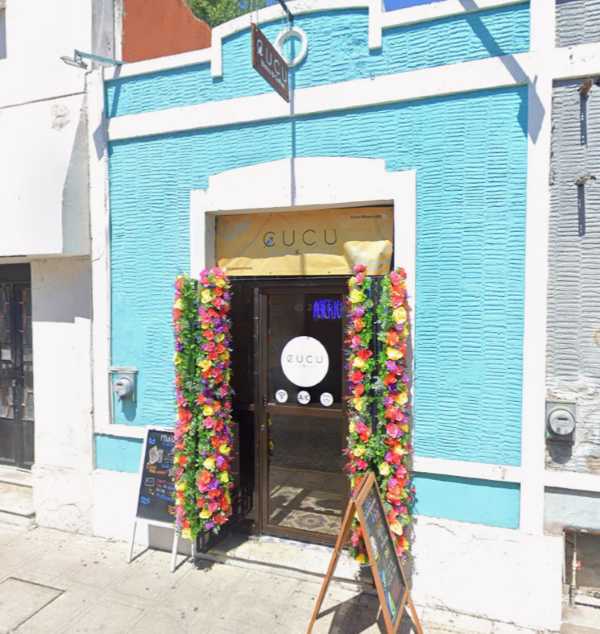
Isn’t it just like a girl to take the easy route. We wandered along past Santiago Park, and kept going. When the zocalo appeared a few intersections further along, still only a mirage full of traffic and importuning, we passed the Cucu. It was open. I realize that “passing the cucu” sounds like a euphemism, but I assure you it’s a restaurant. My wife and I switched roles. I walked right by it, while she paused at its sandwich board.
It looked Mexican twee to me, which didn’t suit. I wanted coffee like a bitter penance, and a breakfast like the kind they serve in prison. The Cucu Bistro doorway was ringed with a garland of plastic flowers, and the sandwich board described the kinds of complicated breakfasts I don’t favor, the kind designed to fool girls into thinking they’re not eating right out of the sugar bowl like a housefly. You know, Starbucks sorts of things. Wedding cakes for breakfast. I pooh-poohed the idea thusly:
“I’ll bet they don’t have air conditioning.”
“There’s a big sign on the door that says ‘air conditioning’.”
“Reading the signs is cheating.”
By this time, a cute little girl (I’m getting old) opened the door and said, “Come in, we’re open, and we have coffee and air conditioning.” At least that’s what I think she said. She said it in Spanish, and I was still in arguing with my wife in English mode. It takes a few seconds of hummina hummina when you switch back and forth. She may have asked me if I wanted to buy a Panama hat, or take a hansom cab ride. My wife went straight in. I was left on the curb with no one but her imaginary divorce lawyers to keep me company. I surrendered faster than Vichy France and followed.
I was disappointed that the interior was as pleasant as the help. It was getting harder and harder to win the argument. The place was like most structures in the city, very skinny and very, very deep. We kept passing through seating areas, past a station where the servers made coffee and conversation, until we hit a door out to a hidden patio. We were about as interested in sitting outside as do-it-yourself dentistry, so we plopped down in the last stretch of seats, right under the mini-split, and looked around. The place was as neat as a pin. It had handsome tile floors in the big, colorful patterns they favor down here. The overall color scheme was a peaceful yellow and gray, with dashes of blue. The tables were simple, sturdy, nicely finished and well-matched, made from the kind of lumber rich suburban American women salvage from pallets, because they wish to appear poor and resourceful, and fail at both. No one was failing at anything at the Cucu.
The siren who lured us in was our server, and continued her song. She took pity on us, though, and she fished around and found menus in English for us.
Aha!, I thought, but didn’t say. There was nothing on the menu for me. I still held out hope that I could win this argument, if that’s what it was. It was the usual lament. Complicated mayonnaises and avocados everywhere. As you know, avocados are just rancid pears full of green gun grease and a giant kidney stone. Mayonnaise of any kind is suitable for several uses, none of which involves eating at breakfast unless you’re more of a honkey than I am. The rest of the menu was runny eggs and runny cheeses and various other things not often sold to drunken Irish authors, which I aspire to be. They had coffee and air conditioning, so I didn’t complain much. As usual, my wife saved me: “They have grilled cheese and tomato soup.”
I know what you’re thinking. This dude is in the Yucatan peninsula and he’s going to order a grilled cheese sandwich with tomato soup. He must miss grammar school lunches. Perhaps they should serve it with a waxy box of milk to complete the trip down memory lane.
But you’d think wrong. Merida is actually notable for its Yucatecan cuisine, which in my book should be treated as assault in a court of law. It’s all pretty dreadful and strange, and it has no visible relationship to what anyone in the US thinks of when you mention Mexican food. Everything on the menus looks like you cleaned out the kitchen sink strainer after doing the dishes and dumped it into that dish you keep under the sink if the drain leaks. They put chocolate on chicken down here, among other horrors. It gives me the willies.
Think I’m exaggerating? Challenge accepted. Their signature dish is cochinita pibil, At first blush, if your Spanish is rusty and you’re not too inquisitive, it sounds like a pulled pork sandwich. Dig a little further, and you might find your appetite for it wanes. And I really mean dig a little further, because it’s prepared by drowning the pig in the juice of bitter oranges (don’t ask), then wrapping it in banana leaves, followed by digging a hole, starting a fire, and burying the pig on top of the coals in your backyard overnight. The next day, you dig it up, dust it off somewhat, eat it, and pretend to like it.
I’m of Irish extraction, so sketchy uses of various parts of pigs hold no terrors for me. But I, and my brethren, draw the line at grave-robbing.
So no, I am not fondly remembering Mom’s margarine pan-fried Wonder bread sandwiches with two slices of American cheese, along with a bowl of Campbell’s tomato soup with an extra cup of water added, because there were six of us. I’m trying to explain that Merida might be known for cochinita pibil, but should be known for its grilled cheese sandwiches, with tomato soup on the side. It’s Elysian here.
My wife ordered this, because she is, underneath her clothes, a girl eating breakfast in a restaurant:
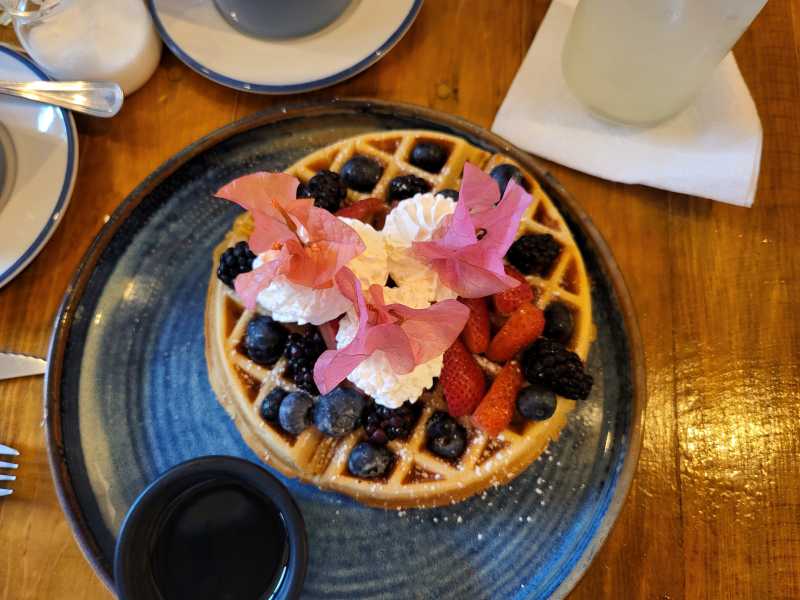
Yup. Whipped cream, blueberries the size of plums, various sugar grenades disguised as fruit, and flower blossoms on top. A wedding cake. I figure anything that reminded her of a wedding cake would turn to ashes in her mouth, what with her husband selection experience, but she soldiers on.
We’re in danger of taking photos of all our meals while writing on the internet. This would make me an influencer. I avoid being called that by always being under the influence instead. Let’s move on. Here’s mine:
The menu reads: Pan rustico + queso de cabra + queso gouda + queso cheddar + tocino + sopa de tomate.
By rustic bread, they’re referring to bread made for humans to eat, by other humans. Big fat, chewy slices that taste of sourdough, maybe a little olive oil, and perhaps a rumor of the wood-fired oven they were baked in. Three kinds of cheese, just not made in the same factory that makes Firestone tires and kamikaze drones like back in the states. The tocino they mentioned is just bacon, in the same way Sophia Loren is just a woman. I don’t know what they feed pigs down here, but it must be more wholesome than cochinita pibil. This also avoids requiring cannibalism as well as grave robbing from the oinkers. PETA would be proud. Almost.
The tomato soup is as thick as hummus, and made entirely by smashing fresh tomatoes in some sort of soup particle accelerator, with some combination of ambrosias for spices. It’s served in a little cup, and you’re supposed to dip the sandwich in it, and eat it like that.
Now, I’m not just going Cucu here. I’ve had the same meal in four different restaurants all over the city. The SOCO. Maria and Montejo. The Galeron. And in each one, in turn, I’ve testified, under oaf (my mouth was full), that it was the greatest grilled cheese and tomato soup combo in the history of the world. And every time I knew I was wrong, as soon as I ate the same thing in the next restaurant.
You know, the historic center of Mérida is protected under Mexico’s national heritage laws as a historic monument zone (Zona de Monumentos Históricos). They list all sorts of architectural and historic reasons for that, but they can’t see the forest for the trees. Put the grilled cheese sandwiches and tomato soup on the city’s seal, and all the flags, and see the tourist dollars roll in. I promise only a small portion of them will leave a seven percent tip.
17 Responses
> Don’t take me alive… Why, did you cross your old man back in Oregon?
You’re making me nostalgic for grilled cheese and tomato soup. I’m quite certain anything I could whip up here would pale by comparison with what you’ve described. I think I haven’t had that since my mom made it with Velveeta. Hmmm, maybe I have – I remember putting strawberry jam on such a sandwich, and don’t think I did that as a kid. With real cheddar, though, but no soup.
I like the look of guayabera shirts. Never worn one. I’m not sure it’d look good on me, unless clothes really do make the man. But somehow, it think it’d look out of place on a slightly overweight German with a gray beard. If I were one to do such a thing, I could give Chad a photo of myself, and have him dress me in one.
Hi Jed- RE: guayaberas. I didn’t really appreciate them properly until I lived here for a while. It’s too hot to wear any sort of shirt that clings to you. I’ve stopped wearing T shirts when I’m out and about because when I get home, I can’t get them off without a spatula. Guayaberas, and cheap Walmart shirts that mimic them, are much better.
ohhhhh my. Our grade school served grilled cheese sammiches with tomato soup on Fridays. They made it even better by including glass bottles of chocolate milk. I’m in heaven just remembering.
I’ll pass on the drowned pig. ew.
Hi Jean- I trust they finished off the meal with a little square of lime jello. We used to barter for those like inmates do with cigarettes.
I had a croque monsieur for the first time in Paris back in ’76. The name sounds like “Kill the Mister”, but it’s actually a French grilled cheese sandwich. Like your Yucatecan version it was basically ambrosia.
On t’other hand I remember the incredibly bad meals served to us under armed guards at our junior high school that consisted of fried cardboard with vaguely yellowish caulking compound between the pieces (the “grilled cheese sandwich”), and something they called “chili” that was actually a conglomeration of canned beans, texturized vegetable protein, and ketchup served at slightly higher than room temperature. You had to be a hungry teenager to eat that stuff.
Hi Blackwing- I have over 2,000 words of culinary description right there, but none of it can hold a candle to “fried cardboard with vaguely yellowish caulking compound.”
But you’d think wrong. Merida is actually notable for its Yucatecan cuisine, which in my book should be treated as assault in a court of law. They put chocolate on chicken down here, among other horrors. It gives me the willies. Think I’m exaggerating? Challenge accepted. Their signature dish is cochinita pibil..
In the TX city where I live, it is not difficult to find chicken w chocolate (Mole) and cochinita pibil. Granted, they are not standard TexMex fare. A restaurant several miles from my condo serves both. You can find Mole paste in all the grocery stores here—which means that it finds its way to local kitchens.
I have had only bad experiences eating TexMex/Mex in New England. Try black beans on Route 1 without any salt. From my experience, TexMex/Mex in New England “should be treated as assault in a court of law.”
Speaking of cochinita pibil and Yucatan, consider this passage from David Sterling’s Yucatán: Recipes from a Culinary Expedition.
I’ll take cochinita pibil and chicken mole over a bean/cheese burrito any day.
“I have had only bad experiences eating TexMex/Mex in New England. Try black beans on Route 1 without any salt. From my experience, TexMex/Mex in New England “should be treated as assault in a court of law.””
Yeah, that’s been my experience too. Especially little places in Maine on Route 1. Nope.
Thing is, if you’re in New England, either residing or visiting, why would you eschew the stuff they do so well there, in favor of something that right there on the face of it you can predict will be horrible? No population that thinks “tortilla” is pronounced “tor-till-i-a” and has to have instructions printed on the bag (not kidding) is likely to make good Mexican or Tex/Mex or any of the many variants thereof.
Instead, just go straight to the important questions like “Woodmans, or the Clam Box?”
Hi Gringo- You ain’t wrong about Mexican food in Maine. A year or two ago, someone got the bright idea that tacos were popular, because they saw it on TikTok or something, and built a taco stand on the rural state highway behind our house in Maine. It was quite elaborate, and looked expensive to build. It literally closed before they got it open. There’s a wide gulf between ideas and reality in the restaurant business, and in Maine generally.
“As you know, avocados are just rancid pears full of green gun grease and a giant kidney stone.”
I choked on my coffee, right there.
Hiya Ralph- Thanks for reading and commenting and not charging me for your keyboard.
My father made grilled cheese sandwiches for our Saturday lunch. Wonder Bread and Velveeta, cooked in margarine, just like in Sippican’s childhood home. But as my mother’s homemade green tomato relish was also included in the grilled cheese sandwiches, the grilled cheese sandwiches were delicious.
Hi Gringo- Our salvation was a pickle, sweet slices, on the side.
Those Tex-Mexicans get around though. Have eaten perfectly good Tex-Mexican is Soldotna Alaska and other than Halibut Tacos on the menu, you could have been in San Antonio. Also a good joint in Gold Bar Washington and Airport Heights just east of Spokane to pick out a couple of North Western examples. We live south of Corpus Christi just 90 miles from the border and there are a multiplicity of variations if you seek them out. I am partial to the West Texas/New Mexico flat enchiladas with a fried egg or two on top!!
BTW – Been reading S.C. for years – Keep up the good work!!
Hi SLM- Thanks for reading and commenting at Sippican Cottage.
I discovered a couple of years ago that I’ve been doing grilled cheese wrong all this time.
The key is provolone cheese.
Hi Ed- I don’t think you should let a secret formula like that out of the bag without charging for it first.