It’s Hard To Become a Mexican Resident, Part 2

[Note: continued from yesterday’s post]

Showing you’ve already got enough money to keep you in tacos and cervezas forevermore is called the Savings and Investments route. It’s the one we took. You can also show them that you make enough money every month to qualify instead of a single pile in the bank. It varies from consulate to consulate, supposedly, but it’s $4,400 a month, net, after taxes where we went. Got a spouse, or child to cart along? Add another $1,400/month per person. You have to prove you’ve made that much for the last six months, unless you go to a fussy consulate, and then it’s twelve month’s worth of proof. If you miss on the low side for ten minutes, the calendar goes back to zero and you start again. Even though it’s ostensibly any kind of income, it’s still aimed at retired people. Mexico hates anyone who will move there and take any Mexican’s job. They’d really prefer that you make that almost $70,000 a year completely passively. And, you know, spend it all in Mexico.

If you’re a digital nomad, you can find any number of places on the internet (teehee) that say that Mexico loves you. Hell, the current Mexican president ran an ad campaign inviting digital nomads to Mexico City when she was the mayor there. Later, she expressed solidarity with protesters chanting gringo go home, stop taking all the good apartments. So I’d keep the “nomad” part of digital nomad in the back of your mind at all times.

In any case, good luck proving to the authorities that you make that kind of dinero every month. If you’re a freelancer, the paperwork is nearly impossible to produce to their satisfaction. They understand W-2s, but your digital bank statements with weird money coming in fits and starts from all over will get you an adios muchacho as often as not. Most digital nomads simply enter the country on a regular tourist visa, which usually allows you to stay for six months. Then they bugger off somewhere else, and then re-enter Mexico later to get another six months. That’s true, unless the immigration officer at the airport doesn’t like the fact that you have no return trip on your plane ticket, and stamps a few weeks on your passport instead of six months. That’s happened to people we know.

Remember, these are all numbers to allow you to stay legally in Mexico for a single year. You’ll have to renew it every year for three or four years, keep your nose clean the whole time, maybe pay Mexican taxes if you’re still working some, including tax on your Social Security as if it was regular income, and pay a substantial fee each time (about $650 per person, per year), until they relent and make you a permanent resident. If you want to become a legal permanent resident right away, you have to have approximately $300,000.00 parked in your accounts for a year, or earn $7,400 a month, net, after taxes, and prove it for the last six or twelve months to their satisfaction. You’ll have to pay more for your spouse, too.

This is just the warm up for proving things, by the way. You’re going to need your birth certificates, and marriage certificates if you’re currently manacled to anyone ’til death or a divorce lawyer do you part. But you’re also going to have to prove that the documents are legit to their satisfaction. To forestall problems, you should send away to the secretary of state of the state you were born in, and married in, enclose your documents, pay a fee, and have them apostilled. If you’re unfamiliar with the Hague Convention of 1961 as it applies to your birth certificate, join the “I’ve never heard of an apostille club.” We meet every other Thursday, and liquor is served. An apostille is a way to certify who is who no matter where you’re from, or where you’re going. The apostille punches two holes through the cover sheet and your document, and certifies it’s real by putting a blue ribbon through the holes, and then affixes it with a giant gold seal. It ends up looking like the kind of document used to legally cut off Anne Boleyn’s head.

Whoah, there, big fellah. You’re not done yet. The Mexican consulate can’t be expected to read the underlying document, because it’s all in English and tied to the back of your apostille. So you have to hire a certified translator, who has to read all the info on the apostilled documents, and translate everything into Spanish. But you can’t separate the cover apostille from the document, so you have to take a bunch of pictures of it by rolling up the cover page every which way, peeking at various angles, and blend it into a kind of mosaic picture of the underlying certificate. Then they translate it into Spanish for you, with an official CERTIFIED TRANSLATION stamp and signature on the document. They generally spell your father’s name wrong, and the town clerk’s name wrong, and about a dozen other mistakes, which you correct for them so they can charge you money for this exact translation.

You’ll need passport pictures. Don’t smile or they don’t like them. I haven’t smiled in thirty years or so, but my wife’s face almost broke trying to look serious. Bring at least two copies. The internet (teehee) says you don’t need them, because they take your picture for your visa anyway. Whatever the internet might think, the consulate took the photos we brought and pasted them on our file, and would have sent us away if we didn’t have them. Oh, and by the way, you need extremely sharp photocopies of everything I’ve listed, including color copies for your passports, usually in triplicate. I compiled a binder for each of us, both over an inch thick. I used clear sleeves to hold the documents, which can’t have any staples, and if you three hole punch anything, go back to square one and start over.

[To be continued]

It’s Hard To Become a Mexican Resident, Part 1

Please note I said “resident.” I’m not talking about becoming a Mexican citizen, because that’s right up there with alien abduction and chupacabra ranching for practicality and likelihood. A married couple like us could, in theory, get divorced, go to Mexico, find two deranged myopic hard-of-hearing Mexicans and marry them, and thereby technically both become Mexican citizens. But unlike the US, if Mexico thinks you’re doing it for a dodge, they’ll probably tell you to pound sand anyway. It’s easier to explain this process if you just accept that you can live in Mexico like a Mexican, but you can’t live in Mexico as a Mexican. This is not ‘nam. There are rules. Boy howdy there are rules.

You can’t start this procedure in Mexico. If you’re a USian, you have to visit the Mexican consulate nearest you in the states. In our case, that was Boston, Massachusetts. That’s two states and a four hour drive away, but rules is rules. You need an appointment. Actually, if you’re a married couple, you need two appointments. The internet (teehee) and the consulate itself will tell you that you either can, or must, make your appointments using their online portal. It doesn’t work, and you can’t.

Hell, you’ll find out after trying to log in to their portal, over and over, that Boston doesn’t even have online scheduling. You can try calling if you don’t mind “Press 1 for Spanish.” Or more to the point, press whatever you like, you’re getting Spanish. They’d prefer (demand) you ask by email. We did, in English and Spanish. The consulate does not even acknowledge that they received it. You’re just supposed to wait, and wonder. After a few weeks, you can email them again. It feels strangely like pushing the elevator button even though it’s already lit, and you and four other people have pushed it already. You are strongly cautioned (by the internet again, teehee) not to get uppity with your followup requests. Just plead a bit. You won’t get an answer to that email, either. You’re instructed it might take up to six weeks to get any sort of reply to anything. And the answer might be two appointments days or weeks apart, months after the reply.

You can try consulate shopping. Wild tales of Vegas consulates passing anyone with a pulse and a few shekels in their pocket are rife on the internet (teehee), for instance. Others have reported luck, good or bad, all over the US map. We looked into going to the Philadelphia consulate, and a couple in Florida, and Houston, because we read that they might be faster than Boston, but we could never schedule an appointment online anywhere. It’s all broken, or we are. And being stranded in a strange city on an open-ended commitment to waiting around wasn’t appetizing. When we begged for appointments in Boston the second time, we lied only a little and told them if they had any cancellations, we’d show up on short notice. American dependability being what it is, they emailed us back with two cancellation slots on the same day a month in the future. God knows what we would have said if they said, “We have one later today.” I can talk faster than a car salesman, but I can’t drive faster than one.

So you’ve got an appointment, What’s required? for openers, you best be a good boy. Been arrested much? Forget moving to Mexico. They’ve got problems of their own, and they’re not interested in importing any more, unless you count me.

You’re going to need money, and I don’t mean toll change. The fee to apply for a residency visa is only $56 per person (in cash, not refundable if you flunk). That’s just the cover charge. There are several ways to demonstrate that you’re not (ever) going to be a burden to the Mexican state, and they all involve various sums you might not have. You might think you’re a rich American, so no sweat, but Mexico doesn’t care about your theoretical money. Equity in your house is theoretical money, for instance, or imaginary if we’re talking about 2009. They’ll also require documentos out the ying yang to prove said sums. For example:

The most common way to get permission to live in Mexico for 1 year is through solvencia económica. The sum required is based on a certain number of days of Mexican minimum wage, which is very minimum indeed, but they want to account for a lot of them in a row. It varies by consulate, and they change it every year, but you’re going to need about $80,000 in the bank to qualify. If you’re married, you’ll have to pay for your spouse, too, but it’s not double. You need somewhere between $2000 and $5000 more.

After you’re done puffing out your chest and sniggering about a paltry sum like eighty large, let me clue you in. Your net worth don’t mean jack shit. It better be in cash, or something close to it, or it doesn’t count. And you don’t get to “explain” anything. It’s “show, don’t tell” south of the border. You have to present 12 straight months of at least that much money on original bank statements. Dip one peso below the required amount for one hour six months in, and your clock starts again. If you’re one of those sexy people who does everything on your phone, including your banking, waving the balances on your Nokia phone at the consulate staff is going to get you precisely nowhere.

We had original bank statements, because we’re the last people on earth that get them mailed to us. We still had to get a credit union officer to personally stamp and sign every month, every page, and then write a cover letter on bank stationery that averred that both my wife and I had unrestricted access to all the funds for the entire 12 months. The look on the bank manager’s face gave me the impression she would have preferred that we rob the bank. It would have been less trouble. And if another month ticks over while you’re waiting for an appointment at the Mexican consulate near you (it will, and it did), you have to go back and get the latest ones stamped and signed, too. And by the way, the consulate wants several copies of every page in addition to the originals, and you better not have a staple in them, or any doodles or highlighting on the originals. When we got our interview, it wasn’t a formality. They looked at every page, and scrutinized every deposit. Got a windfall in there? Best be able to explain it.

[To be continued]

Beelzebub’s Dodge Caravan and Other Discontents

Men need a god. Otherwise they get confused and start worshiping themselves. They climb into a booster seat in the back of Beelzebub’s Dodge Caravan and think they’re driving.

When I was young they taught us history. The nuns patiently trooped through the ages while we followed along closely by staring out the window half the time, and doodling Big Daddy Ed Roth Rat Fink cartoons in our marble notebooks the rest of the hours. Some of it must have seeped into my adolescent corpse somehow. They always started with Mesopotamia, mentioned their balcony gardening skills, hopped the Nile to explain that the pyramids were more than a pile of rocks built by shirtless dudes with two left hands, then dogpaddled the Hellespont to belabor the Greeks for a bit longer than the others. Greece was the first thing they could point to that really looked like our kinda civilization, so they pointed hard. The Parthenon wouldn’t look weird if it was a post office in Poughkeepsie. Abu Simbel would.

We’d hop skip and jump through the ages after that. Romans roaming around Europe, guys who wore HVAC ducts into battle, the Britishers showing up everywhere brandishing the awesome firepower of a swagger stick and Greek and Latin lessons. We’d get about as far as the battle of Yorktown into America’s trail of broken pottery, and then run out of school year before we ran out of history book pages. No matter. You could watch Gunsmoke and The Untouchables reruns to fill in everything from the Civil War to Prohibition, and our uncles would fill us in on dropping bombs on Japanese, or Germans, to taste. As you know, the Fifties never happened, and if it did, which it didn’t, it was all bad, so we didn’t need to look into that any deeper than Fonzie. From then on, we could look out the car window while dad drove and see what was going on for ourselves.

Lingering on the Greeks meant learning their Pantheon of Gods. Babylon wasn’t interesting, really, in that department, so the nuns skipped it. I mean, have you read The Gilgamesh? He dives to the bottom of the ocean to retrieve a head of cabbage or something, if I recall correctly, which I don’t. Then he swims back up and gives it to Gumby, or Pokey, or Spreitel or Chim Chim, I really can’t remember who now, and they live happily ever after, or everyone dies. It’s usually one way or the other with these people. Moving on, the Egyptians were plain weird.

Mount Olympus was more our speed. A toga party in the clouds with recognizable human forms. Wings on your heels are less confusing than a bird’s head on your shoulders. The Olympians were just superhuman humans. They might be the god of water, or thunder, or love, or table tennis or whatever, but they were usually depicted in human form. They weren’t simply abstractions, or concepts. They had agency in our world.

You could go shopping for your own personal deity at the Greek Pantheon Stripmall. One for this, one for that, some covering a bunch of Olympian bases. Officially, there were only twelve of them that had membership cards in the Champagne Room at Olympus. That number is interesting. Keeps popping up all over the place, from Norsemen to apostles. We didn’t need as many Marvel comics as the generations that came after us because we still had Greek and Roman legends to amuse ourselves.

Of course, nuns were involved, so we had the tale of the Christ as a standalone subject. The saints stood in for the various gods they replaced when you needed a leg up with something. Praying to a unitary god for everything can seem futile. He’s got a lot on his plate, and is usually busy elsewhere. If you were drilling holes in west Texas, I imagine there’s a patron saint of oil refineries or something that might have more time to take your call than the head honcho.

I’m on perfectly good terms with the Big Guy. I don’t need a refresher on the catechism or anything, although it sounds like the pope could use one. I’m not talking about needing THE God now. But I do need A god in my life. Gods didn’t used to be all powerful and remote. They drifted in and out of humanity, and meddled. This led to amusing Golden Fleece All-Inclusive Travel brochures and so forth. That’s the type of god I’m currently looking for. A dread god that I can stand up to.

This was perfectly normal back in the mists of time when Demosthenes was still annoying his neighbors in the agora, and Nancy Pelosi was still in grammar school. You might worship gods, but you were allowed do more than thank them or shake your tiny fist at them. You could measure yourself against them. You’re not a passive worshipper. You’re an active participant in a system where the gods set limits, and the meaning of your life is how well you confront those limits. If you beat the gods at their own game, sometimes they sorta adopted you, and give you a day pass to Olympus, or a peek at Hera’s ankle or something. Other times, they chain you to a rock, and you get your liver plucked out daily. It’s all in good fun, either way.

A while back, I moved my family to the edge of the map in To-Hell-And-Gone Maine, to shake my tiny fist at Boreas, and test myself against him. Boreas was the Greek god of the north wind. He brought winter, arctic air, and sixteen inches of partly cloudy you had to shovel every couple of days. When we first lived in Maine, the thermometer touched 22-below zero. We didn’t have central heat. Around midnight that night, I went out the front door and stood in the middle of the street, with moonlight my only companion. I looked at the desultory column of smoke rising from my chimney, and dared Boreas to kick me again, harder. Then I realized I was standing in the middle of the street at midnight in the winter and this might cause comment down at the local grange hall, if there had been someone there to witness it, even though there wasn’t, because no one does anything like that in Maine very often and lives to procreate. Boreas was a worthy adversary, but we beat him. We found an abandoned house without a heating system, and left it with air conditioning and a pile of wampum in our pocket. Take that, Boreas.

So I was in the market for a new god so I could murmur, “You’re not so tough” under my breath after he kicked sand in my face and walked away. I thought, why not go the other way? Who’s the sun god?

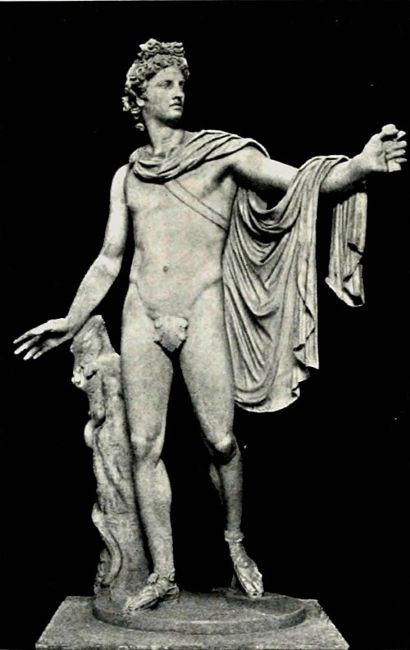
Oh, right. Apollo. We got all bollixed up when we learned the Roman Pantheon after the Greek. Honestly, can you remember which was which between Ares and Mars? They mostly had the same portfolios, so it didn’t matter much. The only name shared by both pantheons was Apollo, the god of the sun, among a lot of other things. Apparently he fit the bill for Mediterranean vibe, no matter whether you were a hoplite or a legionary.

There’s a problem. Apollo is a bit, er, flouncy.

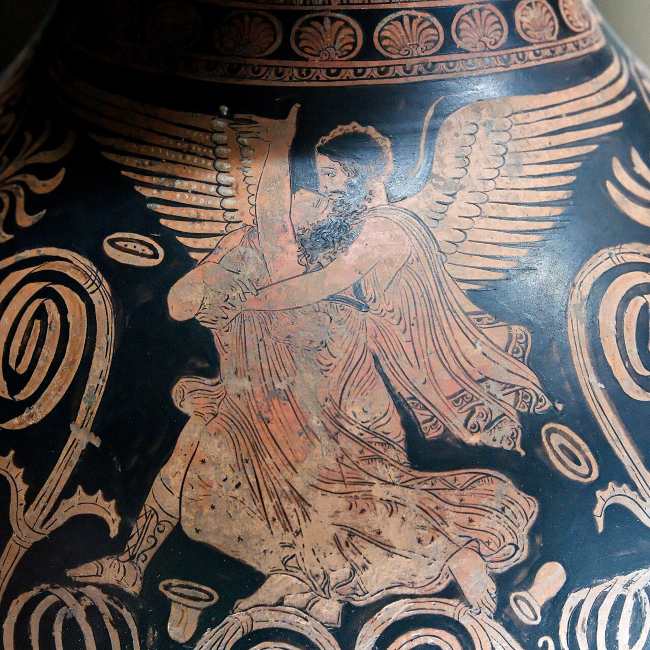
I’m getting on in years and can’t be seen using my old man strength to beat up stringy teenaged looking dudes like Apollo. Naked in sandals is a good look for Playboy models, but it doesn’t fill out the divine male wardrobe very well. I knew I needed to go shopping for a harder dude than Apollo. After all, I just finished off Boreas, and look at him:

See, that’s what I’m talking about. A worthy opponent. He’s got wings, and unlike Apollo, he can grow a righteous beard. He’s kidnapping chicks and taking them north, just like I did. Apollo is minor league stuff. I need a worthier opponent.

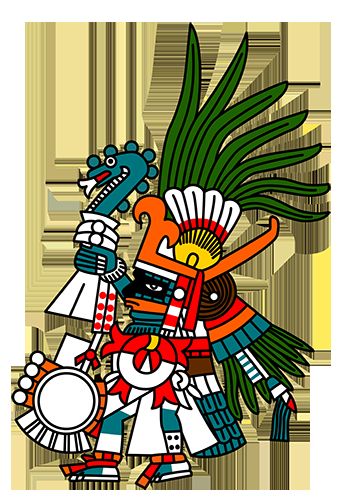
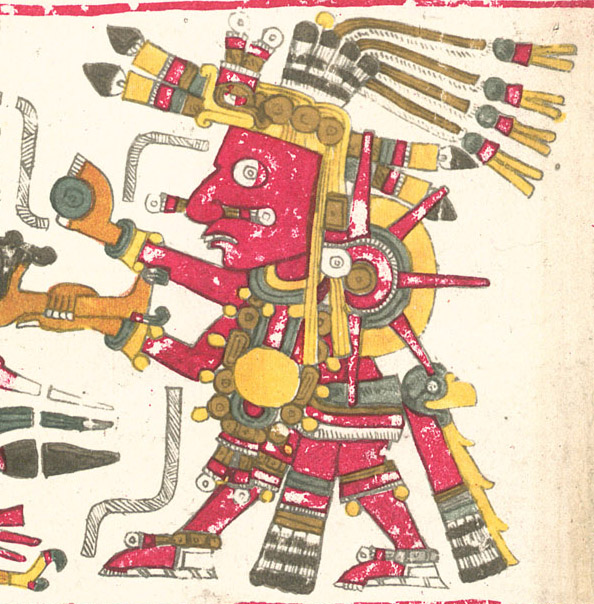
We’ll have to shop around more. Hey, how about the Aztec Sun God Tonatiuh:

This is more like it. The Simpsons style drawings are kinda hard to decipher, but he looks fairly formidable compared to Apollo. What’s his story?

The Aztec sun god Tonatiuh was seen as the active force that drives the sun across the sky, and in the Aztec view, he required constant nourishment through human sacrifice to maintain his strength and ensure that the sun would continue to rise each day. As the ruler of the Fifth Sun, Tonatiuh embodied the idea that the universe depended on a reciprocal relationship between gods and humans, where people had to offer their blood in return for the gods’ self-sacrifice that created the world. Without these offerings, Tonatiuh would weaken, threatening the movement of the sun and the survival of the cosmos itself.

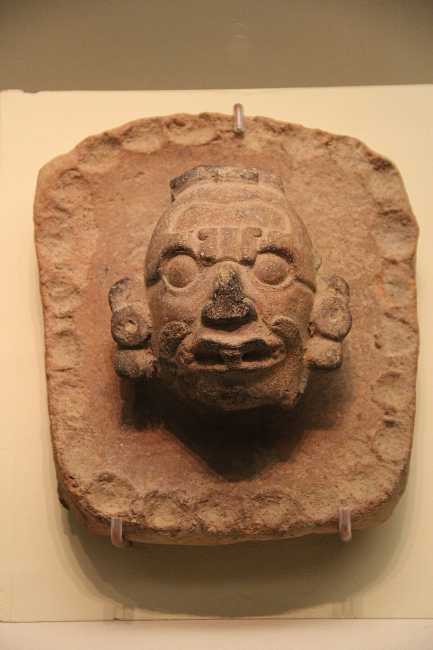
Hmm. Might have bitten off more than I can chew, there. Let’s try the Mayan version of a sun god, Kinich Ahau:

Not exactly Cary Grant, but he’s doesn’t have one of those heads with an extra set of teeth that pop out when they’re menacing Sigourney Weaver or anything. What’s his story?

Kinich Ahau was the Maya sun god associated with daylight, warmth, and the life-giving power of the sun, often depicted as a youthful figure with large, sometimes squinting or crossed eyes, jaguar-like features, and solar symbols marking his divine nature. He was closely linked to kingship, as Maya rulers were believed to embody or channel his power, and his role was tied to maintaining cosmic balance, agricultural fertility, and the orderly passage of time. Rituals in his honor did not center on large-scale human sacrifice but instead focused on symbolic offerings and bloodletting ceremonies, in which nobles and rulers would draw their own blood—often from the tongue or ears—to communicate with the gods and sustain the cosmos, reinforcing the idea that divine and human realms were interconnected.

So the Aztec sun god Tonatiuh wants your heart torn out and shown to you to keep the temples humming. The Yucatecan Mayan god only demands Curad cuts to guarantee the orderly passage of time. Mexico it is, but it looks like the Yucatan peninsula is more our speed.  Tonatiuh is the equivalent of a daily IRS audit. Kinich Ahau sounds more like an occasional bad currency exchange rate. We can handle that. Shine on!

The Nose Under the Tent Smells Coffee

I’m back in Augusta, Maine, where it’s impossible to find a good cup of coffee. Bear with me while I refer back to Mérida, Mexico, for contrast, where it’s nearly impossible to find a bad cup of coffee.

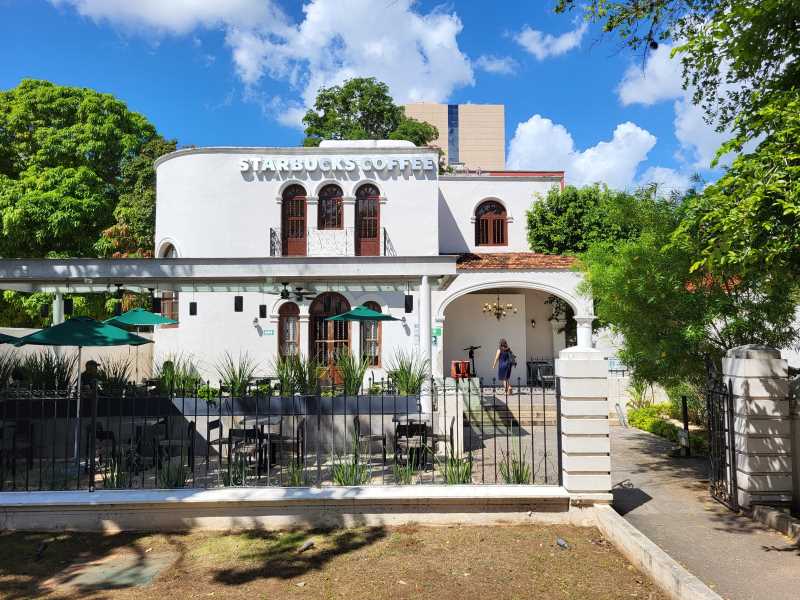
Well, there’s at least one place you can find a bad cup of coffee in Mérida. It’s right there on the big ol’ boulevard, the Paseo Montejo:

Therein lies a tale, and a telltale.

Now, I’ve been in a Starbucks three times during my long and tedious life. It was so memorable that I can recall each episode. Then again, I still remember breaking my ankle pretty clearly, too. To me, Starbucks is just like jail. Sensible people don’t go to the jail and ask to be let in. I have to be dragged there against my will.

I freely admit I did the thing. I asked for a small, black cup of coffee. It’s what I wanted, so that’s what I asked for. The counter hippies’ eyes roll back in their head if you do that. “Sir (pronounced cyr, but understood to mean: F*ck you, Charlie), wouldn’t you prefer a Limitless-Mega Venti-Quadrophenic-Unfat-Evinrude Foamed-Ultra Acid-Double-Obstreperous-Diabeetus Cloudburst-Catmilk-Praline Infused-Tannic-Triple-Pumped Pumpkin-Spice-Upside-Down-Mocha-Swirled Macchiatoccino™?”

After about fifteen minutes or so of haggling, you can get them to make you a cup of black coffee if you hang in there. It tastes like a burnt orphanage, and makes you about as sad. Walking out of the place is like free acupuncture, though, what with all the daggers they’re looking at you with.

Back to Mérida. I was living a few blocks from the Starbucks last month. There were at least three places to get superb coffee even closer. We stumbled upon the Esquina Barista on Calle 62 one afternoon, while looking for something else. It was about 150 degrees out, but they had air conditioning to soothe our fevered brows. The place was tiled in big, square marble tiles, and looked sharp all around. They had one of those nifty Italian-looking coffee makers that hisses and steams like the counter help in Starbucks when you order a cup of black coffee. They grind the beans per order. A cafe americano costs 60 pesos, about $3.25.

If you wanted the French version of the coffee shop, we could walk around the corner to the Café Créme. It’s a good restaurant, if a bit funky. The place looks like Vietnam in The Quiet American. There’s a big interior courtyard for breakfast and lunch filled with palm trees, pockmarked stucco walls, faded paint, and adorned with tall, shuttered doors with a handful of louvers nicely askew to complete the vibe. You can get an americano in there for 40 pesos. Fantastic.

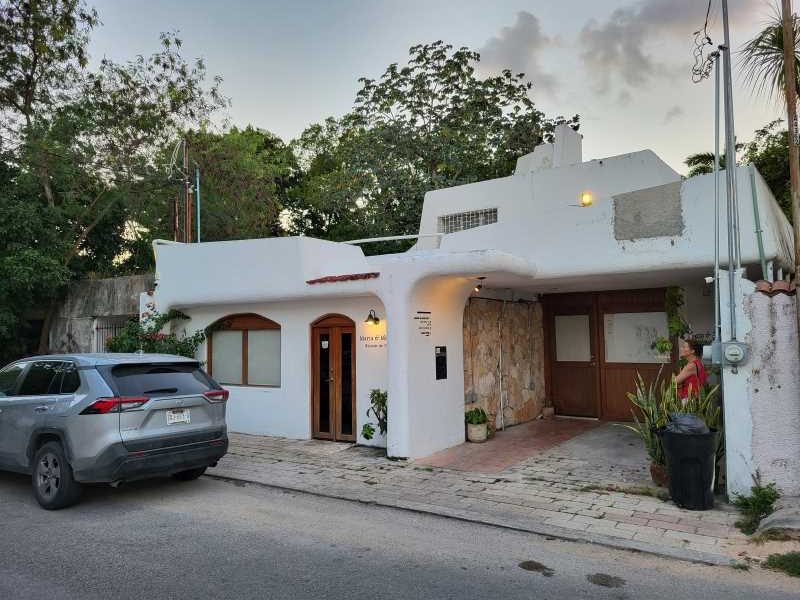
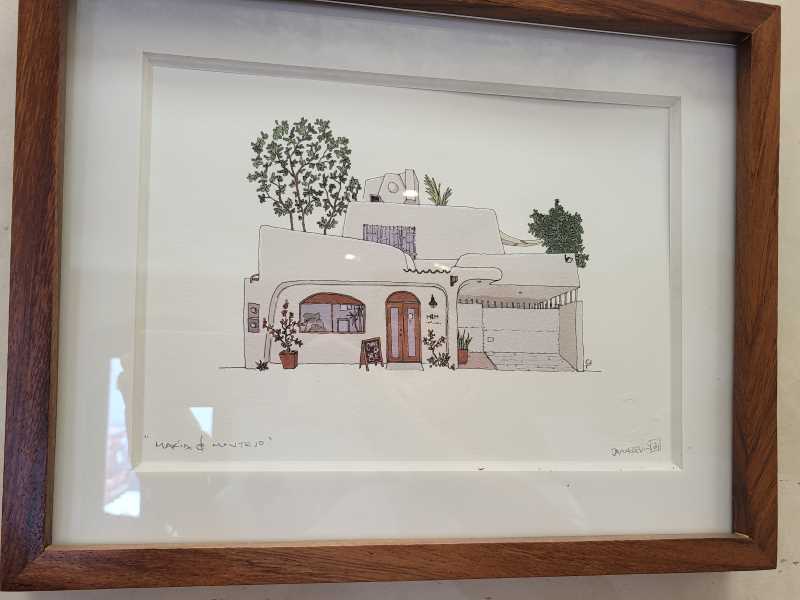
We discovered pretty late in our sojourn that there was an even better place about 200 yards from our casa: Maria y Montejo. It’s a wonderful little cafe that looks like hobbits built it.

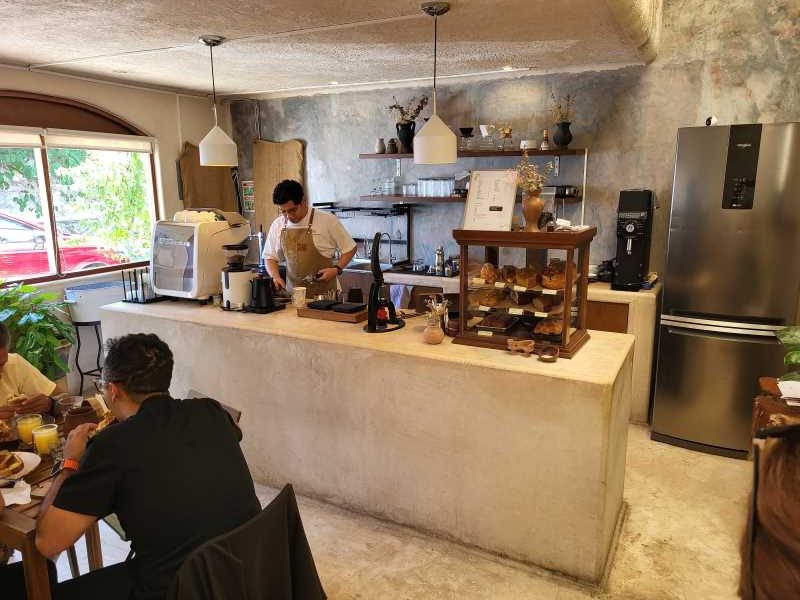
That picture was taken after it closed for the evening. When it’s open, the shades are up, and there are bistro tables and other bric-a-brac on the sidewalk to enhance its appeal. It bustles. Here’s the interior:

That guy right there in the apron. An artist. A warrior. A genius. A demigod. They do that press thing where they grind the beans finer than moon dust,  put it through that transmogrifier to make coffee crude oil, and then measure in hot water from a little watering can to get it perfect. I had at least ten cups of coffee in that place. There was no variation in them. They were all perfect, and exactly the same, though he made each one with a process, not a pre-measured anything. I was actually kind of in awe of the guy. He was friendly as hell, and humored me while I butchered Spanish at him. He never tired, and never faltered. He loved what he was doing, and it showed.

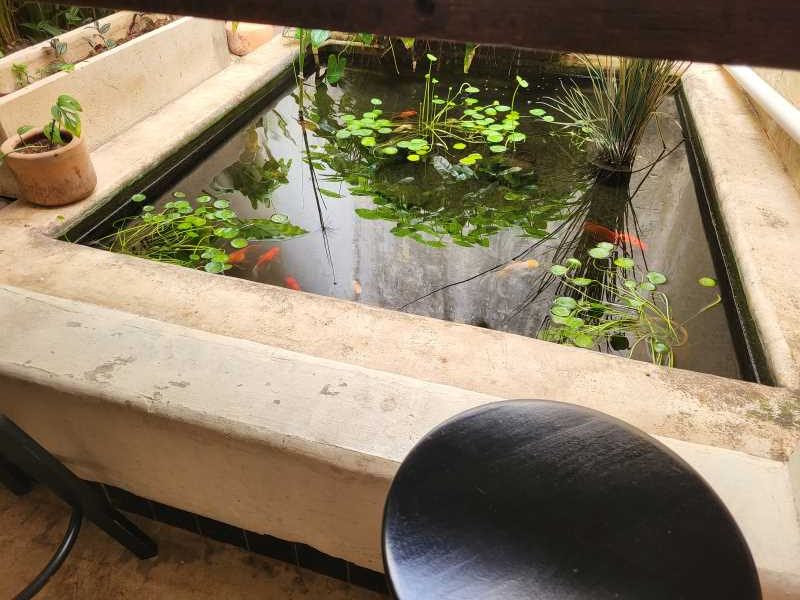
There were six or eight tables scattered around the wee place, and some stools at standup bar, but they still had room for a koi pond:

In our first trip in, my wife ordered one of those bear claw thingies in the display case. The magician behind the counter made our coffees, but the waitress disappeared. My wife tried to explain that she also wanted one of the rolls, pointing to it over and over in the case, while everyone looked confused. The waitress appeared from the back, with the roll, heated up, slathered with frosting, and packed in a to-go capsule. We’d become so accustomed to bad service in our home country, we caught ourselves looking for it everywhere. It’s not to be found in Maria and Montejo.

We ate lunch in there, too. If I told you I ate grilled cheese, both times, I’d sorta be lying. They call it grilled cheese, and it was made from bread with cheese in it, but it would be criminal to describe it simply as grilled cheese. The cheese was made from the milk of the Cattle of Helios, I think. The bread was manna, I gather. They serve it with this little cup of spicy tomato soup to dip it in, to shift you from ecstasy to flat out seizures. But it’s just grilled cheese, somehow.

So Mérida is filled with places like that. The cafes are run by families and like-minded people working together to deliver the best product they can at the lowest price they can manage and still keep body and soul together. They greet you like a friend when you come in. The interiors are varied and interesting. The signage is just enough so you know where you are.

But America has come to Mexico. Franchises. McDonald’s and Subway and even I-freaking-HOP. It’s only a matter of time until places like I described are subsumed in a tidal wave of enshittifcation. They’ll close up shop, and end up glaring at you over a minimum wage, soulless, franchise counter, just like they do here.

You can’t compete with a coffee shop that trades on the Dow Jones, no matter how bad their coffee is. I’ll salute them while they try, though.

Que Paseo

Well, I’ve been blabbing about the Paseo Montejo over and over. I suppose I should show you what it’s like. This poses problems. It’s easy to characterize it simply as a big boulevard that runs north and south in the middle of Merida, Yucatan, Mexico, because it is. It’s also all kinds of other things, because Mexico. You’re bound to see most anything while walking down the Paseo, and probably will. Something unpleasant is pretty rare, but other than that, the bets are off. Let’s see if I can demonstrate what I mean.

Here’s what it looks like in general, from a pedestrian’s point of view:

There’s another sidewalk just like this on the other side of the street. There’s a median strip in the middle, too, filled with flowers and trees and people trying to cross without becoming pavement pizza. It’s a busy street.

There are bike lanes on both sides of the street, too. In the US, bike lanes are an urban ornament. Everyone votes for politicians who want bike lanes, who get them installed, and then everyone votes with their ass in their Chevy Tahoes to avoid them. It’s not virtue signalling in Merida. People really do bike in these lanes, and at the drop of a hat, the city closes down half the Paseo, and lets people ride on that all day, too.

The bottom (southern) end of the Paseo is called the Remate. It’s lorded over by a statue of the Montejo boys.

The Montejos were a father/son team. They were both named Fransisco, and there was a cousin named Fransisco hanging around confusing things further. Fransisco the younger was nicknamed el Mozo, which means “the younger.” Apparently conquistadors weren’t staying up late thinking up nicknames back then.

El Mozo is pointing north, and if you follow his directions for about forty minutes, you’ll be at the Port of Progreso on the Gulf of Mexico. That’s where his dad scurried, after the Mayans kicked his ass on the first go-round. Dad figured the Aztec-conquerin’ playbook would work in the Yucatan. He discovered that even the Aztecs thought better than to FAFO down there. El Mozo had better luck when he came back later, and he founded Merida on top of the mostly abandoned Mayan city of T’Ho’. It’s unclear why the city was abandoned. I suspect that the Maya ran out of apostrophes, and went back to the jungle to look for more.

Horse-drawn carriages, decorated with lights and flowers, are a popular thing on the Paseo. I didn’t notice all that many gringo tourists riding on them. Mostly Mexican families out for a lark. The neon sign on the right is the famous Cafe Impala. It’s been in that spot since 1958. If you’re wondering how it got its name, you won’t have to wonder long. There’s half a Chevy Impala sticking out of the wall over the awning.

People mostly sit outside in the evening at the Impala. There’s a legion of feral but tame cats that sit under the tables and perform janitorial duties. They’re completely unafraid of the diners, but it’s nearly impossible to touch one of them. Why do cats know exactly how long your arm is, plus three inches, but the arm’s owners don’t? It’s a dark and bloody mystery.

When you’re done eating at the Impala, you can wander up the street to the Dulceria and Sorbeteria Colon. It’s been thrumming with customers since 1907:

The cats either don’t like commuting this far up the Paseo, or don’t like ice cream, so you’ll have to talk to your family instead of making psss psss noises.

The street is lined with colonial mansions like this one. This was about the richest street in the world around the turn of the twentieth century. The Yucatan was home to henequen plantations. Henequen fibers made the best rope in the world, so the city got rich, and people lived like emperors in big mansions like this one. Then plastic rope turned the place into a ghost town. The mansions are mostly turned into banks, event halls, restaurants, upscale hotels, and…

Honestly, America is an infection at this point, not a country. The last thing Anywhere Mexico needs is an Eightbucks Coffee house. We could walk to four superb little cafes and coffee shops from our house to get cold press ambrosia for less money, and we did. But it was kind of amusing to walk by this place, and the mission-style McDonald’s and other anglo franchise places. Humorous like watching a four alarm fire in a law office, I mean.

Some of the conquistadors have fallen on hard times:

There’s still a fair bit of rubble in Merida. The city is about halfway to restoring all the old abandoned colonial buildings into fashionable homes, shops, and restaurants. The Montejo Palace Hotel wasn’t colonial. It was some sort of midcentury concrete monstrosity. The address was valuable, though, and they are building/rebuilding a ten story something on this lot. Most of the city is only one or two stories high, and it’s kind of a shame to see towers going in.

Across the street, there’s a new, swanky hotel called El Conquistador. When I said that you’re bound to see most anything while strolling the Paseo Montejo, I wasn’t kidding. Get a load of this new batch of conquistadors:

Aren’t you a little short for a storm trooper takes on a whole new meaning in Merida, where the centers on the high school basketball teams are 5′-7′, or would be, if anyone played basketball here, which they don’t. I’m pretty sure I could have bopped all three of these fellows on the top of the head and gotten away with it. My wife said she figured it was a million to one against seeing Darth Vader on the Paseo Montejo.

I told her to never tell me the odds when I’m walking down the Paseo Montejo.

Tag: the other Mexico

Find Stuff:

Archives