By The Messalonskee

Great piece of film making. It’s as much a lost art as the work in the ax factory.

I’ve been through Oakland, Maine. It’s near Ogguster (the capital) and Waterville (a somewhat large but  somewhat downscale city). The Messalonskee Stream is pictured and mentioned in the video. It widens out after that and becomes a creditable lake. The population of Oakland has doubled since this video was made, but that’s not saying much. About 6,000 people live there. There are a lot of towns in Maine with about that many people bothering their neighbors in them.

These fellers all have Yankee-sounding names. Maine was like that back in the day. It’s not like 1965 is ancient history or anything. These guys are old enough to be my grandparents, or maybe an older uncle. I worked in construction with guys like these when I was young and they were looking forward to a gold watch, a two week-vacation in Florida, and their complimentary myocardial infarction. They’re hardly mysterious to me.

Of course axes used to matter more in the twentieth century than the twenty-first. Firewood for heating fuel is still a thing here, but it’s dying out now. In 1965, I’ll bet lots of Mainers felled and split their own. I’ll bet Earl and Elwood did.

If that factory was still open, I’m pretty certain they could be selling fancy axes for beaucoup bucks on the interwebs. Making axes is one of the intertunnel’s favorite things for cubicle dwellers who want to feel outdoorsy for a few minutes. They watch videos of people making fancy knives and axes and medieval armor, and then go back to working on their fluorescent light tans.

People might snicker when the narrator mentions that Elwood makes $1.25 an hour making axes. Not many would bother to do the arithmetic to figure out what kind of travesty that might be. The narrator certainly seemed to think it was some kind. He mentions that Elwood will leave to get a buck bump in his wage just by pushing a broom in a Connecticut factory. I’ll bet he’s obliquely referring to the Collins Ax factory in Connecticut. I’ve been in the Collins Ax factory building. It’s offices for interior decorators and dentists and stuff now. I also own a machete made in the Collins Ax factory, that I bought in Guatemala, but that’s a story for another day. Stanley Tools bought Collins, I think, and closed it down in 1966, so Elwood would have been out in the cold anyway, and far away from home to boot.

The median wage for an individual in 1965 was $3,360 per year. If you worked 2,000 hours per year, that’s about $1.68 an hour. I’ll bet everyone at the ax factory worked more than 40 hours a week, 50 weeks a year, so while they weren’t getting rich, they weren’t starving compared to everyone else or anything. And it was cheaper to live in Oakland, Maine than most of the rest of the country. Still is.

So if Elwood worked 2,000 hours a year at that rate, he’d make $24,360, if we adjusted for inflation. The median income in Oakland Maine a year or two ago was $34,934, although it’s lower for women, at $24,286 per year. That’s probably because there are only two types of jobs in Oakland. Construction, usually heavy, and being clerks in schools, hospitals, and the government. I’ll leave it to you to decide who does what.

So work like the Pioneer Ax factory had to be shipped overseas. It would have been fairly simple to update the processes shown in the video to increase production, increase wages, and make life somewhat easier for the workers. How hard would it have been to bump Elwood’s wages to match today’s median in Oakland? Not hard. But it was more profitable for a few people who farm mahogany in skyscrapers to ship all the factories overseas, to make axes in conditions far worse than shown by the banks of the Messalonskee, for slave wages, and then sell very shitty axes in Home Depots nationwide. The payoff for this creative destruction was the creation of lots of paper-shuffling jobs that pay less than the crummy wages mentioned in the video, but that anyone can do, because they’re not doing any real work.

We didn’t choose, but whoever chose for us chose very, very wrong.

OK, Everybody; Let’s Play: Find The Bank!

One of these descriptions is how a bank is run. The other one is how a pawn shop is run. See if you can identify which is which.

Situation 1: People need to borrow money. They put up collateral against the sum they need, after a gimlet-eyed appraisal by the lender. The borrower pays a non-adjustable rate of interest on the money. There is usually a balloon payment due at the end of the term to repatriate the collateral. If the borrower defaults, the lender keeps the collateral and sells it to others more able to afford it.

The deals are essentially made between the two parties with a handshake. The lender uses his expertise, hard-won in the marketplace, and subject to the immediate loss of capital should he mis-appraise more than a handful of items in a hundred. If the lender dips into the funds he keeps on hand that allow him to supply the liquidity his customers demand, to squander on his own amusement or speculations, or if he tries to capture business that he is not prepared to handle for a short-term bump in his notoriety, or to monkey around with the short-term look of his balance sheet, he will immediately go out of business. Since his business is predicated on good relations with his customers and his neighbors in his local community, the lender strives to keep on genial terms with the public.

The lender relies on other experts from time to time, but generally relies on his own good sense. The borrower is in an equal, or superior, position to the lender in determining the value of the property he uses for collateral, as he is in possession of it already and knows its provenance. In any case, the terms of the loan are entirely straightforward and immutable and agreed upon by both parties with no proxies. The lender does not employ any strong-arm tactics to make the loan, and certainly does not need any when the borrower is in default. He simply takes over possession of the asset in a perfectly straightforward and legal process and sells the asset  if he can.

Situation 2: People need to borrow money, so they put up capriciously appraised collateral, sometimes that they don’t even fully own, and/or submit to a byzantine, arbitrary, personal appraisal of their financial affairs made by a slew of shady and disreputable third parties. Both the lender and the borrower know that the third party appraisals are akin to a farce, but neither really cares about the long-term viability of their transactions. The borrower generally has no intention of following through on the terms of the loan all the way to its end, and will try to foist his obligations or the original collateral off on another party in the interim. The lender likewise has no intention or expectation of the loan being paid off on the terms on which it was made, and may secretly desire the borrower to default on the deliberately convoluted and intricate terms so that the borrower’s obligations can be increased. Sometimes the lenders repatriate collateral from defaulted loans that they don’t even really want, by force, and then just destroy it to appease some kind of lust for destruction or as a warning to others, or more generally as part of a Minotaur-worthy tax evasion scheme.

The lender generally slips the loan into a weird, giant package of other loans, which is then sold to other, unwitting lenders under the guise of a business opportunity. These lenders who would be left with little or no recourse if (and more generally, when) the borrower defaults on his loan.

Other types of loans are made without collateral by these same lenders. They employ a capricious and sometimes draconian sliding scale of interest rates, penalties and fees, deliberately obscured from the borrower to entice them to borrow money at one rate while allowing the lender to collect the loans at a much higher, often usurious rate. If the borrower doesn’t pay, the lender begins a non-stop campaign of threats and harassment against the borrower, often hiring vicious and unscrupulous third parties to collect the debts for them, regularly using a campaign of terror that involves the destruction of the borrower’s reputation in his home, neighborhood, place of business and among a multitude of government agencies, where many unscrupulous bureaucrats are willing participants in the swindle, and often receive payments from both parties in the disputes.

The lenders are not well educated or experienced in the forces of the marketplace, and simply join breeder gangs of like-minded persons, many with bizarre initiation rituals among members of a self-selecting and homogenous elite. They are bullheaded, extravagant, and greedy, often dipping into their funds to speculate wildly in all sorts of shady enterprises, mostly using inside information, and regularly secretly betting against their public positions in the market and against their own customers. They are not afraid of a loss of capital because they are adept at skimming money from insurance scams, looting retirement funds, tax evasion, and other government swindles, counterfeiting, and when all else fails, they terrorize entire communities with the threat of taking everyone with them when they go down.

OK, take a crack at it in the comments. Which is the bank, and which is the pawn shop? But remember, no wagering! I’m not running a casino here, which is like the stock market, but with fewer gangsters.

[Note: This post was edited and updated, but legacy comments were preserved]

I Want To Watch This More Than Anything

What’s not to like?

Hot foreign-ish babes in Reynolds Wrap dresses.  Chinstrap beards. Water buffalo and Star Trek hairdos. Suits and ties. Heavily sedated emcee. Nunchaku earrings. Some sort of percussion lackey, trying to look busy so he doesn’t get asked to carry anything heavy after the show’s over.

I don’t know much, but I’ll bet that drummer could kick Chuck Norris to death with that right foot.

Great Moments in Maine Real Estate

Shopping for houses in Maine is a total scene, man.

Sorry, I lapsed into hipster mode there for a minute. But I stand by the sentiment. If you hit up Realtor dot com and poke around you can find all sorts of wonderful things, in the true sense of the word “wonder.” You wonder what gets into people’s heads. Maybe the hats with the flaps we all wear in Maine are cutting off the air to our brains, and leading to all kinds of metal disturbances, like buying ceiling fans for every room in a house just outside the Arctic Circle.

Here’s a recent, generous helping of some of Maine’s great moments in real estate:

Many Mainers don’t read no good. They see a flyer from Home Depot that touts Kitchens and Baths, and decide that it’s a single entity.  Or perhaps they’ve been watching any one of the seventeen hundred botoxed hosts on home and garden television telling them to take down all the walls in their home to achieve an open plan. Sooner or later, the bathroom walls inevitably become the last frontier to conquer. Now, it’s possible that they’re only storing a toilet in the kitchen temporarily, but I wouldn’t bet on it. People in Maine get shit done, and in every room of the house, too.

These fine folks have installed their own personal convenience store in their foyer. The realtor touted it in the description, so I assume this sounds like a good idea for a substantial portion of the local populace. Of course it’s a long time since I’ve attended school. It’s possible that they’ve updated the food pyramid in the intervening years. Perhaps the layers are now: fructose, sucrose, glucose, Sweet ‘n Low, and xanthan gum. An attentive mother would make sure her brood got enough of each, for as long as they can fit through that door, anyway.

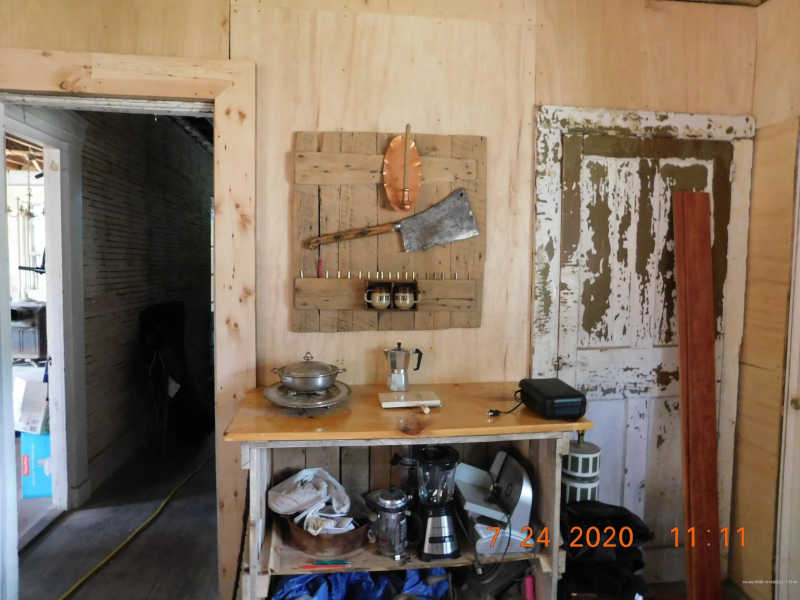
Ah! Cleaving by candlelight. That’s romance. As the eye wanders, it eventually rests on a deli slicer on the shelf below. These fine folks are hell bent on two-dimensional meat. Perhaps I’m just a nervous Nellie, but if I was the realtor taking this picture, I’d hesitate before heading down that dim hallway with the extension cord on the floor, and no plaster left on the walls. There might be a an electric bone saw back there.

The tarpaulin walls are fantastic, of course. But it’s close to decorating genius to add the blue tarp bedspread to the ensemble. I assume the denizens hired someone like Martha Stewart to pick everything out, but only had a Harbor Freight gift card for a budget. The delicate sheer curtains set off the exposed rock wool ceiling nicely, but it’s the rhino turd pillow on the bed that really completes the room.

A purple room? Check. Bats? Check. Skulls? Check. Cactuses? Sure, why not. This is what happens when you don’t buy your daughter a pony, people.


There’s so much concentrated awesome in this room I don’t know where to begin. Shockingly, it’s in a trailer park. Whoda thunkit? I’m not sure what kind of ceremony this joint is set up for, but after you put on the fright mask on the left, crank up the King Crimson record to jackhammer volume on those JBL speakers, and pay your obeisance to the gods of African fauna and WWF grappling, a guy can really get some quilting done.

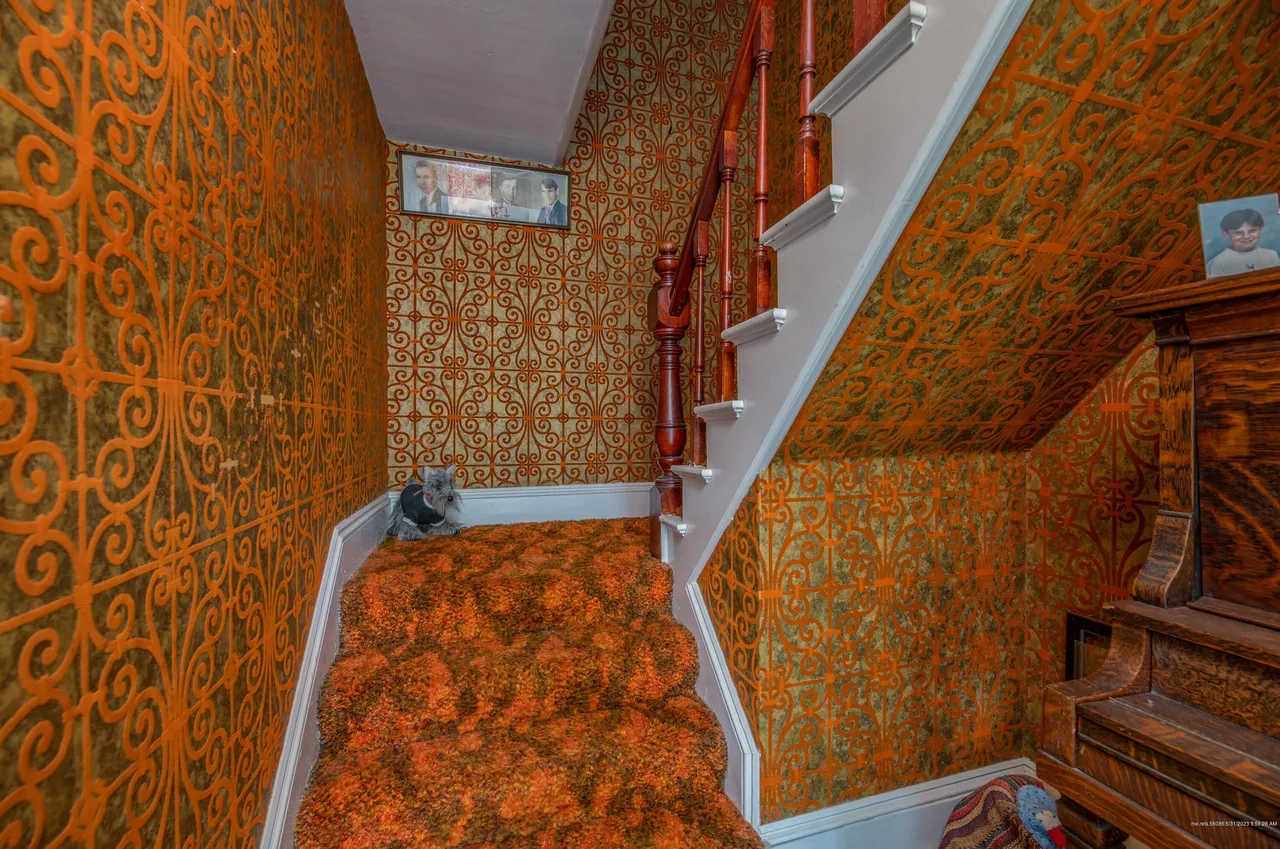
I do believe the piano has lingered in this stairwell too long, and its woodgrain is attempting a chameleonic transubstantiation to adapt to its surroundings. The dog has been afraid to move since Nixon’s first term, but he’s probably OK. The owners are no doubt saving up to get a dog with three heads to properly guard the landing, but he’ll do in the interim.

The Varykino Gambit

Ever watch Dr. Zhivago? It’s a David Lean movie. Made all sorts of money. It’s a tale from Russia, with love. The love part was a minor problem back in the day. Lots of critics, who are almost people, but not quite, objected to what they saw as mundane romantic subject matter ladled over titanic upheavals. They didn’t get it. They wanted the movie to be about the Soviet Union, portrayed as either very bad or very good, to taste. Some would have preferred the usual war is bad theme. Yes, deep thoughts there: war is bad. Thanks, I had no idea.

David Lean liked stories about (more or less) regular people caught up in great events, just trying to get by.  For a backdrop, Zhivago had the end of WWI for Russia, the founding of the Soviet Union, and a civil war. It’s an excellent example of the old saying,”May you live in interesting times.” That sentiment sounds attractive to some ears. I see a lot of people nowadays wishing for great upheavals, morning, noon and night, because things aren’t going their way, or they are, but not fast enough to suit them. It’s actually a curse, not well-wishes. The Strelnikovs of the world, portrayed here by Tom Courtenay, want to live in interesting times, because big upheavals are the only opportunity they’re going to get to get ahead. They’re just cranks with pamphlets in uninteresting times.


Robert Bolt, about the greatest screenwriter I know of, tried to cut the critics off at the pass with that scene, but they’re up a stump and can’t ever come down. They can’t get it through their heads that trying to live a normal life in abnormal times can not only be commendable, it can be heroic. Movie critics have always had more in common with Strelnikov than Zhivago. They can’t relate to a normal person, even if they happened to meet one, which is highly unlikely.

When the nutters finally get the upper hand, their one, true wish is to extinguish the private life. Everything is political. This makes perfect sense to them, because they’ve suffered from scoliosis of the soul for so long, they don’t even recognize someone standing upright anymore. Or more to the point, they recognize any attempt at normality as a frontal assault on their worldview. On the bus, or under it. And by the way, the bus is full.

There’s a more nuanced explanation of the problem earlier in the film. Zhivago’s half-brother, Yevgraf, is an important secret policeman. Strelnikov is a famous terrorist, and he is admired or feared depending on whose ox you’re currently minding in Minsk. Yevgraf doesn’t do anything spectacular like burning villages for collaboration or just for shiggles or whatever. As Strelnikov says, “The village betrays us, the village is burned. The point is made.” It takes a village is a double-edged sword, apparently.

No, Yevgraf is the real deal. He’s not a would-be commissar on the make like Strelnikov. He’s already part of the big club, and wields a big club in everyone’s affairs. He shows up unexpectedly just as the locals in Moscow are hounding his estranged half-brother, rioting in his living room, and Yevgraf simply has to walk into the room to make his point.

Strelnikov uses his little army to scorch the earth to make a point, which may or may not be pointless, by his own admission. Yevgraf simply snaps his fingers, like a conjurer, and his will is obeyed without even being uttered.

Yevgraf visits with his brother, and listens to his views on the events in Russia. By any regular standards, Yuri Zhivago is a harmless person. Commendable, even. He even professes a bit of admiration for the revolution. Yevgraf comments, in his head by voiceover, that his brother’s enthusiasm for The Party, the only game in town, is subtle, and that is the equivalent of walking around with a noose around your neck in revolutionary Russia. So, to paraphrase The Dude here, Strelnikov isn’t wrong, he’s just an asshole.

Yevgraf advises Yuri to leave the city and live obscurely in the country, in Varykino in the far-flung Urals, and he fixes them up with a pass to do so. He understands that his brother will never be able to stay alive in a milieu where every act and utterance, no matter how mundane, is a political football. His brother is a poet. Ambiguity is his business. Hell, in that atmosphere, even doing or saying nothing is a political act. Any of this sound familiar yet?

The author of the novel that the  Zhivago movie is based on, Boris Pasternak, knew what he was talking about. He was Russian intellectual who refused to leave the country, no matter how bad it got. He was 27 years old in 1917, so he had a front-row seat for all the fun. He was a poet with a convoluted love life, just like Zhivago, despite a fairly close resemblance to Lurch the butler. And he tried, somewhat successfully, to just live in a world where that was made pretty hard indeed. Pasternak’s real-life version of a finger-snapping savior might have been Joe Stalin himself, who reportedly crossed his name off a list of people to be executed with the remark, “Do not touch this cloud dweller.”

It’s funny, but the critics got the world exactly backwards, like they mostly do. How you order your private life is a profoundly political act. Hell, in a world where everything is political, just living life on your own terms is a revolutionary act. You can say, “The private life is dead, for a man, with any manhood,” and make me listen to you at gunpoint. But you can’t make me cooperate.

My family has long since moved to our own Varykino. And what have I been doing there? Just living, and the living’s not easy. But I’ve got one thing going for me that Boris Pasternak, and his creation, Dr. Zhivago would have been wise to emulate. I’ve completely avoided the library in Yuriatin.

Month: June 2023

Find Stuff:

Archives