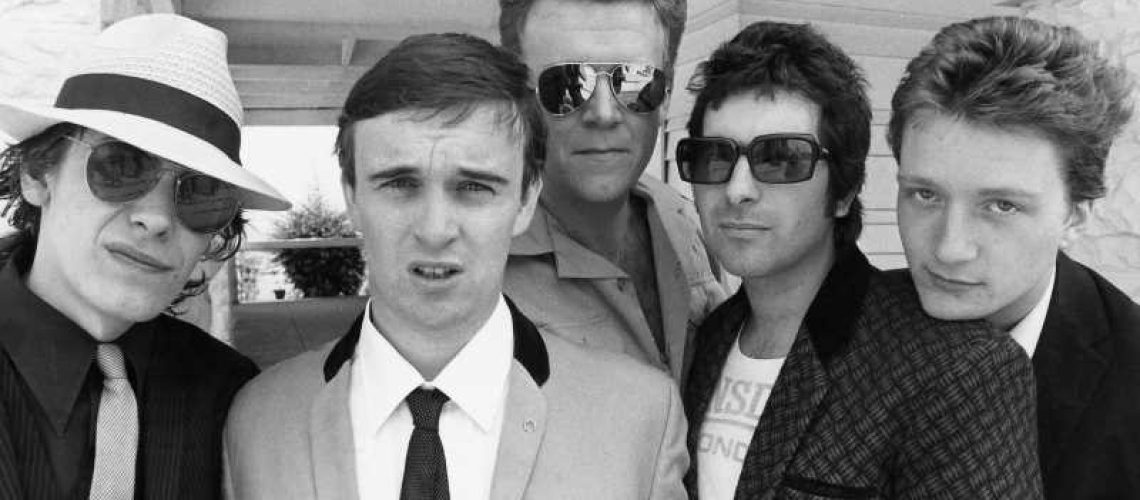

Squeeze from 1979, from the Cool for Cats album.
Cool for cats, indeed. That’s only their second album, and they look it. They’re as fresh-faced as high-schoolers in that video. I’m always impressed when musicians are that young and that sophisticated about the songs they write. Mostly the lyrics. Lotsa musicians are capable of playing their instruments like demons and singing like angels before they’re old enough to drink. But writing lyrics, or much of anything literary, is not generally for the young, or the young of heart.
There’s a reason why most rock music is singsong doggerel. Tonight I’m Really Gonna Rock You Tonight shouted over three chords is about right when you’re brimming with hormones and luxuriant of hair. By the time the requisite amount of world-weariness is stored up to say anything really interesting, never mind profound, you’d feel silly still being a rock musician. If you were capable of feeling silly, I mean. Rock music’s HR department generally starts off every interview with, “Are you capable of feeling silly? No? Great, this is the profession for you.”
“Up the junction” is a UK expression. It means something like up the creek without a paddle. It’s interesting that the title of the song, which is generally beaten half to death in the choruses of the average ditty, doesn’t even appear until the last line of the lyrics. And there is no chorus. Notable, that. It just sort of climbs a little staircase of chords to increase the tension in the song as it bumps along.
I’m not put in mind of other musicians when I listen to this. It’s Tony Richardson. He directed well-known Kitchen Sink dramas like Look Back in Anger:
Difford and Tilbrook, Squeeze’s songwriting duo, are too winsome to “eat the scenery” like Richard Burton always does, or take a hard line like John Osborne, who wrote the play Look Back in Anger is based on. But there’s definitely a taste of Kitchen Sink honey in Up the Junction. The examination of working class people, hinting at the inevitability of everything good or bad in a Clapham life, followed by a general disaffection with the life that’s doled out, which leads unerringly to a crackup, is pure Kitchen Sink stuff.
John Osborne’s endless stream of rat-a-tat pissing and moaning could never compete with this couplet:
The devil came and took me
From bar to street to bookie
And Squeeze finishes up with the kind of denouement any writer dreams of writing, and usually misses by a mile:
Alone here in the kitchen
I feel there’s something missing
I’d beg for some forgiveness
But begging’s not my business
And she won’t write a letter
Although I always tell her
And so it’s my assumption
I’m really up the junction
Toe-tapping flash fiction, that.
5 Responses
Great lyrics really make the music/song IMHO.
Ditto on the great lyrics. For millennia, poems rhymed. Nowadays, them as call themselves poets seldom write verse that rhymes. Robert Frost rhymed, but he died 6 decades ago. You need to go to songwriters to get verse that rhymes.
From the way the song went, it was not difficult to infer the meaning—or approximate meaning—of “up the junction.”
Which reminds me of Junction, Texas. I have passed through Junction while driving or hitchhiking. Perhaps the most famous Junction native is Coke Stevenson, Governor of Texas from 1941-47. He is best known for his loss to LBJ in the 1948 primary for the Democrat nomination for US Senator. LBJ won the primary by 87 votes, due to ballot stuffing in South Texas. That was far from the only example of ballot stuffing in South Texas. I have read that LBJ lost the 1941 primary because of ballot stuffing, and swore that he wouldn’t let that happen again. JFK got on LBJ’s nerves by calling him “Landslide Johnson.”
I had also read some claims that Coke Stevenson had also benefitted from ballot stuffing in his political career, but LBJ’s biographer Robert Caro refutes that claim. Should be easy to check—find out the vote in Duval County for the 1941 Democrat primary.
Ladybird Johnson called a classmate in my brother’s elementary school class after he wrote a letter in favor of her highway beautification program. An astute politician, that woman. Took two minutes out of her day, and won a lot of goodwill. No accident that LBJ consulted his wife on his political moves. She also had some guts. In 1964 she took a whistlestop railroad tour of the South in support of the recently passed Civil Rights Bill. That was not a tour for the faint of heart.
Hi Gringo- The wiki entry about Coke Stevenson is quite a rollicking read. What an interesting fellow. The real kind of interesting, not the hair on fire kind of interesting we have today.
I am a poet and you’re mostly right. My work doesn’t often rhyme. More like a conversation or thinking out loud. Visit and decide for yourself.
Somewhere on my blog I wrote: poems don’t have to
rhyme all the time.
I still believe that.