American Idol


Sarah Vaughan might have the loveliest voice in the history of the United States.

You know, the original hit with Judy Garland is excellent. Judy Garland could sing. But not like this. This is a person who has an enormous instrument at their disposal, and is using all their effort to determine what they’d like to sing, not what they can sing. Such cultivated ability is a rare thing indeed.

She won that old version of the talent contest, the Apollo Theater Open Audition Night. It’s piquant that she just accompanied her friend on piano first, and then thought: “I could do that.” Yes, you could.

She learned to sing in church, like so many good singers do. You are contemplating the divine and expressing devotion in church. Those things come in handy wherever you go. Her singing could help a man hunched over a tablesaw to think of the sublime and important and beautiful while working, for instance. The whole wide world is an altar to worship at, isn’t it?

If you go looking for it, you can see some seedy patches in Sarah Vaughan’s background. Why do it? There she is in the video, forever preserved in a glamorous amber for you — elegant, assured; at the height of her abilities. Why go backstage and see the soiled back of the curtains; the dripping faucet in the shabby dressing room; the men that did not love her, really, just grubbed after her money, or loved her but made her life a shambles? It’s not the face she tried to show us.

The people in the talent contests nowadays can’t sing much. What singing they do is mindless melisma spittle learned in lessons suited to singing at strip-mall banquet hall weddings. And the shows they use to showcase these karaoke attention mongers are all about looking at the man behind the curtain. And the rarest of things in entertainment is any man behind the curtain that doesn’t give you the urge to wash your hand in bleach after you shake theirs. Why go there? Real performers go there because they must, because it is the place the sap is collected to be boiled down to make something worthwhile. Why would you want to lick the tree? It the maple syrup you want.

Sarah Vaughan’s singing is the syrup.

I’m Not Tired Of Tired Of Being Alone


I must be the worst blog correspondent on these here intertubes. I hardly ever point at anybody else’s blog.

I’m not in the controversy business, really. Few pots are stirred here. Grenades are rarely rolled. But the real problem is that I’m in the content business. I’m generating text, not pawing over it much. I will leave dissection of ideas and vivisection of other pundits to the professionals.

Every once in a while I emerge from this torpor and throw a link in the right hand column to people I read. I’m about four years behind right now, I guess.

“Callimachus” writes for some sort of newspaper. Whatever newspaper that is, I wish I could read it, because all the local papers here look like Highlights or Grit, only the spelling is worse. He has a keen mind, and assembles text in a lively way on an odd assortment of topics over at the blog Done With Mirrors. I think he swears sometimes, but not so’s you’d notice. He is aided ably in his efforts there by Reader Iam, who drops a comment here on this blog occasionally, and lives in one of those rectangular states somewhere I think.

Anyway, I was reading his blog yesterday and he had a list of people who share April 13th as a birthday. It was an odd and wonderful assortment, but if you know anything about me at all, you know I never got past the second entry before I went to YouTube.

Even on his birthday, he throws the party for us.

Lost In The Kerfuffle

It was the voice that would grab you.

He passed away yesterday, and he slipped below the horizon too quietly for his talents, lost in a media frenzy over a pointless kerfuffle. The fellow made me smile, and marvel at his talent. He made James Earl Jones sound like Lou Christie. Voices like that, in performance, are rare and wonderful.

What else would Sylvanus and Lovie Browne call their son, but Roscoe Lee? Roscoe was educated in literature and languages, and began his adult life as college professor. He was a little bit of a salesman after that, and then decided when he was in his thirties that he wanted to be an actor. He was always in demand.

Look at his imdb file. He has way over a hundred entries. He was a fixture on TV in the seventies and eighties, a voice over artist of the first rank, a Shakespearean actor. He won awards. He worked.

You can tell that there was a enormous backstop of cultivated talent there. The talent part only gets you so far. People who are really good performers work hard when no one is looking so it will look effortless when the lights hit them. It’s the reason why so many people think they’d make a good entertainer if they just got the chance; really good performers make it look easy. You wouldn’t. It isn’t.

Roscoe Lee Browne could jape with Carroll O’Connor, hit his mark, and deliver his line in the French accent he didn’t have to learn because it was catalogued in his head already. He knew from instinct and experience how long to pause before he delivered that final punchline for its full effect. It’s a trifle, and I’m sure he knew it, like so many trifles he participated in. But he took trifles seriously. That is the true measure of the entertainer. It’s easy to be serious about serious things.

Certain actors can walk to the edge of a stage, and stand there and hold your attention. They are often not beautiful. Roscoe was not a leading man type. He could weave a little story in the air better than most any actor I could name, really.

I remember him always as Mr. Nightlinger, the cook on a cattle drive, in one of the few John Wayne movies that is a real good movie. The Cowboys. He must share a bunkhouse with the pack of young boys that are all that John Wayne can find to drive his cattle to market.

Browne has many impish and serious moments in the movie, but the little vignette when the man, an exotic man, goes in among the boys and tells a wild tale of his heritage, –the boys spellbound, but no more than the audience– is the best example of his craft I can think of. A man that knew Shakespeare and the Bible as he did knew how to say those lines. You cannot take your eyes from him, and yet you could close your eyes and let his rich, deep voice bring the tale just as convincingly. He was like Babe Ruth was; pitching or batting, doesn’t matter.

He got kinda lost in the shuffle yesterday. Someone needs to wish him well. Someone needs to tell him that they watched him in a darkened movie house all those years ago and sat up bolt upright when he boomed in that mellifluous, stentorian voice; “Children, I feel your eyes on me!”

Yes, they were.

Not Knowing What’s Not So

Well, we’ve been visiting old houses hereabouts. It got me to thinking. What’s the oldest wood-frame house still standing in the US? It’s hard, what with fire, termites, and Supreme Court Kelo decisions, to keep much of anything made of wood standing for a long time. As far as the oldest house of any kind, Saint Augustine Florida tries to pawn off a house made of a sort of seashell masonry, and New Mexico has some sort of mud hut I suspect is not really original equipment mud, but neither is made predominately from wood so let’s ignore them anyway.

I found two houses, right here in Massachusetts, that claim 1636. The provenance of the one in Beverly is a little sketchy, and their website is dreadful, so I hereby bestow the claim to the Johnathan Fairbanks House in Dedham, Mass:
(By the way, the Beverly Yacht Club is about a mile and a half from my house, which is about an hour and a half from Beverly. Everybody knows this is where you want to be.)

Anyway, if you examine the floor plan, it was originally a linear plan, about 34 x 16 feet, two rooms, really, and then had a bunch of little additions put on. McMansion, colonial style.

The additions are really ancient, too so they’re not cheating with the date. 1648, 1654. It’s not all that spartan inside, when you get a peek in there:
OK, that bedroom is 16 by 8 feet. It’s against the building code to build a room less than 7 feet wide in Massachusetts, including in a prison, so it still passes muster, barely. The building inspector wouldn’t like that firebox; too shallow, not enough hearth, not enough clearance to combustibles over the opening, not fire brick… well, the house lasted over four hundred years and Dedham has probably buried 50 building inspectors since then, so maybe they should mind their own business more. If you’ve ever used a fireplace like that you know it draws well and throws a lot of heat and light into the room.

The kitchen has all the bells and whistles:
Lessee. You got your fire, some more fire, (a bread oven) a shelf, a plate or two for the shelf, some guns to fill the plate, a hook to hang the pot. Anything else would be extravagance, really.

It ended up a four bedroom house, with several parlors, and a real privy indoors. Two holer, too. Guy must have been rich. Oops, spoke too soon. They put four more bedrooms upstairs. Mrs Fairbanks must have been tired a lot.

I’ve been in many houses almost this old, and I can assure you they are quite pleasant to live in once you update the bathroom and get some electricity and heat going in there. I can’t stand up in many of the rooms, and have to duck to get through the doorways, but that’s a little thing. The builders didn’t know what they were doing, so they relied on pattern books with everything based on classical themes. And classical Greek and Roman architectural proportions are based on the human body, and people instinctively respond to a facade that looks like a head, or a windowpane that is proportioned like a face, or a moulding based on a section of the Parthenon’s columns, which is based on a man’s stature, and so forth.

So in their ignorance, vernacular builders then knew many things that educated persons now do not, because they did not know what was not so. It strikes me, in architecture as well as many other things, we have come full circle, and must make a supreme effort to not know what is not so again.

Here’s A Teaspoon. Dig A Canal

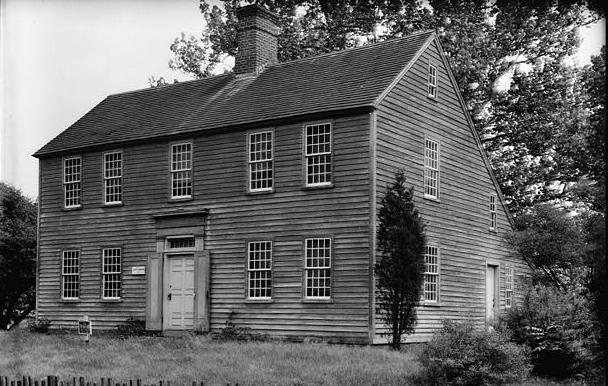
Well, we mentioned a saltbox plan yesterday, so you knew it was coming. The John Osborn House in Fairfield, Connecticut. Built in 1772, and still in the same family when these pictures were taken in the 1930s. Like every house on the northern east coast that was standing at the time, they claim George Washington slept… er, check that — had a drink of water here.

The old Osborn well further down the road had a silver tankard hanging by its side, a vessel brought from England, and here neighbors and travelers were accustomed to quench their thirsts. Tradition has it that the silver tankard which hung by the well was preserved and that Washington refreshed himself by its service.

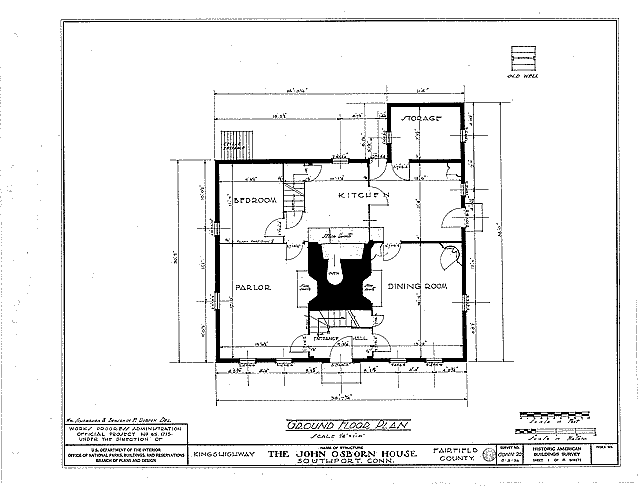
Hmmm. “Tradition has it” that Salma Hayek has been desperately trying to get my phone number, to attempt to woo me away from Mrs Cottage. A fruitless endeavor. I can neither confirm nor deny this. Anyhow, here’s the plan:

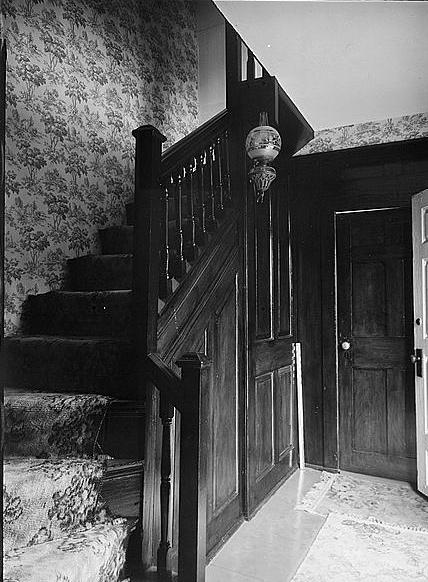
The linear plan is still discernible, and the massive center chimney with all sorts of fireboxes. The saltbox form allows two rooms to be appended on the back of the linear form. The front stairwell is little more than a ladder in a shaft,with pretensions, at this point. There’s two large chambers upstairs, along with two storage rooms under the long sloping back roof.

People were more attuned to their surroundings then, as they were at the mercy of their surroundings more than we are, and would generally turn the long, blank, sloping roof in the back towards the north or northwest, to shelter against the winter wind coming from that direction. The largest expanse of glass would be on the front facade to maximize winter sunshine getting into the house. They’d leave only deciduous trees out front, so they’d shade the house in the summer, but shed their leaves in the winter and allow the low angled winter sunshine in. They’d leave any evergreen trees only behind the house, so they’d block winter winds with their year-round foliage. Why doesn’t your developer know that? Because you have electric lights and an oil-fired boiler, and can afford to be foolish and not shiver in the dark half the year. Still good advice. I took it.

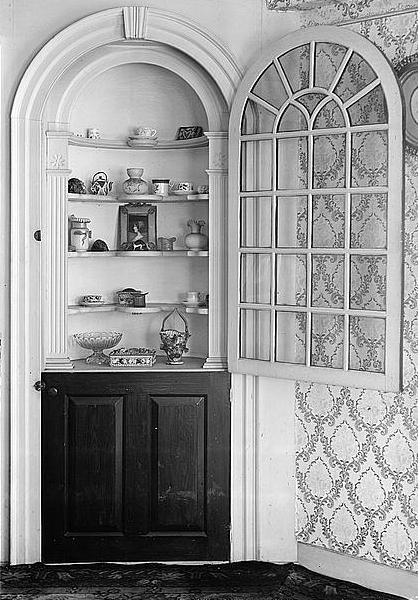
I ask you without trying to be snide: Is there anything this elegant built into your home? Anything even close?

If you’re like most folks, the answer is no. And this is work done by people with no formal training. But the wonder of this millwork, and the whole house, really is not just how elegant it is despite being fairly spartan. It might have been added a little later, but it’s still really old. If you saw the toolbox the builders had to make this thing, your jaw would drop.

I could make that thing, and the house it’s in. I’ve made both built-in and freestanding versions of that thing. And here’s what I’d use, to do it, that the fellows that built this one didn’t have:

  • kiln dried dimensioned lumber
  • power planer
  • power jointer
  • powered rip saw
  • powered cut-off saw
  • powered drill
  • steel cutting tools
  • spindle shaper
  • aliphatic resin glue
  • wire nails
  • pneumatic anything
  • modern sandpaper
  • powered bandsaw
  • an electronic calculator
  • pipe clamps
  • pre-mixed paint
  • a library

I’d keep going but the internet might run out of pixels. Hell, something as mundane as light and heat would have been pretty sketchy then, too. And the Pequot Indians that were right down the street might interrupt your exertions, and they didn’t just drop by to remind you to visit their casino back then. When they weren’t bothering you, the British would drop by from time to time and burn this and that to the ground in Fairfield. George the Third was a fairly humorless fellow.

If I made that corner cabinet, with all the tools and information at my disposal, you’d marvel over it. Picture the fellows that made the one in the picture under the shade of the tree outside.

Month: April 2007

Find Stuff:

Archives