Didn’t like Italianate? I bet you built one of these instead.
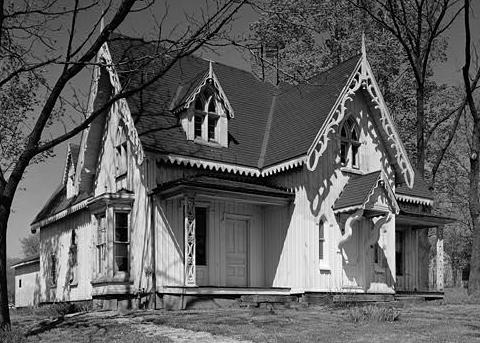
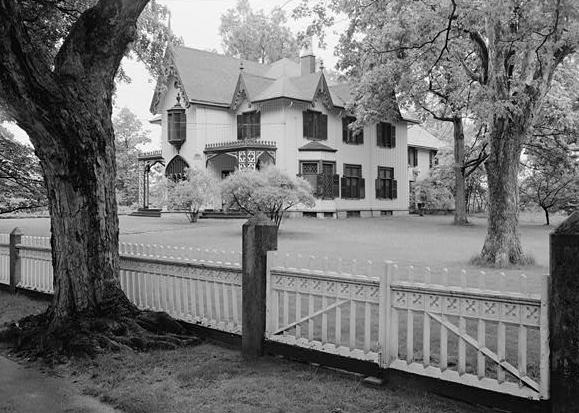
During the same period of time as the Italianate style, let’s say between 1840 and 1880, the Gothic Revival was also in its glory. Like Italianate, it’s considered a “romantic” style. Picturesque informal setting country houses were all the rage, and the Gothic style suited it too. Here’s an example from Sinclairville, New York, that has most all the bells and whistles of the type:
Let’s see-
steeply pitched roofs
steep cross gable roofs
gothic or “saracen”arched windows
decorative gable trim
finials
projecting bays
open cornices and eaves
vertical board and batten siding
trail of breadcrumbs to door
Sometimes small things make a great deal of difference. There’s a lot of elaborate decoration on Gothic Revival house, and it’s the worst kind to make. It’s got curved lines in it. Any architect will tell you that doubles the price of anything. But the introduction of the mechanical scroll saw at around that period that made all that gingerbread possible. Before that, anything like that had to be cut by hand with a fret saw. Not fun.
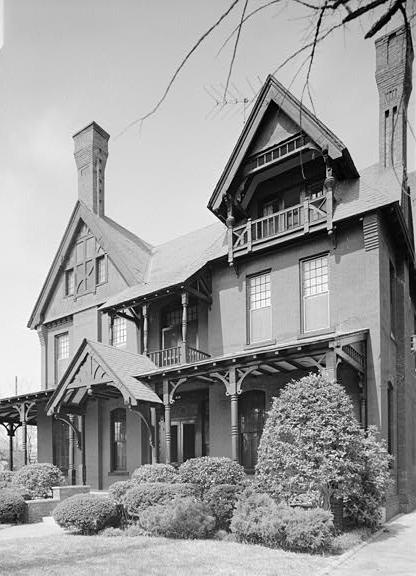
Here’s another example, from Tennessee:
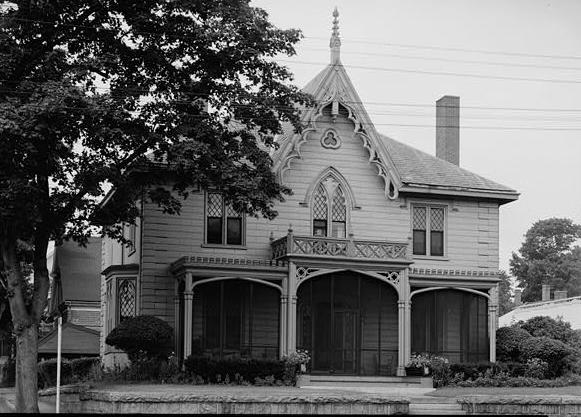
That one is bordering on a subtype called “Stick.” Let’s move on. An excellent example from Essex, Massachusetts; the Brooks House:
That one has quoins on the corners, to mimic a masonry building. It shows the classic flattened pointed arch between porch supports. It’s got the tiny diamond paned sashes for that medieval effect. Nice crenellation atop the porch roof. Everybody calls that dentillation. Everybody is wrong. Dentillation faces down. Crenellation faced up. If you called it castellation, I’m not allowed to flunk you. You’ve seen a million houses like that. All the filligree is removed, the windows are swapped out, the porch is in the landfill, and it’s got clapboards or vinyl siding on it now. Look for the pointy cross gable in the center of the front. It’s the giveaway for what you should still be looking at.
I’ll build you that house for a million. I’ll paint if for two million.
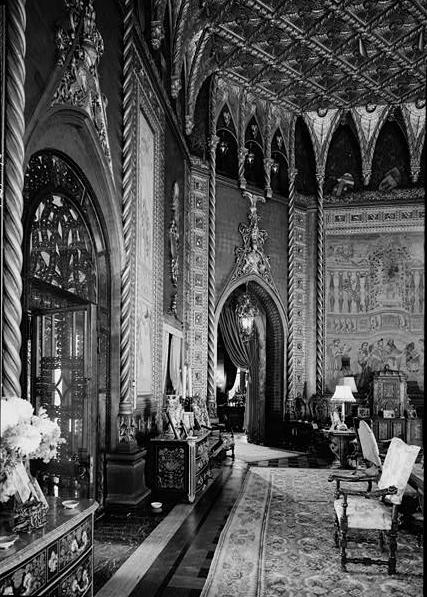
It’s medieval in tone, but it’s not necessarily rude and plain. Mar A Lago in Palm Beach is Gothic Revival, more or less, and it’s not too spartan. Or Spartan:
This place is awesome. It even has a gothic fence. I’ve got lots of pictures of it. I know you’ll tune in tomorrow. It’ll be worth it just to see the bowling alley in there. The gothic bowling alley.
After Greek Revival, there were a number of prominent “Romantic” styles fighting for the affections of the American architectural public. Let’s go with the Ghibellines and leave the Goths and so forth for later. Let’s see Italianate:
Yes, let’s do, if it looks like that. That’s the City Library in Newburgh, New York. It looks confectionery, like a lot of Italianate architecture does.
Italianate buildings were born of the “Picturesque” movement in the arts, a sort of reaction to the formality of the styles that had preceded them. They used rural Italian villas as a sort of paradigm for the style, and later had a variant that used Italian domestic city architecture as its basis. That is generally called “Renaissance Revival,” but more or less it’s all the same idiom.
It’s exuberant, and lends itself to a certain extravagance of detail. Here’s the Morse House, still in Portland, Maine. The tower is a popular feature in the style. Two or three stories, low pitched roofs, wide eaves with lots of brackets and modillions, tall skinny windows, many with a curved top and variations of hoods over them. This is the first style in America that commonly featured a large piece of glass in the front door. Entryways were very elaborate, generally. Many elaborate porches were popular.
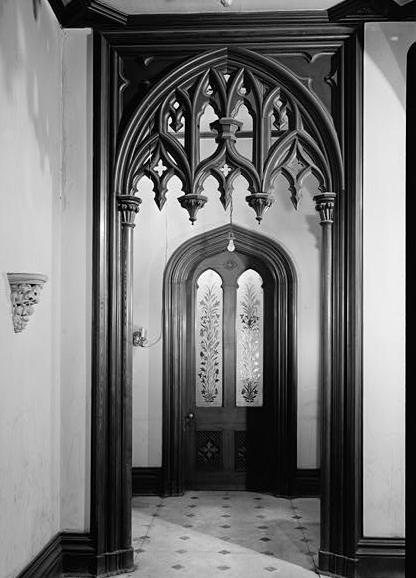
The interior of the Morse House shows how elaborate the whole thing could be, if you wanted. For about thirty years, from about 1840 to 1870, it was probably the most common style in the United States. It is sparsely represented in the deep south, as the post-bellum zeitgeist didn’t favor exuberance. Here’s a lovely little example from Bellaire Ohio. The sled and the cooler on the stoop hints at a change in the seasons when the picture was taken. Lovely hooded windows in the flat brick facade. Here’s a more modest version being run into the ground in Cincinatti, Ohio. The fate of most of these more plebian versions was to have the brackets, porches, and prominent window trim removed and be covered with aluminum, and later, vinyl siding. You can just make out the tower with clerestory windows that likely brought sunlight into a center stairwell in this example. There was a boom in the economy in the decades following the end of the Civil War, and people embraced the lighthearted approach and fancy decoration of the Italianate style. A financial panic in the 1870s brought an end to the attitude of frivolity, and when things got going again economically, popular taste had passed the style by. If you had dough, you’d build a Queen Anne house after that.
It had a very common iteration that you can see most everywhere to this very day. I give you: The Italianate Office Block: I never did get used to putting my money in banks in a strip mall. I wanted to walk into something like the Sprague Building, in Tacoma Washington, with its rusticated masonry and imposing solidity, and look for a bank.
Man, that’s Greek. Bucks County Pennsylvania Greek, that is. Doric columns with no base. Don’t get no Greeker than that. That’s the Josiah Hayden house in Williamsburg, Massachusetts. That’s not to be confused with Williamstown, Mass. The locals call Williamstown “Billsville,” to avoid or add to the confusion, I’m not sure which. Williamstown in the northwest corner of the state. Williamsburg is in the center of the state. The Connecticut river valley used to be the center of manufacturing in Massachusetts, which was the workroom of the whole country at one time. The Haydens ran factories in Williamsburg, including a brassworks, until 1950. The industry moved on. The Greek Revival style was perfect for the times. Absolutely dominant style from 1825 to 1850 or so, it was sometimes called the “National Style.” Pretty much everything built east of the Mississippi River was Greek revival for those 25 years. San Francisco too.
I doesn’t have to be really plain, either. Here’s the Porcher-Simonds house in Charleston, South Carolina. Whoah: There were pattern books for carpenters to follow to build in the National Style, but America started to have professionally trained architects designing buildings. And they gravitated to the very fashionable style of the times. It was hip, and it allowed for a great deal of improvisation.
What’s this magnificent building? Courthouse? Mansion of a captain of industry? State Capital? Nope, it’s Pumping Station Number 1 in Louisville Kentucky. It’s a little more Roman than Greek, really, but it demonstrates the desire for Americans to build in a sophisticated and monumental style during the period, no matter how mundane the project.
Why Greek?
The War of Independence of Greece against the Ottoman Empire captured the imagination of many Americans. After the War of 1812, there was also a backlash against anything that smacked of the British Empire. The Adam style of high style colonial went completely out of favor, and it was based on a sort of application of Roman details to colonial houses, and it seemed very British. People began to associate Greek themes with a kind of purity of thought. Greece was the mother of Rome, and it was kind of search for authenticity to revive it in sticks and bricks. London, seemed, well, Roman.
Greek Revival was everything everywhere in the United States for a while, only to be subsumed in a wave of Italianate and Gothic Revival styles in its turn.
Its enduring legacy is still with us all over, though, if you know where to look. It gave us the front gabled house. It’s in there. Somewhere.
We interrupt our regularly scheduled foaming at the mouth about outdated architectural styles currently residing under vinyl siding to answer a question from one of our readers, Deb in Madison:
Oh, been meaning to ask, what’s the story about that bench in your Sippican Cottage Furniture graphic on the right sidebar? I’m sure there’s a story there…
Well, Deb, my kids gotta eat twice a day and once on Sunday, same as yours. So I’ve put a hyperlink to my furniture business right here on the page to tempt people into clicking on it in a weak moment and buying things. Preferably while inebriated and clutching your tax refund. Also, all this writing I’m doing is making my blog turn up in websearch engines over the furniture page, and people are getting confused looking for furniture and finding a gradeschool picture and a bunch of slapdash text.
But what of that bench?, asks Deb. Is it inneresting? Why yes, it is:
Harry Longbaugh’s Bench
“Grampa, Mama says that old bench is special. It looks awful plain to me.” “Your mama’s right, in a way, my boy, but like every thing a man can own, the people who use it are more captivatin’ than the thing itself. That’s Harry Longbaugh’s bench. Well, not his bench ‘xactly.” “Who in blazes is Harry Longbaugh? Is he that man mama went to grammar school with that put a frog in her bookbag? And why do you have his bench? And..” “No, no, my boy. You see, your grampa used to work on Harlem and Long Island Railroad, back when the years began with 18’s. I was a crack telegraph operator…” “What’s a telegraphs any ways, isn’t that that guy who used to come to the door with the brushes and soap and get the door slammed in his face by pa …?” “No, no, my boy. The telegraph was a machine we used to send messages to each other, before you, your mama, or the telephone was around. We did manage okay then, you know.” “But who’s Harry Longbow? Why did you steal his bench? Is he that man that came with the crooked stick to find a place to dig for the well, that daddy says “If he ever shows his face around here again, I’m gonna…” “No, my boy, I didn’t steal anything. You see, The telegraph operator had to keep busy all day, even when there was nothin’ to do, so I was in charge of sweeping the station in Harlem, and lighting the lamps, and tending the Lost and Found…” “But who’s Harry Longfellow? Was he lost? Did you find ’em?, was there a reward…?” “Harry Longbaugh! No he wasn’t lost, but there was a reward, but I didn’t get it, exactly, and if you’ll let me…” “Is the bench your reward, did Mr. Longshanks give it to you for…” “I declare, young man, I’ll be gone to my reward before I finish this story! Now keep still, and I’ll unwind it straight through, and no more detours!” “Now, people left the darndest things in that station house. And we’d keep ’em in the office for what seemed like eternity, because you never knew when they’d come ‘lookin’ for ’em. Of course there were the usual parasols and bowlers and such, but one day, the baggage boy brought me out to one the benches, THAT VERY BENCH you’re sittin’ on, to be specific, and pointed to a valise left on the shelf below, where I’d found many a forgotten item. It was a curious sort of bag. I found out later they called it a Gladstone Bag, after a Britisher, I think, and made from a Persian Carpet! Well, as a matter of good sense and manners, I keep my nose from other’s business, and stick to my own, but I felt an overpowerin’ urge to look in that bag, you see, and make out if there was something inside to tell me where I might find the owner. And what do you think I saw? “ “Henry Longchamp’s unnerwear!” “Harry Longbaugh, you little knothead! NO. As I was sayin’, inside, what did I see but a big Colt revolver, the old army sidearm my daddy called a “leg of mutton.” Now, you don’t see that sort of thing in New York City much, but it didn’t catch my eye as much as the money. Stacks and stack of bills, tied ever so neat with string, like little bricks…” “Was that the reward…?” “No, my boy, now listen. Along with the money and the pistol, there was a ticket, for passage on the “Soldier Prince,” a boat bound for Argentina! and on that ticket was a man’s name.” “Harley Limbaugh?” “That’s Harry, dear boy. Harry Longbaugh. Yes, it were. and I must admit, I was caught in a sort of reverie, thinkin’ about that ship, and that money, and that gun, and Argentina, when easy as you please, a man taps me on the shoulder and says, “Excuse me friend, I think that belongs to me.” He was a handsome man, with a big friendly grin, but there was something else about him, too, something hard and cold behind that smile.” “Well, he took that bag, and walked straight out of there, and joined another man and a lady on the platform outside, and no doubt went to Argentina. And I kept that bench, where I found that bag to remember it by.” “But with all that money, he didn’t give you a reward for findin’ it? What kind of story is that!” “My reward my boy, is that I’m still here to tell the story. For I found out at the Post Office, not long after that very day, that Harry Longbaugh was known by another name too-The Sundance Kid.” Harry Longbaugh’s Bench.
Isn’t it Romantic? Actually, technically it isn’t. It’s really just Adam style colonial. Nice. That one’s in Vermont. It’s the only exuberant thing there, maybe. Chastely exuberant.
But we want Early Classical Revival today. The thing that replaced colonial style. Think Roman. Our Founding Fathers did. Especially that Jefferson fellow. Architecture was an amateur thing, and he was the patron saint of getting old design books like Palladio’s Four Books Of Architecture and grabbing stuff out of there. I still grab stuff out of that book. They thought the freshly minted United States needed something that bespoke an important civilization. Rome seemed to fit. There were classical elements all over the preceding colonial styles, but they were little bits and pieces added on. Early Classical Revival was the whole design, and wasn’t shy about it. Of course Jefferson’s own home is a signature example: Monticello. The place shown above is a great example, too. Sabine Hall in Warsaw, Virginia. It’s got what looks like a systyle full height Roman temple rammed right into the facade. Systyle means you the gap between the columns is two column widths. The house was older, 1730, but they later lowered the roof and gave it the signature portico and gable front and wings so common to the type. It’s a southern style, really, very rare North of Philadelphia. The crib notes version to delineate Early Classical Revival from the Greek Revival that followed it and overlapped with it is this : if it looks like Elvis and Nero had a Bed and Breakfast together, that’s probably it.
It’s post-revolutionary Republican monumental architecture. It lasted until about 1820, when the newspapers were full of stories of the Greek War of Independence from the Ottoman Empire, and people got all hopped up on Plato and Socrates and that hopeless dead Romantic Lord Byron and decided their houses should look more like this: Isn’t it Romantic? Yes, that one is.
Month: April 2007
sippicancottage
A Man Who Has Nothing In Particular To Recommend Him Discusses All Sorts of Subjects at Random as Though He Knew Everything.


Recent Comments