Interestingly, ‘Incompetence Polymath’ Is the Name of My Air Supply Tribute Band. But I Digress

Oh, I tried to burn that “seasoned” firewood, yes I did. When you’re cold, you make fires with what you have. But it was near impossible to set it on fire. I’d mix it with about 50% kiln dried cut-offs from the scrap bin, and when that got meager, I cut up usable lumber like 2 x 4s to supplement it. I pulled down the OSB ceiling in the basement, and chopped up some rude shelving to make fires underneath our asbestos firewood. It would have been easier to get rid of a corpse. Wet wood doesn’t burn.

I learned my lesson. If we were going to burn firewood, I’d have to dry it myself. When the spring rolled around, we still had some of the damp squib pile moldering in the yard. I was determined to use it next season, and get a whole lot more. I did a lot of research on drying wood for firewood.

The internet. Jayzuz, the internet. No one has any idea what they’re talking about on the internet. If they do, they’re buried so far down on the search results that you’d need a Geiger counter to find them. The more prominent the opinion, the more likely it is to either be useless or worse than useless. That’s why I’m so tickled that no one reads this website. Ipso facto it proves how smart I am. Sorta. I think. OK, maybe not. But I do know how to dry firewood. Here’s how:

First, get some firewood.

If you must, cut and split your own firewood. Many of my neighbors buy whole logs and have them dumped in their yards, and then cut, split, and stack them at their leisure. I can’t believe I put ‘leisure’ in a sentence about cutting, splitting and stacking firewood, but there it is, as prominent as a carbuncle on your nose. I do things like that to prove I’m not a bot. Bots never use the perfectly wrong word. They’re trained by reading the internet, so they use only vaguely wrong words.

Anyway, it’s too much work to process whole logs for the money you might save, if you ask me. You can buy cords upon cords of cut, split firewood and have it delivered. We did. The first full year, we bought 6 cords, but it wasn’t enough. We bought 8 the year after, and that wasn’t enough. As a matter of fact, the word ‘enough’ and the word ‘firewood’ have never been successfully concatenated before. You have to staple a ‘not’ in front of them like a hood ornament to get them to make sense.

Let’s move on, then. There are three kinds of firewood you can buy:

Kiln Dried Firewood-

Lawdy lawdy, Rockefeller, you’re buying firewood baked in an oven? It will be seasoned, I’ll say that for it. I think it would be smarter to go to the Orange Place and burn framing lumber. That’s kiln dried, too, and it might be cheaper. When I showed you the chart the other day in A Little Regler BTU Math with firewood prices, they weren’t referring to this kind of stuff. The chart says that firewood is $15.91 per million BTU. Kiln dried firewood would be about the same as buying heating oil, $25-$30 per million BTU. Maybe more. And I don’t know what your oil delivery service is like, but they don’t generally make you stack the oil, or carry it into the house in buckets. Rich people buy kiln-dried firewood to have showy fires in their ski lodges. We’re just trying not to freeze to death, or go broke(r). No need to explore KD further.

Seasoned Firewood-

This is going to be a lot easier on all of us if you simply discount the concept that seasoned firewood is actually seasoned. It’s not. It never is. The firewood dealer probably doesn’t know how to do it, and even if they do, they’re funning with you. Everyone will swear up and down that the log laid in the yard for a year, or the heap of split wood was only partially in a mud puddle all summer, or it was covered the whole time, so rain won’t get in, or whatever bosh the probably truly believe, but just nod and smile and ask for:

Green Firewood-

Look, the firewood isn’t going to be dry, no matter how much you beg and pay for seasoned wood. Why pay extra for it? In the off-season, which is roughly spring and summer and a little bit of fall, you can get all the green firewood you want, and you can take a third off the million BTU price that I mentioned earlier. It’s really cheap. Buy it cut, split, and delivered, and stack it yourself. Firewood dealers love selling green firewood because they split the stuff right into the back of their truck, and get rid of it immediately. It doesn’t take up space by hanging around pretending to get seasoned.

For all you Paul Bunyan wannabes out there, I can assure you that it’s still plenty of work to stack eight cords of wood. Lugging it inside, bit by bit, and burning it every day isn’t a picnic either. You can hang up your axe and still work on your pecs, I promise.

And now I’d like to say a word in defense of the firewood guy. I’ve lambasted him, excoriated him, mocked him, and cast aspersions on his wood-drying skills here. Doesn’t mean I don’t like him, or respect him. You see, I live in Maine, and it’s really hard to get cheated in Maine. People are generally honest and pleasant, if a bit taciturn. There are some sharp dealers, but not a lot of outright crooks in any walk of life. Plenty of people are incompetent, it’s true, because they’re people. Human being are frail, timid, defective creatures, or seem so until two of them reach for the last donut at the same time in the break room at work and start throwin’ hands. Then they seem plenty sturdy and forward. I’m not originally from Maine, so I’m a special case. I’m so bad at so many different things that I’m an incompetence polymath. Most people here, to their credit, specialize.

Let’s face it. It’s hard to dry firewood properly, and for the most part, it’s not practical for people who deal in firewood to do it for you. The only way to properly dry firewood is out in the open, on a hard surface, stacked neatly, with a cap on top of it, for a long time. If you’re dealing in hundreds or thousands of cords of wood, I can’t imagine how much space it would take up, and how much effort you’d have to add to the process (and the price) to handle it twice, or three times, instead of once. There’s a reason why firewood dealers have their junks in big piles. It’s the only thing that makes any sense.

Well, that and selling it for $100/cord more, because it’s “seasoned.”

[To be continued. Thanks for reading and commenting. Please tell a friend to visit Sippican Cottage]
Go Get The Witch’s Broomstick. Then We’ll Talk

So, if you’re following along in your playbook, we got the beast into the basement. My son thought about disowning me, but visions of heat in his bedroom took the edge off his discomfiture, if not off the ache in his arms. Of course in the basement didn’t exactly mean in place. This paperweight had to go, first:

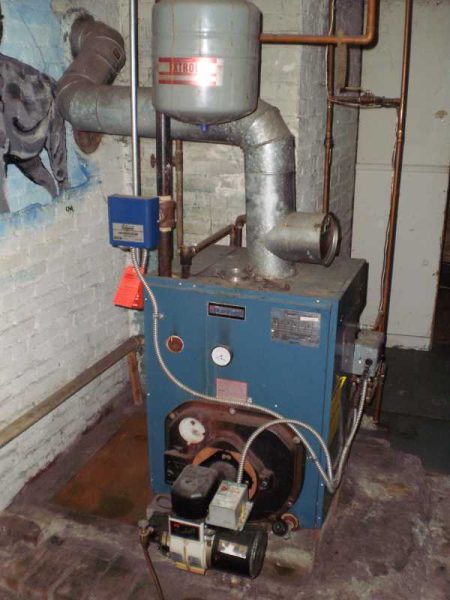
There was a tag on it from the last time it was checked and cleaned. Ronnie Raygun says hi. It was good and rusty, and the jacket inside it was cracked. It’s possible it weighed more than the new furnace. But we didn’t mind that much, because we could treat it like the government treats taxpayers. We had a jolly time cutting all the pipes and wires.

We saved the copper pipe, because we’re honorary crackheads. We don’t take drugs, but we’ll tear out copper plumbing and bring it to the scrapyard for a few bucks. I’m sure the fellow there thought we were the neatest and politest crackheads in line, but I doubt he thought we were regular folks who needed the money. We’d be a rara avis in that milieu.

My older son sorta dreaded moving the thing, until I explained that I not only didn’t mind if we broke it some, I’d prefer that we broke it some. Sooner or later it would have to go to the scrapyard, too, and smaller pieces weigh less. We walked the thing across the floor to the door, looked both ways to avoid any deer wandering by who deserved a more dignified death, and then let that beast roll down the ramp and into the snow, where it lay until spring arrived. Fun.

We shouldered the new furnace into the old spot. There’s a concrete pad there in the floor, and it’s original equipment, so I’m sure there’s been something burning something there since 1901. There is a coal pen in the next room. There used to be a pass-through gap in the brick wall so you could finagle a shovel into the coal pile and load a furnace. I imagine they switched to burning oil not long after the house was built, though. Fuel oil heat has been pretty standard in Maine for a century.

So our furnace needs stove pipe into the thimble in the chimney. We’ll use the same thimble as the old unit. It will also require ducting to transmit the warmed air up into the rooms upstairs. We used galvanized stove pipe, 8″ in diameter, and made a little box to accept the pipe up under the dining room floor, which is almost right over the furnace. That box serves what used to be a big, cast iron cold air return in the dining room floor, which you might remember:

Instead of bringing cold air down to the furnace, we were going to blow it up into the dining room, which is more or less the center of the house.

The usual idea behind this kind of furnace is to make it a backup, or supplement to your existing furnace. You’re supposed to meld your new furnace hot air ducts into your existing hot air ducts. It’s essential if you do, to put a damper in so you’re not blowing hot air from your oil burner into the stove, or vice versa. Since our existing furnace was a boiler, not a furnace, and was slumbering in the drive under a blanket of snow, this wasn’t possible, or necessary. But if you’re interested in how it’s normally done, here it is done by a normal person with a much more piquant twang in his voice than I possess:

We haunted the aisles at the local hardware store for the stove pipe and other amenities. Burning wood for heat isn’t unusual around here, thank Jeebus, so they had most everything we needed. The furnace was a floor model, and had been pawed over more than a taxi-dancer after a shore leave. Everything was wrong or broken, but honestly, even the most determined Orange Place imbecile can’t really hurt a quarter-ton lump of cast iron and welded high-temp steel. I had some head-scratching moments trying to wire the beast, what with instructions being scarce, but the only really “busted beyond repair” things were the refractory bricks that line the furnace. But once again, the local hardware store came through, because busted refractory bricks are generally the only kind anyone has around here. They had a pile of ’em, and they were cheap.

Now there was only one problem. We needed to buy firewood in March in Maine. It would have been a lot easier to get the witch’s broomstick.

[To be continued]

It’s Only a Matter of Going

If you’re just tuning in, we’re recounting our BTU journey through the years. We started with bankruptcy and electric baseboard heat, which is more or less the same thing. Now we’re moving on to burning firewood, and anything else made of anything combustible that will fit through a one-foot square furnace door. We’ve purchased a semi-broken floor model of a big ol’ wood burning furnace, and a freight company has dutifully plopped it on a sheet of ice in my dooryard.

I called my family over to the window to look at it. “There it is, boys and girls. Real heat is over there. It’s only a matter of going.”

It was late winter already. The snow comes and goes, receding like a tide. It tricks you into thinking it’s leaving for good, and then you wake up and it’s back with its family in tow. Sometimes you’d get a foot of a dusting.

Other times you’d get eighteen inches of partly cloudy.

That hump you see at the end of the driveway was the real problem. That’s the end of the driveway that leads down to the back of the house, and that’s where the furnace has to go. We abandon that driveway pretty early in the season, and use it as a place to throw all the snow. It’s usually five or six feet deep, and harder than Chinese arithmetic after a subzero week or two.

The furnace would have to go up and over, until we reached this door about halfway down the driveway:

We built a ramp out of planks that stretched from the door to the edge of the driveway before the snows came.

So my family looked out the window, and didn’t like what they saw. It turned into another in a long line of Howyagonnadothatdad, and they turned away from the window and went back to shivering in peace. How, you ask? With a winch and a strap and a 2″ x 6″ board.  That’s all it takes, come on guys, it’s just a matter of going!

So we went to Harbor Fraught, and bought a tow strap:

…and a winch:

…and if you need a picture of a 2×6, I think you’re at the wrong blog. Anyway, the kids didn’t really warm up to the idea yet, because even though we had some experience moving heavy stuff around, we never did it on ice skates before. They thought the ice would make it worse, but they didn’t realize it would make it easier.

So we cut the 2×6 in half. Then we went out in the cold, and used a 2×4 as a lever and a milk crate as a fulcrum, and lifted up one side of the pallet off the ground. We screwed one of the 2×6 boards flat on the bottom of the pallet, and the kid got the picture immediately. We were making a sled. We lifted up the other side and finished the job. The two of us pushed the furnace across the ice over to the end of the driveway pretty easily.

Now comes the part where you have to understand that everything is backwards. You don’t want a tow strap to pull the pallet anywhere. You want a tow strap to keep the pallet from sliding down the hill and eventually into the river. Gravity and a lack of friction will do the work for us if we let it. We had plenty of heavy work to do, though, to flatten the mound at the end of the driveway. We threw the snow further down the driveway to sort of even it out, until we could push the pallet on top of the snow from its spot in the dooryard. Then we got a very nervous Mrs. Cottage, and put her behind the wheel of the van, backed it out into the street, and hooked the tow strap to the pallet on one end and the tow hook under the bumper on the van.

We left a little slack in the strap. My son and I gave the beast a shove, and it started down the steep incline without much fuss. The strap tightened up, and we waved our petite heroine gently forward to slowly ski the pallet down the driveway to the foot of the ramp. We didn’t even break a sweat, which was a shame because it was plenty cold out there.

And now, ladies and germs, I’d sprung my trap. My son had seen that quarter of a ton slide right down where we wanted it, easy peasy, and could be easily gulled into thinking getting it up the ramp into the house would be just as easy. I let him think that, because Satan calls me for advice when he really needs to get stuff done.

I had bolted that cheap hand-cranked winch to the floor in the basement workshop, and I pulled the cable with the hook down to the pallet. I hooked it on, and said, “One of us has to turn the crank, and the other has to walk behind the pallet and push it and steer it. He jumped at the chance at the crank, which was great. I wanted him to choose that option, and didn’t want to force him to do it. You see, a winch works by increasing the weight you can move by gearing your motions down. You turn that crank a lot, and the weight moves a little. He learned that in short order. The boy did his best, and had to, because the crank handle needed more laps around the circuit than the Indianapolis 500. He slept pretty good that night, if I remember correctly.

I never told him that I wanted the job pushing it up the ramp and steering because if the cable snapped (the cable made by the low bidder in a Chinese sweatshop),the man behind the pallet would be killed, and I like him better than I like me.

[To be continued]

Only One Problem

OK, so we decided to burn firewood to keep the ice inside the refrigerator where it belongs. That was a good idea. Waiting until the winter to decide was a bad idea.

You see, people in Maine understand that there are seasons, and the time to prepare for any given season is the season before. Of course, that only applies to merchandise on the end carrels at Walmart. You know, pool noodles in the winter, parkas in the summer. People around here start preparing for next winter about a month before the current winter has ended. They know what’s coming, and they’re ready for it. I didn’t, and I wasn’t.

Now, if you’re from away, you might have a mental picture of burning firewood. There’s a cozy scene of a family in woolen clothes sitting on rocking chairs next to a wood stove, with the dog slumbering at their feet. Believe you me, a little wood stove like that wasn’t going to cut it. Those heating calculations I posted yesterday require me to make about 30,000 BTUs per hour in the house just to stay even. I probably needed twice that to actually heat the place. A tiny cast iron box with a stove pipe full of soot and creosote wouldn’t put a dent it. We went looking for a wood furnace.

We wondered how the locals did it, so we looked around. Some of our neighbors had what looked like a porta-john, or maybe Darth Vader’s public phone booth, out in their yards. These turned out to be outdoor wood furnaces. Like this one:

There’s a reason they’re out in the yard, and not in the basement. They’re like nuclear reactors without the uranium. That’s a little one, and it makes close to 70,000 BTUs per hour. The big ones put out 400,000 BTUs. Your house would glow like the Chevy Malibu in Repo Man if you put that beast indoors.

I’m not the hardy sort, although I fake it pretty good, so the idea of going outside to stoke the furnace didn’t really appeal to me. And the price tag, about half the cost of our house, didn’t appeal to me either.

But we persevered, and wandered the earth online and in person, and finally found one of these:

It’s an Englander 28-3500. It burns wood. Lots of wood. Tons of wood. It’s about as elegant as a Mexican submarine. And even though it’s fairly big, you can put it in your basement and not pyrolize the walls. You open the top door to put in the firewood. You open the bottom door to slide out a tray full of ashes from time to time. There’s a squirrel cage fan hanging off the back, which circulates air in the passageways between the inner firebox and the outer sheet metal case, and then blows it out of the 8″ silver duct stub you see on top there. There’s a steel pipe sticking up a little in the back. That’s where you put the stove pipe and run it into your chimney. There’s a little lever you move left to right to let more or less air into the firebox. There’s a spinning wheel on the ash dump to let more air under the fire, if you really want to get the thing hot, and burn up your eight cords in eight weeks. It has a barbaric temperature switch in the back. It’s a spring that expands as it gets hot, and closes a circuit to start the fan when the air inside the jacket reaches around 90 degrees.

Here’s a guy using one to make a tiny fire of some sort. He should burn the mandolin he’s playing, although a full-sized guitar burns longer, in my experience:

The stove was touted as capable of heating 3,000 square feet of house. I don’t know about you, but I’ve noticed that some houses, say, in San Diego, require less heat than houses, let’s say, in Minneapolis. So that figure might be of doubtful utility to me. I did some rough calcs on how much wood I could ram in the thing, and how long it would last, and how many BTUs were in that weight of wood, and figured that if I soaked the wood in gasoline before I started, I might get 60,000 BTUs out of the beast and heat 2/3 of the 3000 square feet they claim. But it’s important to understand input heat and output heat. If your furnace is 90% efficient, and rated for 50,000 BTUs, it really only delivers 45,000 usable BTUs. Burning firewood is much less efficient than other fuels like oil, so I figured a 50-percent haircut. I’ll take 30,000+ BTUs of heat. That’s the equivalent of almost 10,000 watts of electricity per hour. At the time, that was close to saving $2 per hour instead of running that much baseboard electric heat. It would only take us about 3 or 4 weeks to pay for the stove itself like that.

We found a floor model of this thing in the back of the Orange Place, with most of the parts thrown inside, shrink-wrapped on a pallet. It was getting to be late winter, and they needed room for the pool noodles, I guess, so we got it for a massive discount. I figured I could fix whatever was busted on it.

There was only one problem. It weighs 570 pounds.

[To be continued. Thanks for reading and commenting and hitting the tip jar. It is much appreciated]

A Little Regler BTU Math

I apologize in advance. We’re going to do math.

Relax. We aren’t going to be doing that fancy math. The devil got up on his first day of work and went into his infernal office and put letters into equations that only had numbers in them a minute before. We’re upright folks here in Maine and will have none of that. Fancy math just leads to guys with MBAs telling you to come in on Sunday to make their numbers come out right. For what we’re trying to find out, regler arithmetic will do. And I already work on Sunday, thank you very much.

The question at hand is this: what’s the cheapest form of heat we can buy? No fooling, it’s got to be cheap, coming and going. By that, I mean it has to be cheap to buy the equipment to run it, and it has to likewise be cheap to make BTUs with that cheap equipment.

I turned to the unlikely source you could name. I asked the government. Now I understand that the government is what the devil made on his second day at work, and he’s been working at it non-stop ever since. But in Maine, the government is occasionally a time-warp, and it functions like Eisenhower was still in office. Or maybe Coolidge, on a really good day.

The Maine state government has one of those old-skool bulletproof websites that’s filled with nothing but information. They thought about putting an image or two on it, but their Brownie camera was on the fritz, I guess. So I asked the state gov, “What’s the cheapest form of heat I can buy around here?” Here’s the answer, up to date to today:

Aw, man, that requires too much math for me anyway. I know for certain how many unfortunate romantic liaisons there are in a gallon of gin, but how many BTUs are in a gallon of kerosene or propane or bunker fuel will remain a dark and bloody mystery to me forevermore. And they all taste even worse than gin. Besides, even ill-informed me knows that the furnaces I’d need to burn any of that stuff cost too much money to be practical. I need better answers. Hey look, the government came through again:


I know a million anything sounds like a lot, but we need many millions of BTUs to live where we do. This chart is getting things done for me. Of course the prices were different back when I really needed this chart. A chicken egg didn’t cost four bucks back then. You could buy a house for twenty-five grand after the great recession did its work, and I did so. But the ratios were about the same.

So feast your eyes on “Electricity – Baseboard,” and compare it to whatever fuel you’re using. I was heating my house, sorta, using that method, and the only decision I had to make was to run electricity through the baseboard heaters and pay the power company in gold bullion, or to pile up ten dollar bills in the middle of the living room and burn them to keep warm. The cost was about the same.

We could rule out natural gas right away. We ain’t got none here. There aren’t enough people to make it worthwhile to run it out into the boonies, and even if you wanted to, the ground is so full of granite that you’d need Oppenheimer to get back to work to blast the way in for the pipe.

But hey, look at that firewood number. On a good day, it’s as cheap as natural gas. It’s about 20-percent of the cost of electricity. And believe you me, we got trees in Maine. And I could use an 80-percent discount. Only shoplifting and highway robbery pays better than that. And highway robbery in January in Maine is a tough gig, man.

Now this is where internet wags are going to weigh in and tell the world, from their apartment in Tallahassee, that a real man don’t buy firewood. Nosirreebob. You go out and chop down trees like Paul Bunyan and kill something on the way home for the pot. Listen to me folks: No you don’t. You buy firewood. Why? Because you need a big woodlot to cut your own firewood, and you don’t have one. Firewood sellers do.

Let’s do the math. How many cords of wood do we need? That’s easy.

Heating Load=House Area×Heat Loss Factor×Temperature Differential

So my equation goes: Heating Load=Ginormous Victorian dustcatcher x heat running out of every seam in the joint x Oh my god I have to make it 90 degrees hotter in here in February and still wear a sweater.

So I need about 8 cords of firewood. There’s something like 22 million BTUs in a cord of hardwood firewood, so we’d end up with 176, 000,000 BTUs languidly making their way out of my house over a heating season. Eight cords is a lot of wood.

A cord of wood is a stack 8′ long by 4′ high by 4′ deep. It’s 128 cubic feet. The firewood “junks” as we call a piece of firewood around here, are usually 16″ long. I’m not going to stack anything 4′ deep, because that’s not how you dry firewood. One junk deep is it. So I’ll need a pile 24′ long by 4′ high. Actually, I’ll need 8 of them. I certainly don’t want a single pile 4′ high, 192′ long, because I’ll start in my back yard and end up in the street our front, and the plow driver hates that.

So maybe you’re starting to see the problem with you can get your firewood for free if you’ll just cut it. Just stacking that pile is plenty of work, believe you me. We’re doing some math again, and not talking about how firewood warms you twice and similar shite from armchair Daniel Boones. It would take about 24 full-size trees to make 8 cords. A woodlot can produce 20 to 40 cords per acre, but that’s only if you treat it like Sherman treated Georgia. If you want wood every year, you can only cut down 1 or 2 cords a year per acre. I don’t own an 8-acre woodlot.

But what if I did? If I cut down 24 trees, and skidded them out of the mire, and cut them up (by the way, you don’t chop firewood. Ever. You cut it or saw it or split it or stack it. You don’t chop, unless you’re nuts), then split them and trucked them back to the house. You only needed about $100,000- worth of trucks and chainsaws and mauls and kevlar pants and earplugs and whiskey for your frostbite. If you were a pro, it would take you about 60 hours to do all that, working all the time. Then again, if you’re a pro, you’re selling firewood for $350 a cord to people like me, and you’ve got oil heat at your house.

[To be continued]

Tag: HVAC

Find Stuff:

Archives