Pellet Stove Lovin’

If you just wandered in, we bought a pellet stove several years back to replace our wood-burning furnace. One of these:
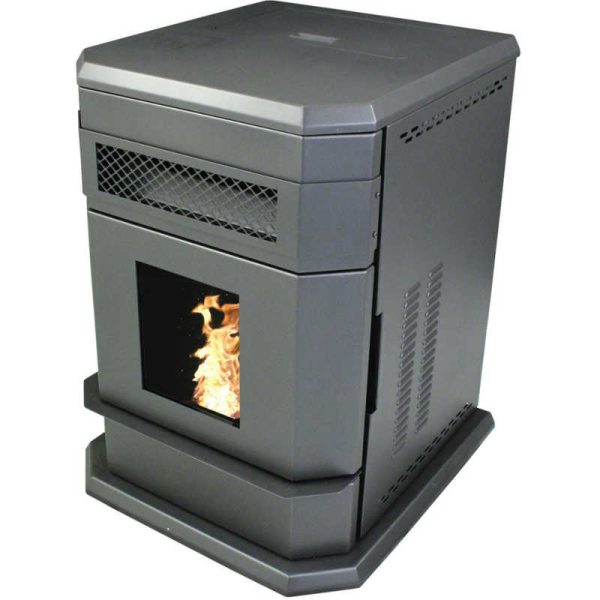
 

It’s a Vader C3PO. It has astromech force lightning ignition, and blows 7 parsecs of Unifying Force out of its…

Sorry, I got to musing about its design ethos, and my mind wandered. Jayzus, it’s ugly. It could be worse, though. The more expensive pellet stoves try to make their units look more swoopy or Telluride-y or folksy or something, and they end up looking as elegant as a gaudy cement mixer.

Ours is a Vogelzang VG 5790. I’m not sure if you can buy one anymore. They still appear on the Orange Place website, for instance, but they intone out of stock rather ominously. The price listed is more than twice what we paid for ours. And of course the price for the unit isn’t the whole story. You’ll need some double-walled pipe for venting the exhaust, and if you’re smart, you’ll get a fresh air return kit for combustion air, too. We escaped for less than two grand for everything, including a ton of pellets, but we got a floor model and bought it back when no one was buying much of anything. Good luck now, folks.

It’s an interesting device. The fire in the burn chamber is basically outdoors. It’s totally enclosed and gasketed. You draw in fresh air from outside, burn pellets with the air, and exhaust it through another pipe. There’s a barbarous heat exchanger with a fan to circulate air from the room past the steel back wall of the combustion chamber and out that grate in the front. The sides are on hinges, and you open it up to get at all the fans and sensors and so forth. The door with the glass in it hinges open, too, to clean it out. I know these things intimately, because you have to clean out a pellet stove a lot. No one does, but you have to.

I’ve read about eleventy zillion scathing diatribes of why this pellet stove doesn’t work. Sometimes I think the internet is like a suggestion box at a factory. It’s only there to make people think they’re accomplishing something by complaining, and to identify cranks to be weeded out. Everyone complains about this stove. I’ve made a handy little list of my analysis of the most common problems people report with this stove:

  1. You ignored the installation instructions and put the stove pipe inside the house because you wanted to get the last BTU off it before it went outside. It’s designed for a stack effect in the pipe it never achieves indoors. So it doesn’t make many BTUs, but it sure gets dirty
  2. The stove is dirty
  3. The stove needs cleaning
  4. The stove is still dirty after you cleaned it
  5. The stove pipe is full of soot
  6. The stove is full of soot
  7. The stove needs to be cleaned out
  8. Clean the stove, will ya?
  9. The pellets are wet. And by the way, the stove is dirty
  10. The pellets bounce out of the burn pot, because the stove is dirty, and make the stove dirtier

That’s my analysis of what’s really going on, mind you. The complainants have other ideas, including: THIS THING IS A PIECE OF JUNK SCAM AND THE COMPANY WON’T DRIVE TO MY HOUSE AND FIX IT FOR FREE BECAUSE IT’S A SCAM AND I WANT TO RETURN IT BUT IT WEIGHS 300 POUNDS WHAT A SCAM AND I’VE REPLACED THE CIRCUIT BOARD THREE TIMES BUT IT STILL DOESN’T HEAT MY AIRPLANE HANGAR LIVING ROOM AND HOW MANY TIMES DO YOU EXPECT ME TO CLEAN THIS THING OUT I DID IT TWICE LAST YEAR!!!!!ELEVENTY!!!

It’s the company’s own fault, at least a little. They try to sell this thing like it’s a dishwasher or a refrigerator or something. They tell suckers potential purchasers that it’s a breeze to operate, and only needs a little attention from time to time, and is so quiet you can hear your significant other beckoning you to the toasty bed for some pellet stove lovin’.

Well, it ain’t like that. It reminds me of big, cast-iron stationary woodworking equipment. You know, table saws and lathes and suchlike. Most come packed in gun grease in a crate and the instructions read: If you need instructions, you shouldn’t have bought this. The pellet stove has plenty of instruction, written in delightful Chinglish. They’re beside the point, really. You’re going to have to learn how this thing operates, and work on it to make heat come out of it. There’s no way around it.

Luckily, it’s a pretty simple machine. You open the hopper on the top, and pour in wood pellets. An auger in the bottom of the hopper turns and the pellets are transported up a chute to drop unceremoniously down another chute into a burn pot in the burn chamber. There’s an igniter that aligns with one of the many holes in the burn pot, which ignites the pellets (well, it’s supposed to). A fan blows the exhaust gas out of the house when a sensor on the fan tells it that the air is hot. Another fan comes on when a sensor on the back wall of the burn chamber tells it some heat is available. That fan sucks in cool room air, and blows it out the front. toasty hot.

But of course there’s a problem. Someone decided that a pellet stove needed software. That same someone has decided that your car needs software, and your dishwasher, and your vacuum cleaner, and your stove, and your doorbell, and your blender, and your coffee maker, and your pacemaker…

I don’t know how to say this without hurting Bill Gates’ feelings, so I’m just going to say it: All software sucks. All of it. And adding software to anything always makes it work worse. You could replace the circuit board on this pig with three or four switches, or a dial or two, and the stove would run better. But then you couldn’t pretend that anyone could own this stove, and run it like it was an air conditioner or a toaster.

Vogelzang means “bird song” in German. Apparently the birds in Germany make a loud fan noise when they catch on fire. But we didn’t care too much about that, because it was going to make as much heat as our wood furnace, more or less, and it could run for more than a day without refilling it. But first we had to get it in the house.

[To be continued}
God Only Knows How I Feel About Pellet Stoves

So we were going to do what we were expressly told not to do. Again. We were going to buy a pellet stove and try to heat a whole house with it.

I was in good company. Everyone buys a pellet stove or wood-burning furnace and immediately ignores the not-very-fine BOLD print that tells you not to try to use these “add-on” stoves and freestanding appliances as your main(e) source of heat. They’re supposed to supplement your existing heating system. You know, the one you don’t have, or you wouldn’t be buying a big, honking pellet stove. In their hearts, they know that you can’t depend on these things to work continuously and reliably. They’re just getting out in front of their scathing Yelp reviews with a big warning not to even try it.

There are such things as pellet furnaces, and they can act as a 100% substitute for an oil burner or gas furnace or whatever. They’re really big, and really expensive, and really weird, if you ask me. Burning pellets doesn’t lend itself to too much automation. When you’re burning other sorts of fuel, the thermostat goes off, the burner kicks on, and some fuel gets squirted into a burn chamber to boil water or heat  air or whatever. When it’s sweltering next to the thermostat, it turns off.

Pellets don’t co-operate like that. You have to ignite a hearty handful of them to get them going, and once they are going, they have to burn until they’re gone. That arrangement doesn’t work all that well with thermostats. But if you must, you can see how you can have an oil boiler without the oil:

There’s some handwaving in there about emptying ash drawers and so forth. But I didn’t need that to put me off a fully automated hands-off pellet heating system. They all cost eleventy-gorillion dollars, and I only have toll change and couch cushion pennies to spend on my setup.

So we would be buying an appliance, not a heating system. A freestanding pellet stove, not a pellet furnace or boiler. There are about eleventy-gorillion models and brands of pellet stoves, all sold by maybe three companies, and all made in one factory in Shanghai, from what I can gather.

A pellet stove works like this:

I looked around quite a bit. Everyone said buy a Harman pellet stove. They reminded me of woodworkers who demand that you only buy Delta tools, or mechanics and their Snap-On mania. A Harman stove cost like five grand and had to be installed by the dealer. Hard pass. We had to take care of this problem ourselves. We eventually cast a longing eye on a Vogelzang pellet stove at the local Harrow Stockpile store.

Why? Because it was big, and because it was cheap. Like our wood furnace, it was the floor model, and toddlers had been swinging on its door for several seasons. There were a few parts missing. But it made a lot of heat. How much heat, exactly? God only knows.

You see, pellet stove makers use the same dodge that wood stove dudes use. They tell you how many square feet of house you can heat with one, because, as you know, a dwelling just outside Miami Florida has the same heating load as one just outside Miami University in Ohio. If you take one of the salesman’s family hostage, and demand to know exactly how many BTUs the thing puts out, they’ll ask you which family member you’ve got chained in your basement. They won’t give up that kind of info for a mother-in-law or teenaged girl with an Instagram account. Under additional duress, they’ll blurt out 65,000 BTUs, which is a good honest lie. But you can work with it.

You see, you can do your own arithmetic here, and figure out just what percentage of the BTU number is bosh. The hopper of a VG 5790 holds 120 pounds of pellets. They claim it will run for up to 80 hours on that load, which is another fib, but let’s run with it. A little math get applied and it’s supposedly burning 1.5 pounds of pellets an hour. That’s 12,000 BTUs, if you give a very generous estimate of how many BTUs there are in a pound of pellets (8,000). These manufacturers seem to test their stoves with trees from the gasoline forest in a laboratory with 100% oxygen in it. But even crap pellets will give you 7,000 BTUs per pound, and la-di-da softwood pellets might give you 8,000.

What happened to 65,000 BTUs, you might ask. Well, the thing does have five speeds. Each increment dumps more pellets into the burn pot, turns up the fans, and give you more heat, but less and less of that 80 hour run time we mentioned. I guess in theory, you could get some of the magical jet fuel-soaked pellets these tests use, and turn the stove up to five, and squint some, and forget to turn off the regular furnace, and get somewhere close to 60,000 BTUs per hour. Of course they tell you not to run the stove on five continuously, or it will glow like Chernobyl after an hour or so.

But I didn’t really need to worry about the party line on how many BTUs this thing could put out. All I had to do was compare one company’s fibs to the other company’s lies, and take the one who told the biggest whopper. The Vogelzang VG 5790 was the biggest one there was, so that’s the one I wanted.

[to be continued]

[Update: many thanks to Cletus Socrates for his uber-generous hit on our tip jar, and his Christmas wishes. It is very much appreciated]

Urine Mead Smoothies and Other Discontents

Wait, what? All that blather and you’re not even burning firewood anymore? Have you no shame, Sippican?

No. No I don’t. I came defective from the factory. I shed my skin and slither away noiselessly pretty regularly. Get used to it.

The wood furnace doesn’t owe us anything. It’s still in place in case of emergencies. It’s a simple beast and will last a very long time. But relying on firewood for whole-house heat was too much work for us. It was very cheap to buy the furnace, it was very straightforward to install it, and firewood doesn’t cost much, at least in the scheme of things. But I wanted to sleep for four hours at a stretch once in a while.

I ruled out oil. Again. Oil heat is popular around here, almost universal, but it reminds me of picking a fight in a bar with someone you don’t know. He might go into the fetal position fairly readily. He might have a black belt. The point is, you don’t know what’s going to happen. Every few years, the price of heating oil goes parabolic. You might do your calcs at $2.50 a gallon, but find out someone got a tanker stuck in the Suez or something and the price goes to $5, and your bill goes to eleven. The heating plants are fairly complicated, and expensive. You have to know more than a little HVAC, electrical, and plumbing to install one correctly.

Propane is available around here. But it’s actually fairly expensive. The furnaces are cheap, though, but only if you get one that’s not very efficient. And if you install it wrong, your house can join the space program. hard pass.

But I needed something that ran for more than three or four hours at a stretch. I cast a longing eye at pellet stoves.

If you’re unfamiliar with pellet stoves, you’re not alone. They’re lumped in with everything labeled “biomass” in those weird websites where everyone is wearing socks and Birkenstocks, sporting a manbun, and saving the planet by recycling their urine into mead smoothies or something similar. But they’re not wrong, they’re just strange. Pellet stoves are pretty neat. If you’re wondering how pellet stoves compare to burning firewood, you can read this: Top Ten Ways Wood Pellets Beat Firewood.  If you scroll to the bottom to the comments, you can see the firewood devotees foaming at the mouth, but I can testify everything in that list is true.

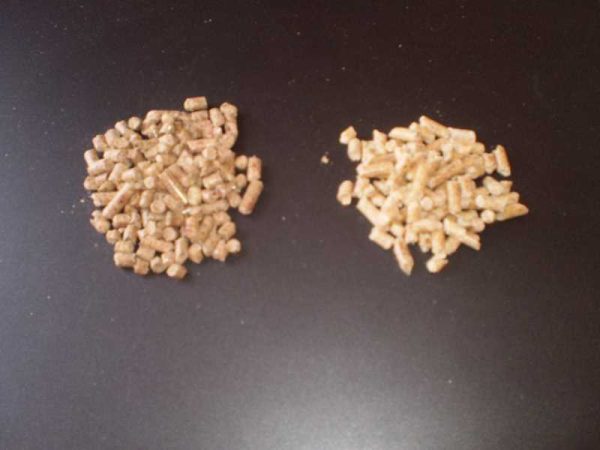
Pellets look like this:

They’re little extruded cylinders of dried, chopped up wood. People think they’re made of sawdust, but they’re not, really. More like corn flake-sized wood chips. They’re fairly hard, and have a kind of glossy finish on them. That’s simply from the heat and the pressure of forcing them through an extruder. They’re 100% wood with no added ingredients. The ones on the left in the fuzzy photo are a mixture of hard and softwood. The ones on the right are 100% softwood. Softwood costs more, and burns hotter. They smell nice. I don’t know what they taste like, but I bet it tastes better than a urine mead smoothie.

Softwood burning hotter than hardwood sounds counterintuitive to many folks, but it’s true. There’s more lignin in softwood per pound, and lignin burns ever so much hotter than cellulose. The paper mill down the street captures the lignin from their wood chips, and only uses the cellulose part to make paper. The lignin is concentrated into a kind of all-natural crude oil they call “black liquor,” and burned on an industrial scale to make electricity. The hardwood/softwood mix is plenty good enough, and much cheaper; usually $50 per ton cheaper. Even cheap pellets are creeping up to $300 a ton nowadays, but when we started burning them, you could sometimes find them for around $200 a ton.

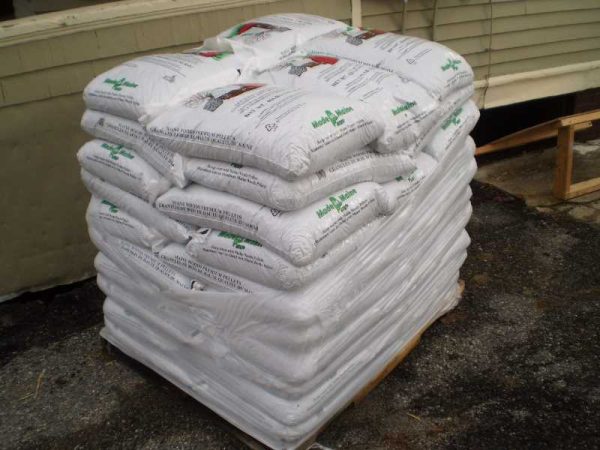
Pellets come in 40-pound bags, usually. You can buy them almost everywhere around here. There are a lot of brands, and people swear by or at one brand or another to taste. There are several pellet mills within driving distance of my house. The normal way to buy them is by the ton, however (50 bags of 40 pounds each), and to have them delivered. They’re shrink wrapped on the pallet to keep them dry. A pallet of pellets (that’s fun to say; go ahead, say it) looks like this:

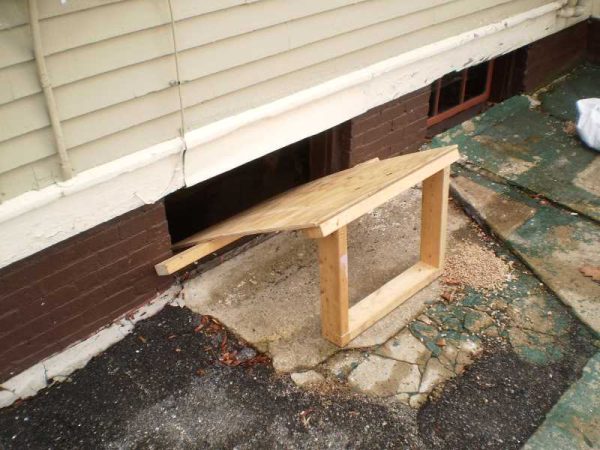
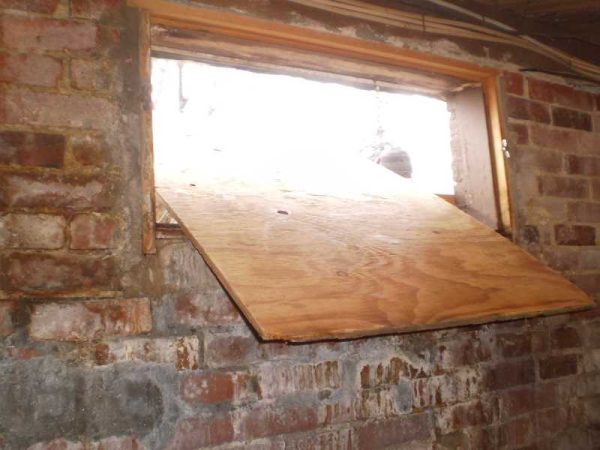
This one’s half unwrapped, and ready to go down our pellet chute. That’s a little number we made to make life easier. There used to be a coal chute right there, and we repurposed the window to accept pellet bags. Like this:

You wax the plywood, of course. It’s also more fun to say wheee! as the pellets go down the chute. Well, it’s fun for the guy that doesn’t have forty pounds hurtling at his head.

A pallet of pellets (a ton) has about the same amount of BTUs in it as a cord of firewood, which made figuring out how much we needed easier. We usually bought eight tons, but had the deliveries come two tons at a time. My sons would stand in the driveway, unwrap the pallets, and send the bags down the chute one at a time. I was in the basement, and caught them, and stacked them on pallets in our basement. If you’ve never had forty pounds thrown at you 100 times in an hour and a half, you haven’t lived.

But hey, if we have eight tons of pellets in the basement, I suppose we should get a pellet stove. They’re hard to shoplift, so I guess we’ll have to figure out some way to buy one.

[To be continued]

A Kingdom Where The Sky Is Burning

Well, now that we’ve warmed up with lots of talk about firewood, I’ll going to pull the rug out from under you. I apologize in advance for that, and for the pun, too. We don’t burn firewood anymore.

We haven’t for a while now. It was the only way we could figure out to avoid freezing and starving here in the hinterlands. It’s bad manners to freeze and starve at the same time, I think. Smacks of an inability to make up your mind. So we had firewood for heat and ate peanut butter a lot and got by.

I could wax poetic about fires, if you like. I used to rouse myself at around 3 AM and go down in the basement in the dead of winter. I always loved that term, the dead of winter. There are two or three weeks here in late January where the daytime and nighttime temps don’t budge. The average is something like low 20s in the day and 6 at night. It just hangs there like that until a day or two into February when the average ticks up one degree, and you know the sun is spinning properly and the earth is tilting a smidge and you’re coming out of it. It’s generally those three weeks when you see -20F at night, and sometimes the daytime temp never cracks zero.

So I’d get up a half an hour before I went to bed, I think. I’d shuffle through the chilly kitchen, and stand for a long moment at the top of the stairs, and look out over the landscape. There’s no moisture in the air at those temps, so everything is as clear as the instructions for a hammer. If the moon is out, the bare trees spray their shadows over the snow in perfect relief, and you can’t tell what’s the tree and what’s the shadow sometimes. There are more stars than you’re used to. They were sprinkled nicely on the firmament in summer, but they’re blasted all over in the winter. There are so many that they seem to be holding hands. It’s too cold for anything to be out and about, but you look for foxes and fishers and moose and bears and deer just the same.

If you get up a little later, the sun puts on a show just over the horizon. It slinks behind the mountains and lights up the sky with delicate pinks and powder blues, with more than a hint of Maxfield Parrish in them. But you can’t linger. Down the stairs to the furnace, to make a fire.

When you’re really burning wood for heat, not just amusing yourself, you can make the old joke that this winter was so mild that you only needed one fire. It lasted from Halloween to St. Patrick’s Day, but it only took one match.

It’s really cold in the basement. We keep the rat run from the water meter to the water heater just above freezing, and leave the faucet dripping all night in the kitchen to keep the pipes from freezing. The first glass of water in the morning was kind of slushy sometimes.

I placed an overturned milk crate in front of the furnace door. There were buckets filled with junks of firewood nearby, placed there the afternoon before, because you don’t want to go outside until the sun is full up if you can avoid it. It takes twenty to thirty minutes to make a fire, and you can’t force the issue. Lord knows I tried, and failed, to hurry it up. It just does.

The fire looks dead out but it ain’t, unless you slept overmuch. You take a poker and rake through the coals, and they brighten up a bit. I coveted anything that could start a proper fire. Paper of any kind immediately got scarcer than a husband when the dishes need washing. My wife would collect egg cartons for me, the gray kind made of cellulose. I’d tear them in half. I’d go in the cutoff box from making furniture and such and fill the little egg holes with little bits of pine and curly maple and cherry and whatever else was in there. You’d lay some paper in, but twisted, so it wouldn’t ignite immediately.  Then you put the egg trays on top of the paper, and then a few sticks of kindling. Then you plopped the three or four logs from the bucket on top, while trying not to smother the whole thing. Open the ash door on the bottom of the stove, and you’re in business.  You hope.

Opening the ash cleanout door lets air underneath the coals, and if you did it right, the the whole thing comes alive without a match or any fussing. Do it wrong, and you have to take the whole mess out and start over in the cold.

This is when the cat would come out of nowhere and sit in my lap. Cats just know these things. The fire would start to perk up, and the heat coming out of the open furnace door was instant summer. The bottom door has to be closed as soon as possible, and judging the knife edge between the fire going out and a four alarm fire got to be an art. There is a cast iron spinner on the ash dump door, that lets in a little air after you close the door, but if you’re doing it right, you can close it. There’s a little air inlet in the firebox you’re supposed to fiddle with. I think it’s there to keep you busy, like a mobile over a crib.

The fire really gets going, and the jacket on the furnace creaks and groans like an uncle sitting down after Thanksgiving dinner. You wait and shiver until the temps in the chase between the firebox and the outside of the stove gets hot enough to trip a switch, and the big fan wakes up and starts blowing air up into the house, and you can go upstairs. In two or three hours, you can go down and simply drop more logs on top of the existing fire, and keep the thing going like that until you falter and fall asleep, and then it’s back to raking through the coals again.

A five-gallon pail holds a single fire.  We began to refer to days as “Six bucket days” or “eight bucket days” after looking at the weather and guessing a bit. On really cold days, you’d need twelve of them lined up. As E.B. White said, in Maine, winter is a full time job.

We did what we had to. We hung curtains in parts of the house to cordon them off from the heat we were hoarding elsewhere. For about a year, we put a thick sheet of foam insulation in the stairwell and abandoned the second floor entirely. My wife and I slept in our clothes sometimes. We turned on electric baseboard heat in the kid’s rooms at night, because kids shouldn’t suffer for their parents mistakes, should they? I could always rob a convenience store or something when the electric bill came, I thought.

And through the whole escapade, I patted myself on the back for my mental fortitude. By that, I mean I resisted the urge to climb inside the furnace each and every time I lit a fire. And for the whole twenty or thirty minutes it took the flames to infect the paper and the kindling, and creep up and over the logs in a wave, I daydreamed of sleeping four hours at a stretch. There was only one thing to do. Buy a pellet stove.

[To be continued. Thanks for reading and commenting and hitting the tip jar. It is much appreciated]

This Is Not ‘nam, This Is Firewood. There Are Rules.

Well, I’m going to tell you the rules, right now. These are not the rules you’ll find elsewhere on the intertunnel about drying firewood. I know, because before I gave up on that information enterprise, I checked them all out. They’re all wrong. Forget them. This is how you do it:

First, get a nice mix of hardwood. People get confused about burning hardwood and softwood, and start arguing, and hitting each other with axes, and nothing gets done. It’s interesting, but basically all wood is simply two ingredients: cellulose and lignin. Different kinds of wood have different ratios of those substances, and a varying melange of trace elements. If you like, you can read all about calcium carbonate and compare the trace amounts of manganese compared to boron over at Wikiwhatsis. Study up on alkenes and alkynes and alkanes to your heart’s content. But leave me out of it.

Why do you want hardwood? Because it’s denser. All other things being equal, denser is better. That’s about it. Oak makes great firewood. Maple makes good firewood. Birch makes good firewood. Around here, that’s about all you’ll get in your firewood delivery. Oak is the best, because it’s the densest. Denser wood burns longer and so you get to sleep three straight hours instead of two-and-a-half because you’re tending the stove, and if the fire goes out, it’s in the thirties in your living room in a hurry.

Oak is great for another reason. You see, when you burn wood, it becomes pyrolized. Pyrolosis is what happens to wood when you heat it up. It chars, and releases volatiles. It’s the volatiles that burn. That’s why flames appear in the air above a fire. It’s hard to get pyrolosis going if your wood isn’t seasoned correctly. Please notice I didn’t say “wet.” If the internal moisture content of your firewood is low, you can throw it in the furnace soaking wet on the outside, even caked with ice, and it will burn fine. Dry on the outside and wet on the inside won’t burn.

Another factor to consider is called coaling. Good luck looking that up on the intertunnel. I’ll explain it as best I can, seeing as how I barely understand it myself. Good firewood, like nicely dried oak, is dense, has a lot of BTUs in each junk, and burns longer than species like pine. It also coals nicely. Coaling is what happens when the wood is completely pyrolized, and slowly combusts with nearly no flame. In a furnace like ours, you can get quite a show in the observation window when you’ve got the air intakes just right, the fire just right, and the firewood just right. The charcoal remnants of the original logs emit some volatiles, but no smoke. The volatiles are ignited in the air above the fire, just under the baffle that leads out to the flue. They dance around like the aurora borealis. The wood is all black, and doesn’t seem to really be on fire, but it’s slowly consumed and gives off beaucoup heat. That’s coaling, and you want it.

So, how are you going to get it? Like this.

  • Stack your split logs in single rows. Never in a pile or with rows touching each other. Air has to circulate all around to dry the wood
  • Never try to dry your wood inside a structure or up against a structure of any kind. Sunshine and wind are your friend
  • The rows of logs should run vaguely east to west. The sun is in the south in our hemisphere. You want it shining on the long face of your woodpiles, not the ends
  • The woodpiles can be five feet high or so, to save space, but higher is a PIA
  • The wood piles should not be on turf or soil if you can avoid it. Moisture will come up out of the earth and set you back. Pavement is great for this. If you don’t have any, put down heavy plastic first
  • If you’re on pavement, you don’t have to put the wood up on anything. On bare ground, use pallets or something to get it up out of the muck
  • Put your first row on the southernmost part of the area you’re stacking wood in, at noon
  • Look at where the first row’s shadow falls. Put the second row up against the shadow, but not in it. The sun will shine on the face of every row, all day, more or less, if you repeat this strategy with every row.
  • You don’t need any kind of props to hold a firewood rick. Stack logs in alternating layers of three junks on the ends of the rows. They’ll hold
  • Your firewood will dry faster if you cover the top so rainwater or snowmelt doesn’t filter down into the center of the rows, but don’t cover the faces under any circumstances. If your firewood is 16″ long, cut OSB into 18″ strips and plop it on top of the rows. With barely an inch of overhang, the faces of the logs get wet during rainstorms, but that will help you, not hurt you. When the sun comes out, the wetness wants out of butt ends of the logs, and they split open nicely. That lets air get further into your junks. That helps get moisture out of the interior of the junks

That’s it. I’ve dried eight cords of wood in my back yard parking area in less than two months. And I have a moisture meter, so I’m not funning about it being dry. I took a sample from the middle of the pile, split it, and laid the moisture meter on the fresh face. Under 20% moisture in there and you’re good to go.

And what’s it like, to burn firewood for your heat? It’s fine, as long as you show no enthusiasm but don’t complain.

Tag: HVAC

Find Stuff:

Archives