We’re All Buster Keaton Now

Chaplin (1992) is an underrated movie. The producers lost their lobster thermidor-stained shirts on it when it bombed. Boo hoo. Robert Downey made a creditable stab at impersonating a person who was familiar to nearly everyone on the planet. Charlie Chaplin moved into that layer of the icon stratosphere where only entertainment sputniks and celebrity telstars whiz by. It must be hard to portray someone rocketing around the Van Allen belt (and suspenders) of celebrity while your name recognition is still flying at 30,000 feet.

Whatever its flaws, the movie was (is) a great encapsulation of a time and place. Movies that accomplish that reward occasional rewatching. I got to thinking the other day about Douglas Fairbanks Jr. (Kevin Kline) opining on the coming of talkies to the cinema, and what it might mean to guys like him and Chaplin. They put on greasepaint with a roller and brush, made big gestures, and relied on intertitles to deliver any dialogue.

In that scene, it’s just dawning on Fairbanks. He fears his party’s over. Chaplin poo-poos the idea. He is marinated in the milieu of the mime, and treated talkies like an internal organ someone was trying to insert in him while he was sleeping. He didn’t think he needed a second appendix full of words, and assumed his body (of work) could simply reject it.

It occurred to me that this kind of societal shift is exactly what’s happening with Chad, i.e.: Artificial Intelligence chatbots. The legions of people who have survived, and sometimes thrived in the nooks and crannies of the online world, are poo-pooing Chad in the same way Chaplin downplayed the coming of talkies. They talk endlessly online about the “slop” that Chad is gonna generate forevermore.

Merriam-Webster names ‘slop’ the word of the year

AI’s impact on our social media feeds has not gone unnoticed by one of America’s top dictionaries. Amidst the onslaught of content that has swept the web over the past 12 months, Merriam-Webster announced Sunday that its word of the year for 2025 is “slop.”

The dictionary defines the term as “digital content of low quality that is produced usually in quantity by means of artificial intelligence.”

If you’re a low-level code monkey, or a copywriter, or any number of other textual, image, and moving picture drones, you’re whistling past the graveyard if you think Chad ain’t coming for you. Well, it’s coming for your job, anyway. It doesn’t care about you. It doesn’t care about anything. You’re not being attacked. You’re being displaced. Disappeared. It’s a shame, really. If you were really being assaulted, you could gin up a GoFundMe page and get a few dollars for your troubles. It’s hard to get the same sympathy when you’re being replaced by a Dell Optiplex on steroids. No one cares much, because they’re adapting themselves to the new reality, and you aren’t. It’s easier when it’s not your ox that’s being gored.

You see, it’s a certain type of intellectual that’s getting their ricebowl broken. They know a little javascript, or how to write an SEO-optimized 750-word piece of drivel, or photoshop the background out of a thumbnail image of a cute top for a Shopify store, or maybe look up some arcane webhosting approach on Stack Overflow. It was on their resume for some reason when they got hired, so their boss expected them to fix it, but they didn’t know how. Chad knows how.

Many of them will stamp their feet, and leave drunken Reddit comments at 2 AM about AI slop until their phones run out of charge. It’s hard to charge anything inside a van down by the river. But no matter how they complain, Chad is not going away. There is a fundamental reconfiguration of cultural and technical production going on, and who’s gonna matter from now on. The people complaining about AI slop want you to shed a tear for them, but they didn’t give a shiny shite about all the people they helped wipe out by leveraging the internet and cellphones into a living while the oldsters complained.

I got to wondering if anyone else was getting the same vibe, that a big shift is happening right in front of us, a disquieting, amorphous wave that you can either swim in or drown under, take your pick. I discovered Jean Baudrillard. Never hear of him before. I doubt I’ll hear of him much going forward. Been dead for 18 years. He was a sociologist, or philosopher, or some similar kind of big thinker. He was interested in hyperreality. Really interested in it, I gather, because he made up the term.

Hyperreality is a concept in post-structuralism that refers to the process of the evolution of notions of reality, leading to a cultural state of confusion between signs and symbols invented to stand in for reality, and direct perceptions of consensus reality. Hyperreality is seen as a condition in which, because of the compression of perceptions of reality in culture and media, what is generally regarded as real and what is understood as fiction are seamlessly blended together in experiences so that there is no longer any clear distinction between where one ends and the other begins.

So instead of droning on and on, like I do, Jean summed it up pithily:

“Intellectuals are doomed to disappear when artificial intelligence bursts on the scene, just as the heroes of silent cinema disappeared with the coming of the talkies. We are all Buster Keatons.”
Jean Baudrillard (Cool Memories II, 1987-1990)

So Jean’s better at it than I am. He understood artificial intelligence before there was such a thing. But I’ve outlasted him, and can check up on his supposition. I’m still desolating the internet and various restaurant menus. I’m in a better position to judge what happens when “…what is generally regarded as real and what is understood as fiction are seamlessly blended together in experiences so that there is no longer any clear distinction between where one ends and the other begins.”

Where one ends and where one begins? I look at it the other way around. It begins with slop, and it’s going to end in tears.

The Genie of Everything

When you ask “Chad” (as we refer to Chat GPT, or any LLM) to make an image, a video, or write you a story or something, this video is a great approximation of what’s happening behind the curtain. Kutiman had LLMs figured out 16 years ago, although LLMs didn’t exist back then, and he had no inkling what was coming down the pike. Then again, it doesn’t matter why someone is right. There are no style points in right/wrong questions. Kutiman took bits and pieces of the internet, and made something transformational out of them.

There have been plenty of lawsuits filed against LLM outfits over copyright and trademark infringements. They’re all losers, at least to date. Don’t be misled by a ginormous settlement by Facebook for $1.5 billion or so, paid to a gaggle of authors.  That really wasn’t a lawsuit based on LLMs scraping the internet and re-using what they found in amalgamated forms. Facebook got caught using libraries of pirated books to train their bots, so they lost the case. Legally accessible stuff has never gotten a plaintiff a copyright win against any Chad that I know of, probably won’t ever, and shouldn’t, at least in today’s legal landscape.

The Fair Use Doctrine comes into play here.  Fair Use is a legal principle in U.S. copyright law. It allows people to use copyrighted material without permission in certain situations — typically for purposes like criticism, commentary, news reporting, scholarship, or research. It’s easier to skate on Fair Use if you’re futzing around with factual stuff, and/or the output is educational. Using only modest amounts of any particular pillaged work helps. If the final product isn’t likely to harm the value of the original work, you’re probably golden. But the key detail is that the output has to be transformative.

So what qualifies as transformative, you might ask? Well, I am not a law talking guy, so I’ll keep it as simple as I am. If you transmogrify the original work to say or do something new, add commentary, change its purpose, or make art out of the artless mess you found, you’ve transformed it. You’re probably in the clear, legally. Although if Disney sues you, being technically correct is no longer the best kind of correct. The kind of correct with 400 lawyers on speed dial is the best kind of correct these days. Remember, the courts can stay irrational longer than you can stay solvent. Facebook found that billion-and-a-half in their couch cushions. I doubt you can pull off that trick.

Regular humans don’t produce anything artistic or intellectual in a vacuum. People are just like LLMs. Everyone is magpie for information their whole life long. You might get your information in the library, or by watching Two Broke Girls, but whatever you know, someone else has already known it, unless you’re John Von Neumann, and he’s dead. Or maybe Tarzan. But even he picked up stuff from the apes, including fleas. Everyone spends their whole life integrating disparate, already experienced things into their daily activities. Intellectual work is no different than shoveling the driveway. You don’t invent a shovel before putting on your mukluks and heading out. And all your curses have been uttered before, believe me. By me for certain, and probably by several other people who slipped on the ice.

So now LLMs can synthesize all sorts of inputs and produce all kinds of output much faster than homo sapiens, or whatever species they hire to write the New York Times. I really can’t keep up with the pace of it. Here’s a video produced with a suite of AI tools from about five months ago:

There’s a heaping helping of uncanny valley in there, but the days of putting 13 fingers on two left hands is pretty much over. Homages, riffs, and little bits of ephemera are giving way to full-blown productions. That was inevitable. It’s a cinematic Rubicon, the same sort of paradigm shift that self-publishing books produced. I never would have been able to publish a book unless I could pull the self-publishing end-around on nineteen women named Heather at Simon & Scribner Random Penguinstein and Co., all chanting Boxwine Über Alles while typing my rejection letters. And, no, “the end-around” is not a euphemism, although it has plenty of potential.

Just a month after that last one, someone else posted a short Sci-Fi film that looks miles more detailed:

LYRA is a haunting, beautiful glimpse into a future where humanity is gone, and a lone robot walks the Earth. Prompted and produced by Top Notch Cinema, this 3-minute cinematic short was created using a suite of cutting-edge AI tools including MidJourney, SeedDance, 11Labs, Adobe Firefly, and Kling. This film explores themes of identity, memory, and what remains when everything else is gone. As AI tools evolve, we’re just beginning to see how creators will harness this power to tell deeper, more meaningful stories. This is just one example of what’s possible.

If you’re one of the nice folks hoping that any obvious synthetic qualities of AI-generated video and audio will eventually turn people off, maybe you should review the way the music industry adopted pitch-correction software to make singers out of mumblers. Pitch correction was designed to be undetectable, a Lilliputian fraud on the audience, but it took about fifteen seconds for the talent-challenged to turn it up to eleven, where the effect became obvious.

That example was from 27 years ago, by the way. Everything on pop stations has that robotic twang now. People prefer it, I guess. I think it’s like eating Hamburger Helper without the hamburger, but facts is facts.

Back to the videos. Of course 99% of AI video things are bound to be science fiction, or sparkly vampire bodice rippers. The people who produce them are the biggest consumers of the genres. They are bound to get high on their own supply. But they’re going to have a hell of a time trying to “tell deeper, more meaningful stories,” when they’ve never read one, never mind told one.

It’s a Director’s Cut generation. They will watch endless hours of “cinematic universes” filled with creatures named Glorp or Flapdiddle wandering the actual universe in search of new galaxies and a plot. I have no idea how many version of Star Wars are out there, but at this point I imagine you’re watching droids doing their laundry and defrosting their refrigerators.  Hell, even the original Star Wars barely had a plot.

That what Kutiman brought to the table, and why his thang was different than most. He was the first true prompt engineer. Each of the videos in his concatenation was A Thing on its own. He gathered them up, painstakingly I’m sure, because finding particular stuff on the internet sixteen years ago was no picnic. Then he used his own artistic and comedic sense to make something more entertaining than the sum of its parts. His work was transformative. It was His Thing.

Where’s it all going? Probably nowhere very satisfying. The amalgamated output of pablum is more pablum. Good writing is not to be found very often on the internet, or even on the best seller list. You certainly won’t discover its secrets on things like the Hemingway app. And I hate to break it to you, if you need that thing, you’ll never be a good writer.

So Chad is getting really powerful. I know it reads some good writing, because its bots beat the hell out of this website, for instance. But it has no idea what to make of it, and neither do internauts using various Chads to make videos. I explained it to Chad a long time ago, but he didn’t listen. Neither did anyone else:

Granpa told me all about the genie in the lamp.

It’s the oldest story ever and came from the land of the sand and the women with only eyes. It’s in there, the genie of everything, but you have to find him and let him out. Then he’s out and you have to figure what to do with him. Granpa says he’s wonderful but as dumb as a stump, just like all of us. He can do anything but doesn’t know what to do. He needs guidin’.  — A Thousand and One

Take that, Kutiman. I wrote that one 18 years ago.

What Did We Learn, Palmer?

I don’t think the people who are building LLMs (Large Language Models) are all that smart.

I’ll start off by noticing that they have no idea what to even call the things. As usual. I’ve been using Chat GPT for a while now. I just call it Chad, because you have to call it something less goofy than Chat GPT, or any of the other attempts to label the things. LLMs? Generative AI? Neural Language Model? Ugh. But everything in the internet age is named by the same sorts of people, and badly. Is there an uglier and less informative possible word for this essay than a blog? But we’re stuck with it because a bunch of people who attend marriage ceremonies held in Klingon said so.

So around the Cottage we call it Chad because it’s close enough to Chat, and it’s very like Brad Pitt’s character in Burn After Reading. It’s amusing in a child-like way, helpful in mostly unhelpful ways, energetic and somewhat obsequious. It can also get you shot in a closet or killed with an ax in the middle of the street if you listen to people who listen to it uncritically: (Some swearing)

That’s a minor quibble, of course. I use Chad often for a lot of things, although I gather from seeing what my nieces use it for on their phones that my Chad workload is a solid minority, as usual. I’ve never described my cat to Chad, and had it turn it into a person, for instance.

So it’s great for silly business. Fine. I find it’s superb for reading the internet for me, and vomiting what I’m actually looking for instead of having to wade through oceans of Search Engine Optimized drivel to find the part number on a washing machine or something similar. It’s not the birth of artificial intelligence, but it is the death of Google, so there’s that.

But back to the point, if I have one. I’ve always suspected that the wrong people are working on all the various versions of Chad, and that’s why its such a muddle trying to figure out where it’s going. These companies have hired anyone who’s good at math, statistics, and computer languages to work on the things. These people aren’t smart. They’re like the IT Crowd version of Chad Feldheimer. Being good at heavy lifting and running in place doesn’t make you smart when you’re looking at “…names and shit and these other files are just, like numbers arrayed. Numbers and dates, and numbers and numbers, and dates and numbers, and I think that’s the shit, man. The raw intelligence!”

Internet math geeks are like plumbers. They’re not dumb, but they have a very narrow worldview. If you ask a plumber to design a house, it will have two bedrooms and fourteen bathrooms. It’s human nature. Ask math geeks what to call a collection of essays, and they’ll call it a weblog. Ask them how to make a machine intelligent, and you get numbers and dates, and numbers and numbers, and dates and numbers, and I think that’s the shit, man.

Now back when I was in high school, and Noah was still looking for his bevel square, they used to acknowledge that verbal skills were more important for high-level thinking than math skills. That’s right, you’d take the SAT, and your final score was your verbal score X 2, plus your math score. It was how a stoner who skipped the better part of the last three years of high school classes became a National Merit scholar while the kids who got an 800 on math grumbled and wondered. The math wizards are the same people who became computer programmers, and claim on Reddit that speling doesn’t matter. Of course, a spelling error in their computer program occasionally destroys an entire company in an afternoon, but C’est la vie! They’ll say it’s all part of their “journey” on their next job application.

So the founders of these companies are ardent bullshitters and sophists, but that’s not the same as being verbally brilliant. Shamelessness is more useful when you’re pitching some vaporware to angel investors. And the glorified statisticians they eventually hire are always busy looking at the digital world as one big spreadsheet.

Now on top of what little I know about the truly technical matters involved, I heard an interrumor that at this point, the people that built the LLMs no longer understand how it works. This attracted my attention, because it made perfect sense to me why that would happen. To stretch my simile, you don’t hire plumbers to pick out your curtains, either, because the catalogs don’t have any porcelain drapes in them. And the math wizards are looking for mathematical drapes in Chad’s output.

So, who to ask about my suspicions? Why not Chad hisself?

Uh huh.

So there you go. We asked Chad some questions about how Chad works, and got some Chad answers. So let’s sum it all up, roll up the ball of wax, and survey the whole megillah:


Checking in With Chad

I wonder how many of my readers are familiar with one or another or all of the chatbots. Every tech company seems to have one now, including Gargoyle. They all have vanishingly dumb names. Naming things has never been the intertunnel’s strong suit. Everything is childish gibberish. I love when websites you rely on for business are busted, and you’re presented with a 404 page that says things like wah wah, oops, our bad! our team of trained monkeys has been dispatched to twist your pixels. This from a business larger than the Dow Jones Industrials, combined, from 1990. And when I say I love it, I mean that if I had a rocket, I’d shoot the web developer responsible into the sun.

My wife and I have anthropomorphized Chat GPT, and call it Chad, and ask it stuff. I’ve been poking around it since its inception, and use it for this and that. I’ve looked (askance, mostly) at the offerings of Facefriends, and Gargoyle, and Bingo Was His Name-o, and the Oriental one that you can supposedly run on your 1979 Texas Instruments calculator. They all suck, or don’t, about the same amount. They’ve mostly been trained by looking at the intertunnel. Then again, so were the Kardashians. It’s not a recipe for clear thinking.

But clear thinking is not on the menu. No thinking is, at least not yet. I’m of the opinion that thinking as we understand it is not possible with a machine. Inspiration isn’t keystrokeable. I’ve always ascribed to the theory that genius is the ability to see connections between very different things that don’t seem to have any connections. A goodly dose of intelligence, which is not related to genius, simply means you might understand what a genius says when he boils it all down for you. Regular smart people don’t come up with the theory of relativity. No bot ever could, because the bots are the Dewey Decimal System, writ large.

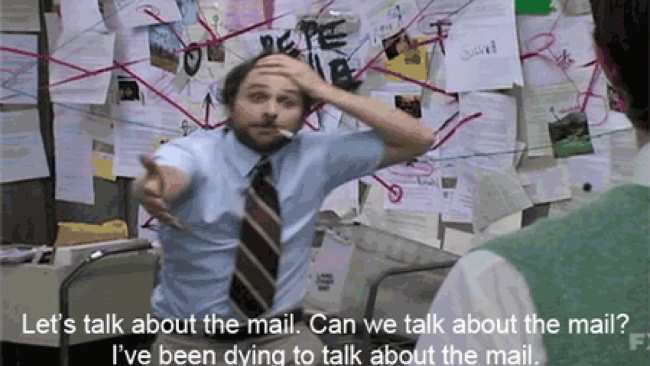
We don’t watch teevee (I know, I know what that sounds like. But at least we aren’t vegan or anything), but I know there’s a meme with a not very smart guy thinking he sees connections where they ain’t. Off to Chad:

There’s an image of a crazy looking nerdy guy standing in front of a bulletin board with lots of images and newspaper cuttings connected by yarn and pins, indicating a connection between them that isn’t really there. Can you find it for me?

Chad’s answer:

I can’t search the web for images directly, but it sounds like you’re describing a popular meme or scene from TV shows and movies where a character is obsessively trying to connect dots or create wild conspiracy theories—often shown standing in front of a bulletin board with images, newspaper clippings, and strings connecting everything.

This kind of image is common in memes or portrayals of characters like Charlie Kelly from *It’s Always Sunny in Philadelphia*, or sometimes in conspiracy-themed shows. If you’re looking for a specific image, you could try searching for “crazy conspiracy nerd bulletin board meme” or similar phrases. Let me know if I can help further with anything else!

Oops, I forgot that free Chad doesn’t search for images. The paid Chad will. But the search he suggested immediately rendered this. If I logged into pay-Chad, I”m sure he would have fetched it for me:

It is labeled Charlie Kelly, so Chad immediately knew what I was asking, even though I didn’t. Chad is like that.

Chad and his ilk make mistakes. People refer to them as “hallucinations.” I’ve observed many people claiming that Chad, etc. can’t give them what they asked for, even though they ask over and over again. In almost every case, it’s because the average internaut cannot read, write, or spell anything but poorly formed vernacular, slangy English. The Zman, who certainly can think and read and write, mentioned an example of one he’d seen on Reddit or somewhere, where no matter how many times the fellow asked, he couldn’t get the bot to generate a picture of of a glass “filled to the brim.” The redditor just kept asking it over and over, more or less in the same way. I’d seen that very example in several places on the interwebs. It’s always presented as a problem with the bot.

But I doubt it. I could test out my opinion, but I’m too dull and lazy to make the effort. Anyway, glasses don’t have a brim. Hats do. Filling a glass to the brim is a vernacular expression. Bots are literal creatures. An older person steeped in finding stuff in card files, encyclopedias, and dictionaries before computers would know enough to back up a step and ask for a glass filled to the rim, or maybe to the top. The iPhone generation doesn’t approach things like that. They stamp their foot and ask more loudly each time. But Chad’s the deaf, dumb, and blind kid. He can do prodigious things, but he needs to be led to where you really want him to do it.

So Chad, good God, y’all, what is he good for? Absolutely — something, say it again. Chad is good for several things, actually. I’ve coded a dozen WordPress plugins with it. It works, if you know how to kick it when it wanders. But what it’s really good for is avoiding having anything to do with the intertunnel. The interwebs are a very large pile of hot garbage, ablaze in a flaming dumpster of suck. Gargoyle ruined the web five different ways, but demanding that SEO crap is the only thing that could get its head above water in search results is exhibit A.

Chad is based on the supposition that there’s a kind of wisdom in crowds. The internet is very, very dumb, at least when it’s not entirely malicious. But Chad has time to do what you don’t. It reads the whole goddamn thing and boils the whole shebang down into one, more or less average answer. For that, it’s invaluable. It’s a search engine and a dessert topping and a floor wax. It’s way better than Wikipedia, something it swallowed whole, and was still hungry.

So let’s ask free Chad about my favorite topic: Me. The last time I asked it for shiggles, it identified me as some guy I never heard of, an honor I’m sure he can do without.

Question: Can you describe the writing style of Sippican Cottage?

Answer: Sippican Cottage, a blog created by the writer “Sippican,” is known for its unique, conversational, and reflective writing style. The tone is often humorous, understated, and filled with a quiet intelligence. There’s an almost nostalgic quality to the writing, with a deep appreciation for the small, everyday moments in life. The author tends to blend wit and wisdom, often exploring themes related to personal experience, family, history, and the passage of time.

The style is also marked by a certain level of erudition, where the writer can effortlessly incorporate literary, historical, and cultural references, without making the prose feel overly formal or academic. It’s grounded in a sense of authenticity and humility, and there’s a tendency to favor detailed, sensory-rich descriptions that evoke strong imagery. Despite a calm, almost leisurely pace, the writing often carries an underlying current of sharp observation and insightful commentary.

In short, the writing of Sippican Cottage feels both intimate and reflective, blending light humor with deeper reflections on life’s intricacies. It’s a style that invites readers to slow down and appreciate the subtleties of everyday existence.

Wow. So Chad is kind of polite, I think. He didn’t mention the fart jokes. But if that’s the distilled version of what the intertunnel thinks of me, I’ll take it. Now if I can just continue to fool the public, I’m sure Chad won’t come up with any opinions of his own, and ruin the whole thing for me.

BBROYGBVGW

Fascinating look into a factory making motherboards.

A motherboard is the component that holds the CPU –Central Processing Unit — in your computer. It generally holds your memory and has lots of connectors on it for your peripherals — your disk drives and such.

This is an old-fashioned sort of factory. It mentions that Giga Byte is now the last motherboard manufacturer in Taiwan. China is Taiwan’s Taiwan now.

I’ve worked in a clean room factory on electronic stuff before. Defense plant stuff. It’s a bizarre atmosphere. No natural light all day makes you weird. It’s doubly weird if you work the night shift. If you sleep all day, in the winter you never see the sun.

It was a very long time ago, but I still remember the mnemonic device for remembering what the colored stripes on the resistors we used meant: Bad Boys Rape Our Young Girls But Violet Gives Willingly is how it was taught to us. They’ve since tried to make it more politically correct, and hence, less memorable.

These motherboards are generally sold to housebound agoraphobes covered in cheeto dust who play video games and put together their own rigs. The world is getting strange. An ax is more useful than a computer now.

Tag: computers

Find Stuff:

Archives