Well, they called it a Country song. I guess it was, at least before Freddie Fender got ahold of it. Then it became another country song. It had been recorded by a bunch of people, including Jerry Lee Lewis, but no one remembers that now.
The Freddie Fender version was a throwaway afterthought. A record producer wanted a version with Spanish lyrics mixed in, so he hired Freddie to sing it. “I was glad to get it over with and I thought that would be the last of it”. It made it to Number One on the Billboard Hot 100 in 1975, and was the fourth most popular song of the year. After that, pretty much no one knew Freddie had ever sung anything else. The music business is like that sometimes.
We have friends here in Merida. It was already a polyglot crew, but now we seem to have inherited a Poligano posse as well.
Poligano is a fraccionamiento, or perhaps a colonia in the northwestern part of the city. No one calls a neighborhood a barrio here. The older sections of the city are called colonias, and the planned developments are called fraccionamientos. Poligano isn’t much of either. It’s an area with a mix of building styles, almost entirely single family homes. It’s where real people live. Working class, and mostly poor. In many ways, it’s the polar opposite of the colonia of Santiago, where we live. We live south and west of the main part of the city, which we can walk to. Poligano is towards the northeast corner of the city. You can’t walk to anywhere from there but more Poligano. Our new Poligano friends exhibited a brand of friendship I recognize, but only dimly, like a black and white movie on a VHS tape. It has not been on offer in the country of my birth for a long time.
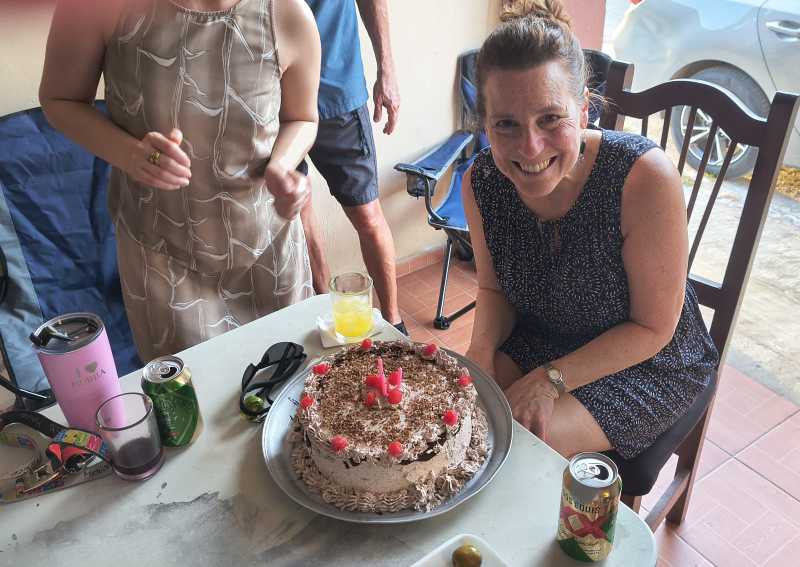
They are cousins of one of our original friends here in Merida. They have a big family and get together at the drop of a sombrero and party down. They decided to throw my wife a surprise birthday party. She never caught on, even after it was well underway, because she couldn’t envision something like that happening to her. It had to be explained to her that this party was in her honor, and these people had gathered to celebrate it, as if she were three years old.
Their house is one in an endless row of mismatched masonry dovecotes. It’s hacienda style, I guess, but only technically. The front of the house is a big iron gate, nothing more than a heavy screen. The front room is a garage, sort of, but garages are tiled here, and rarely used for parking cars. The streets are skinny and filled with cars that have seen better days, but will see many more days anyway. For instance, across the street was a glorious 1970-ish VW bus, painted various fetching shades of pink (by brush and roller). It had four flat tires. On either side of it were cars fifteen years newer than our old Volvo back in the states, so I’m not sure exactly what you can infer from that.
The garage had long tables set up in it, lots of mismatched chairs, and a television of the size that would make your children invoke the Geneva Convention if you tried to make them watch it. There were cheap speakers screwed to the walls, the ghost of boomboxes past, I guess, ready for a fiesta at all times. On the wall was a shrine to Our Lady of Guadeloupe, surrounded by Christmas lights. It’s a staple around here.
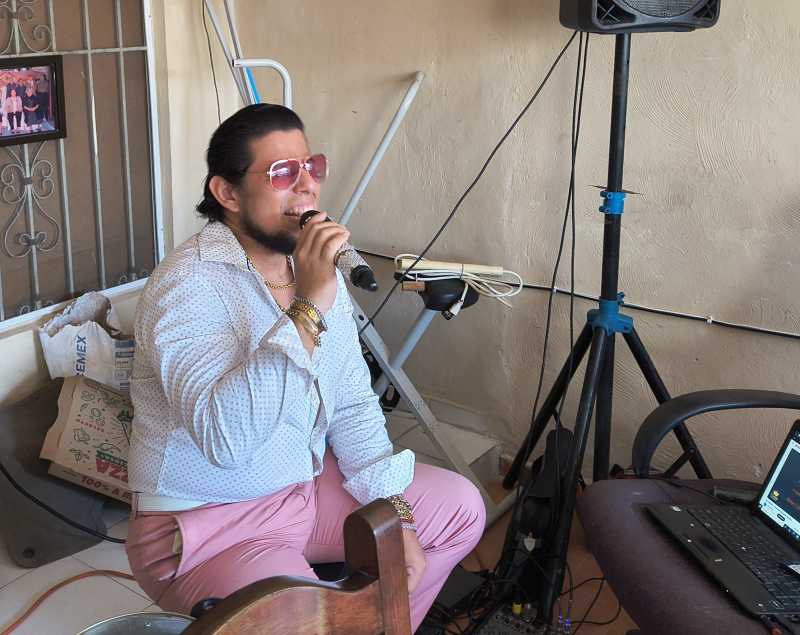
I tell you what, you have not lived until you are taken in, like stray cats, and eat tacos prepared in a kitchen with no running water (until it rains again, and the cistern fills up), and put yourself outside of arctic cervezas that sweat only a trifle more than you do in the heat. You dance and sing along with an Ecuadorian Elvis, hired to bring his karaoke machine and perform. Was he good? I told him that if he was around when my mates and I were still performing pop song covers back in the day, we’d have put him out front and in five minutes we’d make a grand a night, and two on the weekends. He replied that it wasn’t important, because he was an electrician all day, and didn’t need the money, really.
So Marcello the Ecuadorian Elvis sat on his drum seat throne, clutched his sequinned microphone, and held court for three hours. The crowd ebbed and flowed the whole time, extended family showing up, young men immuring themselves in some interior chamber and playing video games, venturing out for Cokes and cake. At one point, a handful of people were delivering a refrigerator to the house next door from the corroded bed of an ancient Datsun pickup, and danced and sang along on the sidewalk to some slice of Saturday Night Fever that Marcello was improving.
Ecuadorian Elvis was a riotmaster, and got each and every person to get up and sing, either with him, or against him, or next to him, but it had to happen. My wife, who is the shyest person on earth, manufactured the verve to sing Walk on By like the little angel she is. Then Marcello did the impossible, and made me bellow out New York, New York, because to an Ecuadorian, Maine is New York. I was informed that fourteen stray cats were found dead the next day, but I maintain the evidence of my guilt is tenuous at best. There was no indication that they took their own lives, for instance.
And lovely Elsie baked my wife a glorious cake and we all sang Happy Birthday in Spanglish.
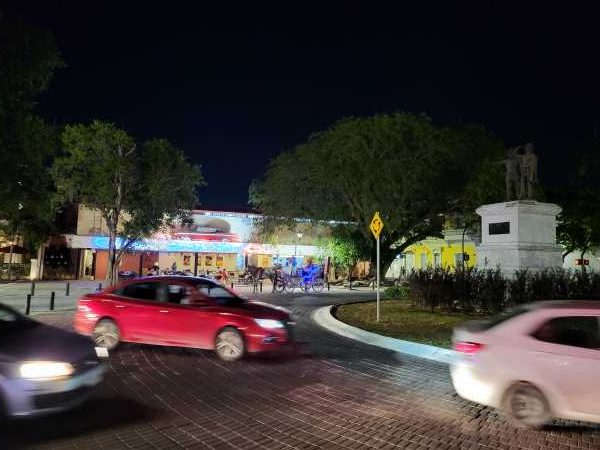
We took an Uber home, late, the only long drive we’ve ever had in this town. The car was an MG of the sort you can’t buy in the US. It was an elegant four-door sedan, with leather seats, and the air conditioning set on stun. The city passed by, Egyptian-style in the side windows, an endless scroll of nightlife and fast food and cantinas, dog walking, lovers walking hand in hand, with scooters and buses fighting for primacy in the roundabouts, until we arrived home.
As we turned the key in our lock, the iron grates of the house across the street opened up with a metallic groan, a party with twenty people appeared seated in their garage, and an honest to goodness Mariachi band started playing.
It’s just like that here. Happy birthday, Mrs. King.
When nothing in society deserves respect, we should fashion for ourselves in solitude new silent loyalties.
― Nicólas Gómez Dávila
I was at a gathering. Certain kinds of people call a barroom a gathering. Certain kinds. Most everyone was familiar, although nearly no one is here. An extranjero to us, and everyone else, had appeared, friendly, gregarious. He’d been adopted into the brotherhood of the bar tab already. I tried to catch up.
He had been partially disassembled by his country, then put back together pretty well, thank God. But he was a ship of Theseus. He was the same person, but not the same. He was wandering the world in search of new silent loyalties, although he skipped right over the silent part.
A friend pointed to me and said that’s _________. He’s a writer.
No one had ever said that before. Never. I’ve been called every damn thing, but never that. It was way down the list of things to be called, on some second page of a resume that never gets printed.
Al was there. He wanted another copy of my book. He’s a philosopher, I guess. Or maybe a Buddha. A wandering ascetic. Whatever he might be, people sit next to him and feel better. I have. He had a copy once, and liked it, so he gave it to the library. He said he couldn’t do without it, even one step removed, so I gave him another one.
A young girl swam in our pool. When she comes she hugs us and says, “Mucho gusto,” instead of all the wan greetings we’ve learned from our lessons. She wanted a book, although she cannot read English. I signed it in Spanish, or maybe Italian, or both, the language is like that sometimes. She held it like a missal. I’ll never forget it.
No one speaks English here, but my book is in the library. It isn’t in the library where I pushed the rock of my life up its hill, over and over. I fashion for myself in solitude new silent loyalties.
I’m getting used to living in a city again. I’ve lived in Boston for a few years. Los Angeles. But for the most part, I’ve always gravitated to the exurban life. Occasionally the suburbs would swallow the exurbs I was in, but I’d generally moved on by then. Not always because the police told me to.
Mérida, Yucatan, where I am now, is big. Depending on how you count its metropolitan area, it’s got either just under a million souls, or 1.3 million. That’s about the same population of the entire state of Maine. Not many people here have even heard of Maine, when they ask me where we fled from. We usually give up after a few tries and say, “Boston,” and that satisfies them, if not me.
This city is like Los Angeles used to be, though. Not much of it is over a two stories tall. It’s spread out all over, but the houses are packed cheek to jowl. You can wander a long way without encountering any gap between buildings. The zoning is by sixteen-sided dice, I think. Everything is everywhere. You can encounter all kinds of things just by wandering around aimlessly. All kinds of people, too, if you’re open to it.
Yesterday evening, we went out to eat with some friends. After we lightened the larder at a sitdown restaurant, we walked down the Corredor Gastronomico, the long strip of restaurants, nightspots, and general folderol this city offers to the sunburned and the thirsty, i.e., us. We pounded dinner home with some frosty helado, sat outside, and watched the parade of people passing by. It’s in the mid-seventies at night, so we decided to just keep wandering around, in search of a nightcap or something.
We got to the head of the remate, the butt end of the big north-south boulevard called the Paseo Montejo. We’ve been there plenty of times before. We were going to pass on by, when we heard the clear, clarion call of a trumpet. Music spills out into the street from lots of doorways, but you can always tell when music isn’t recorded. And a trumpet carries further than other instruments. We shrugged and said, “What the hell,” and went to find our Mérida Joshua.
There was an unusual combo playing at the Tropico 56, an indoor/outdoor place we’ve been to plenty. There was the trumpet we heard first, joined by a keyboard, a pretty girl singer, and a percussionist. We sat down and decided to put ourselves outside some beers, and hang a while.
They were really good, and favored exactly the stuff we’d always like to hear, but never do. One Note Samba. Spooky, by the Classics IV, or the Atlanta Rhythm Section, depending on how old you are, or they were, at the time. We especially liked Perhaps, Perhaps, Perhaps:
We’ve always loved the Perez Prado version, but you can hear everyone from Doris Day to Cake performing that one.
So it was an eclectic, very cool jazz and pop combo, with an equally eclectic mix of music. When they took a break, the trumpet player walked by, and we asked him if he spoke English. He answered in American TV weatherman diction, which made us laugh. We asked him the name of the band. He said he didn’t know, but he’d ask, which also struck us funny.
Music is like that sometimes. Combos, especially jazz combos, are often put together on the fly. Guys that can really play can simply be plugged in at the last minute and still do the job. My brother is like that. I never was. I noticed the trumpet player reading a chart over the keyboard player’s shoulder. That’s a tell. He might not have ever played some of the tunes before, but as long as he could see the chart, no one in the audience would notice. His name was David Terran.
We got to chatting, because he used to live in Los Angeles, and my brother owns a music store in West LA that’s popular with jazz musicians, among others. Then he casually mentioned I might know who his father was. I did, and I bet you do too, even though you don’t know you do. I’m pretty sure this is him, playing the trumpet:
Here he is making a featured appearance on I Love Lucy:
Tony passed away several years back, full of years and accolades. I’m sure he would have enjoyed hearing his son play outside the Tropico. I know we did.
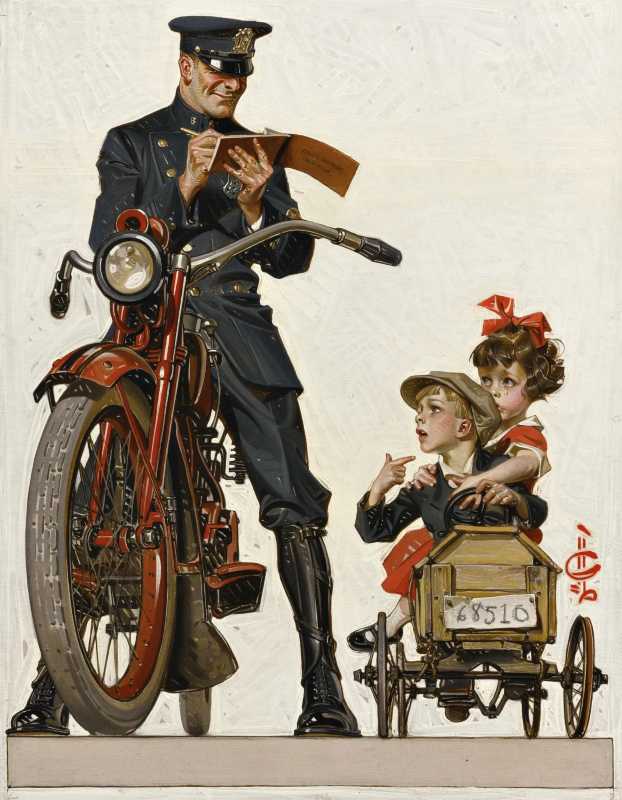
The image is cropped, but I know you know who painted it. The combination of subject matter and technique is unmistakable. Man, I love illustrations like that.
If Norman Rockwell was Disney, than Leyendecker was Warner Brothers. I always like his Bugs Bunny style better than Rockwell’s Mickey Mouse, but it’s a quibble, not a criticism:
I’m not exactly sure when illustrators fully took over for artists. “Real” artists decided to sell their dropcloths instead of their work a long time ago, probably over 100 years. I’m too lazy to look it up. Thank jayzuz illustrators took up the slack.
The average Lucky Strike ad had more art in it than ten Picassos. Hell, I’d rather look at an expired calendar for an hour than spend ten minutes in any museum of modern art. To wit:
Oh look. A recognizable skin tone, a nose on the front of the face, and without a ring in it to boot. Edgy, these days. I couldn’t care less they’re hawking Coke. They’re not agitating for the destruction of the culture that produced them. That’s one in the plus column.
All art of any kind is defined as ideation. The conceptualization of a mental image. It can be idealistic as well, to taste.
“Idealistic” refers to a belief in or pursuit of high ideals, often with a focus on achieving very good things, even when they seem unlikely to others. It can also relate to the philosophical doctrine that reality is fundamentally tied to the mind or ideas rather than material objects.
Complaints that good things, or even sublime things, are false, because they are idealized, is a quotidian modern lament, and profoundly stupid. If you believe in nothing, you’ll believe in anything, I guess. Listen, good is good. Whether it’s good enough for a cat lady on her third box of wine is irrelevant.
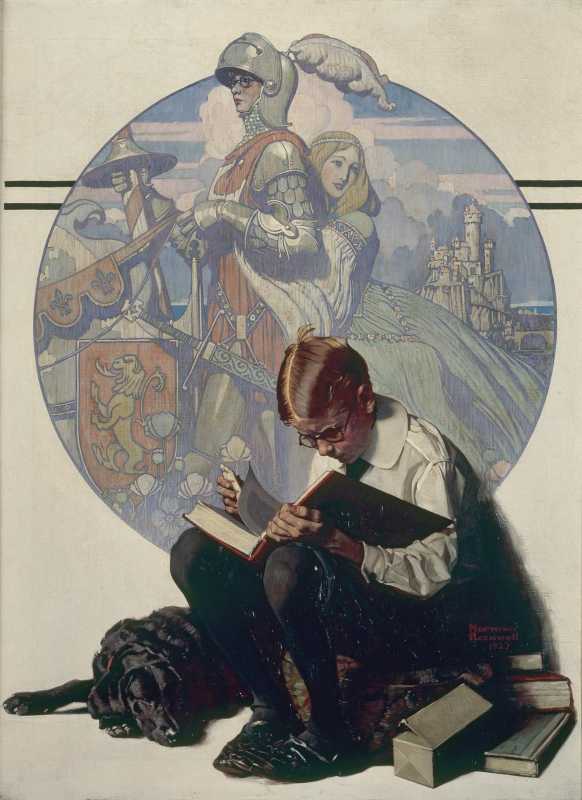
So let’s get back to the first illustration. A young boy, lost in a dream world of Arthurian legend. The Rockwellian detail of still wearing his glasses under his sallet is piquant, no?
It’s about so much more than “books are good.” It is an idealization of the value of forming mental images in your own head, instead of having them force-fed to you. It was painted, no doubt, years before the force feeding apparatus was in full swing. The Leyendecker illo is bold, and universally amusing. The Rockwell image is profound, buried in his usual kitsch camouflage.
You cannot form mental images by watching movies, or egad, television. Impossible. Can’t happen. The part of your brain that does that sort of work goes dormant when you’re force fed images like that. Your brain keeps working, but it’s in a passive cognitive state. Information gets processed, sorta like Kraft mac and cheese gets processed, but nothing of your own input is added. The box is emptied into your head, gets heated up if you still have a pulse, and travels through your intellectual alimentary canal without being digested one bit. Rockwell is telling you that books are a recipe you cook yourself. You should listen to him.
You cannot daydream while watching television. Self-reflection is impossible. What goes on in your head is smothered with the pillow of Two and a Half Men. The extent of you mental processes is limited to a vague remembrance that you’ve heard that joke before, maybe yelled by Ralph Kramden.
Dad (not mine, but we’re idealizing here) used to come home from work and have two scotches and watch TV for an hour before crashing into bed because work used to be demanding. Turn off your mind relax and float downstream was invented before the Beatles were. Dad needed to shut off the executive portion of his gray matter, because it was doing chin-ups all day.
But TV programs were on a schedule then. When a show was over, it was over, You could watch TV continuously, but at the very least you’d have to hunt and gather among the channels to take your mind out of your torpor, and get a little exercise by throwing the TV Guide across the room.
VCRs changed that, and streaming was the pile driver of the process. Binge watching became not a thing, but THE thing. Producers responded by running shows like M*A*S*H that ran longer than the war they were based on. Pretty soon you’re watching Tony Soprano cooking dinner, cleaning out the lint trap in the dryer, and folding the paper bags from the grocery store to fill up the time. The audience became dress dummies just offscreen from the actors, not participating, but never anywhere else either. Drama used to be defined as life with all the boring parts removed. Now it’s a director’s cut with four extra hours of Gandalf’s horse taking a dump or suchlike entertainments.
When I first saw a smartphone, I winced. Oh no, a handheld television. They’ll never turn it off now. It’s a Soma and lotus blossom smoothie, I thought. I thought wrong.
It’s much, much worse than a hand held TV. It’s teevee with the illusion of agency mixed in. It’s like holding your thumb on the change channel button on the remote, never watching anything, getting some primitive dopamine jolt from pressing a button now and then, your decision making put through an information deli slicer until you can see through it when held up to the light.
There is no focus. There is no attention span. It’s infinite, algorithmic, and the only reaction it can produce seems to be disquiet, if not rage. It’s more of an unpleasantness generator than a Pomeranian.
So the teevee makes you endlessly passive. A bump on a log. The phone makes you endlessly restless. Foaming at the mouth with attention span rabies. A book makes you an Arthurian knight, with your own Alisande riding pillion, living in your own private Ivanhoe. Choose wisely.
sippicancottage
A Man Who Has Nothing In Particular To Recommend Him Discusses All Sorts of Subjects at Random as Though He Knew Everything.



Recent Comments