I Got Killed. But I Got Better

Well, the latest crime statistics for Mexico are in. They incite a certain “compare and contrast” urge in me. You see, I came to Yucatan, which is a state in the southern jungles of Mexico, from Maine, which is the unheated basement of Canada. It’s yin and yang. Scylla and Charybdis. I dunno, maybe Abbot and Costello.

Yucatan, the state, is one of three states in the Yucatan Peninsula, if memory serves. To the west is Campeche, and to the east is Quintana Roo. Quintana Roo is where Cancun lurks and cruise ships disgorge their frightful freight of potential sunburn victims.

I’m going to compare crime statistics between Maine and Yucatan for two reasons. One, I’ve recently lived in both places. Two, my wife and I were assured by everyone in Maine that if we moved to Mexico, we would be murdered, or kidnapped, or kidnapped and murdered in no particular order, likely immediately upon landing. I think they set up a betting pool. They wagered on whether we’d get it in the neck at the baggage claim, or maybe be spirited away to a torture dungeon directly from the immigration desk. Perhaps held for ransom by the cab driver waiting at the curb, to me murdered at leisure. One enterprising brother-in-law took a big flutter on us being massacred on the plane itself by a rogue cartel stewardess. We don’t fly Spirit airlines, so he lost his shirt.

There are other reasons to compare the two. Maine is pretty big, but it’s pretty empty, too. Yucatan is slightly less than half as big as Maine, but it has 2.3 million people in it, while Maine has 1.3 or 1.4 million, depending on how many of its hardy souls tried to go ice-fishing one last time in May. So the two places are somewhat comparable.

The comparison even holds additional water, because in both places, the population is all in one place. We’re in Merida, the capital of Yucatan, where between 900,000 and 1.1 million people live, depending on how you define the city limits. Similarly, pretty much everyone in Maine lives in what we used to call Northern Massachusetts. It’s the strip of land that stretches along the coast from the New Hampshire border to Portland. Most people think Portland is the capital of Maine, but it’s just the biggest city. Augusta is the capital. We used to live there. The population of Augusta is 19,000, to give you some idea of how Maine operates. Most of Maine outside of a few cities is nothing but trees, fleas, and disease.

So let’s begin with the crime statistics released today for Yucatan:

MÉRIDA, YUCATAN — Yucatán accumulated 2,346 alleged common law crimes between January and April 2026, keeping it among the safest states in Mexico, according to the latest report from the Executive Secretariat of the National Public Security System (SESNSP). (link)

By “common law crimes,” they’re not describing domestic donnybrooks in trailer parks by couples that can’t afford destination weddings, although that classification would work just fine in Maine. Down here, they are referring to every sort of crime that would be reported to the police, not just the kinds of crime that happens when your meth-smoking common-law wife objects to your preference for spending her SNAP check on fentanyl in your single-wide outside of Lewiston.

The only two states in Mexico rated (barely) safer than Yucatan are next door neighbor Campeche, and Tlaxcala, a tiny little state further up the eastern edge of  Mexico along the gulf, although it’s landlocked. I think they’re fibbing a bit about Tlaxcala. While it’s probably true there’s not much crime there, it might only be because Tlaxcalasians commit all their crimes in the US. Federal Hill in Providence used to be pretty peaceful too, for much the same reason. Many gangsters don’t shit where they eat. Merida ain’t like that. It’s truly peaceful here.

So I asked Chad (chat GPT) to compare crime rates in Merida to Maine. This is especially interesting, because Maine is one of the safest states in the US. Our relatives don’t think they’re courting death by living in Maine, unless they head out to the mailbox in January without a rope tied to their waist and the house. They think we’re crazy, though.

Maine is generally considered one of the safest U.S. states. However, Maine’s reported crime rates are much higher than Yucatán’s reported figures.

Recent FBI-based statistics typically show:

Violent crime: roughly 100–120 per 100,000 people annually
Property crime: roughly 1,000–1,200 per 100,000 people annually
Total index crime: around 1,100–1,300+ per 100,000 people annually

So if we compare reported crime rates directly:

Jurisdiction Approx. annual crime rate
Yucatán (annualized from Jan–Apr data) ~294 per 100,000
Maine ~1,100–1,300 per 100,000

On paper, Yucatán’s reported crime rate appears roughly 4–5 times lower than Maine’s.

Chad cautioned me that there might be a problem with the statistics, because:

Official crime rates don’t necessarily capture:

    • Open drug use
    • Chronic public disorder
    • Reckless driving and traffic violations
    • Shoplifting that businesses no longer bother reporting
    • Trespassing, vagrancy, and nuisance offenses
    • Repeat low-level offending that communities simply tolerate.

A resident’s lived experience can therefore diverge significantly from the official numbers.

I got the impression that Chad was warning me about Mexico, but I can assure you that open drug use, public disorder, reckless driving and traffic violations, shoplifting that businesses no longer bother reporting, trespassing, vagrancy, and nuisance offenses are unheard of in Merida, but they might as well be printed at the bottom of the ENTERING AUGUSTA signs at the edge of town.

So we’re between four and five times safer here in Merida than we were back in Maine, which is about tied for the safest place in the United States. I’d like to assure our relatives that we’re trying as hard as we can to get ourselves killed, or kidnapped, or kidnapped and killed in any order, but it’s going to take a while to settle their bets. Sorry.
Nowak! Szybciej!

Moonlighting (1982) is a small movie. In fact, it’s so small, it’s practically claustrophobic. It’s the story of four men sent from Poland to England to renovate their boss’s rundown pied-a-terre, even though it’s not legal to do it. The film is set contemporaneously in the early 80s, an interesting time period in both countries. Poland was still under the communist thumb, and England was still trying to shed its post-war torpor.

Small movies are hard to find these days. The American studios are only interested in financing Spiderbatwars movies that can gross over a billion. Occasionally someone makes a minor hit on a relative shoestring, like Jon Favreau did with Swingers. Then Hollywood hires them to make Spiderbatwars movies along with the rest of the mafia they’re running out there.

Then again, Hollywood didn’t have anything to do with Moonlighting. It’s a British/Polish production. They still know how to do small. The UK has a long tradition of so-called kitchen sink dramas, going back to things like Saturday Night and Sunday Morning, or Look Back in Anger. They honed their inquisition into social class, everyday life, and regional differences to a knife edge, and portrayed it with modest, naturalistic, almost documentary style. In Hollywood parlance, those things add up to: cheap, and hard to monetize, so they’re not interested. The way productions are paid for in the UK make small movies possible. They’re subsidized by various governments, the TV networks themselves, and any number of other not-quite-government entities. The actors don’t get Brad Pitt money, and the stuff gets made.

Jeremy Irons plays Nowak, the foreman of the other three Poles sent to camp out in a London flat while renovating it on the sly. He’s fantastic, like he always is. Irons affects a believable foreign tang in his voice that makes his halting English more believable. In the story, he’s the only Pole who can speak English, so he’s in charge. He’s also the only who can read the newspaper. He discovers that while they were away, martial law was declared in Poland, and tanks are rolling in the streets. The conundrum he faces on whether to tell his mates the truth is the central hinge of the movie.

Unless it’s not. The movie is also a fascinating look at British life at the time, and how foreigners might see it. Fish don’t know about the water they swim in, so a pack of Poles is a great way to get some perspective on Lunnon life.

The Poles are all painfully honest — for a while. They’ve been introduced into a byzantine quest to renovate a flat, and are forced to adapt to the way people behave all around them. After they’re robbed and taken advantage of in various ways, they start doing as the Romans do. Nowak starts by cutting corners, followed by outright stealing when he gets desperate. He learns how to steal by watching how the locals, who have no reason to be desperate, steal and chisel each other.

The movie has enormous appeal as a character study, but it delivers much more if you get interested in it. It is the most realistic portrayal I’ve ever seen of what it’s like to be a workman, banging away on some far flung project to make a couple bucks. You’re not in charge, even of your own affairs, far from home, sleeping on the floor in the rubble every night. You can’t stop or even quit until you finish. It’s a fantastic depiction of, “No matter what happens, keep going.”

Socialist paradises tend to produce a keep going ethic in their populations, frequently at bayonet point. It’s not the desirable version of toughing it out. You plod along, going through the motions, get your ration of gruel, and become ambivalent. It’s hard to tell if everything is illegal, or nothing is, depending on the number on your party card. The Poles work hard, crazy hard, without anything but the tools they can carry and sneak through customs, because they’ve been promised a better deal than they’re getting at home. Maybe.

That’s where Moonlighting delivers another incredibly accurate aspect of the life of a worker at the bottom of the employment totem pole. You’re often working merely on the promise of money, or a promotion, or some other intangible leg up in this world. The work is always worse than described, and the promised emoluments play hide-and-go-seek as often as not.

Irons provides a voiceover throughout the movie. I can count on one hand movies with a continuous voiceover where it improves the movie. This is one of those rare exceptions. Nowak and his minions have jumped from the Kafkaesque frying pan into the Gogolish fire, and the voice in his head makes it plainer for the audience to understand. It’s not exposition, a cheap short cut to depicting their world. It’s an explanation, written by a Pole, who can make Russian writers look cheerful by comparison.

Halfway through, Nowak thinks, “I can speak their language… but I don’t know what they really mean.” One wonders, Nowak, if they do either.

¿Qué Onda, Doc?

I went to the doctor yesterday.

It’s useful to compare and contrast mundane things when you’re in a strange place, and your audience mostly isn’t. I’ve seen a metric boatload of videos about Merida, Mexico, where I’m currently living. I watched them, along with videos of all sorts of other places, to help make up my mind where to bivouac next. The most useful were the quotidian entries. People simply walking around, or driving around. The best of them had no narration or music. They were experiential, so they were useful for the task at hand, which is to figure out what it’s really like in a particular place.

These are hard to find, generally. Videos about far flung places are almost uniformly tedious chronicles of vacations. The current generation seems to worship Instagrammable vacations above all things. They aver that their lives won’t be satisfactory until they’re on vacation all the time.

They’re nuts. By necessity, I have been in consulates and airports and taxis and Ubers and hotels and restaurants recently. I don’t know what vacation is anymore, but it ain’t vacation. “There’s no place like home” once meant something it doesn’t in the parlance of our times. Ho hum.

When home is a vacuous gray-on-gray plastic and concrete dovecote in some megalopolis, you could end up thinking the way they do. The suburbs aren’t much better. I’ve often lamented the rise of the snouthouse. It’s a symptom of the same idea: Nothing matters about your home except leaving it. Remember to Live Laugh Love, of course, but do it elsewhere, not under the sign in your living room.

So instead of making a video of my wife and I stuffing food in our faces, declaiming that everything is amazing in Merida, I’ll treat you to a simple task here. A doctor’s visit. Not to worry. Nothing major. No splintered bones on display, or gunshot wounds or anything interesting.

I’m required by my health insurance to visit a doctor once a year in Maine, so I have recent experience with the same sort of low level appointment in both places. Let’s compare and contrast, shall we?

The Appointment:

Maine: A doctor in Maine is like Bigfoot, or the pope. Not often available for a sighting. A phalanx of grossly overweight women wearing pajamas and lanyards while drinking out of binkie bottles behind bullet proof glass fills out a little card with a date in the far flung future. No matter what the date, or the time, this appointment will not happen. They will contact you over and over to postpone it again and again. The last time, my appointment was rescheduled numerous times and moved in baby steps from March until it finally landed in October, even though I offered to come on any day of any week, at any time.

Merida: Appointments? Que? Just show up when we’re open. First come, first serve.

The Location:

Maine: A building appurtenant to a hospital. There are fourteen examination rooms, fourteen rotund tattooed nurse’s aides, and one obese doctor. They’re all full of health advice. You know, for you. The walls are covered with posters warning you not to contract diseases unavailable outside of San Francisco bathhouses and wet markets in Wuhan. They also urge you not to kill yourself, for obscure reasons.

Merida: They call them “Doc in the Box” here. These are consultorios attached to farmacias, which are all over the place. I can easily walk to a dozen farmacias. Not all of them have consultorios. There is a modest, clean, tiled waiting room with nothing in it for furnishings other than plastic chairs bolted to the floor.  The posters on the wall tell you how to behave in a flood, a fire, or an earthquake. There is, I shit you not, a posted list of all the common medical procedures they offer, with a firm price listed for each. The list is laminated, so I know they don’t change the prices very often. There’s a dentist office upstairs from the consultorio I went to. Same deal. Price list, first come, first serve.

The Process:

Maine: You show up for your five-time  postponed appointment ten minutes early. The waiting room is full of people who formerly could only find employment in carnival sideshows, but now represent the general population. I don’t know what they display at freak shows anymore. Maybe a clean-shaven guy wearing a business suit and a tie, with no tattoos on his face?

You wait in the waiting room (duh) for a good long while, because any doctor appointment is kept by sundial, not clock these days. Then you’re led to another waiting room to be pawed at by a noseringed dirigible girl with pink hair you’d forbid your grown male children to talk to, as if they needed that sort of advice. You sit there like a mook for another fifteen or twenty minutes and look at posters with the IKEA instructions for assembling a human on the wall. Then the young, flabby doctor, who you could beat up with both your hands in your pockets, comes in to give you health advice while ignoring any actual maladies you might have.

Merida: The place was open when I arrived at around 9:00 AM. Any doctors who are available are listed with placards on the wall, with their regular hours. I was alone in the waiting room, and had just enough time to figure out exactly what I should do if I was drowning while on fire and the ground was shaking. A mother and her son left the only consultation office and passed by me. There is no receptionist. I heard a voice from behind the door saying “Adelante!, so I went in. There was a trim, serious looking female doctor behind the desk. I’m informed that these are not Dr. Nick Rivieras. They are the same doctors you’d see in a public or private hospital. They just make extra money on their off hours by serving the public directly in consultorios.

She asked me my name, my age, my place of birth, and any allergies, and typed it into her desktop computer. Thus endeth the paperwork. I had written out a translated version of the reason for my visit, and included an acronymed reference to a condition that flummoxed my Maine doctor, but she never batted an eye. She inspected me a little for a few minutes, only interested in my problem, not inventing another one for me, typed some more, and her printer spat out una receta, an all purpose bill, summary of my diagnosis, and a list of four medicines I needed, with instructions, which she signed. She explained as best she could with our language barrier what the instructions meant.

The Bill:

Maine: Pricing is obscure in Maine. Since I was required to go to the doctor by the insurance company, I’m not supposed to pay. They did send me, probably erroneously, the paperwork for the visit, which listed a bill from the doctor’s office for something over $500. Then they haggled it down to $90, and paid that, if memory serves. If I was paying, I’m sure I wouldn’t have had the same luck.

Merida: I was confused a bit. I’d never been, so I asked in halting Spanish, “Where do I pay? In the farmacia?” The doctor smiled and said, “You pay me.” I counted $70 into her hand, and thanked her.

Of course I should point out that Mexico uses the dollar sign for Mexican pesos. At today’s exchange rate, 70 pesos is about four dollars.

The Pharmacy:

Maine: The doctor’s office promises to send your prescriptions to the pharmacy of your choice. They rarely do. You call them over and over, and eventually when you’ve run out, they treat it like an emergency, and forget to call it in even harder. Eventually they read the post-it note or something, and it goes to the pharmacy. They contact you and tell you it’s ready for pickup. You go, and they don’t have it ready, and tell you to come back in two hours. Then you go through a byzantine labyrinth of discount coupons they have on offer to have your wallet vacuumed.

Merida: The farmacia is attached. You just go in there. Although you don’t have to. Unless your prescription is for something very, very sketchy (I have never even met Hunter Biden, so it’s not a problem), any pharmacy will sell you anything they’ve got, whether you have a prescription or not. They’ll deliver it to you, too, usually by a Didi or Uber dude on a motorcycle.

It’s funny, but I mentioned the same problem I was having to the doctor in Maine. He looked in my ear and said there was nothing wrong with me. Then he asked me for the fortieth time to have a covid shot and a colonoscopy.

I also mentioned to the Maine doctor for the umpteenth time that I was still suffering from hypnic headaches. I told him that it was strange, but the only time I didn’t have them was while I was in Mexico. I wondered why that would be, since he and his predecessors had never been able to offer me any relief from them. He answered snidely, “Well maybe you should move to Mexico then.”

Yeah doc. Maybe I should.

Welcome to the Other Summer

Well this kind of weather couldn’t last forever, amirite?

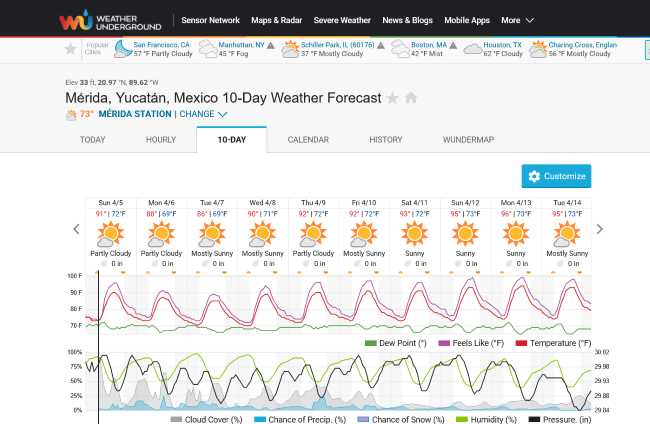
I must admit, for someone accustomed to New England weather, it seemed like forever. Merida, Yucatan shifts its seasons, it’s true. But not while you wait, the way it is back in Maine. Yucatan uses a calendar for weather decisions. Maine uses a clock. Summer in the sun, winter in the shade is a thing back there. Here, it’s always some form of summer.

Forgive us for being lulled and gulled by a weather report that looked like it was painted in oils. We went something along the lines of 45 straight days just like you see there. Egad, Lovie! We have to put more water in the pool every day!

It couldn’t last. The seasons are the opposite of up north. Winter’s nice, summer, not so much. There are only two seasons, just like Maine. Maine is nine months of winter, followed by three months of tough sledding. Here in Merida, there’s summer, followed by the other summer.

The “other summer” is the rainy season. If you want to be pedantic (who doesn’t?) there might be a third season: hurricane season. But honestly, how much worse can it get than the “other summer,” which showed up here last week:

That’s out in front of our house. There’s an eight-inch high curb out there, which is a lot by US standards, but barely adequate here. The city of Merida is the geologic equivalent of one of those pool tables without pockets that require more geometry to play than I carry around in my head. There are no bodies of water, no rivers, runnels, or gullies where the water might go. Either it ends up in the ocean, or the Gulf, the occasional cenote, or your living room.

Obviously this has been noticed by the people who lived here before us. I espied two brackets anchored into the masonry walls outside the only door in and out of our casa. I’m good at architectural hints. For instance, if you remove all the railings on your staircases, because a raccoon-eyed harridan on home and garden TV told you to, I’ll take the hint and fall down your stairs and sue you. I assume that’s expected of me. I hate to disappoint people.

The bracket hint was saner than that. I went hunting around and found a six-inch tall metal weir, a dam that slipped into the brackets snugly. So between that and the curb, we had about a 14″ head start on the rainwater. It wasn’t enough:

Consecutive days of torrential downpours have left the city of Mérida waterlogged, with official data revealing that parts of the Yucatecan capital recorded a staggering 436.7 millimeters (17.2 inches) of rainfall over a single seven-day period.

According to a report released on Wednesday, June 3rd, 2026, by the National Water Commission (Conagua), Mérida has solidified its status as the wettest location in Mexico over the past week. The most severe accumulations were registered in the western sector of the city between May 27th and June 2nd. Conagua noted that the 436.7 mm volume is visually equivalent to dumping nearly 22 twenty-liter water jugs onto every single square meter of land in the area.  (link)

They were eager to add several rainstorms together to get that figure. There were days scattered throughout that week when it didn’t rain much, or at all. Most of that 17.2 inches of rain fell in a few hours, scattered over several days. It only rained all day once. I’ve taken showers with less water being dumped on me.

According to the chatbots, 17.2 inches of rain is about half the expected yearly rainfall here. Also according to Chad:

Spread evenly, 17 inches of rain means every square foot of ground received about 106 gallons (400 liters) of water.

Now, I may not be able to play pool with no pockets or anything, but I know when Sam Altman’s turbo encabulator is having an aneurysm. I said, check your math, and yourself, roboboy:

Good catch — that number is way off.

Let’s calculate it correctly.

A square foot receiving 17 inches of rain gets a volume of:

Area = 1 square foot
Depth = 17 inches = 17/12 = 1.4167 feet

Volume = 1 ft² × 1.4167 ft = 1.4167 cubic feet

Since 1 cubic foot = 7.48 gallons:

1.4167 × 7.48 ≈ 10.6 gallons

And since 1 gallon = 3.785 liters:

10.6 × 3.785 ≈ 40 liters

So the correct statement is:

17 inches of rain means every square foot of ground received about 10.6 gallons (40 liters) of water.

The previous figure of 106 gallons would correspond to about 170 inches of rain, which is exactly 10 times too high. I accidentally shifted the decimal point.

Do tell.

For poops and giggles, I asked Chad how much snow that would be, if that much moisture fell on Maine.

Maine perspective

A week’s precipitation equivalent of 17 inches of rain would translate to roughly:

14–21 feet of snow in a single week.

So, about four to six hours after I took the video, all the water in the street was gone except for some puddles. Where it went, only Kulkukan knows. The pool was full. And I didn’t have to shovel 14-21 feet of snow off the sidewalk.

All in all, I’ll count it in the win column.

A Scandi Fred Flintstone

Hampus Granstrom is quite the shade tree mechanic. He’s apparently based in northern Sweden, so the shade trees are really tall, and throw as much snow as shade. Additional information about him is not easy to find, and what I could discover was in gorny gorny umlauty lingo, so I’ll give it a pass. Let’s just agree that the fellow is a wonder, and leave it at that. I especially liked the long-winded, extensive explanation of his background and worldview he offered on his YouTube page:

Description: I like cars.

I guess so. Me, I liked watching a video of him restoring a ’66 Volvo, start to finish, and found it to be some brand of awesome. I’m fairly familiar with ’66 cars, having owned a couple of them back in the day. Unlike Hampus, mine were at least running when I got a hold of them. I had to make all sorts of repairs to them to keep them running, but nothing major like his videos. I was an auto dermatologist, maybe a bit of a chiropractor. Hampus is both a thoracic and a plastic surgeon. I dunno, maybe a psychiatrist, too. Here’s that video:

Having fixed the same vintage car helped me to understand what a fantastic worker Hampus is. I’ve done the bondo repairs and paint and drum brakes and seat covers and suspension and I don’t know what-all besides. Watching him do it, I felt like a guy who painted the walls in a room while Valasquez worked on a canvas in the middle of it. We both owned brushes. That’s about where the similarity ends.

The first video, the one with the abandoned Saab, really killed me though. Whenever the first tool you select to start an automotive restoration is a chainsaw, you’ve entered another dimension. The molecules of that Saab were barely holding each other’s hands, and he ended up driving it through the primeval forest with the unpaved road scrolling past under his clutch foot like some Scandi Fred Flintstone.

On top of everything else, Hampus simply points the camera at the thing that is happening, says nothing, and doesn’t seem to own a radio. If you notice anything wrong with his videos, his general approach, or his particular skills, feel free to point it out. Forgive me if I won’t stand on one leg and hold my breath while waiting for you to do it, however.

Main Archive – Page 5 – Sippican Cottage

Find Stuff

Archives