Fifteen Million Pesos-Worth of Sheet Metal

There’s quite a stack of calendar pages in my life’s rear view mirror, to stretch a metaphor to its breaking point. However, I’m still young enough to dream, I guess. I may have recently decided what I want to be when I grow up. It may not be what my readers were expecting.

Of course faithful readers of this spaced-out space know I’ve spun the tumblers of occupations many times in my life. Everything from a welder in the desert to a near-arctic handyman, with lots of incomprehensible stops and temperatures in between. Most of those stops were just me trying to get by in a world bent on pooping in my punchbowl pretty regularly. Like a lot of my brethren, you’re forced to choose from a very limited selection of grocery enhancers that’s on offer at any given time. If my wide range of affairs over the years signifies I’m a polymath, I assure you I’m a very dumb one, and doing it with a financial gun to my head at all times.

There was little time for dreaming about how I’d like my life to be ordered. I was just trying to feed my kids without being forced to feed one to the other. I might have been tempted to sell them to the circus, but they closed them all down after the elephants joined a union or something. The option of getting a few bucks by selling our tots for medical experiments dried up pretty quick, too, when the public school system started their free, forced injection and vivisection services and crashed the market.

But even at this late date, I still dream. I think I want to have hot and cold running potato chip faucets in every room. I may want to purchase Saddam Hussein’s used living room furniture. I might want my swimming pool to have more hot babes in it than JFK’s secretarial pool. I may want to be something when I grow up, even though I already have.

So I see a business across the street here in Mexico. It’s outfitted with three, deep, offstreet garage bays in a neighborhood where such a thing is unheard of. On the weekends, the bays are closed with elegant Zorro-style wrought iron gates, not the brutish, inelegant overhead doors we favor in the states. The climate here doesn’t require total enclosure of almost anything. In some of the older houses, many of the main rooms are gathered around an open interior courtyard. Kitchens and dining rooms are literally outdoors, even if they are under a roof. If the temperature dips to 60 degrees in this burgh, they set up shelters for people to warm themselves in. It’s hot here, they’re accustomed to it. No one is crazy except Americans. In Maine, for instance, people pretend they live in San Diego, and live in houses built to suit anywhere but Maine. Their children stand in the snow at school bus stops in January in shorts and a tee-shirt. They’re cold, but they’re cool, as we used to say. Everybody in the Yucatan knows its hot, and lives like it’s hot.

This part of town, Centro, sort of, Zona Paseo Montejo in particular, is kitted out with colonial houses and businesses all touching each other. A parking space on the housing side of the sidewalk is spoken of in hushed tones, accompanied by extra zeroes in the real estate peso department. So the purpose of the office across the street would have been obscure to me even if their sign wasn’t in Spanish. The structure itself was only half the conundrum. All the bays, and every parking spot for fifty yards on the curb out front was adorned with a car I could never afford, even if I was willing to part with both kidneys, instead of just one. There were BMW land yachts and myriad Porsches, Land Rovers, and Jags, plus wonder of wonders, the occasional big, black Suburban, a vehicle almost unheard of around here. The side view mirrors whack pedestrians in the head on both sides of the skinny streets as they drive along.

When the first Mercedes something or other rolled up this morning, I was thoroughly vexed. I decided once and for all that I needed to know what they were doing over there, because I wanted to start doing it as soon as possible. Drug lords? Nah, they’re closed on the weekends. Drug lords are like 7-11s. They’re always open, and their clientele requires daily fixes. Slave traders? Unlikely. You can get your pool cleaned for $2 a week around here. A slave would be superfluous. My thinker-upper went into overdrive, and I began to come up with very wild guesses. Is alchemy a thing after all? I didn’t spot lead ingots being loaded in, or gold bars being loaded out, so ixnay on that. Are they selling crypto bucks they manufacture on old Dells and sell to fools with new Apples? Very unlikely. The cars across the street were elegant, not ridiculous atomic doorstops like the Lambos and Veyrons that are favored by the Ukrainian internet scam set.

What could possibly merit three garage bays full of cars too expensive to lend to Top Gear, because they might scratch them? I had nothing to go on, until I noticed the little, stylized feather in the center of their sign. As it turns out, that’s the traditional way to notify the public about what goes on in a certain type of office in Mexico.

I think I want to be a Notary Public in Mexico.

I’ll have to hedge my career bets here. I’m not sure I want to be one, because I have no idea what they do around here. I have to go by surface evidence alone. Then again, one only went by surface evidence when judging Grace Kelly. It could soften her allure if you knew she walked around her palace eating beef jerky and telling servants to pull her finger, then delivering on the threat. It’s an IKEA world all around, and you can be certain that there’s a particle board interior 1/32″ below the sexy wood veneer on most everything and everybody. We’ll stick to what we can see, and worry about the rest later.

So a notary public in Maine is just a tubby girl who works in the credit union and has a stamp and a pen, and will notarize a bill of sale for a battered bass boat you sold on Facebook marketplace. I don’t know exactly how cool it is to be a notary in Mexico, but I’m beginning to think it’s more along these lines:

So, at the risk of repeating myself, I think I want to be a Notary Public in Mexico. I’ve been going to the gym, and my forearms are already pretty strong. I’d be a natural, I think, if I could figure out what they hell they do that merits fifteen million pesos-worth of European sheet metal parked outside.

In the Navel of the Moon

The little store of good luck. Indeed.

No one really knows for sure how Mexico got its name. I find the place, the name, and the whole lost in the mists of time angle appealing. When Spanish freebooters arrived, the locals they encountered spoke Nahuatl. This “encountering” consisted mostly of rapier thrusts and arquebus blasts, so perhaps the natives were mostly unavailable for comment about place names.

In Nahuatl, meztli (rhymes with Nestle) means moon, and xictli (sheek-ti-lee, best spoken with a Daffy Duck pronunciation) means navel. So for a long time Europeans thought Mexico meant the navel of the moon. Unless it didn’t. Other names like “place of springs,” and “killed by an obsidian arrow” were favored by other intrepid scholars who were scratching their heads and wondering why they were up to their ankles in a swamp with obsidian arrows sticking out of them all of a sudden.

About twenty-five years ago, the Mexicans got tired of people arguing about where the name of their country came from, so they convened an azul-ribbon panel to do what intellectuals do best: argue about it some more. They decided that the Aztecs (the Nahuatl, more or less) once had a leader of some sort named Mexitli, and he decided they should stop wandering around and set up shop for good in what is now Mexico City. His friends called him Mexi, and co in Nahuatl means “place of”, so you end up with Mexico.

Here’s Mexi’s picture, sorta:

I’m not sure I’d want my country to be named after a guy in a straitjacket, with two left feet, his dentures flying out of his mouth, and a barrage balloon of Binky from Matt Groenig’s Life In Hell comics tied to his topknot, but it’s not my country and they didn’t ask my opinion.

I know how modern intellectuals think. I imagine they fixated on the dubious idea they knew the nickname of a guy in a loincloth in the 1300s first, and they worked backward from there until they got the “facts” they needed to make it work out. My Latin is pretty limited, but I pretty sure I’m referring to ex post facto thinking, or petitio principii, or maybe post hoc ergo propter hoc, perhaps ratione conclusa, or it could be spaghetti bolognese. It’s one of those, surely.

Well, I’m in the Yucatan, and everyone around here is Mayan, more or less, and didn’t have a lot to do with the Aztecs back in the day, and don’t have much to do with Mexico City nowadays, either. The Maya, on the whole, look different than Mexicans from farther north. They’re low to the ground, and tend to be stout. A tall Maya is around 5′ – 6.” They’re a wonderful medium brown color, and generally don’t have things like freckles or any other imperfections in skin tones. They have straight, black hair as thick as minks, with dark brown, almond shaped eyes. With a description like that in hand, you can imagine what they think when we walk down the street. Oh look, the nice Italian lady is walking her albino giraffe again.

It took Hernan Cortez two years to conquer the Aztecs. The Aztecs were powerful, but not popular. They had an empire, and empires have a tendency to engender ill feeling from the assorted vassals. Cortez made alliances with various tribes in the area who tired of the Aztec’s approach to open heart surgery. That made it easier to turn Tenochtitlan (Mexico City) into just another excuse for a Spanish town hall.

The Spaniards decided they wanted the Yucatan peninsula, too. Instead of 2 years, it took them 175 or so. The Mayans were tough opponents, proud, pretty sophisticated, and could knap an obsidian arrowhead with the best of them. Perhaps the most vital thing they had going for them was a decentralized state. The Aztecs were an empire, and once you marched into the capital and fertilized the royal palace with the royalty, the war was more or less over. The Yucatan was more like a series of city-states, like Italy or most of central Europe once was. The locals fought like balams (jaguars), and once you beat them, there was another set right down the road to start all over again. And you had to hack your way through the jungle to do it, too.

But it was worth it, on the whole. The Yucatan is where the world of mammals was born, really. A meteor strike there killed off the dinosaurs. If it wasn’t for the Mayans, we wouldn’t have tomatoes, or avocados, or tobacco, or chili peppers. We wouldn’t call 200-mile-an-hour windstorms hurricanes, because they’re named after the Maya god Huracán. Many people still sleep in hamacas here, although we call them hammocks. Without the Mayans, we wouldn’t have known what to call them, and telling your wife you’re going out in the back yard to put your ass in a sling wouldn’t have the same connotation of relaxation, would it?

But above all, there’s one contribution of the Mayan people that tops all the others. Mi esposa y Yo will go out tonight and stroll down the magnificent Paseo Montejo in the cool of the evening, and eat our anniversary dinner under unfamiliar constellations. And for dessert, we’ll have chocolate (chokolatl) something or other, prepared by the very people who invented it. We’ll treat our waiter to a heaping helping of our barbarous Spanish, and tip him enough so that he doesn’t turn to his co-workers after we leave and call us the lint in the navel of the moon.

Traveling Again

Well, I’m traveling again. I’m not sure what fresh observations I can bring to the table about the process of going hither and yon and to and fro and above and beyond. I’m afraid my missives will quickly devolve into a rejected Seinfeld script about little packages of peanuts and fights for primacy over the arms of aircraft seats. Besides, they give you crackers, not peanuts now.

But perhaps my lack of experience in the current landscape of travel might be of some use to my readers. I have fresh, bloodshot eyes to observe the cartage scene. I gather the average person travels all the time, so none of this is new to them. I can certainly assure you that the below average person is currently clogging up the airports as well. So maybe I’ll just try to notice things that others take for granted at this point, and by holding a mirror up to the proceedings, illuminate them somewhat.

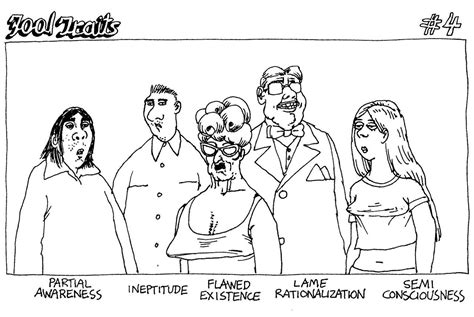
In the Portland, Maine airport, I’d be at a loss to describe the polity on the whole, other than to say everyone looks like a Kliban person to me. The Washington DC airport doubled down on the effect. Houston wasn’t much better.

It’s not that most people aren’t particularly attractive. I’m most people, so I can deal with that. It’s that everyone tries to look as unattractive as possible. Violently unattractive. I’ve never concatenated those two words before, but nothing else will do: people are currently violently unattractive, and deliberately so. It’s not just their trappings, their weedwhacked bedhead hairdos, their DigSafe tattoos, or the Marley’s chains they’ve added to their faces. Their mannerisms are, too. No one looks or acts in any way that would put another person at ease around them. It’s useful to reflect that organizing your appearance and behavior to put others at ease is a pretty good definition of what a lady or a gentlemen is. That brand of human has been hunted to extinction in US airports.

So instead, we get human dirigibles, manatees in yoga pants, and whole families from suburban goy shtetls cultivating hobo chic like the lotus blossoms they consume. I gather there’s a pirate website or ten somewhere that sells bogus “service dog” sweaters to all comers, because a hearty helping of the passengers had every manner of rat dog and poochie alike kitted out in one, all acting completely unable to service themselves, never mind their owners. There were many other such dodges on display. A substantial minority of passengers have discovered that if you ask for a wheelchair, you’re squired around the airport by your own personal coolie and allowed to board the plane first. It’s impossible to see that many gimps suddenly get up and walk outside of Lourdes.

It boggles my tiny little mind how much money you must have to spend to look this bad. There was one guy that made quite an impression on me. He was wearing the kind of flip flop sandals I remember on girls in grammar school back in the day, wrap around mirrored sunglasses that looked like skiing goggles for a pro wrestler, a Cat in the Hat chapeau, with dreadlocks peeking out over his pasty forehead, and doing justice to their name. The rest of his ensemble was a mishmash of the kinds of garments used to climb Everest on a hot day, designed for, marketed to, and worn by people who only climb out of bed after 1 PM. The overall effect was a North Face Imhotep, or maybe an Oakley Tutankhamen. The unsittable chairs attracted ad hoc nursing homes like algae blooms, gathering and dispersing on some unseen tide of departures and arrivals.

The physical structure of the airports was totally modern, in every sense of the word. I’m not sure exactly whose idea it was to declare that a complete lack of any kind of style should be considered a style in itself, but I’d be willing to help knock together a gallows for him if you can find him. Nothing in an airport reflects or supports the humanity that passes through it. Acres of carpet spread out underfoot, looking like a malfunctioning fax machine’s idea of a test pattern. It has a riot of uninformative information on the walls, and plenty of advertising for things like our Imhotep’s sunglasses, but nothing to set you at ease in any way. It looks like a mental hospital hallway with more Coke machines. The whole megillah was capped off with a continuous stream of the singsong Urdu of distorted, unintelligible arrival and departure announcements launched into a ten-dollar microphone clutched like a rapper’s first performance.

I spent an hour staring at a trash bin. It was bisected into regular trash, and recyclables. No signage is allowed to have regular English text on it any more, so you discerned the difference between the two sides using only hieroglyphics. So if you had a fish head with a spine attached, or a loaded diaper, or some candy, or an apple core, or several other items that added up to the worst meal ever eaten, you chucked them in the left one. The right one had childish icons for cans and bottles. It makes sense. Both the airplane seats and the trash in the airport are sorted to determine if they can get an extra nickel out of you.

But I survived, of course, like Ishmael, to tell the tale. The epidemic of female docents flying miltary helicopters into airliners has abated. The crackers and Sprite didn’t kill me. The, ahem, service dogs didn’t bite me. So I have no real complaints. But I did notice one thing in America’s airports that was such a fundamental change that it kind of shocked me. Not one, single, solitary human being in three airports and on three very large airplanes, out of thousands of people, was reading a book of any kind. Not even carrying one. Well, you know, except me and my wife.

I’ve been informed that the last person to leave civilization is supposed to turn out the lights on the way out the door. We’re currently searching for the switch.

Back to the Future

Dawn has come to Millwood, the city where Richard Anderson lives—a city neither small nor large, simply a normal community where people live together, work together, and do things for each other. This is the story of one day in Millwood—just any day.

The story begins at daybreak. All is quiet in the Anderson home; everybody is asleep. It is still some time before Richard has to get up for breakfast, but while most people are still asleep, many are at work doing things for others—things which mean a great deal to the community, including Richard himself. While Richard sleeps, men at the dairy are filling bottles with fresh milk, and long before daybreak, Richard’s milkman picks up the milk and delivers it to the Anderson home in time for breakfast. All night long, the bakers have been baking bread for the day—bread which the delivery man now takes to stores and homes. Long before stores and schools open, trucks are bringing food for Richard’s dinner into town from nearby farms and distant places. From a refrigerated truck, the butcher is already unloading meat—some of which will be on Richard’s table today or tomorrow.

Richard’s community is always at work. All night in the telephone building, operators have been busy at the switchboards, putting through calls—perhaps to a doctor or fire station. In the city’s water plant, pumps run day and night to keep Millwood’s reservoirs filled, and men check gauges so that Richard and others always have water. At the power plant, engineers keep watch so there is electricity whenever it’s needed. At the post office, workers sort mail throughout the night so Richard’s mailman will have the letters ready in the morning. Meanwhile, at the newspaper office, men and women work to meet the deadline for Millwood’s morning paper. As getting-up time approaches, the newsboy is already on his route, delivering the paper to Richard’s home.

For Richard, the day is just beginning. On his way to school, he sees people in his community at work—like the linemen who keep the electric lines in good repair. Richard has never really stopped to think about how much people in his city depend on one another. His mother shops at the grocery store, and he often buys things there too, but he hasn’t thought about what the city would be like without stores—no groceries, no shoe stores, no furniture stores. The people who work in these places do important jobs for their neighbors. A community needs many kinds of workers—ways for people to get from one part of town to another. Some go by taxi, some walk, others use their own cars, and many use buses. Buses are slower than taxis but cost less and are easy to use. Bigger buses take people to many parts of the country, stopping in Millwood too. Trains come and go from the railroad station, carrying people and goods. Trucks carry mail from the station or from the helicopter field, which brings mail from nearby suburbs and towns. Helicopters need little space to land on, unlike airplanes, which require large airports on the city’s outskirts. Many people come and go by airplane daily.

Though Richard may not realize it, he has an important job too—going to school to learn the things that will help him become a good citizen, ready to take his place in the community. No matter what someone does for a living, many people depend on them—and they, in turn, depend on others. People who work in factories make goods for stores to sell; people in offices write letters and keep records. Some are craftsmen, some professionals like doctors and lawyers, some are storekeepers, and many are housewives who manage homes and care for children. Whatever a person does, it helps—whether in big or small ways—to make the community a better place.

In City Hall, people work for the city itself. The mayor, elected by citizens, runs the government and oversees departments like the police, who make the city safe and direct traffic. They enforce laws made by the people for their own safety. The fire department is also part of the city government, ready day and night to respond to fires before they spread. The city hires workers to build and repair bridges, streets, and sidewalks, and to maintain streetlights for safety. It also helps protect public health by monitoring the water supply and inspecting food-handling places. Another department collects garbage and burns it, while a city dump holds non-burnable waste, keeping Millwood clean. The city provides playgrounds for children, ball fields, jungle gyms, and benches for adults to rest on. Recreation also includes tennis courts, a recreation center for parties and games, and a public library with books, records, and films for all ages. Richard and his family go to church, and there are other churches for those who worship differently.

Millwood has a radio and TV station, where programs are created by many people—from actors to technicians—ensuring Richard gets the right show at the right time. He enjoys watching television and sometimes learns a great deal from it. The family often goes to the neighborhood movie theater, and Richard’s father enjoys bowling once a week with friends. At night, when Richard goes to bed, he may not think much about what his community has done for him or what he has done for it—but the work of the community never stops. Bread is baked, milk is processed, newspapers are printed, electricity is generated, water is pumped and purified, and phone calls are connected—day and night. The work of the community goes on, with people helping and depending on one another, all partners in making Millwood a better place to live.

Before my time, but time-adjacent enough to recognize that the video is not exactly raging propaganda. No one is talking about running roughshod over the whole world or anything. Little Richard isn’t being brought up to be much of an ideologue, although a stretch in college in the 1960s should take care of that deficiency.

At any rate, a lot of America was just like that back in the day. The parts that weren’t, weren’t. They refused, or were unable to act the way the people in the video were acting. The suburbs and exurbs served the same purpose as the frontier once did. When cities became corrupted, people reassembled themselves out in the landscape and started over. A republic, if you can keep it, over and over. It has as many obligations as benefits, and anyplace with benefits eventually attracts people who want them without toting the knapsack of obligations that everyone else is carrying. Eventually the free riders get a quorum, and a new frontier is necessary. Lord knows where we’ll find one now. Perhaps the bombed out numerous remains of Free Rider City will be the new frontiers, after the locusts move on.

People like to point to traditionally minded people, with horrified looks on their nose-ringed faces, and screech that trads want to take us back to the 1950s. I can assure you that I’m fairly conversant in all sorts of history, and that the 1950s you fear and trads want isn’t reachable by putting the Caddy with the big fins in reverse. It was way, way more sophisticated, challenging, and complex than life is today, and it would take a lot of work to achieve it. Going to other planets would look easy compared to assembling the modern version of Millwood again, and making it at least common, because people being people, universal is not possible.

This sentence punched me in the face:

In City Hall, people work for the city itself.

Pull the other one. It has bells on.

Month: October 2025

Find Stuff:

Archives