Even Tantalus Wouldn’t Drink That

Even back before I knew I wanted a heat pump, and a pony, I knew I wanted to handle some air. In HVAC, this is usually handled by an air handler. Duh. That’s a big cabinet-looking appliance with a big fan in it in most people’s houses. If you have a standard furnace, the unit itself usually functions as the air handler too. You burn some sort of gas or goo to heat up some air and then you blow it through some ducts hither and yon around your house. Boilers do the same sort of thing, but they heat water instead of air, and circulate that around.

Well, I was producing hot air without the goo already. I”m nor referring to blogging here. I was burning pellets in a big stove and dumping the hot air in the dining room. Luckily, the dining room was more or less centrally located, but heat takes some persuasion to get it to go to where you want it. The little 200CFM fan in the back of the pellet stove wasn’t going to spread it around 2,000 square feet of house. We didn’t (don’t) have the money for a proper central heating system, so we resorted to our default guerilla warfare approach to the problem.

Way back when, I outlined our scheme to get heat from the dining room upstairs into our children’s bedrooms in The Tin Man’s Autopsy. We couldn’t afford an air handler, but we could put some tin pipes between floors to coax the heat upstairs.

Then I painstakingly explained Eight Things That Won’t Happen in Heating, to outline why I was doing what I was doing in the manner I was doing it, but I freely admit I did a lousy job explaining what I wanted a pony for. This HVAC explanation was roundly ignored by several people in the comments, who love them some ceiling fans, and the rest of the internet, more or less. After a somewhat charming lagniappe filled with my children’s music videos and earnest pleas to my wife not to leave my sorry ass even though I didn’t get her a pony for our anniversary, I finally got around to Let’s See if Sippican Can Tie His Heating System Into His Sewer System.

Of course everyone immediately lost interest in my ersatz air handling explanations and glommed onto the Geyser of Excrement tale. I know I did. In the world of construction triage, fixing a problem with not enough BTUs floating by comes well after stopping merde floating by in the basement. You can read all about it at the link, if you like. Lots and lots of people have. It’s a testament to what’s important in this online world that the most notable thing I ever wrote was about just how full of shite my life had become.

But ignored in the scum scrum was the fact that we did actually solve our air handling problem, albeit incrementally, not exponentially. We installed ducts up high in the dining room wall, and ran them up into the second floor. It’s all achieved inside of closets, a happy accident of floor layout. The inlet pipe was up by the ceiling in the dining room. There were two outlets upstairs, one for each kid’s bedroom. We simply stood a regular tabletop fan on top of the big cabinet that once stood there, and it blew the heated air upstairs. It wasn’t a pony or anything, but the kids still liked it.

I had bought enough tin to make a cold air return as well. I planned on recovering cold air near the floors in the bedrooms upstairs, and dumping it through the floor directly over the pellet stove. It would make a nice convection loop, and make it easier to force air up the ducts into the rooms in the first place. It was a great idea that was not to be. When the geyser hit, I had to return the remaining HVAC ducts to the store to get a credit to apply to the cost of some of the plumbing supplies we were going to need tout de suite. I was Tantalus, but I wasn’t up to my knees in water, exactly.

But the seeds of inspiration were sown. I went into my closet and looked up, and saw ductwork heading upstairs. Then I looked straight down, and realized the furnace was directly below in the basement. From the inside of that closet, and the closet above it upstairs, I could picture ductwork coming straight up from the basement and serving the living room, dining room, three bedrooms, and the hallways and staircases on two floors.

It would take years of scrimping and saving, but I could see a way to heat the whole house with a central heating plenum and ducts running straight up through the center of the house, and not lose an inch of livable floor space in the bargain. It wasn’t a pony, but central heating would still be pretty good. Besides, I’m not sure a pony would taste all that good, even if we got our hands on one.

[To be continued]
It’s a Magic Show

I kinda decided I wanted a heat pump. After a decade of freezing in our hovel in western Maine, and shoveling tons of firewood into a furnace and pallets of pellets into a stove, I wanted a dial on the wall that you turned to have some effect on the temperature. I got old, or tired, or lazy. You decide which. I’m too old, tired, and lazy to figure it out.

You can, or you can’t have a heat pump in Maine, depending on who you listen to. The crux of the problem is that the people who tell you that it’s perfectly fine, even commendable to have a heat pump in Maine are wrong, and the people who say you can’t have a heat pump in Maine are wrong, too. They’re just wrong for different reasons. Don’t worry. You look worried. But don’t. I’ll explain.

The State of Maine wants you to buy a heat pump. They’ll sort of pay you to buy one, actually, in the form of rebates. Here’s a not very exhaustive list of the sort of rebates on offer, if you’re interested. I wasn’t.

What this meant in practice is you got a coupon for a discount on a ductless minisplit heat pump. Ductless refers to the way it’s set up to produce heat or air conditioning. There’s a compressor outside with a big fan and lots of coils in it. There’s a “cassette,” a large-ish plastic radiator monstrosity you hang on the wall in a single room in your house. It burps out heat or cooling using a little fan. In between the cassette and the compressor, you run two copper refrigerant lines, a plastic drain hose (because the thing frosts up like a 1940s reefer), and a very substantial electrical circuit.

Of course, to get the rebate, you’re required to hire a certified (by the government) installer for your minisplit, who would immediately add the value of the rebate to the price you end up paying, because human nature isn’t (yet) controlled by the gov. Then they’d come to your house and hang an unsightly compressor on your house wherever was convenient for them, usually right by the front door, and then snake unsightly plastic chases (to cover the piping) all over the side of your house, till they arrived at the spot where they could drill a hole right through it. That’s the other side of the wall where they’re going to hang a big, unsightly cassette in one room of your house. Minisplit installers seem to all have been trained as cable TV installers in the past, as far as running new utilities goes.

They do make minisplits that serve multiple cassettes from a single compressor. If you’re in a Captain Nemo mood and want your house to look like it’s being attacked by a giant octopus, these are just the thing for you. But for the most part, Mainers just like the rebate, and use a single cassette leading to a single compressor as a replacement for a room air conditioner, and don’t use the heating function much. Most of Maine has zero cooling degree days a year, so you can anticipate how efficient giving residents rebates to overpay for minisplits has been to achieve their stated purpose, which is getting rid of heating oil as a primary heat source in the state.

So those are the people who tell you that making 12,000 BTUs of heating and cooling and dumping it in one spot in your house is a substitute for your 75,000 BTU oil furnace and ten miles of ducts or copper pipes. They’re wrong, but they’re not the only kind of wrong. The other faction tells you it’s too cold in Maine to have a heat pump. They say they’re just for air conditioning in Tallahassee, and that’s that.

That’s a whole different kind of wrong there. When the gov banned pesky chlorofluorocarbons in heating and cooling devices because the ozone layer got a bald spot, it set the refrigeration and HVAC industry back some. But they got busy and eventually found able substitutes. They put them in heat pumps now. Do try to keep up, people.

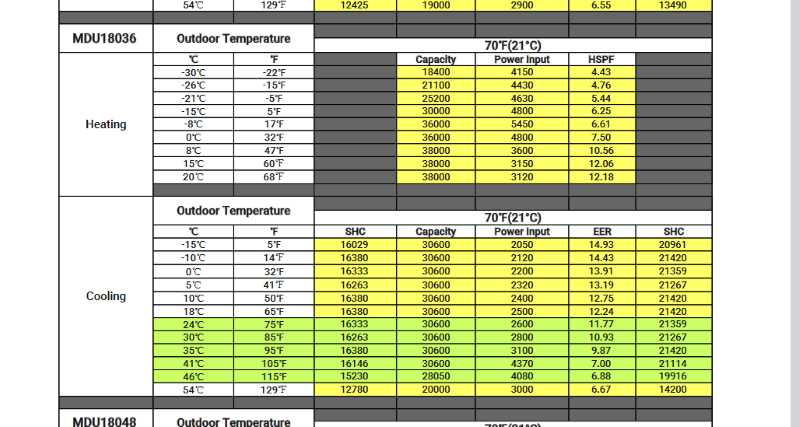
I’m going to give away the denouement of this little jag I’ll be foisting on you for days now, by telling you I have a heat pump, and here’s a chart of the temperatures it’s rated to work at:

It produces 36,000 BTUs of heat.

Well, it produces 36,000 BTUs of heat if it’s 68 degrees out. That’s a layup, of course. It ain’t hard to raise the temperature in your house by four degrees or so, is it? Heat pumps work by capturing heat from outside in recirculating coolant, bringing it inside, and emitting it by blowing a fan over some coils. When there’s lots of heat outside, it’s easier to bring a bunch inside.

Now let’s go back to the chart. The heat pump also produces 36,000 BTUs of heat when the outside temperature is 17 degrees F. The amount of heat it produces goes down from there, but the thing still makes 18,400 BTUs at 22 below zero Fahrenheit. The efficiency goes down, (see the HSPF column) but it still makes heat. It’s interesting, but 22 below zero is the coldest temperature I’ve ever observed here since we moved in. So, it’s not too cold here for a heat pump.

You have to understand the HSPF rating, though. The Heating Seasonal Performance Factor (HSPF), is a rating that measures how much more efficient a heat pump is at using electricity compared to regular resistance electric heat. If you run electricity through a baseboard heater, it’s 100-percent efficient. That is, 100 percent of the electricity is turned into heat. It’s also 100-percent efficient in hoovering out your bank account. Electric resistance heat is the most expensive form of heat I know of. You may be burning Coach handbags in a hibachi to get your heat, I don’t know, but around here, everything is cheaper than electric.

Heat pumps don’t work like that. They use electricity to circulate coolant, compress it, and blow fans over some coils filled with the circulating coolant, both inside and outside the house. Those sorts of pumps and fans use electricity, but not nearly as much as simply heating metal fins by running electricity through them. The HSPF rating tell you how much more efficient it is compared to resistance heat. The bigger the number, the more efficient it is.

To figure out HSPF, you take the heating output in BTUs and divide it by the amount of electricity it took to make it. So to compare:

  • If I put a watt-hour into a baseboard heater, I get 3.41 BTUs out of it
  • If I put a watt-hour into a heat pump rated at 10 HSPF, I get 10 BTUs out of it

So even at 22 degrees below zero, a heat pump is still about 25% more efficient than 100% efficient baseboard heat. That’s not a heating device. It’s a magic show.

So it ain’t too cold here, but I don’t want an octopus on the side of my house. I still want to get up to 10 BTUs out of a watt-hour. What exactly do I want?

[To be continued]

Good People All, This Christmas Time

The Wexford Carol is a traditional Celtic Christmas thingie. Somewhat obscure, I guess. It’s old, but no one knows exactly how old. The musical director and organist at St. Aidan’s Cathedral in Wexford, Ireland wrote it down after hearing a local singer belting it out. It found a place in The Oxford Book of Carols in 1928, but it might be four or five hundred years older than that.

It’s got lyrics, but God knows what the original lyrics might have been. Things passed down orally through centuries have a tendency to pick up modifications like a ship picks up barnacles. Here are some of the verses:

Good people all, this Christmas time,
Consider well and bear in mind
What our good God for us has done
In sending His beloved Son
With Mary holy we should pray,
To God with love this Christmas Day
In Bethlehem upon that morn,
There was a blessed Messiah born.

The night before that happy tide,
The noble virgin and her guide
Were long time seeking up and down
To find a lodging in the town.
But mark how all things came to pass
From every door repelled, alas,
As was foretold, their refuge all
Was but a humble ox’s stall.

Wikipedia has some Irish lyrics. I put them into a translation thingie. Here’s what came out:

Oh, come all and pray
The child is lying in the cradle
Remember the love of the King
Who gave us salvation tonight the Naí.
And Mary Mother in God’s Paradise,
For Eve’s poor children, pray now tenderly,
The door of the aperture is never closed
May you worship Mac Mhuire Ogh from now on.

In east Bethlehem in the middle of the night’
The good news was heard for shepherds,
Clearly for life from the sky sweetly
Angels were singing from tip to tip.
“Move alive,” said the Angel of God,
“Go to Bethlehem and you will find Him
Don’t lie peacefully in a manger of grass,
He is the Messiah who loved life

The Irish have been confusing and confounding the English since about 1100 AD. Maybe they should have stayed home. I guess it shouldn’t be a surprise that they confuse an English translation machine, too, although that eighth line, that bids the listener to worship Fred MacMurray for some reason, might have taken it a step too far.

In any case, Nollaig Shona Daoibh to all my readers, and all the ships at sea!

Dream BIG

Burning wood pellets cost more than burning firewood. But not a lot more, honestly. Remember our chart of heating fuel costs per million BTUs? Here it is again, with info from November of this year:

Those are Maine prices, but they’re high in my experience. It might be because I live in the poor-people-land part of Maine. God knows what people with whales on their pants pay for things Downeast. They’ve usually got more money in their Ikea couch cushions than I have in my bank account, but that’s their problem. Or mine, I forget which.

Pellets are flirting with $300 a ton nowadays, even for the ho-hum brands, but you’d have to be burning some artisanal free-range pellets to spend $385 a ton. Same thing with firewood. I haven’t bought any lately, but you’d have to swallow the dealer’s buncombe about just how “seasoned” their firewood is to pay $350 a cord. Green firewood you dry yourself costs much less, and no matter what it costs, you’ll be drying it yourself, remember?

But let’s go with these numbers. You’re buying kiln-dried firewood, and pellets from forests filled with trees on the endangered species list. What would it take to produce the 800,000,000 BTU WAG (wild-assed-guess) I made yesterday, depending on the fuel, at today’s prices? Lessee:

  • Firewood: $12,728
  • Wood Pellets: $18,664
  • Heating Oil: $22,840

Rely on my experience in these matters (if you dare): The firewood number is way off, but then again, it’s not. Firewood isn’t that expensive to buy, but then again, a firewood furnace is a woefully inefficient thing compared to something like an oil burner in good working order. Lots and lots of BTUs go up the chimney. It’s the nature of the steel beast. And the amount of BTUs you get out of the woodpile varies greatly, from log to log.  But the number is wrong in two directions, so maybe it balances out.

As far as wood pellets go, I actually know how much it cost me to get 800,000,000 BTUs. We paid a total of around $12,500 for 50 tons of the stuff. It averaged around $250 a ton. No one selling it that cheaply this year, though, but you can still buy perfectly usable pellets for $300 a ton, with free delivery and no tax (heating fuel isn’t taxed in Maine). So using today’s prices, wood pellets would cost $15,000 for 8 million BTUs-worth.

The other costs to consider are what the heating plants cost to buy. The firewood furnace only cost us about a grand. The pellet stove cost about two grand. An oil burner would have cost me $10,000 to install ten years ago, and probably more now. Yikes. And that’s just the cover charge to get into the crude oil dance, remember?

So buying a pellet stove and installing it ourselves and fixing it ourselves cost about half of what it would cost to buy, have installed, maintain, and buy fuel for an oil burner.

But our pellet stove cost even less than what I listed. Here’s how to save even more on your pellet stove: Buy a domain name with “wood pellet” in it. It costs $12 a year. Load WordPress on a hosting server. WordPress is free, and hosting is cheap. Get a free theme for your website. Write 12 search-engine-optimized reviews of pellet stoves and pellet brands and publish them on the website. Slap Google Adsense on the website. Whenever any of about 300 people (over 10 years) leave a comment, whether to ask a question or simply complain about something, answer it politely. Collect enough money from Google to pay for the website and the pellet stove, and make some inroads on paying for all the pellets, too. Easy.

But I’m not satisfied. I’m never satisfied, am I? I got tired of shoveling firewood into the furnace, and only sleeping 3 hours at a stretch in the winter. I got tired of humping 8 tons of pellets into my basement every year, and then humping them up the stairs 40 pounds at a time. I got tired of vacuuming out the pellet stove. I began to dream. Not only that, I began to dream BIG. I dreamed of a dial on the wall, and if you turned it, the temperature in the house simply changed. I dreamed of a heat pump.

[To be continued]

Smells Like Teen Spirit and Wood Pellets

So we burn pellets. Lots of pellets. We installed the pellet stove I’ve been maundering on about something like ten years ago. We have probably consumed somewhere between 50 and 75 tons of wood pellets using the same machine. I know it pretty well by now. In the intervening years, we’ve had to perform the following fixes:

  • The slightly bent hinge pin on the shopper-abused combustion chamber door eventually broke off. I brought it to a welder who lives down the street and he welded it back on for a double sawbuck
  • I’ve replaced the burn pot twice. They’re made of high-temp steel but they wear out
  • I’ve replaced the combustion fan motor twice. All the hot exhaust gas exits through it, and it runs continuously when it’s on
  • I’ve replaced the convection fan twice. It sucks air out of the room, passes it over the heat exchanger, and blows it back out into the room at 200CFM (cubic feet per minute). They never quit, they just get noisy
  • I’ve replaced thermodiscs several times. They’re small, rudimentary switches that open and close when temperatures change
  • I tried to replace the auger motor. It was broke. I bought a new one. We shivered while we waited for it to arrive. The new one arrived broken. I got tired of waiting and took the old one apart and fixed it. I got a full refund on the busted one
  • There’s a rope gasket seal on the combustion chamber door. I’ve replaced that twice, maybe three times
  • There are gaskets on the cleanout panels on the sides of the heat exchanger. I’ve replaced them umpty-nine times. I started buying sheets of automotive gasket material and making my own to save dough
  • I replace the igniter, which works like a cigarette lighter in a car used to, back when people smoked and fumbled with cigarette packs in their cars when they wanted to crash into things, instead of texting like they do now.

All that together cost about a thousand dollars, spread out over ten years, and required only a Phillips head screwdriver or a single nut driver to make the repairs. You can judge if that’s a lot of money or not. We produced maybe 800,000,000 BTUs with the thing, and needed every one.

I’ll tell you right now that the machine didn’t work right out of the gate. After we fixed the hopper switch, it functioned, but it didn’t work. Anyone who’s been in the Registry of Motor Vehicles in Massachusetts knows what I mean when I say, “It functions, but it doesn’t work.” There was a minor design flaw in the machine that would have been vanishingly easy for the maker to fix, but they never bothered to try. The burn pot is too shallow.

Pellets roll down a chute and hit the bottom of the OEM burn pot and bounce out. These pellets smolder in the ash dump because it’s hot in there, and they cause all kinds of problems. The greasy soot they produce coats everything with an impenetrable dusty carapace. The flame sensors malfunction because the soot acts as an insulator, and they can’t sense the flame when they’re coated with it. The viewing window turns black in an hour or two. The flue pipes get positively furry inside, when they’re not full blocked, I mean. And when you turned off the stove to clean it, you could never wait long enough for the smoldering pellets to go out. The house would go cold, and when you couldn’t stand it any more, no matter how long you waited, you’d open the door to clean it out and your house would fill with smoke anyway. And the smoldering pellets set my shop vac on fire once. I appreciate free heat as much as the next guy, but the burning plastic smell took some of the enjoyment out of it.

The Vogelzang VG 5790 isn’t supposed to be used as the sole heating device in your home. The manufacturer puts that right out front, so you’ll understand that it’s not reliable, and don’t come crying to them if you’re cold and don’t have another heater. But you can use it for your only heat source. We did. We had to. We suffered along with it for a while. I put up a shield wall of broken refractory bricks salvaged from the wood burning furnace around the burn pot, and that helped a bit. Then I found a guy making an aftermarket shield made of high-temp steel that you stuck on top of the burn pot to nearly double its height.

That was all it took. Every problem disappeared. We poured in pellets, cleaned it out once a week, and wondered just how dumb the manufacturer could be to piss off countless customers instead of fixing the problem. You have to understand customer service a little to figure out why.

You see, customer service is considered a cost to someone who went to Wharton. It can’t be anything else. The only way (for him) to get a bonus is to cut costs. So you put the girl who couldn’t work the coffee machine properly at the pellet stove warehouse in charge of answering customer complaints. She works part time. They give her a script to read. The enraged customer calls, and between their chattering teeth they explain their problem. The girl dutifully looks it up, and asks, “Have you tried turning it off and on again?” She’s not the curious sort, or she’d begin to wonder why there are seventeen pages in her script, and the reply to every question is, “Have you tried turning it off and on again?”

This is usually followed by a lot of yelling from the customer, and, “I’m sorry we must have a bad connection. I can’t hear you. Please call back.” Then she goes to lunch, which lasts until Monday next. If you call back enough, they’ll eventually send you a new circuit board. The problem is never, ever, your circuit board, but it takes two weeks for you to receive it, and another week to figure out how to install it, and then another week on hold listening to Paul Anka sing Smells Like Teen Spirit until you get the same girl again, who asks you, “Have you tried turning it off and on again?” A month of peace is worth a circuit board to them, I guess.

Fixing the problem would have been so much easier than making spittle-flecked customers listen to Paul Anka for hours, but fixing the problem would have been another cost. Wharton don’t play dat, homie. You can’t fire the girl who answers the phone, because you still need a customer service line, even if no one calls. She’s cheaper than an Indian call center anyway, and she’s already on the payroll. So it’s:

Hello, hello, hello hello…

[To be continued]

Month: December 2023

Find Stuff:

Archives