Hydraulic To Lift, Mechanical To Support

OK, there’s another piece of equipment we’re going to be using, and it’s fraught with peril. It’s not a sawmill with all the guards removed or anything, but a little caution will go a long way with it. We’re going to buy some bottle jacks.

Bottle jacks are cheap, and they’re very powerful. Their lift ratings are way beyond anything from our screw jack calculations from yesterday. I bought a handful of 10-ton bottle jacks to help with the process. You could, too, if you were lifting up your own crappy abandoned Victorian dustcatcher at the edge of the map. But I promised to lay a Golden Rule for house jacking on you, and it involves bottle jacks, and screw jacks, and shores, and any other version of things to prop up a house. Here goes:

Use hydraulic jacks to lift, use mechanical jacks to support. To shorten it even more: hydraulic to lift, mechanical to support.

This is tres importante, people. Hydraulic jacks like bottle jacks are way, way more powerful than almost any screw jacks, but they have two fatal flaws that can be fatal to you, too. You just can’t rely on hydraulic jacks to keep holding things over your head for very long. Firstly, when a hydraulic jack fails, it fails utterly. If it blows out a seal, the plunger in the jack plunges immediately under its load. Bottle jacks don’t often fail, but then again, you don’t die very often, either. Once is generally enough for both to happen. That’s why smart mechanics might use a hydraulic jack to raise a car, but they won’t work under it until they place stanchions (a form of shore) under the frame. Hydraulic to lift, mechanical to support.

Secondly, even if the hydraulic jack doesn’t fail internally, it can tip over. It’s a hinky little process to align a solid base under a bottle jack, a metal plate on top of its plunger to spread the force over a larger area, and then keep the jack both plumb (level, except vertically) and centered under the weight it’s lifting, which by the way is moving around. Your house and the ground want to spit that bottle jack out sideways like a watermelon seed.

There’s another problem with really powerful jacks. They can lift 20,000 pounds each. So what? your house is not a dump truck. There’s no place to put a jack on your house to lift the whole thing, so don’t bother looking in your house’s owner’s manual to find the jacking location like you do with your Audi. If you put a 10-ton jack under a spot in your house and start pumping the handle, you’ll just puncture a hole in whatever you’re trying to lift, or whatever the jack is sitting on. Your house is more like a tent than a solid structure, remember?

Now here’s another handy tip: Go to flea markets. Look for something called a railroad jack. It might be called a trumpet jack, or something similar. It’s a trumpet-shaped, cast iron blob with a steel screw and head coming out of the top of it. A new one looks like this:

But you don’t want a new one. A new one can lift 20 tons, but it costs $200. Farg that noise. Go to flea markets and poke around, and you can find them for twenty bucks or so. Antique-type places just think they’re vaguely industrial knick-knacks, suitable for conversion into the center leg on a Fire Island coffee table. But no matter how old a railroad jack is, it will still work, and they’re absolute beasts for picking things up. I bought one to go with my stunningly curated collection of bottle jacks.

So, despite our Golden Rule, we could just use our screw jacks to lift the house, and skip hydraulic jacks altogether. They’re very unlikely to fail catastrophically, and they act as shores the moment you stop turning the screw. Why do we need bottle jacks, anyway, you ask?

Because we’re lazy. Indolent, almost. I have to lift a house, but I don’t want to lift a house. I don’t want to die while lifting the house, or end up wearing a truss for the rest of my life, either. But you try turning the screw on a screw jack while a house is sitting on it. The sales brochure is accurate. It says it’s possible. It didn’t say it wasn’t hard.

And remember, you have to turn a whole bunch of them, basically all at the same time, if you want to lift a house properly. On a good day, when the teenager is awake before noon, we’re just two people working. So we use hydraulic jacks to lift a little, and then spin the screw jacks like crazy, with the pressure mostly taken off them, and repeat, over and over, while the plaster flies off the walls upstairs. Because we’re lazy, and in a hurry, remember?

The advice you always get, to only raise your house 1/8″ a day, is for people who care if the plaster in their house hops off the wall. They must live in a nice house, to care about something like that. Me? I bought a house that cost less than a motorcycle. There’s no way I can make it worse, so what me worry? The plaster in my house will hop off the wall whether I jack the house up or not. Forcing it to immediately will save me having to demolish it later anyway.

Enough of all this theory! Tomorrow, let’s get physical.
Jacks, In The Box

Alright, I know I can’t dissemble and tell fart jokes about the basement forever, can I?  Readers get bored. They’re hungry for the real skinny. They want me to tell them secrets about lifting the back of a house with very little money and only a teenager to help. Well, OK, I’m game, and gamey, so here goes, a bona fide secret: There is, essentially, no useful information on the internet to help you when you’re doing anything like this in the real world.

You heard me right. The internet is nearly 100 percent search engine optimized, Google-approved, government-grade blather. There are so few people on the internet who know what they’re doing, and can help you figure out how to do it yourself, that I see no point in dialing back my hyperbole: No one on the internet knows anything.

If you want to find out, say, how to renovate your bathroom, you’re going to use Google to find out how, and Google has no idea who knows what about anything, and doesn’t care. They only know who knows exactly how to game Google’s little system for ranking websites. People who know how to make a website about renovating bathrooms, or about making YouTube videos about renovating bathrooms, are not the same thing as someone who knows how to renovate a bathroom properly. They just know how to stuff keywords into some text and various other internet visibility schemes. In general, people who really know how to do regular, practical things don’t do it while you watch them. They basically never do it while you record them.

Let’s experiment. I searched for jacking up your house. I visit the website that the search engine says is the nibs for jacking up your house. There is no useful information in the article. The whole thing is search engine optimized, so it simply chants a series of keywords interspersed with some text that would insult a gradeschooler’s intelligence. They’re probably using an SEO plugin to count the number of times per hundred words that this series of keywords will appear in order to appeal to Google. It will also tell you if too many of your sentences are too long, or if too many are written in passive voice, and so on. The credit for the source material the article is based on might be a paid link, to boost the Google ranking of their website. That’s pretty common. The source material is about lifting an entire house, like when you’re going to move it, which is not really the same as jacking up portions of it to make repairs, so it’s off-topic anyway. And the picture in the article is completely unrelated to the topic. The first video that’s recommended is a familiar face to me. He has no idea what he’s talking about either, and his advice is borderline dangerous.

So here we are, in the real world, trying to lift a portion of a house and slip a foundation and some framing under it. Don’t bother Googling “house jacking equipment,” either, because that same stupid article will appear, and the same goofy video. The Amazon links come next, and call everything a jack, but they mostly aren’t. A metal column with a metal plate on the top and bottom is a shore, not a jack. If it has a screw adjustment, it’s an adjustable shore, not a jack.

Do your self a favor, and do what real construction contractors would do. They don’t shop on Amazon and they don’t read The Spruce for insight. Go to Ellis Manufacturing and buy stuff. That’s what I did. I bought enough shores, and jacks, to lift my house. Let’s have a gander at how they work:

Wow, 13,000 views on YouTube in five years, and no comments. The imbecile in the first video I mentioned earlier has 785,000 views on his video, which is less informative, when it’s not plain dangerous. Guess who Google likes, and who they don’t like.

Here’s how the shores work:

In the words of the inimitable Oscar Gamble, You don’t think it be like it is, but it do. The shore clamps work completely on friction, and friction is a mother, and a mother can hold up 3 tons, I guess.

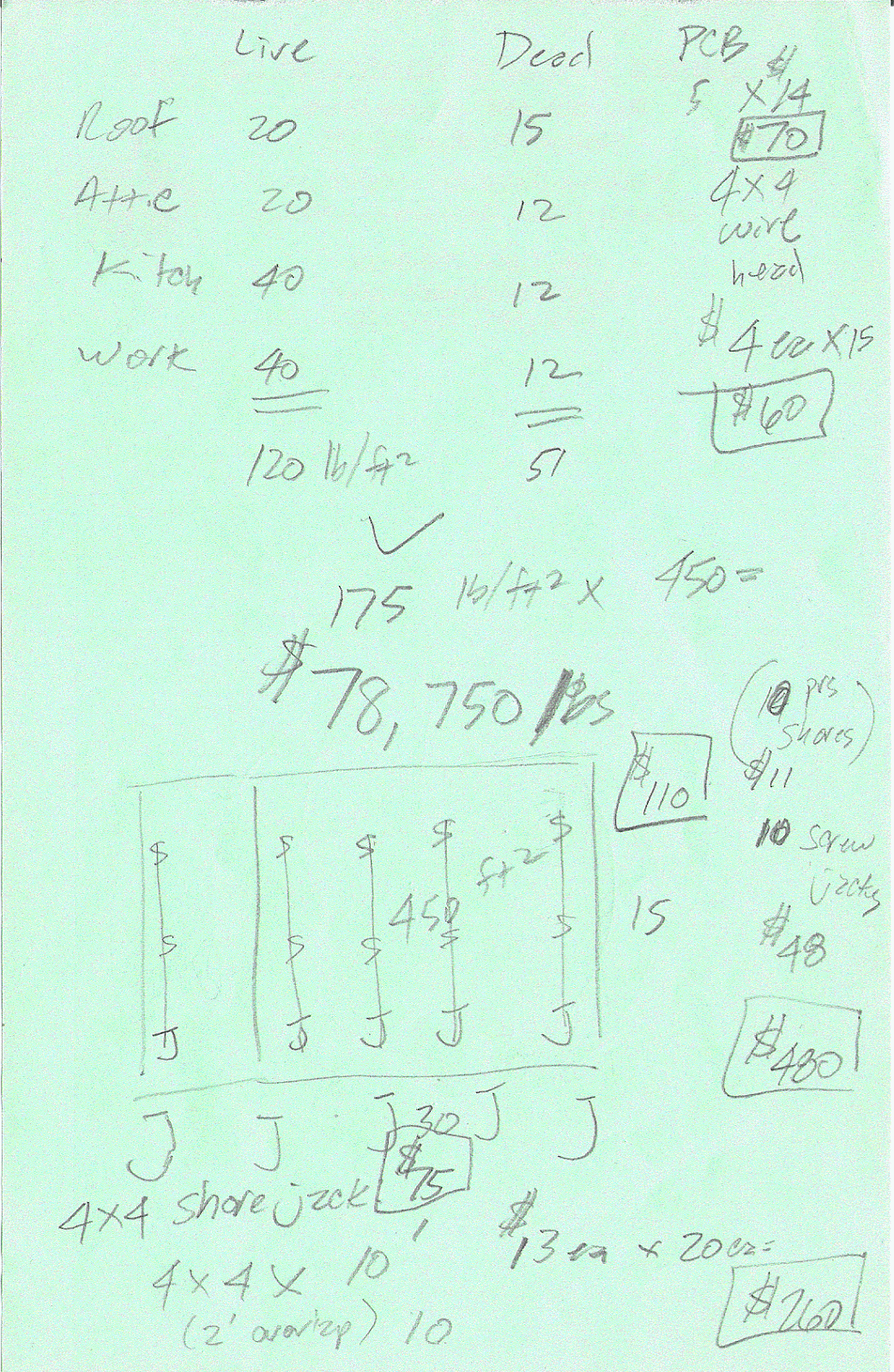
How did I know how many to buy? Let’s look again at the embarrassing set of squiggles I showed you earlier, that masqueraded as my plan:

I know, I know, it looks ridiculous. But it’s got more useful information than all the Google-ranked SEO articles combined. Figure out your live load (120 lbs/ft2), add it to your dead load (51 lbs/ft2), multiply the total by the square footage of the area we’re working on (15′ x 30′ = 450 ft2), and you get 78,750 pounds. Each screw jack has 4,000 lbs. of lifting capacity. The wooden shore clamps we’re going to use will hold 6,000 lbs. each, but you can’t lift with them. Divide 78,750 by 4,000, and you get 19 and a fraction. That’s what the plan shows. We’ll buy 10 jacks (J) and 10 shores (S). We’ll put 5 jacks outside the house, and five just inside, and support the floor joists above (they run left to right on that plan, or would, if I bothered to draw them) on beams. The part farthest inside is already the correct height, so we’re really only lifting half of it.

Is it safe? Well, it’s safe-ish. I mentioned that a screw jack will only lift 4,000 lbs, but it will hold around 10,000 lbs at around 7 feet high over your head. Multiply 10 jacks times 10,000, plus 10 shores holding 6,000 lbs each, and you get… um… well… some kind of really big number. I went to school for architecture, remember, not engineering. It’s way bigger than 78k, anyway. That’s good. I don’t want to drop a house on my son. He might be standing next to me.

Now read the prices on the green sheet for shores and jacks, look at the calendar, and weep. The screw jacks were only $48 ten years ago. Now they’re $128 apiece. The shore clamps are $20 a pair now, instead of $13. I bought a bunch of steel caps for the tops of the shores and jacks, including some nifty swiveling items that I’ll show you later.

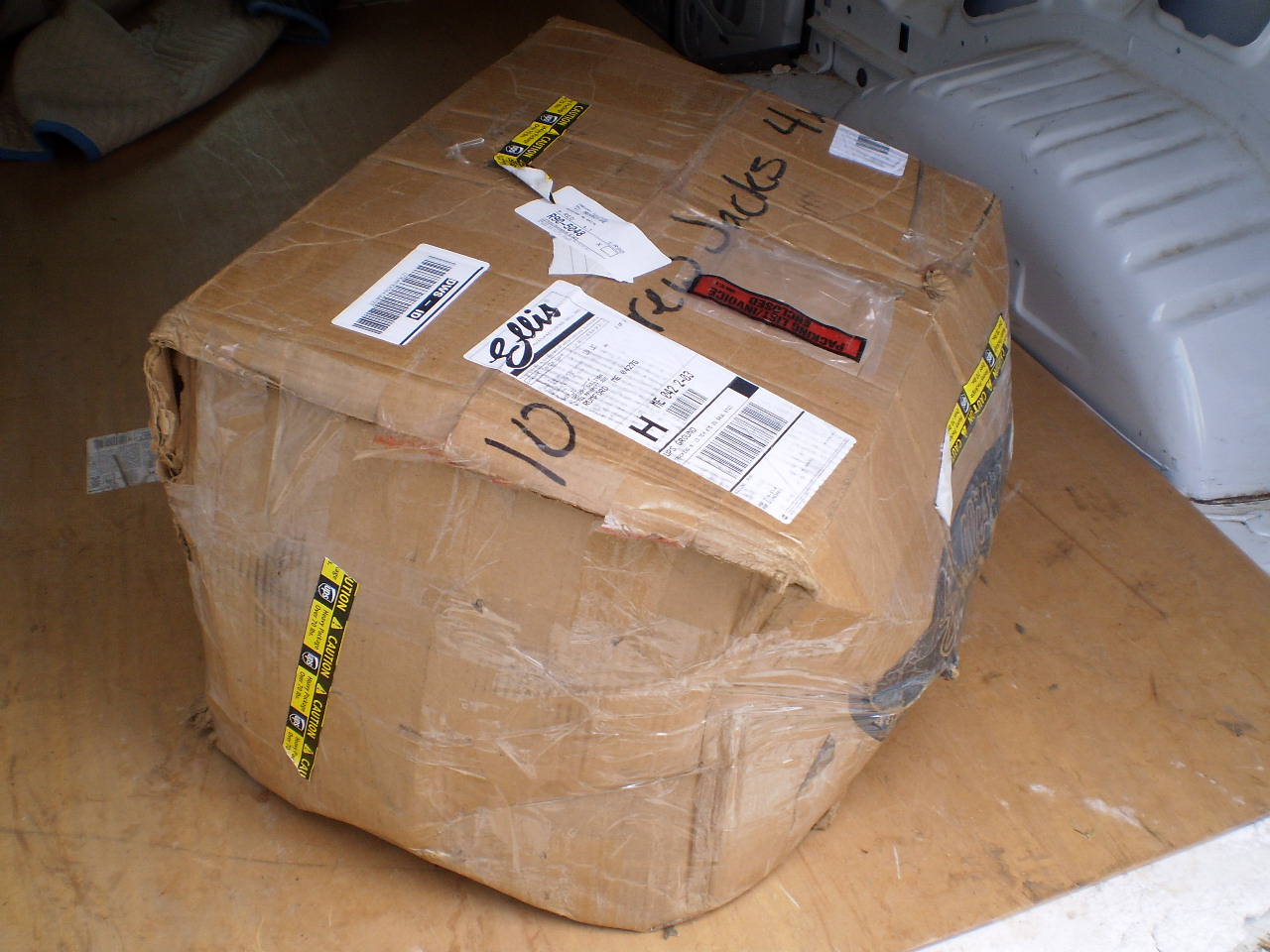
Now wait until you read the price for shipping all that stuff to you. If you order enough for a big job, it probably has to come by motor freight, lads and lasses, because it’s a horrible, heavy box of steel stuff, and UPS won’t be interested. If it’s a little job like mine, UPS will be interesting in accepting the package, but various package handlers they employ won’t like it. It will show up looking like it was dragged all the way from New Jersey, instead of riding in the truck. But it doesn’t matter. The stuff is nearly indestructible. Here’s the jacks in a box:

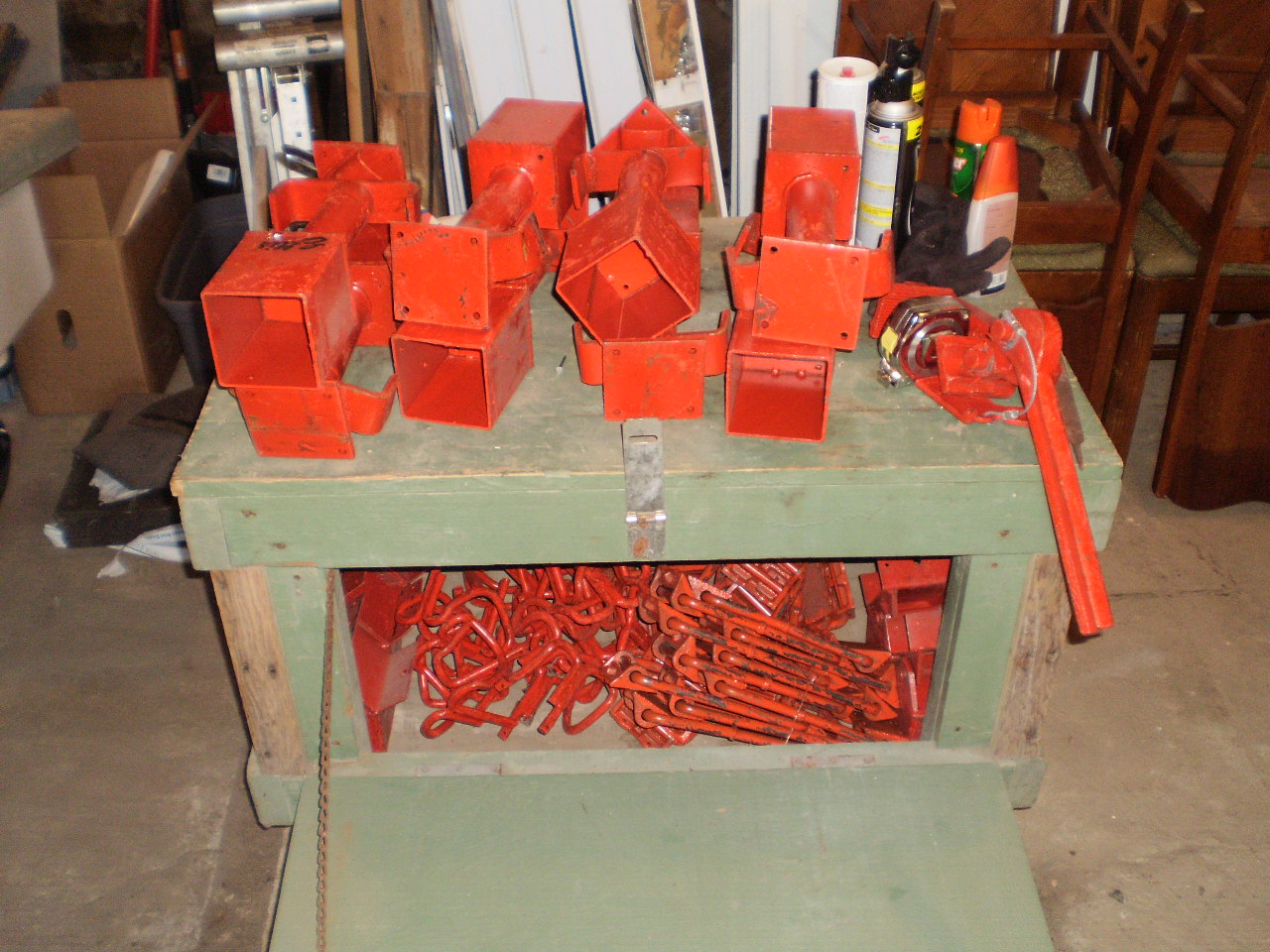
And here’s what the whole mess looks like unbound:

There’s more to jacking up a house than that, of course. I’ll tell you the Golden Rule for house jacking tomorrow.

Day: July 21, 2023

Find Stuff:

Archives