Eventually, Everyone Turns to Stone

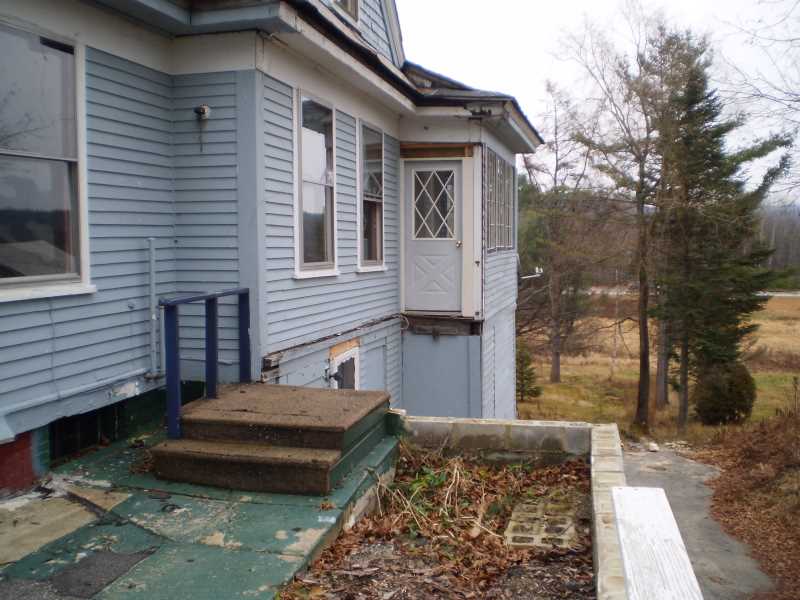
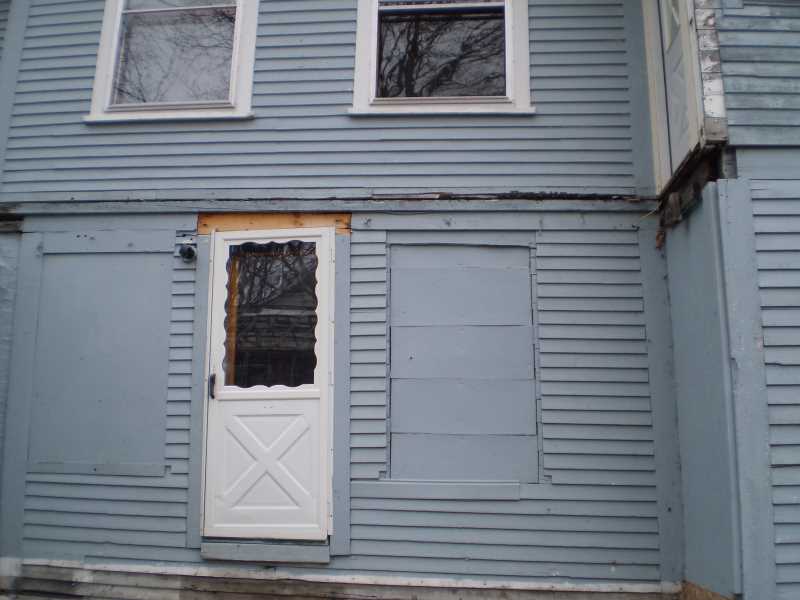
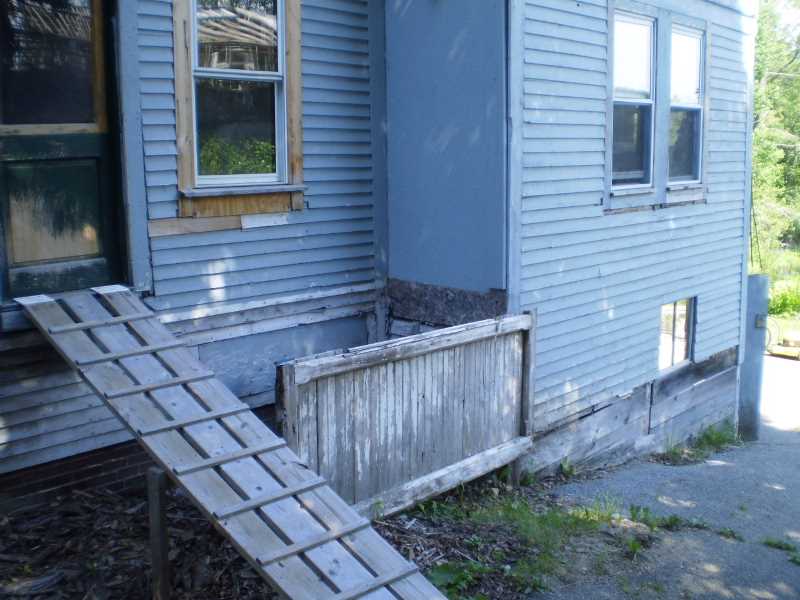
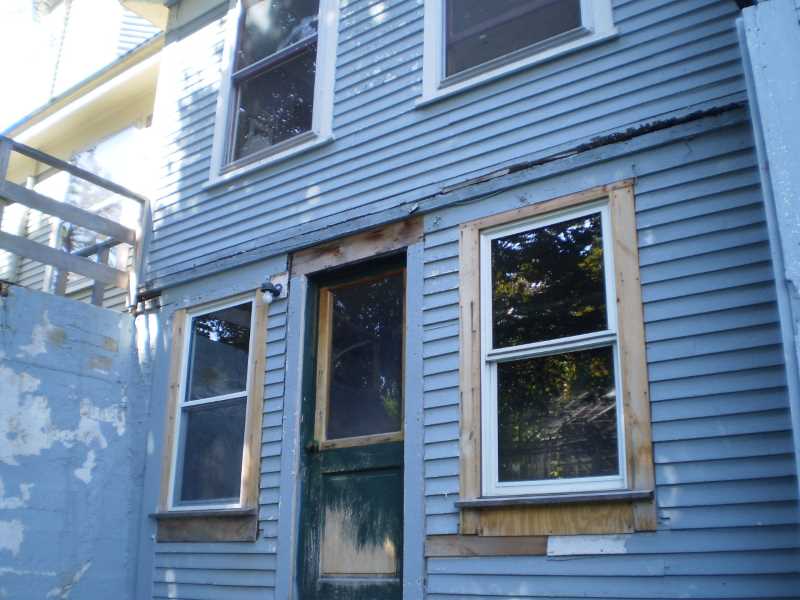
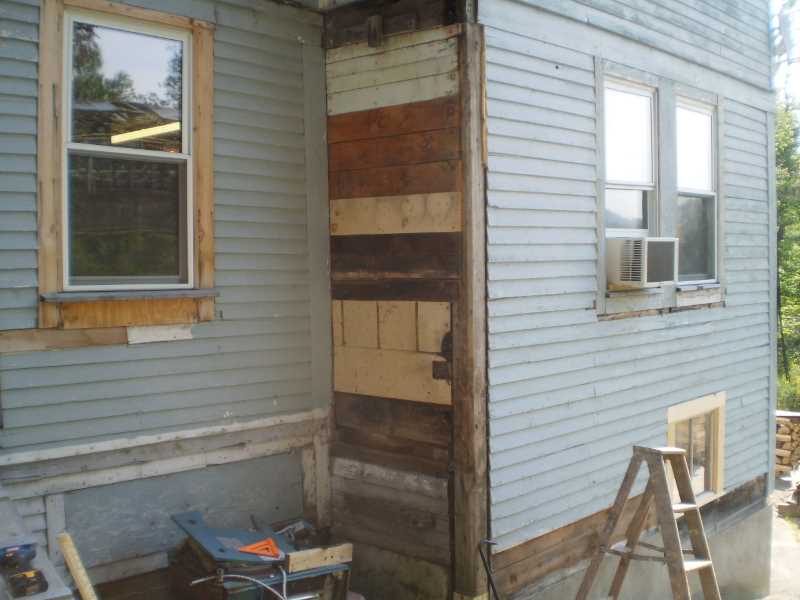
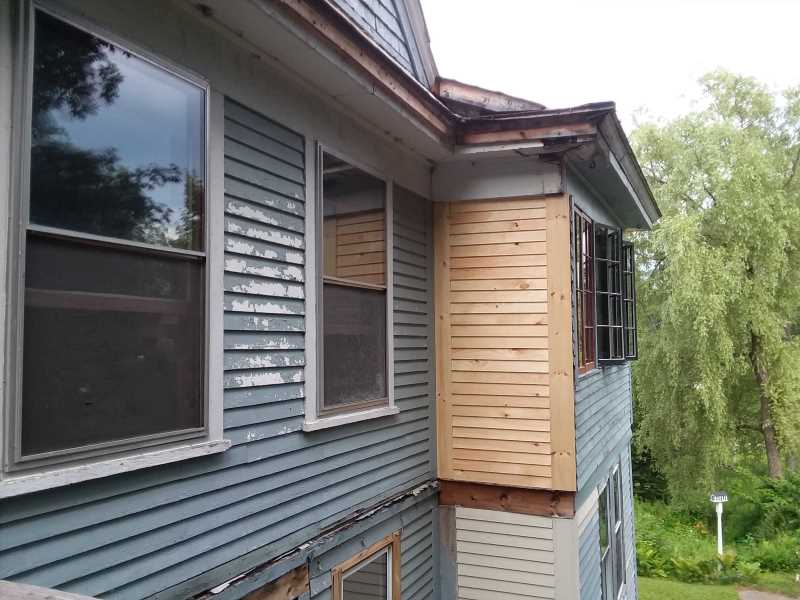
By our standards, this job didn’t take very long. Not a lot of photo evidence, your honor, just circumstantial stuff. I bounced up and down that @#$%ing ramp outside that basement door for a plenty long time, but once we set our minds to replacing it, it was done pretty quick. There’s my spare heir painting a bit. We put new clapboards over the patchwork sheathing wall, and wove them in under the windows and such. We added a water table to the raggedy slot that the old ledger board from the catwalk once occupied. Multiple water tables look fine on an old Victorian/Arts and Crafts house. The A&C style especially liked horizontal bands on houses. They work to kick water away from the siding below them a bit, too. Big blank walls of siding look dreary anyway.

Before painting, we prime knotholes with BIN primer, which is shellac with white pigment in it. No water base or alkyd based primer works for that, no matter what the label tells you. Then we primed the raw wood with alkyd primer, because it works great, but mostly because we had some. The spare heir is caulking the seams where the siding and corner boards, etc. join together. Energy efficiency devotees love caulking, but they always use the wrong kind in the wrong places. We use plain painter’s caulking. It doesn’t have any silicone in it. It’s getting hard to find. Everyone wants silicone in all their caulking. Everyone wants their paint to peel, I gather.

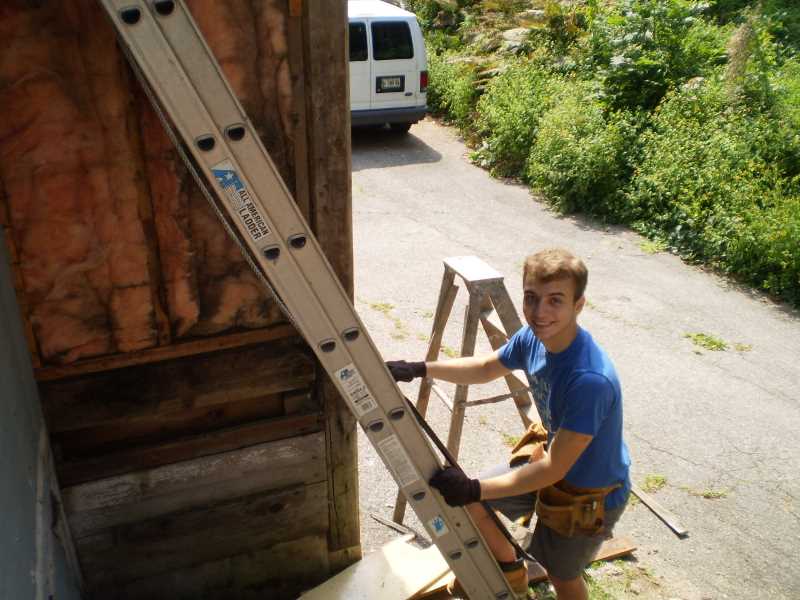
Here’s the typical division of labor on jobs at my house. My son poses for Animal Crackers, and I work like I was twenty years younger than I am. I’m screwing down leftover decking from the front porch, to a deck suspended on 4 x 4 pressure-treated posts left over from lifting the back of the house. We offset the stairs from the door. There was a weird assortment of footings scattered around the sloping leftover space where the porch was being built. There was a flat, level, wide footing in one spot, and we’re going to land on it with the stairs.
The whole porch was assembled with better screws than I was used to seeing back in the day. These things are beastly strong and tap their own holes and frighten small children, delicate women, and men who wear spangled spandex to ride a bicycle.

Besides, it’s what they had at the local lumber yard. First we screwed a PT ledger board to the house. We put standoff blocks behind it to keep water from collecting behind it and rotting the house sill. Then we put in the posts on the two outboard corners. We found two footings from porches past, and decided the porch would look great with those dimensions, whether it did or not. We gave the framing the right pitch by laying a level on it, and assembled it with the Strong Bad screws. Quick and dirty, but plenty sturdy. We screwed an extra ledger board between the left-hand post and the intermediate post, which projects down behind the joist to accept it. That gives us a big landing surface for the stair stringers.

The right-hand post runs straight up and through. It’s a smart way to keep the railings from getting hinky over time. We used strap anchors to affix the stair stringers, used the same decking for treads, and had a working porch in one day. We’ll put an outboard railing on the left hand side there later. The railings ended up very sturdy, and they were sized to allow you to push snow off the deck without having to lift and throw it.

Here’s most of the balustrade in place. The top and bottom railings are just PT 2 x 4s. You cut matching bevels on the table saw on the top of them to shed water. You leave a flat spot in the center that’s the width of the square spindles. Then we cut some caps for the top of the posts out of cut-off planking, and made a four-sided pyramid cap to sit on top, also to shed water.

The outboard (left-hand) railing is in place now. We left it off as long as we could to allow us to work in the slot between the battered concrete wall and the new deck. We proceeded to paint everything. We sealed the knots with BIN primer, but other than that, we just put latex house paint right on the PT wood, including the decking. Many people think pressure treated wood is immortal or something. It doesn’t rot, usually, but it kind of works itself to pieces and looks like hell in a few years if you leave it raw. The siding and trim in the background is all painted now.
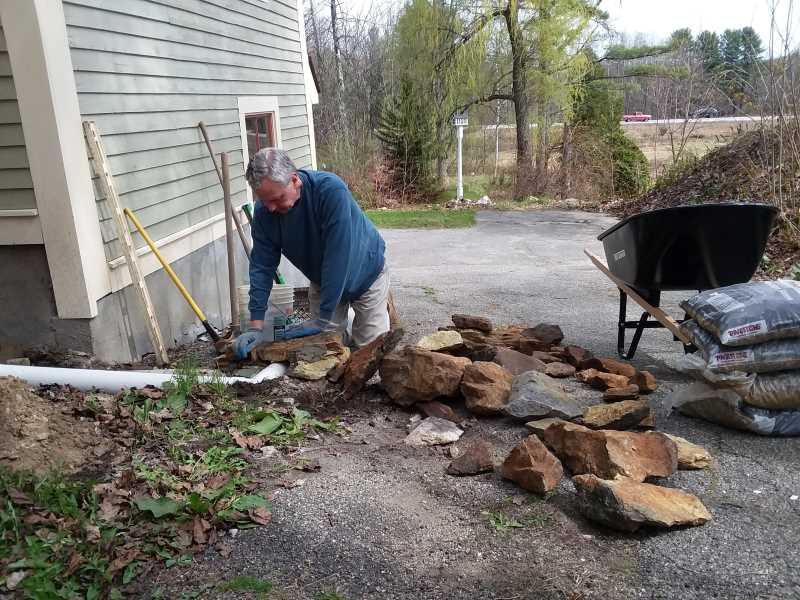
The porch looked swell and all, and I was plenty enthusiastic about turning the @#$%ing ramp into firewood, but the ground it sat on was still a dump. We scavenged some stone from around the yard to make a low wall and level out the ground. We buried a perforated pipe, because the roof overhead dumps rainwater something awful right in that corner. It has an outlet a couple of feet out on the driveway, to push the water away from the house.

The little wall took the curse off the slope, and we filled the void with crushed 3/4″ gravel around the pipe, soil we’d manufactured in a sawdust mulch pile, and some landscaping mulch to finish. Some of the stones have dollops of hidden mortar behind them to hold them in place.

Drill some holes in the bottom of a washtub, dump in some gravel and soil, and plant some posies. It ain’t the Boboli Gardens, but it’s OK for us. We ain’t Medicis.
[We’ll start a new project (we already started and finished) tomorrow. Thanks for reading, and commenting, and thanks to the anonymous donor on my Ko-Fi tip jar. It is much appreciated}

Recent Comments