You’re Living in Your Own Private Ivanhoe. Or Not

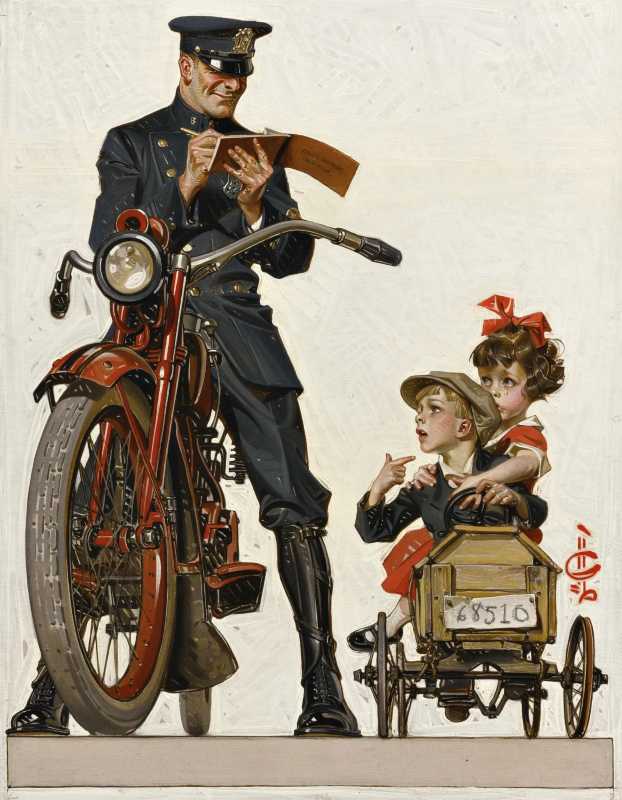
The image is cropped, but I know you know who painted it. The combination of subject matter and technique is unmistakable. Man, I love illustrations like that.

If Norman Rockwell was Disney, than Leyendecker was Warner Brothers. I always like his Bugs Bunny style better than Rockwell’s Mickey Mouse, but it’s a quibble, not a criticism:

I’m not exactly sure when illustrators fully took over for artists. “Real” artists decided to sell their dropcloths instead of their work a long time ago, probably over 100 years. I’m too lazy to look it up. Thank jayzuz illustrators took up the slack.

The average Lucky Strike ad had more art in it than ten Picassos. Hell, I’d rather look at an expired calendar for an hour than spend ten minutes in any museum of modern art. To wit:

Oh look. A recognizable skin tone, a nose on the front of the face, and without a ring in it to boot. Edgy, these days. I couldn’t care less they’re hawking Coke. They’re not agitating for the destruction of the culture that produced them. That’s one in the plus column.

All art of any kind is defined as ideation. The conceptualization of a mental image. It can be idealistic as well, to taste.

“Idealistic” refers to a belief in or pursuit of high ideals, often with a focus on achieving very good things, even when they seem unlikely to others. It can also relate to the philosophical doctrine that reality is fundamentally tied to the mind or ideas rather than material objects.

Complaints that good things, or even sublime things, are false, because they are idealized, is a quotidian modern lament, and profoundly stupid. If you believe in nothing, you’ll believe in anything, I guess. Listen, good is good. Whether it’s good enough for a cat lady on her third box of wine is irrelevant.

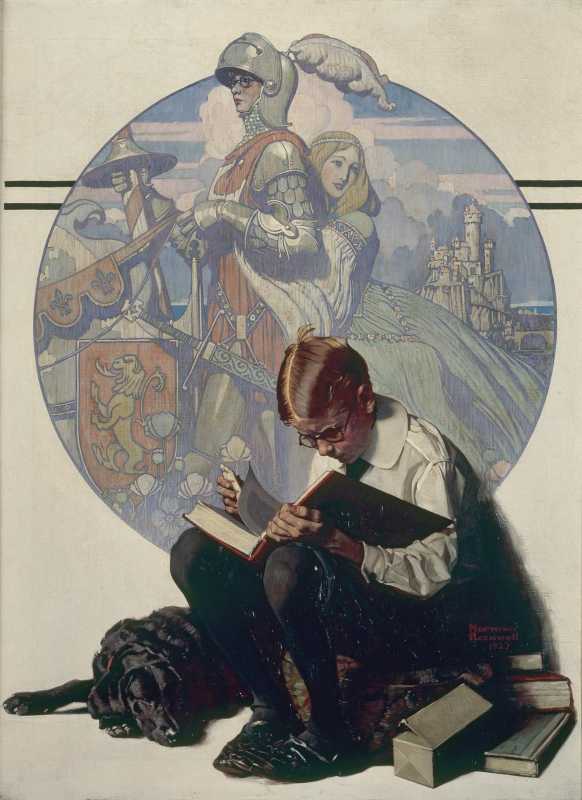
So let’s get back to the first illustration. A young boy, lost in a dream world of Arthurian legend. The Rockwellian detail of still wearing his glasses under his sallet is piquant, no?

It’s about so much more than “books are good.” It is an idealization of the value of forming mental images in your own head, instead of having them force-fed to you. It was painted, no doubt, years before the force feeding apparatus was in full swing. The Leyendecker illo is bold, and universally amusing. The Rockwell image is profound, buried in his usual kitsch camouflage.

You cannot form mental images by watching movies, or egad, television. Impossible. Can’t happen. The part of your brain that does that sort of work goes dormant when you’re force fed images like that. Your brain keeps working, but it’s in a passive cognitive state. Information gets processed, sorta like Kraft mac and cheese gets processed, but nothing of your own input is added. The box is emptied into your head, gets heated up if you still have a pulse, and travels through your intellectual alimentary canal without being digested one bit. Rockwell is telling you that books are a recipe you cook yourself. You should listen to him.

You cannot daydream while watching television. Self-reflection is impossible. What goes on in your head is smothered with the pillow of Two and a Half Men. The extent of you mental processes is limited to a vague remembrance that you’ve heard that joke before, maybe yelled by Ralph Kramden.

Dad (not mine, but we’re idealizing here) used to come home from work and have two scotches and watch TV for an hour before crashing into bed because work used to be demanding. Turn off your mind relax and float downstream was invented before the Beatles were. Dad needed to shut off the executive portion of his gray matter, because it was doing chin-ups all day.

But TV programs were on a schedule then. When a show was over, it was over,  You could watch TV continuously, but at the very least you’d have to hunt and gather among the channels to take your mind out of your torpor, and get a little exercise by throwing the TV Guide across the room.

VCRs changed that, and streaming was the pile driver of the process. Binge watching became not a thing, but THE thing. Producers responded by running shows like M*A*S*H that ran longer than the war they were based on. Pretty soon you’re watching Tony Soprano cooking dinner, cleaning out the lint trap in the dryer, and folding the paper bags from the grocery store to fill up the time. The audience became dress dummies just offscreen from the actors, not participating, but never anywhere else either. Drama used to be defined as life with all the boring parts removed. Now it’s a director’s cut with four extra hours of Gandalf’s horse taking a dump or suchlike entertainments.

When I first saw a smartphone, I winced. Oh no, a handheld television. They’ll never turn it off now. It’s a Soma and lotus blossom smoothie, I thought. I thought wrong.

It’s much, much worse than a hand held TV. It’s teevee with the illusion of agency mixed in. It’s like holding your thumb on the change channel button on the remote, never watching anything, getting some primitive dopamine jolt from pressing a button now and then, your decision making put through an information deli slicer until you can see through it when held up to the light.

There is no focus. There is no attention span. It’s infinite, algorithmic, and the only reaction it can produce seems to be disquiet, if not rage. It’s more of an unpleasantness generator than a Pomeranian.

So the teevee makes you endlessly passive. A bump on a log. The phone makes you endlessly restless. Foaming at the mouth with attention span rabies. A book makes you an Arthurian knight, with your own Alisande riding pillion, living in your own private Ivanhoe. Choose wisely.

The Original Show About Nothing: Jeeves and Wooster

Of course it’s a misattribution or malapropism or maladroit miscommunication or some other whatsis to refer to Seinfeld as The Show About Nothing. That whole idea is an in-joke that got embedded deeply into the meta information of the show itself. The sitcom was based on the idea of demonstrating how comedians found their material in ordinary life, and then showcasing them (Seinfeld) delivering that material in its finished form.

But still. The joke stuck, and became a metonym for the whole enterprise. It kinda works, because by design, no one on the show learns anything from their misadventures, never grows up, never matures. They never alter their behavior after learning any lessons delivered from their trip through their pampered version of the school of hard knocks. Their woes are trivial. While hundreds of people pass through their warped little world, the principals (and their principles) don’t change one whit.

By those standards, it is a show about nothing, but it’s not the first. P.G.Wodehouse wrote the first show about nothing I know about, even though it wasn’t a show when he thought it up. It was a series of published stories. Jeeves and Wooster adumbrated the show about nothing.

If you’re not familiar with the stories, Bertie Wooster is a somewhat dimwitted wastrel semi-aristocrat flouncing around London and various posh country estates in Great Britain between the two wars. Jeeves is his wise and hyper-competent manservant. This kind of turnabout is common now, but it was fresh when Wodehouse started it. Wodehouse began contemporaneously with the subject matter, but he somehow kept it going until 1974, through 35 short stories and 11 novels. Bertie never learns anything, Jeeves never forgets anything, they never get any older, time never passes, and nothing much happens throughout the whole enchilada. It’s still funny, and always will be, because Wodehouse was a funny writer.

There have been various attempts to dramatize Jeeves and Wooster over the years, including radio programs, stage plays, and TV shows. The best known is probably Jeeves and Wooster from ITV back in 1990. It still holds up pretty well. You can find all of them on YorubaTube if you poke around. Here’s the entire first episode:

There is a problem, although it’s something of a quibble. Wodehouse is not well-suited for dramatization. Hugh Laurie, who plays Wooster in the last clip, had this to say about Pelham Grenville:

The facts in this case, ladies and gentlemen, are simple. The first thing you should know, and probably the last, too, is that PG Wodehouse is still the funniest writer ever to have put words on paper. Fact number two: with the Jeeves stories, Wodehouse created the best of the best.

He’s wrong about some of that, but that’s not the problem I’m describing. Mark Twain is the funniest writer ever to put words on paper, with daylight second. However, both Twain’s stories and Wodehouse’s tales of misbegotten engagements, drunken layabout lords, and theiaphobia have the same drawback when viewed as dramaturgy. It’s the way the stories are told that’s humorous. Both authors have a masterful technique of making written works that are funny to read. While the situations they describe can vary from mundane to ridiculous, the action is in the delivery of the language. The stuff that happens might be comic, but the words make it hilarious.

Here’s two examples I’ve included in an old essay called The Dirty Dozen Best First Lines in Literature. First, P.G.:

Into the face of the young man who sat on the terrace of the Hotel Magnifique at Cannes there had crept a look of furtive shame, the shifty hangdog look which announces that an Englishman is about to talk French.
Pelham Grenville Wodehouse — The Luck of the Bodkins

Then Twain:

This last summer, when I was on my way back to Vienna from the Appetite-Cure in the mountains, I fell over a cliff in the twilight, and broke some arms and legs and one thing or another, and by good luck was found by some peasants who had lost an ass, and they carried me to the nearest habitation, which was one of those large, low, thatch-roofed farm-houses, with apartments in the garret for the family, and a cunning little porch under the deep gable decorated with boxes of bright colored flowers and cats; on the ground floor a large and light sitting-room, separated from the milch-cattle apartment by a partition; and in the front yard rose stately and fine the wealth and pride of the house, the manure-pile.
Christian Science — Mark Twain

Timing is just about everything when you’re trying to say something funny. Neither of those examples is a “joke.” Both writers hated jokes, although they used them to good effect by telling terrific jokes after first describing them as bad jokes, and kind of apologizing for them. For example, Bertie hears someone describing seeing Garrick playing Hamlet at the Odeon, (I’m doing this from memory, the details might be slightly different) and asks, “Who won?”, while no one laughs.

The timing in either of those opening lines is the key. You’re strung along, trying to keep up, and amused along the way by the tortured language and the occasional, offhand-sounding chuckler, then hit with the crusher at the end. They’re both great at it, The best ever, that I’ve ever seen, in print.

But bad books generally make the best movies. Twain’s characters have been portrayed plenty of times in movies and on TV, to poor effect. Huckleberry Finn is the Ur-Novel in American letters, but the story alone is not that interesting without the lively text. And while Jeeves and Wooster is about as good as cable TV shows get, it never achieves the drollery and amusement of P.G.’s writing.

My point is kind of borne out by the way the Jeeves and Wooster series was developed. Like most good British TV, there were only a few seasons with a handful of episodes each season. They still had trouble filling the hours. They mashed handfuls of stories together to pass the time, and then started making up dreadful ideas of their own, like putting Jeeves in drag. They discovered pretty quickly that there was a set of encyclopedias-worth of funny text, but only a handful of funny, televisable things in the stories.

Perhaps one of the reasons why Jeeves and Wooster still holds up is that the paradox of the helpless aristocrat and the competent, long-suffering servant is only half the paradox. It works just as well reversed, because Jeeves, while a servant, personifies rock-ribbed traditional, conservative Great Britain. He reads Spinoza in his room on his day off. But ultimately, he’s not in charge. Bertie may be a member of the upper crust, but he’s always ready to try every passing fad in amusements and clothing. He’s a kind of imbecilic gadfly. He never reads anything but a menu or a racing form, but somehow his class of nitwits are ostensibly in charge of an empire.

Neither Bertie or Jeeves has much of anything to do with the working class. Regular workers barely even enter the stories as props. It’s a struggle between two factions over who will set an example for the rest of the kingdom. In the episode above, Bertie tells Jeeves that he’s not the sort of man who becomes a slave to his valet. It’s amusing to watch him do it anyway, in a show about nothing.

The Taming of the Scrooge

The intertunnel is a machine for staking out ridiculous intellectual real estate. Once it’s out there, you fortify it with references from lamebrain frontrunning fellow travelers. Eventually, the silliest ideas get their low-grade ore heat-treated with the online coke of hyperlinks, and the resultant ersatz intellectual tin gets galvanized into the interwebs’ official opinion.

Many of these Instagramhole attempts fall short, of course. But eventually, the intertunnel will probably decide that Herman’s Hermits were more important than The Beatles, because reasons (see footnotes). But I warn you: It’s a short trip from the moon landings were fake, to the Earth is flat, marching mercilessly to the queue at the Time Masheen.

But this aggression must not stand. Across this line, you do not cross. No, you psodoku-intellectuals, Skakespeare was a real person and he wrote all those plays, sonnets, songs, and shopping lists with his name at the bottom. And your reasoning for why he couldn’t have done so betrays your lack of intelligence, not his, along with your lack of imagination.

Exhibit A, B, and C in this cavalcade of middlebrow research is that it would be impossible for Wild Bill to have written all that stuff simply because he never went to college. Of all the clubfooted intellectual meanderings about the topic, that one is my favorite. This is always the approach for people who go to college, and think that their sheepskin from directional state U. proves their intellectual bona fides over a glover’s son like Billy the Kid Shakespeare. If they went to the poison Ivy League, where even less is learned about anything important than at West Dakota State (commuter), they’ll be twice as opinionated. Shakespeare couldn’t have done it, because I went to PrinceYalevard on the Gold Coast, and I can’t do it. Q.E.D.

By the way, have any of you inteprid internaut iconoclasts ever looked up what got taught in the grammar school that Shakespeare attended? I did. It doesn’t look much like the current tennis balls on the chair legs, finger painting and blocks education everyone’s getting now: Grammar School for Shakespeare (PDF).

Look, I don’t know how to break it to you people, but it’s much more accurate to say that no truly important writer ever finished highbrow college. You think all of them must have, because you read comic books and science fiction pabulum and mistake them for Remembrance of Things Past. And by the way, Proust did pretty well for a guy clutching a high school diploma.

You know, there really have been only a handful of really important writers. I’m leaving off technical subjects here. People style very minor writers, even hacks who write the same horrible horror story over and over, as geniuses. You can usually assess their bona fides to judge a genius by the way they spell it: genious.

Geniuses aren’t thick on the ground. They’re vanishingly rare in the publishing world, even back when the only publishing house was Gutenberg’s. So, off the top of my head, here’s a list of the most trenchant, accomplished writers ever to tread the earth. Well, the earth outside of high-toned universities, anyway. Not one of them finished college (university, if you’re British).

  • Cervantes
  • Chaucer
  • Shakespeare
  • Twain
  • Hemingway
  • Wodehouse
  • Tolstoy
  • Faulkner
  • Kafka
  • Edgar Allen Poe
  • Jack London
  • Tennessee Williams
  • Charles Motherloving Dickens, people

The best of those writers didn’t even finish high school, by the way.

Let’s veer towards the more purely entertainment lane on the important writer highway. How about:

  • Alexandre Dumas
  • Robert Louis Stevenson
  • Kurt Vonnegut
  • Ray Bradbury

If you think I’m a stick in the mud with my reading list, I’ll throw in Camus and Bukowski, too. Dylan Thomas ring a bell, anyone? Happy now, poindexters?

The other “evidence” about Shakespeare being a drooling imbecile who couldn’t possible have written anything of note is mostly teased out of misunderstood “evidence,” coincidentally uncovered by drooling imbeciles who couldn’t possible write anything of note. I give you: Sir Francis Bacon wrote all that stuff, and gave it to Shakespeare, because reasons.

I could delve deep into the very shallow, but still somehow murky waters of this line of reasoning, but you can do your own research if you like. I’ll leave you with one glaring fact:. Sir Francis Bacon was a bright guy, and notable in his day. The most notable thing he was notable for, notably, was not being able to finish anything he started. That’s not the C.V. I look for when I’m beating the bushes for a ghostwriter to surreptitiously compose 39 plays, 154 sonnets, and a bunch of long and short form poems. And then, you know, being anxious to give them away.

It’s all pretty silly. Shakespeare’s life was about as well-documented as a playwright could have been back then. We worship guys that write the bulk of the series of Branded nowadays, but theater people were mostly considered equal to nightsoil collectors back in the day. Plenty of notable contemporaries of the Bard acknowledged his greatness in real time, however. And if you know anything about the egos of writers, such praise comes out like molars. They wouldn’t have offered it to a fraud.

So you can watch the most comically misnamed movie of all time, All Is True, and learn that Shakespeare was gayer than Liberace’s Christmas Tree and his daughter had all the writing chops. You can read any number of books currently clogging the aisle arteries of Barnes & Noble, breathlessly conjecturing about who really wrote Shakespeare’s plays. I mentioned “breathlessly,” because the readers no doubt will get exhausted while reading them with their lips moving.

I can’t wait until all these new fantasias about who wrote Shakespeare’s plays make it all the way through the interweb’s alimentary canal, and the iPhone Time Masheen reports that Robbie Shakespeare was a bass player in Geoffrey “Flying” Chaucer’s jam band, and was famous for writing The Taming of the Scrooge.

The Dirty Dozen Best First Lines In Literature

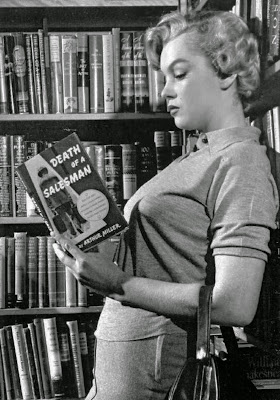
I Just Read Death of a Salesman, and Boy, Are My Lips Tired

I’m sorry to be the one to break this to you, but you like bad books.

It’s not your fault. You’re pummeled with bad books in school like some vicious textual version of dodgeball. You’re required to read bad books. You couldn’t help noticing that bad books are given trophies and medals and their authors sleep on velvet-ticked mattresses stuffed with the souls of good writers and banknotes. You just went with the flow. I hereby absolve you of guilt.

Absolution comes with fine print, you know: Go and sin no more. So knock it off. Stop trying to make Harry Potter happen in adult company. Stop reading books by girls that kill themselves as a career move. And in the name of all that is right and holy, stop publishing lists of the Greatest First Lines in Fiction. And stop starting sentences with and.

In the Beginning, All Books Were Great

First of all, let’s go over the greatest first line in any book, ever:

In the beginning God created the heavens and the earth.
The Bible

Now, if you got your English degree at UNLV unironically, you’re dying to put a comma in there, aren’t you? You know more about dependent clauses than Santa’s pediatrician, but your instincts are all bad. You know rules, but not enough of them to make you of any use, coming or going, writing or reading. Stop publishing lists.

Of course, The Bible is cheating. If you wear a fedora and call fat girls M’Lady, like to visit bookstores to put the Bible in the fiction section while you’re on the way to the Hobbit section, you should give lists of great books a pass.

Good Books, Not the Good Book

We’re talking fiction here, more or less. Litchah. Good books, not the Good Book. Great writers often try to concoct an opening sentence that insists upon itself. Since authors are usually running a tab at a distillery, not just a pub like you do, they desperately need you to pick up the book, open to page one, and then reach for your wallet immediately. So we’re going to judge how they did, right now.

The Twelve Greatest First Lines I Ever Read:

Once upon a time and a very good time it was there was a moocow coming down along the road and this moocow that was coming down along the road met a nicens little boy named baby tuckoo…
A Portrait of the Artist as a Young Man — James Joyce

By gad, you’re always putting Ulysses in your lists. Ulysses is like a postcard from home for a drunken Druid drudge like me, but you should admit you have no idea what’s going on in it, and learn to love his book about wetting the bed, instead.


At an age when most young Scotsmen were lifting skirts, plowing furrows
and spreading seed, Mungo Park was displaying his bare buttocks to
al-haj’ Ali Ibn Fatoudi, Emir of Ludamar.

Water Music — T. Coraghessan Boyle

It’s T.C. Boyle’s first book, I think, and the only one really worth reading. It’s the greatest picaresque novel since Fielding lost interest. They put that sentence, in big letters, on the cover of the edition I have. That publisher knows his arse from his elbow.


Imagine that you have to break someone’s arm.
The Gun Seller — Hugh Laurie 

Yes, it’s that Hugh Laurie. His book is a blast. It’s better than any potboiler you could name. The Day of the Maltese Bourne Majestyk Sanction sorta thing. If you know him solely from an American television show, you should be reading Highlights magazine, not this essay. If you know him from Jeeves and Wooster…


Into the face of the young man who sat on the terrace of the Hotel
Magnifique at Cannes there had crept a look of furtive shame, the shifty
hangdog look which announces that an Englishman is about to talk
French.

Pelham Grenville Wodehouse — The Luck of the Bodkins

This one is like cheating. You can open up anything by PG and paste the first line into your WYSIWYG if you’re on deadline and your employer needs their literary listicle by close of business. The Greatest comic writer that ever lived, but one…


This last summer, when I was on my way back to Vienna from the Appetite-Cure in the mountains, I fell over a cliff in the twilight, and broke
some arms and legs and one thing or another, and by good luck was found
by some peasants who had lost an ass, and they carried me to the nearest
habitation, which was one of those large, low, thatch-roofed farm-houses,
with apartments in the garret for the family, and a cunning little porch
under the deep gable decorated with boxes of bright colored flowers and
cats; on the ground floor a large and light sitting-room, separated from
the milch-cattle apartment by a partition; and in the front yard rose
stately and fine the wealth and pride of the house, the manure-pile.

Christian Science — Mark Twain

I read this aloud to my eleven-year-old at dinner a month ago. He asks me to read it again every night. The second sentence in the book is just as funny, but you knew that, because you looked it up immediately, didn’t you?


Once upon a time…
Grimm’s Fairy Tales — Jacob and Wilhelm Grimm

Every writer knows he’s a piker compared to those two guys. They got more mileage out of those four words than Seinfeld re-runs.


Call me Ishmael.
Moby Dick –Herman Melville 

Whoops, Melville pared it down to three words. It’s useful to remember that old Herm died penniless, and no one gave a shiny shite about his book until he was room temperature. Now he’s on lists.


Marley was dead: to begin with.
A Christmas Carol — Charles Dickens
 
Everyone wants to put A Tale of Two Cities on these lists, but admit it, it sounds like Chuck is foaming at the mouth halfway through that Cities sentence, and he got a deal at the Typesetter Depot on semicolons and was still trying to use them up. His one great sentence is right there. It’s got a colon in it! That’s brass.


He was an old man who fished alone in a skiff in the Gulf Stream and he had gone eighty-four days now without taking a fish.
The Old Man and the Sea — Ernest Hemingway

I understand Hemingway more than I like him, but no matter. He won a Nobel Prize for that sentence, and if you ask me, no one has any idea what he was driving at in that book. I do.


Far out in the uncharted backwaters of the unfashionable end of the
Western Spiral arm of the Galaxy lies a small unregarded yellow sun.

The Hitchhiker’s Guide to the Galaxy — Douglas Adams

I tossed this in here to satisfy people who think George RR Martin needs to be knighted while being given a handy by Sylvia Plath. Douglas Adams invented very good bad writing in the seventies, and he needs his due.


Now is the winter of our discontent
Made glorious summer by this sun of York;
And all the clouds that lour’d upon our house
In the deep bosom of the ocean buried.

Richard III — William Shakespeare

Now imagine Olivier delivering that line. Shakey Bill’s Richard the Third makes Hannibal Lecter look like Mr. Green Jeans, and that sentence nails his colors to his bent mast right off.


I told that boy, I told him.
The Devil’s in the Cows — Sippican Cottage

Yeah, I went there. 


Tag: books

Find Stuff:

Archives