Welcome to the Other Summer
Well this kind of weather couldn’t last forever, amirite?
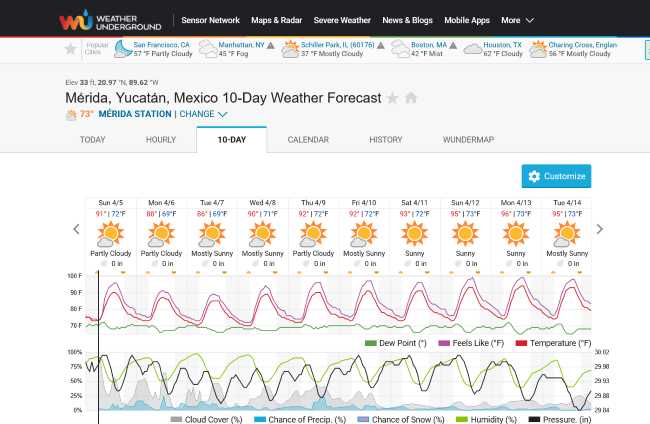
I must admit, for someone accustomed to New England weather, it seemed like forever. Merida, Yucatan shifts its seasons, it’s true. But not while you wait, the way it is back in Maine. Yucatan uses a calendar for weather decisions. Maine uses a clock. Summer in the sun, winter in the shade is a thing back there. Here, it’s always some form of summer.
Forgive us for being lulled and gulled by a weather report that looked like it was painted in oils. We went something along the lines of 45 straight days just like you see there. Egad, Lovie! We have to put more water in the pool every day!

It couldn’t last. The seasons are the opposite of up north. Winter’s nice, summer, not so much. There are only two seasons, just like Maine. Maine is nine months of winter, followed by three months of tough sledding. Here in Merida, there’s summer, followed by the other summer.
The “other summer” is the rainy season. If you want to be pedantic (who doesn’t?) there might be a third season: hurricane season. But honestly, how much worse can it get than the “other summer,” which showed up here last week:
That’s out in front of our house. There’s an eight-inch high curb out there, which is a lot by US standards, but barely adequate here. The city of Merida is the geologic equivalent of one of those pool tables without pockets that require more geometry to play than I carry around in my head. There are no bodies of water, no rivers, runnels, or gullies where the water might go. Either it ends up in the ocean, or the Gulf, the occasional cenote, or your living room.
Obviously this has been noticed by the people who lived here before us. I espied two brackets anchored into the masonry walls outside the only door in and out of our casa. I’m good at architectural hints. For instance, if you remove all the railings on your staircases, because a raccoon-eyed harridan on home and garden TV told you to, I’ll take the hint and fall down your stairs and sue you. I assume that’s expected of me. I hate to disappoint people.
The bracket hint was saner than that. I went hunting around and found a six-inch tall metal weir, a dam that slipped into the brackets snugly. So between that and the curb, we had about a 14″ head start on the rainwater. It wasn’t enough:
Consecutive days of torrential downpours have left the city of Mérida waterlogged, with official data revealing that parts of the Yucatecan capital recorded a staggering 436.7 millimeters (17.2 inches) of rainfall over a single seven-day period.
According to a report released on Wednesday, June 3rd, 2026, by the National Water Commission (Conagua), Mérida has solidified its status as the wettest location in Mexico over the past week. The most severe accumulations were registered in the western sector of the city between May 27th and June 2nd. Conagua noted that the 436.7 mm volume is visually equivalent to dumping nearly 22 twenty-liter water jugs onto every single square meter of land in the area. (link)
They were eager to add several rainstorms together to get that figure. There were days scattered throughout that week when it didn’t rain much, or at all. Most of that 17.2 inches of rain fell in a few hours, scattered over several days. It only rained all day once. I’ve taken showers with less water being dumped on me.
According to the chatbots, 17.2 inches of rain is about half the expected yearly rainfall here. Also according to Chad:
Spread evenly, 17 inches of rain means every square foot of ground received about 106 gallons (400 liters) of water.
Now, I may not be able to play pool with no pockets or anything, but I know when Sam Altman’s turbo encabulator is having an aneurysm. I said, check your math, and yourself, roboboy:
Good catch — that number is way off.
Let’s calculate it correctly.
A square foot receiving 17 inches of rain gets a volume of:
Area = 1 square foot
Depth = 17 inches = 17/12 = 1.4167 feet
Volume = 1 ft² × 1.4167 ft = 1.4167 cubic feet
Since 1 cubic foot = 7.48 gallons:
1.4167 × 7.48 ≈ 10.6 gallons
And since 1 gallon = 3.785 liters:
10.6 × 3.785 ≈ 40 liters
So the correct statement is:
17 inches of rain means every square foot of ground received about 10.6 gallons (40 liters) of water.
The previous figure of 106 gallons would correspond to about 170 inches of rain, which is exactly 10 times too high. I accidentally shifted the decimal point.

Do tell.
For poops and giggles, I asked Chad how much snow that would be, if that much moisture fell on Maine.
Maine perspective
A week’s precipitation equivalent of 17 inches of rain would translate to roughly:
14–21 feet of snow in a single week.
So, about four to six hours after I took the video, all the water in the street was gone except for some puddles. Where it went, only Kulkukan knows. The pool was full. And I didn’t have to shovel 14-21 feet of snow off the sidewalk.
All in all, I’ll count it in the win column.

Recent Comments