You’re Living in Your Own Private Ivanhoe. Or Not
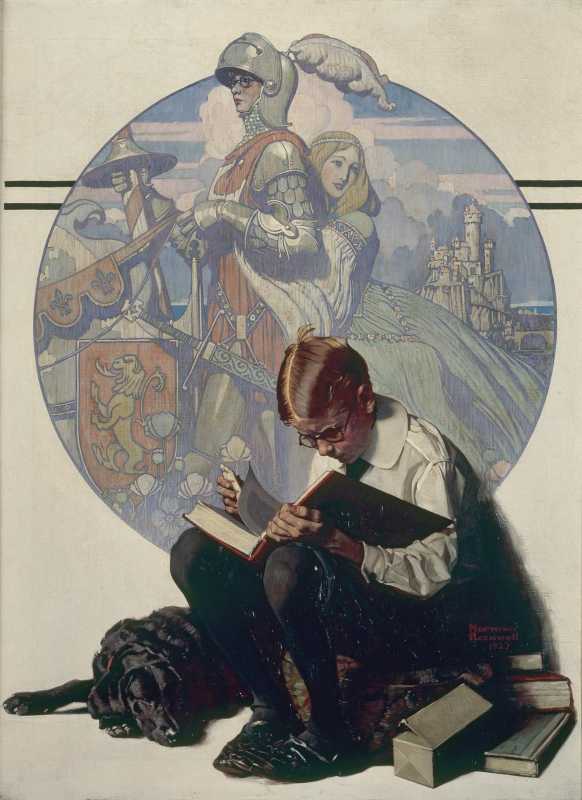
The image is cropped, but I know you know who painted it. The combination of subject matter and technique is unmistakable. Man, I love illustrations like that.
If Norman Rockwell was Disney, than Leyendecker was Warner Brothers. I always like his Bugs Bunny style better than Rockwell’s Mickey Mouse, but it’s a quibble, not a criticism:
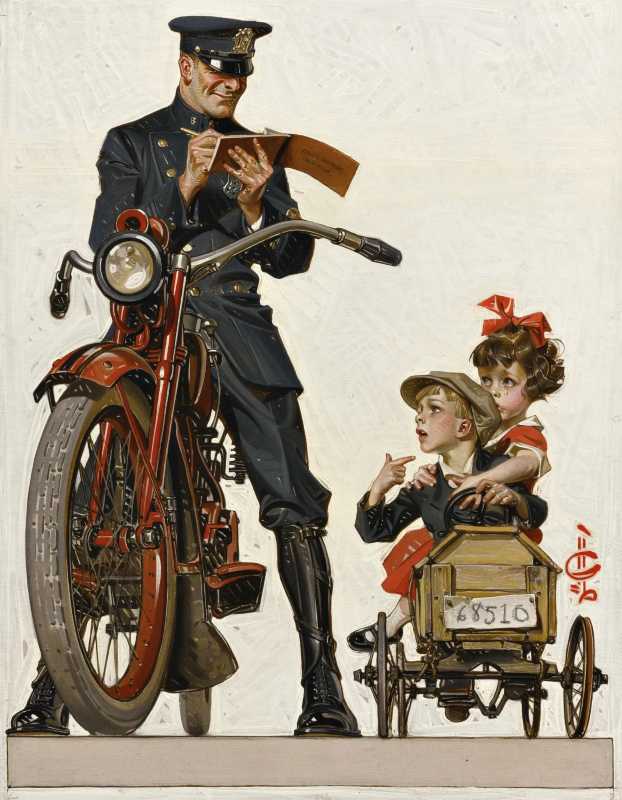
I’m not exactly sure when illustrators fully took over for artists. “Real” artists decided to sell their dropcloths instead of their work a long time ago, probably over 100 years. I’m too lazy to look it up. Thank jayzuz illustrators took up the slack.
The average Lucky Strike ad had more art in it than ten Picassos. Hell, I’d rather look at an expired calendar for an hour than spend ten minutes in any museum of modern art. To wit:

Oh look. A recognizable skin tone, a nose on the front of the face, and without a ring in it to boot. Edgy, these days. I couldn’t care less they’re hawking Coke. They’re not agitating for the destruction of the culture that produced them. That’s one in the plus column.
All art of any kind is defined as ideation. The conceptualization of a mental image. It can be idealistic as well, to taste.
“Idealistic” refers to a belief in or pursuit of high ideals, often with a focus on achieving very good things, even when they seem unlikely to others. It can also relate to the philosophical doctrine that reality is fundamentally tied to the mind or ideas rather than material objects.
Complaints that good things, or even sublime things, are false, because they are idealized, is a quotidian modern lament, and profoundly stupid. If you believe in nothing, you’ll believe in anything, I guess. Listen, good is good. Whether it’s good enough for a cat lady on her third box of wine is irrelevant.
So let’s get back to the first illustration. A young boy, lost in a dream world of Arthurian legend. The Rockwellian detail of still wearing his glasses under his sallet is piquant, no?
It’s about so much more than “books are good.” It is an idealization of the value of forming mental images in your own head, instead of having them force-fed to you. It was painted, no doubt, years before the force feeding apparatus was in full swing. The Leyendecker illo is bold, and universally amusing. The Rockwell image is profound, buried in his usual kitsch camouflage.
You cannot form mental images by watching movies, or egad, television. Impossible. Can’t happen. The part of your brain that does that sort of work goes dormant when you’re force fed images like that. Your brain keeps working, but it’s in a passive cognitive state. Information gets processed, sorta like Kraft mac and cheese gets processed, but nothing of your own input is added. The box is emptied into your head, gets heated up if you still have a pulse, and travels through your intellectual alimentary canal without being digested one bit. Rockwell is telling you that books are a recipe you cook yourself. You should listen to him.
You cannot daydream while watching television. Self-reflection is impossible. What goes on in your head is smothered with the pillow of Two and a Half Men. The extent of you mental processes is limited to a vague remembrance that you’ve heard that joke before, maybe yelled by Ralph Kramden.
Dad (not mine, but we’re idealizing here) used to come home from work and have two scotches and watch TV for an hour before crashing into bed because work used to be demanding. Turn off your mind relax and float downstream was invented before the Beatles were. Dad needed to shut off the executive portion of his gray matter, because it was doing chin-ups all day.
But TV programs were on a schedule then. When a show was over, it was over, You could watch TV continuously, but at the very least you’d have to hunt and gather among the channels to take your mind out of your torpor, and get a little exercise by throwing the TV Guide across the room.
VCRs changed that, and streaming was the pile driver of the process. Binge watching became not a thing, but THE thing. Producers responded by running shows like M*A*S*H that ran longer than the war they were based on. Pretty soon you’re watching Tony Soprano cooking dinner, cleaning out the lint trap in the dryer, and folding the paper bags from the grocery store to fill up the time. The audience became dress dummies just offscreen from the actors, not participating, but never anywhere else either. Drama used to be defined as life with all the boring parts removed. Now it’s a director’s cut with four extra hours of Gandalf’s horse taking a dump or suchlike entertainments.
When I first saw a smartphone, I winced. Oh no, a handheld television. They’ll never turn it off now. It’s a Soma and lotus blossom smoothie, I thought. I thought wrong.
It’s much, much worse than a hand held TV. It’s teevee with the illusion of agency mixed in. It’s like holding your thumb on the change channel button on the remote, never watching anything, getting some primitive dopamine jolt from pressing a button now and then, your decision making put through an information deli slicer until you can see through it when held up to the light.
There is no focus. There is no attention span. It’s infinite, algorithmic, and the only reaction it can produce seems to be disquiet, if not rage. It’s more of an unpleasantness generator than a Pomeranian.
So the teevee makes you endlessly passive. A bump on a log. The phone makes you endlessly restless. Foaming at the mouth with attention span rabies. A book makes you an Arthurian knight, with your own Alisande riding pillion, living in your own private Ivanhoe. Choose wisely.

Recent Comments