You May Not Believe This, But ‘Weapons-Grade Nuts’ Is the Name of My Psychedelic Furs Tribute Band. But I Digress
I like modularity. I feel like I’m pretty much alone in that nowadays.
Everyone seems to be dreaming of some kind of unitary system for everything. The best example of this phenomenon I’ve seen lately is the quixotic quest to automate light switches using phones. To a person like me, that idea lives 167 miles past stupid in the land of Moron. I’ve installed every kind of light switch in a house. The house I currently live in still had some rotary switches hooked up to knob and tube wiring. I think Edison installed it when he was still moonlighting on the weekends trying to make a few bucks. Those are interesting, but they’re honestly lousy light switches. They arc like you’re turning on the lights in Dr. Frankenstein’s parlor, and if you turn them counter-clockwise they do everything except turn the lights on. Some of the switches in my house have two buttons. Top one on, bottom one off. That was an improvement on rotary switches. I’ve replaced most everything with single-pole switches at this point. To turn lights on and off, the design cannot be improved upon. Period.
A box of switches like that costs maybe five bucks. You can take an aborigine from the Amazon and plop him in your living room (this is the current immigration policy of the United States, by the way) and tell him to turn on the light and he’ll be able to figure it out with no prompting. A toddler only needs to see you turn the lights on once to understand it forevermore. I’ll go further. A person that has never seen a light switch can be taught to install one in less than a minute:
- Turn off electricity in the house
- Find the “hot” wire, which is black
- Interrupt this black wire on its trip from service panel to fixture
- Attach black wire coming into the switch box to one gold screw
- Attach the black wire leaving the switch box to the other gold screw
- The green screw is for the bare copper wire. It’s the ground. The switch works even if you forget this step, but you might get a tingle now and then
- The only other wire is white and passes right through the box to the fixture
- Turn the power back on
That’s it. Flick the switch up, the light goes on. Flip the switch down, the light goes off.
Controlling your lights with your phone is one of those ideas that seems futuristic, but it’s not. It’s a futile attempt to make unitary systems from things that work better as modular components. It’s like building a supercomputer to play chess against Gary Kasparov. After seventeen billion dollars is invested, it finally beats him once. Now tell Gary to turn off the lights on the way out of the room. He does it. Tell the supercomputer to turn off the lights, and you’re in for another seventeen billion in startup costs. Humans can keep track of tens of thousands of things like operating light switches without much fuss. A computer is dumb, dumb, dumb, and no matter how smart you make it, it will always be dumb. Every woman who has sat in the dark in a public bathroom stall, waving her hands wildly over her head to reactivate the motion detector light, can testify to this.
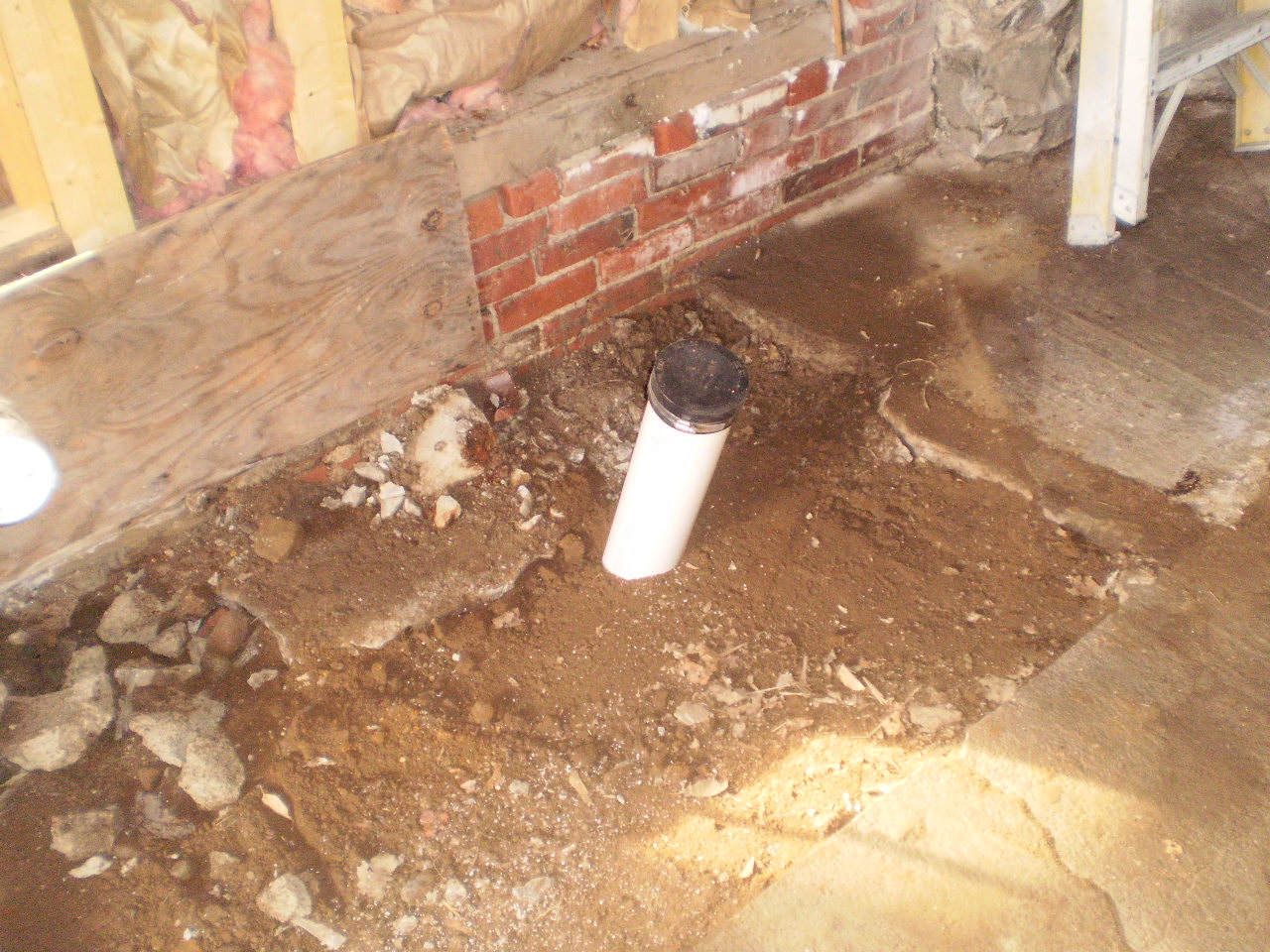
I was able to repair my sewer system because everything in it was modular. The pipe leading out of the house was made up of identical sections of fired clay pipe put together like legos. They were made of durable stuff, and they were installed to work using gravity alone. They worked for over one hundred years despite the efforts of dozens of people to screw them up in the interim. If they were a unitary system of some sort, and they failed, I would have been forced to replace them as a unitary system. To translate, that would have meant moving into a cardboard box behind a strip mall dumpster.
I could fix the broken components, and leave the others alone. Don’t underestimate the importance of this concept. In housing, everyone desires everything to be unitary, and wants it to be brand new forever. I can’t fix a modern house. I’m a dolt, but that’s not why I can’t fix it. In general, everything to do with a modern house can be replaced, but it can’t be fixed. If your hardwood strip flooring is worn, you can sand it and refinish it and get another fifty years out of it. If someone puts a coal out on your Pergo floor, you can lump it, or you can replace it. It’s sold as permanent. In real life, “permanent” really means “disposable.” The word “sustainable” is similar. It really means “in need of massive, permanent subsidy.”
When I traveled to the faraway Home Depot to buy things, I had a very limited budget, and no exact idea of what I would find underground, and what I would do when I found it. I bought a bizarre assortment of modular things that would give me the best chance to solve the problems as I found them. Don’t get me wrong; the assortment wasn’t bizarre to my eye. The clerk in the aisle and the lady in the orange smock at the register thought I was weapons-grade nuts, however.
[to be continued]
[Update: Many thanks to a person who wishes to remain anonymous for their generous donation to our PayPal tipjar. It is much appreciated]
[Further Update: Many thanks to (Sloop) Jon B. in Colorado for his generous contribution via the PayPal tipjar. It is very much appreciated]
[Continuing update: Many thanks to the Pope of the Internet, Gerard at American Digest, for his unrelenting support of this blog, and his very generous contribution to our tipjar. It is very much appreciated]
[Yet More Updated: Many thanks to Fred Z. from Calgary for his generous contribution to our PayPal tipjar. It is very much appreciated]

Recent Comments