You May Not Believe This, But ‘Polyglot Pipe Patches’ Is the Name of My Cowsills Tribute Band. But I Digress
As I was saying (there’s an understatement), your average civilian doesn’t know much about concrete. I’ve built a lot of stuff that had a lot of concrete in it, and I’ve had to bust out a lot of it, too. I’ve demolished concrete using the right tools, and I’ve smashed concrete using the wrong tools. Today, my son, we’re going to be breaking concrete without any tools.
I used the word “any” only somewhat facetiously. What I mean is that we’ll be doing it with only hand tools, our strong backs, and our weak minds. Wait a minute, flip those last two. I wish I had a strong back and a weak mind. I’d be able to sit for hours in an upholstered chair and enjoy everything on television if that was the case. Unfortunately, I’m doomed to walk the Earth noticing things without being able to do much about them.
Concrete is only strong in one direction. That’s a difficult concept for educated people to grasp. If you try to crush concrete, it’s plenty hard. It pulls apart relatively easily. That’s why structural concrete is full of rebar. Rebar consists of steel rods that are encapsulated in the concrete while it’s still plastic. Rebar is good in tension. If you don’t believe me, try to stretch a piece. Concrete is for compression strength and embedded steel is for strength in tension. It’s a great combination.
A cellar floor almost never has any rebar in it. It might have wire mesh, but even that’s pretty rare. There’s no reason to reinforce it. It’s just supposed to keep you from standing in mud when you’re looking for your skis in the basement in the fall. If I had a nickel for every terrified homeowner who asked me about inconsequential cracks in their cellar floor, I’d have several nickels, which believe me, I could use. Your cellar floor cracks because the concrete shrinks while it hardens, and for a long time after that, because concrete is lousy in tension. The cracks rarely mean anything substantial. If you’ve ever wondered why sidewalks are laid in four-foot squares, it’s because they know they’ll crack, so they force a crack every so often to keep it from happening willy-nilly.
So I know we can bust out the concrete with a sledgehammer, because I know how to do it. If you go down in the basement with a sledgehammer and start whaling on your concrete floor with a sledge, you’ll get tired before you dent it much. You’re playing concrete’s game. You’re trying to break it by compressing it. You need to give the concrete someplace to escape to in order to crack it.
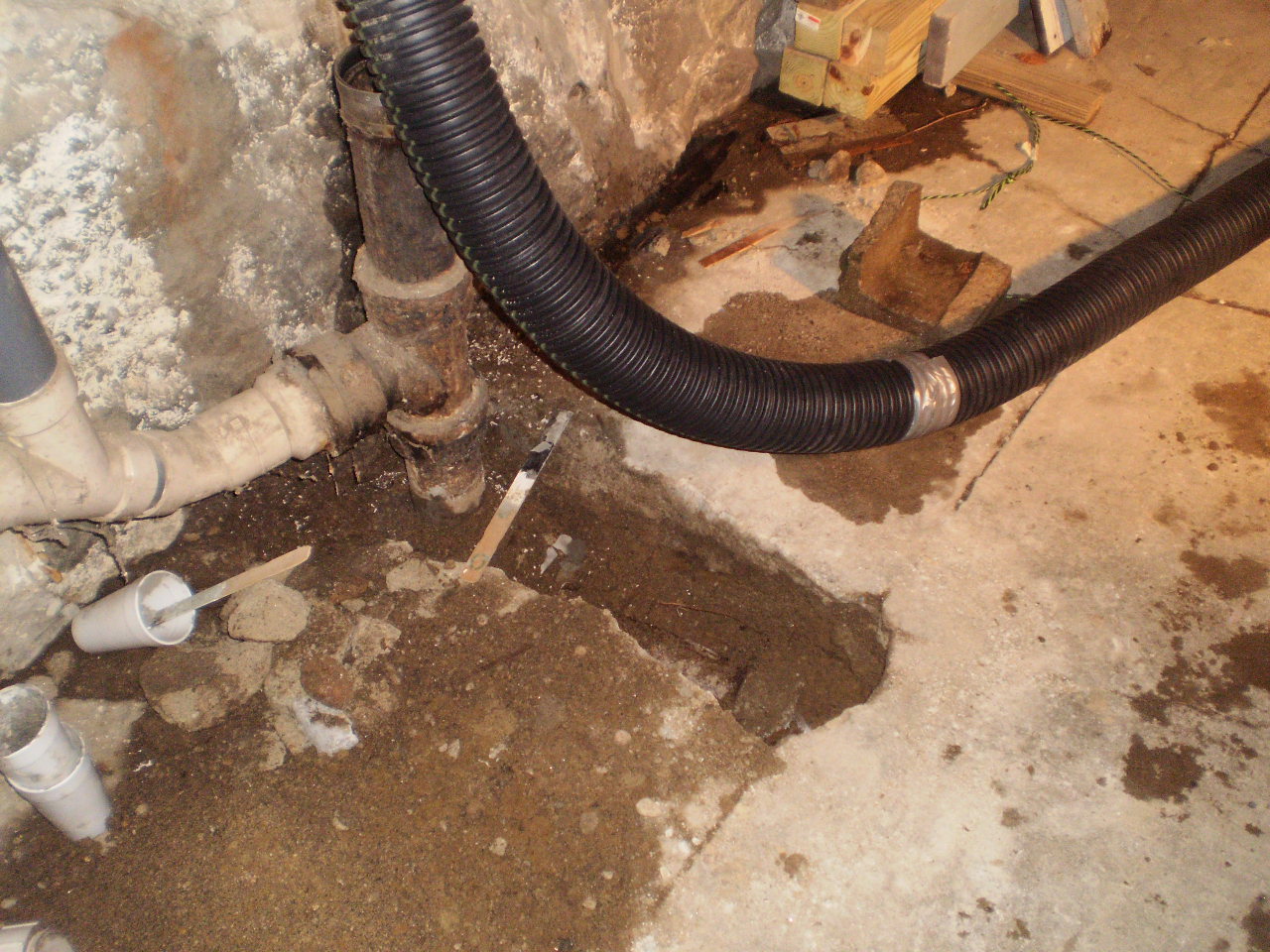
There was a patch in the floor around the 4-inch cast-iron DWV pipe as it entered the floor, because everything in my house has always been broken forever. I took a big, pointed pry bar and whacked at the seam between the ancient patch and the ancient-er concrete floor. Officially, I was breaking the floor, but in reality, I was drilling a little hole. Once I got a dent big enough to lever at it, the pry bar pulled up a palm-sized chunk of concrete. We’re off to the races, son. Hit the concrete a few inches in from the hole, and it will shear off and fall away into the gap. The gap will get inexorably larger, and it will get easier and easier to work the edge. The same technique is used in blasting, which I’ve supervised a little. You shear things off next to a hole, you don’t pulverize it in place if you can avoid it.
It only took a few minutes of pounding to clear the 1′ x 3′ patch. It was easy digging in the soil underneath it, and we exposed the sewer line under the floor. It was only about a foot or a foot-and-a-half deep. Outside the house, the ground slopes steeply, and giant spruce trees mark the property line just ten feet or so from the house. The soil is piled high along the granite block foundation walls, so a foot deep measurement inside would be around four or five feet below ground outside, which makes sense. I got a good look at the pipe in the floor directly under the vertical DWV pipe. It was a “tee.”
That’s bad plumbing, I thought. That’s a bad way to dump waste — in a pile at the bottom of the stink pipe. I’d already tried to snake the drain, but I couldn’t get it to make the turn towards the outside of the house. I could make it turn and go the other way up the crazy abandoned sink pipe, but I ran out of snake before I hit anything. I couldn’t tell what was going on until I dug up the sewer and looked at it.
The sewer pipe in the ground looked like cast iron, but so what. It was dark and shiny and had letters embossed on it. Then I noticed the hub on the Tee fitting, the one that accepted the vertical cast iron pipe coming straight down through the house. It was broken. It’s hard to break cast iron. I picked up the pieces. It was pottery, not iron.
We instructed everyone above grade to avoid running any water, and we took apart the DWV pipe. The polyglot pipe patches make that easy. There were several rubber fittings that rely on clamping rings that are easily undone. Now I could finagle things directly into the horizontal pipe that runs underground. I put the metal snake into the pipe heading towards the outside wall, and it ran into resistance after less than a foot. When I pulled it out, there were bits of tree roots on the spike on the end. The tee was already broken, and would have to be replaced in any case, so I could do what I pleased with it. I took the six-foot-iron bar and jammed it in there, and wiggled it. My son tried it too, and described the sensation as trying to shove a spike through a soggy hardcover book. You could push the rod if you used a little muscle, but it was met with constant, soft resistance.
Now you have all the facts in front of you. You have all the clues a person could need. I’m certain they’re all the clues you need because they’re all I needed to figure out what was wrong. I’ve gotten a lot of advice over the last week about how I should proceed. So here’s your big chance. Tell me in the comments why my sewer wouldn’t work, and how to fix it. I’ll let you know if you’re right.
[to be continued]

Recent Comments