BTDT
CMIIW but FWIW a FOAF told me L337 speak is OFN, w00t
CMIIW but FWIW a FOAF told me L337 speak is OFN, w00t
It’s hard to make it look easy. You can always tell when someone’s worked hard to make it look easy, because in the middle of making it look easy they make a phony gesture that they’re flagging a bit, and then take it up a notch.
.jpg)
“He’s coming here to collect!”
Tom Chippendale knew his good lady wife was prone to fits of panic. But if he heard one more word about the butcher’s bill being unpaid, he promised himself he’d head to the inn for a dram or ten. The woman had no faith in him, is all. He always managed to bring home the bacon in the nick, didn’t he? And the tea table he had made for the Prince of Wales- that would cover the butcher’s bill, and ten others. And the daft woman wants to give it to Annabelle, the butcher’s wife, for a measly three months back debt!
“The Prince don’t pay!” she’d screeched, not understanding that a man in the prince’s position cannot be DUNNED, for the love of the Savior! The Chippendales would get their money by and by, he replied.
“By and by!” she shrieked like a jackdaw. “We’ll need a joint of beef a damn sight sooner than by and by!”
“Oh, what would a butcher’s wife do with the table anyway?” he mused aloud. “Made for royalty from the finest Santo Domingo mahogany, for the future king of England’s… well, ahem, the woman he… the fine lady… his… his… ”
“His konkabine!” she erupted again. “Well, if you owes her ‘usband tuppence, Annabelle puts on airs like the queen of Araby, she does! She’ll know right what to do with it!” she added with a snort.
But he was adamant. He waved his hand with a flourish and banished his wife from the drawing room.
He paused to compose himself and listened to the mantel clock tick solemnly for a few moments. He heard footfalls outside, and then a sharp rap at the door. He opened it. There stood the butcher, looking like he had a toothache, and behind him, blotting out the sun, was the constable, looking like he hadn’t heard a good joke in ten years.
“Good… good after… after… noon,” he stammered, feeling a bit lightheaded, and a little on his heels. “We were? I mean… my wife and I were just… what I meant to say is…” The butcher’s expression began to look like it had been carved from stone by a lost tribe, to frighten tomb-raiders. The constable assumed the expression of a man with a pebble in his shoe.
But then Tom’s world swam back into focus, a smile blossomed again on his face, and he stretched out his hand and offered- “Come in, come in. Would you like some TEA?”
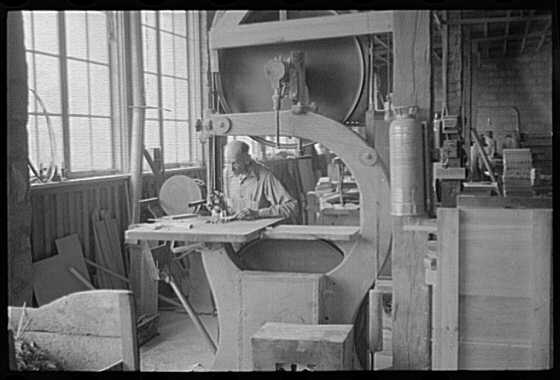 I realize that it’s not readily apparent from reading my paeans to seventies pop musicians, but I make furniture. It’s a tangible art, like architecture, and has certain limitations, which to me make it more interesting.
You see, art isn’t supposed to have limitations any more. Limitations are considered stultifying and constricting — square. And so we have stories that tell you nothing — comic books are now graphic novels; movies are just a bunch of stuff that happened, with explosions and murders to hold your attention; television is nothing more than a catalog of human discontents; the painting world has decided to hang the dropcloths on the wall; and the man on the corner muttering to himself isn’t a bum any more, he’s a performance artist.
But it’s the limitations that define the accomplishment. If your only limitation is your own mind, then you easily slip into the most constricting of modes: I’ll shock everybody! I’ll say doody poopy! at a funeral. I’ll wear my underwear on the outside of my clothes. I’ll eat the paint and puke it on the canvas. There will be religious icons smeared with bathroom offal, oh yeah. I will scream singsong expletives at a volume that will make the microphone superfluous –in a love song.
Yawn. If your approach is simply a sort of artistic palindrome — by that I mean you just do the opposite of the people you consider squares, you’re just as square as they are, but you’ve added another layer of being derivative; that’s it.
Furniture shouldn’t be a kind of joke. It has to function in the real world. There is an enormous industry of Art Furniture loose in the world. They make furniture that looks hostile — and is– or alternately, looks supple and sinuous, but hurts your butt endlessly anyway. The entire industry seems to be entirely made up of both producers and consumers trying desperately to empty out their trust funds. It is a closed circuit, however; the money keeps going around and around, never achieving the thrust necessary to escape the gravitational pull of the atelier. They all wear funny glasses however, maybe that’s where the real money is to be made. But I’m not an optometrist.
But the “citizen soldier” of the tangible arts is hard to find too. If you are unaffected by the urge to call yourself an artiste, you are likely prone to making gun cabinets out of nasty stringy oak and stained early american; nothing stylish please. So they’re of doubtful utility too. When I visit the furniture stores, where real people shop for things to plop their butt on, the utmost facet of the design process always seems too prominent to me: the furniture has pastiche postmodern affectations of a certain style, or several styles mixed together, but the overriding concern with the needs of the factory not the user shape the furniture to the point where it looks more like the box furniture should come in than the furniture itself. And for all these reasons, people like me plug away at making things that aren’t a sort of thing, they are the thing itself.
It wasn’t always this way. Pattern books were published by the directors of furniture making shops, outlining their approach, along with copious examples of what they were doing. Proportion, style, method of construction –it was all there, and even if you didn’t read very well, you could take the measurements right off the drawing and get to work. I still have and use many of these pattern books, written by men whose names you instantly recognize: Hepplewhite, Chippendale, Sheraton, Stickley. You can learn a lot by pawing through architectural books by the likes of Vitruvius and Palladio too. The aforementioned furniture designers certainly did.
I stick to Vitruvius’ three legged stool of design elements, the three things that must be satisfied if you are going to make a piece of furniture that’s a success: Commodity, Firmness, and Delight.
By that he means: ask yourself: Is it comfortable enough, is it strong enough, is it beautiful enough?
One leg of this “stool,” sometimes two, is missing from your average piece of furniture. In the Art Furniture world, occasionally someone hits the trifecta and misses wide of the mark and mucks up all three aspects. He or she usually gets showered with awards and has really unusual frames on their glasses. Someone that lives in a Corbusier house writes them a big fat check, and the circle of trust fund life is unbroken.
As you no doubt remember, I’ve already explained to you that I’ve seen the greatest view in the world.
I hate to brag…
Hey, stop your snickering.
Anyway, I hate to brag, but I’ve now also seen the second greatest view in the world. And this is it:
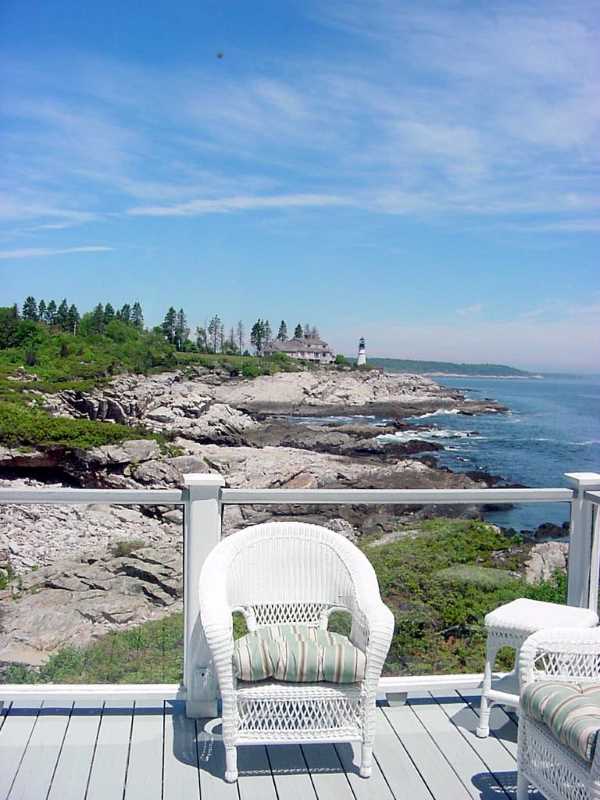
That’s not actually it, but it’s the photo I took to give you the general idea.
You see, I was socializing. I very rarely get to do that. When the opportunity to socialize is offered, you must take it and not waste it by transcribing it for posterity. That concept is not settled now, and people have yet to adapt to the fairly recent capability to record everything digitally.
We attended a party for our lovely niece, who graduated from high school in a town near Portland, Maine. Since we did not get a chance to attend the ceremony itself, we were lucky that her dear old dad had photographed the whole thing, and could plug the camera right into the television and show it to all of us.
It occurred to me that every person who attended the ceremony did that. Everyone records everything now. It’s fantastic and terrifying. We’ve become an enormous press corp following ourselves around. We’re nervously checking for messages on our phones, taking digital pictures and movies all the time. I think it needs more rumination over the effects it has on our participation in anything. You do not fully participate in anything if you’re recording it. And you do not act the same way with a recording device pointed at you.
I think my brother-in-law enjoyed watching his daughter’s graduation more as images of it passed by on the television than he did when he was there, because he was busy making a series of digital artifacts of it while it was going on. It wasn’t real for him until it was on TV, because he could just look at it and see his daughter get her sheepskin.
The TV points a camera at everything and everybody now. When there’s a TV show following the exterminator around, we’ve come to the end to the ennui road, unless they start filming toll booth operators. But reality ain’t real, really; I’ve worked every kind of construction, and believe me if you watch HGTV you have no idea what those people act like when the camera is off. You don’t want to know. Artifice always enters the equation.
It is an important milestone in a person’s life to graduate from high school. My niece is lucky that her father thought enough of her, and it, to remove some of the passive pleasure in it and replace it with the active commemoration of it. Someone has to cook, so that all may eat.
But what if we are all cooks, but no one is hungry, and we’ve forgotten the recipe we were making anyway?
We visited afterwards with an old friend that we’d lost touch with. It was marvelous to see her, and meet her husband, and get a tour of their house. They live on a spit of granite running right into the waves in Cape Elizabeth. That’s the famous Portland Head light there in the background.
Their house was built in around World War I, a period lasting ’til the depression when the most best houses were built in the United States. And unlike a modern version of this house, it didn’t just gape at the ocean through banks of the worst window and the worst door combined –the slider; instead there was a series of framed views, one after another, dizzying in their variety, and ephemeral because they would wink out as you passed by them and went on to the next one. Inexorably, you’d be led on until you stood right on the granite doorstep of the mighty Atlantic Ocean just steps outside the house, and have the Earth and sky revealed to you like the denouement of a play– instead of a combination of a hammer to the senses and a kind of overwhelming wallpaper.
I’m in the recording business here. I’m supposed to take pictures and show them to you. But I’m only human. I enjoyed the company instead, and walked through the house like a guest and a friend and a human, and refused to do my duty instead and record it all for you.
I could lie to you and tell you I forget the camera in the car, or the battery in it was dead. But I can’t lie, because I went to Catholic School what seems like a century ago and I’m still afraid of the nuns. I left it in the car on purpose because I’m selfish and polite. I was not visiting goldfish. In a weak moment, I ran back and took one or two.
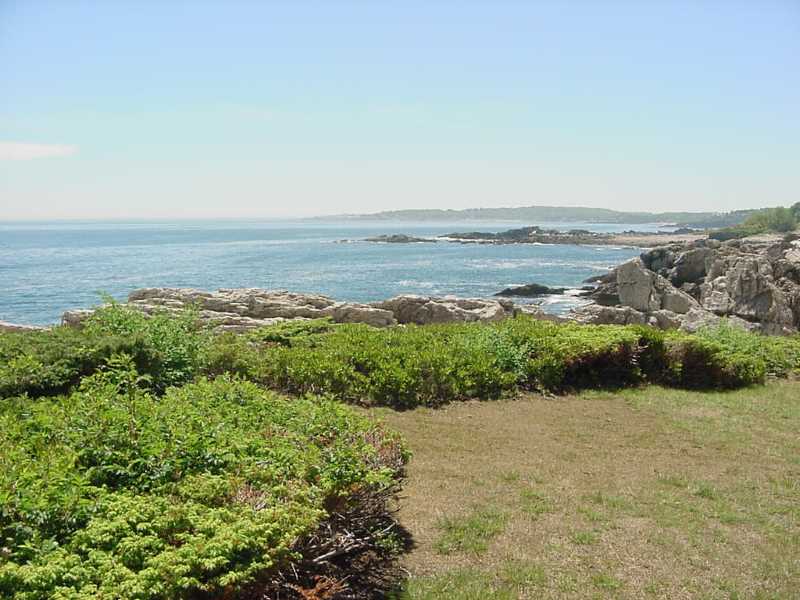
Friends are better than pictures.

Recent Comments