Erroll Garner playing Lorenz and Hart, and Rodgers and Hammerstein, and Rodgers and Hart, I think. That’s what the credits say, but who writes the credits? Before my time.
I always hated Broadway. Right in the middle of a play, people would burst out in song. The better the play part, the more bizarre the musical interlude would seem to me. I could never get over the idea that people don’t act like that in real life.
What a jackass I’ve always been, and always will remain, I’m afraid. But I learn.
Delmer Wilson is a haunt. He is over my shoulder now.
One reads the House of the Seven Gables in grade school. Oops. I meant one used to. You read Harry Potter now. I will leave it to you to decide which is preferable. But you must for a moment try to understand a reverie.
–noun 1. a state of dreamy meditation or fanciful musing: lost in reverie. 2. a daydream. 3. a fantastic, visionary, or impractical idea: reveries that will never come to fruition. 4. Music. an instrumental composition of a vague and dreamy character.
Almost all those words in that definition have been debased in common usage. I’ve noticed that the average educated person’s use of language is a shadow of what I was accustomed to in years past. I rarely see people use language elegantly and precisely any more. I include myself in that, generally. Maybe it’s all the typing and television; I don’t know. The average person has become more highly skilled in jocularity and a kind of direct hammer-blow speech, but doesn’t seem to be able to express themselves with any subtlety or have much of an ability to parse fine shades of meaning from what they are reading or hearing. Many are easily manipulated by those who know how the language works. They glean a false impression. In many cases, the false impression is deliberate. Anyone who has watched an infomercial knows what I’m talking about.
Daydreaming did not used to mean “goofing off in your cubicle.” The word “fantastic” wasn’t simply a sportscaster with a limited vocabulary barking out something that sounds superlative to his tin ear. “Meditation” did not used to infer a period of quiet and intense narcissistic self-absorption shoehorned between frantic periods of yammering into a cellphone. And “visionary” was a serious word once, and not associated with people who make Heavy Metal music videos.
Delmer Wilson would have understood a reverie. His life was like that. Like a monk on a pile of rocks in the angry Atlantic, scratching illuminated texts of the only knowledge left in the world while barbarism raged all around, Delmer knew the solitary room of the mind where you go to see around a corner not visible to other men. Your hands are doing familiar work, and your surroundings are peaceful. There is light and space and an endless supply of just one more thing. You have visions. Inspiration. Quiet contemplation.
Delmer got me to thinking. The machine hums and the silky baulks of wood slide through my fingers. The sounds are all quotidian. Nothing to make the animal brainstem react and put you on edge. You think of Delmer. What makes a man turn his shoulder to his own mother, and stay where he is?
The Internet tide brought in some lovely things yesterday.
I spoke of Delmer, the noble Shaker Brother. There is a tightrope aspect to my scribblings, because I am generally writing straight out of my head, and memory is an imperfect thing. While I’m not exactly General Motors in the hypertext world, enough people see what I write so that if I make an egregious error, I will be found out. After all, people dispute with me occasionally over matters of which I have first-hand knowledge, so I know second-hand knowledge is fraught with peril. I was once scolded by another Internet scribbler that I had no idea what I was talking about regarding an obscure but noteworthy musician. The scribbler had made a sort of study of the personage amid the bookstacks of academe. He asked me, in a flurry of expletives, how I came up with such a crazy formulation of the workings of the mind of the object of his affections.
I told him the fellow had told me that directly while I was working with him.
So I wrote of Delmer, and K2 showed up in the comments and had an actual remembrance of him:
I lived with the Maine Shakers in the winter of 2006/2007, and Sister Frances Carr remembers Br. Delmer Wilson very well. I use to ask her lots of questions about him. She would tell you that he was an old-fashioned Shaker; straight-laced and upright. Even during his last days, he would not allow the Sisters to respond to his final needs. Brother Ted Johnson slept on the floor of his bedroom and attended to Br. Delmer in his last days. During Br. Delmer’s life, he made not only wonderful boxes, but other wooden items. The tables we eat at in the dining room were made by Br. Delmer. (He’s still a very important part of daily life at the village.) He drove the Village’s first car, took fabulous photos, was a first-rate orchard overseer, built a wonderful cabin on Sabbathday Lake, could fix anything broken, and was generally a well-rounded person in mind, body, and spirit. He didn’t like waste, however, and would not have been happy having any of his work spoiled by lack of care. This was a man who would call the Sisters to his side of the dining room to remove toast crumbs from the butter before he would take it. Lack of care in all things was not his style. He was, truly, an old-fashioned Shaker. His influence is still much felt throughout the Village today. He passed, by the way, from this life, in 1961.
I was alive in 1961, too.
Delmer had got me to thinking, and I had decided to search him out as best I could, and write about him today. But my work was half done before it began, thanks to K2.
Sabbathday Lake in Maine is one of the Shaker communities I study. There is Mount Lebanon,NY, which gave a name to this table I make. There is Watervliet and Groveland, also in NY. Harvard and Hancock, Mass. Enfield, CT. Union Village in Ohio, who made me think of their neighbors buying this from them. Kentucky had a village.
I found Delmer’s picture in the book I told you about, just as I remembered it. I refuse to break the spine on a $150 book to scan it for you. But the Internet is our friend here. The Maine Memory Network has some Delmer. It’s piquant that Delmer took most of the Shaker pictures featured there, too. A polymath pilgrim, my ghostly friend Delmer is:
That’s Delmer Wilson on the left. I believe the man seated is his brother, in addition to being his Shaker Brother. Delmer’s mother left her sons at the Shaker Community when they were small. People don’t associate the Shakers with children because of their celibacy, but they would take in whole families, or orphans, or foundlings. They made lots of cradles and little furniture for little people, and not just for “The World,” the term many used for people who were not Shakers.
Delmer’s mother came back years later to get her her boys, and Delmer refused to go. What did a world that abandoned him have to offer? He lived his whole life as a Shaker.
Delmer was highly respected by his peers. I speak from time to time of the grudging respect of men in the ditch for one another if you pull your own weight. There are always a few that command a sort of respect that approaches awe among their contemporaries. It’s not just an old fashioned ideal. People who work in trades still are like this. Bulldozer or block plane; makes no difference. Unlike intellectual pursuits, your credentials mean zero. If I told an academic I had a Doctorate from Harvard I would be accorded immediate respect. If I was placed in charge of men pushing dirt around, and I reached for a pointed shovel to spread processed gravel around instead of a square shovel, I’d be immediately chided and scorned by persons I had the authority to fire on a whim. They are not afraid. Only afraid to let down their mates. Anyone in the military knows what I’m talking about, too.
There’s all this talk about walking the walk. To be a Shaker was to walk the walk. Delmer Wilson inspired respect among people who did not bestow such regard lightly. That is a kind of awe, isn’t it?
Our Internet friend Ruth Anne Adams wonders if I could make Delmer’s box for her. I’ve made things for her lovely family before. It gives me great pleasure to send my trifles out into the world to serve and perhaps to give a sort of enjoyment. I do know how to make Delmer’s box, though I have never made one. It’s not a complicated thing to make. But it is a very complicated thing, indeed, to make even a simple thing that approaches perfection.
I am grateful that there are people in the world that picture a person like Delmer and somehow see me. It is entirely unmerited. But we are all vain, and I am no exception. I have occasionally won the respect of those like Delmer, who think I’m a fool, but willing. It is enough.
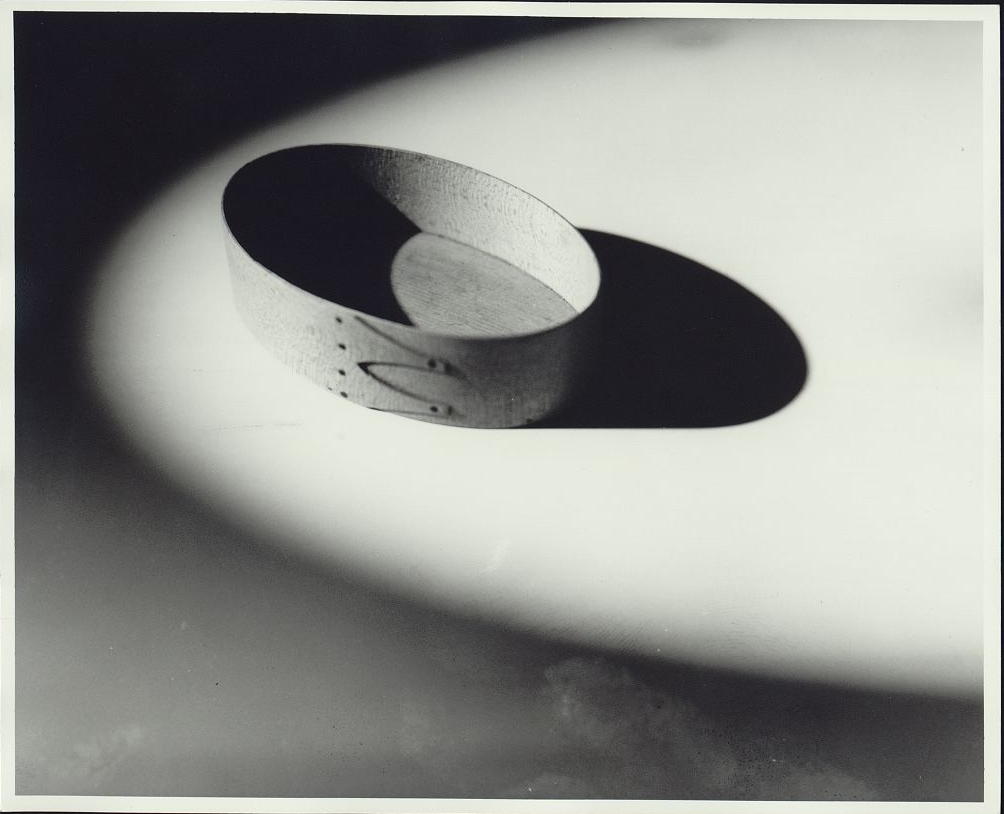
The most expensive Shaker handiwork I’ve ever seen is one of these boxes. I look at the auction records for Shaker items from time to time, and I see their magnificent sewing tables and desks going for real money, as collecting the items has gone to its logical conclusion and only museums and the hardcore speculator can afford most of the genuine big articles.
I found an example of two small boxes like the one pictured, with their lids, that were auctioned in 2003. They are a very bright yellow. Shaker items are often assumed to be from a sort of rich but drab palette of colors, but most of that is because of the passage of time. They were routinely painted screaming yellow and lipstick red and a really jazzy salmon color, among others, but they fade to more sedate hues.
The two small boxes? $42,250. No, really. $42,250. But that’s just one. The other was $34,500.
There’s a handsome Shaker cupboard in the same auction report. Five drawers below with two big doors above. It looks like it’s made of cherry. It’s really big, really fine, in excellent shape as far as you can tell from the picture, and went for $12,500. Why so much for the little box?
Because it’s perfect, and sublime. When you can make an art photograph out of your object, you’re generally on to something.
I have lots of books about Shakers. In one, there’s a fellow named Delmer. Can’t recall his last name. He’s in Maine, and he’s making those boxes about a hundred years ago. He’s standing in front of a pile of them that goes up to the ceiling behind him. He’s in a barn, not a mobile home, so “up to the ceiling” means something.
The boxes were utilitarian. They were for a humdrum purpose. And Delmer made them over and over, and tried to make every one perfect. He hurled thousands of them into the maw of the world, which used them and wasted them or lost them or whatever happened to them all in the intervening years. And there were hundreds of Delmers.
Now they are precious. They are rare because there were so many and they were so cheap there was no reason to save them. And they are fantastically prized for their rarity. But there’s something more; lots of ugly things are rare.
If you woke Delmer up from his eternal slumber, and lied to him and told him they were all lost, and so no one could testify to the effort and care and art and mystery he put into them, I bet he wouldn’t care a whit. I doubt he would have changed a thing. He tried to make a perfect thing in his human and imperfect way, and gave it over to a very imperfect world.
I’d like to tell him just how close he got to the sun. But I am not that nice a person, really. I’d have an ulterior motive to give him his posthumous attaboy. I’d ask him what the warmth of that faraway orb felt like on his face; because how many of us will ever know the sensation?
Month: April 2008
sippicancottage
A Man Who Has Nothing In Particular To Recommend Him Discusses All Sorts of Subjects at Random as Though He Knew Everything.



Recent Comments