The Ash Pits of Hades
We have a tradition here at the Sippican Cottage. And the tradition has been born and tweaked and upheld for over a decade now, and has offered me a perspective on what tradition really means, if only in a small way.

Neither my wife or I had any idea what to do in a garden when we were first presented with the miserable patch of ground outside our exurban door. Our childhood experience was suburban, but our families, like most suburban families of the last generation, were essentially of the urban mindset, if not location. They moved from third floor walkups to suburban ranches, but there was more than a little bit of the rented flat about them forever.

My own father was not a gardener, by any stretch. He mowed the patches of wan green in between the vast stretches of brown on our lawn like a good citizen, but that’s as far as it went. He always had the air about him of a man who should have a newspaper and a pot of tea on a table surrounded by cobblestones — he’s no farmer.

My mother is much more adept in the garden, but I got none of it. There was always something of the urban in her gardening too; more windowbox gaudy than sedate pastoral charm. I was of no use to her as a child, and only learned the simplest things about planting: mix dung and peat in the hole and water it. It was enough, in a way.

I read a lot of gardening books. Some were very serious. You can tell a serious gardening book; it doesn’t have any pictures.

The mass of books I looked at, the ones with nothing but pictures, had the whiff of the fast food restaurant to them. The old advice: “If the menu has pictures of the food on it, it’s not likely to be haute cuisine” applies to gardening as well.

There’s a kind of cognitive dissonance to most gardening in the suburbs, because the whole layout of the houses and the surroundings is flawed, generally, and the visual confusion it engenders leads to a kind of Home Depot delirium tremens in landscape design as well. The home might be put on a kind of country manor house lot, but looks like an urban design, or a home that belongs in a desert is stuck in a jungle, and so forth. Fill in your own stucco nightmare here. A sort of incoherence seeps into the proceedings, garden included.

We’ve murdered enough plants to get Gaia knocking on our door with a mob of woodland nymphs with pitchforks and torchs, while we tried to figure out what to do, where. But while we are not born wise, we learn — if haltingly — what works, and what looks appropriate, and what helps to blur the distinction between in and out, and porch and lawn, and lawn and woods, and woods and world. Just between you and me, the books without the pictures help some, but the beating the world gives you trying desperately to grow things is the real education. I’d skip the Feng Shui picture books altogether, if I were you.

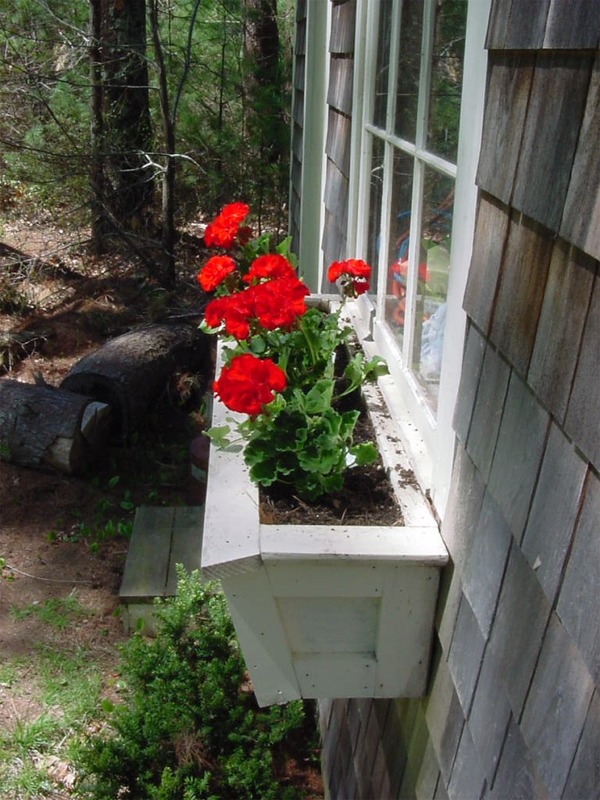
So every year, we put the geraniums in the pots on the front step, and in the window box on the shed, with some vinca vine to trail down and wave hello in the breeze a bit. We divide the hostas and put them around the yard, in the shade, here and there. We tend to the rhododendrons and barberrys we had the presence of mind to plant in the right place a decade ago, getting dividends we earned the hard way which almost banish the cruel thoughts of all those shrubs that did not survive an immediate razoring to the ground by hungry deer. We mow the grass in gentle curves, as nature intended, not laid out as if by laser like a farm plot. We hang a few dipladenias outside windows we want hummingbirds to favor, and we steal the tall phloxes’ freeseeded progeny and the bottomless well of pachysandra one plant provides, and we know it will work, and we know how to work it. We caress the lamb’s ear to remind it to carry on. We leave great swaths of our property wild, and only clean out the buffer between, a little, to provide the transition.

Tradition is a kind of faith; you trust it will work because you trust it will work. I bet many traditions, like ours, are born every day. Sometimes you wish that someone could have told you what to do, instead of having to figure it out yourself; but would you have listened anyway, if the book did not have pictures?

Hope

I forgot who it was. Friend of my wife, I think. My wife came home from work one day, the long slog up the highway and back over, a few shekels in her pocket, a slight aureole of weariness glowing around her, and handed me one of those nasty plastic pouches that have replaced paper bags at the supermarket. In it was an awful, dirty, watery fistful of hosta, given to her by one of her coworkers. It looked exactly like some half masticated frond a stegosaur might have spit out over some perceived unwholesomeness. It was too muddy to throw away, so I planted it.

I planted it with all the hope for resurrection I had when I planted the poor cat out by the swamp when she had strayed too close to the road and broken our hearts. That is to say: none. The hosta was nothing to me, but where else would I put it, but in the ground?

Of course it grew, because we left it alone and didn’t care about it. I’ve divided that hosta four times or so in the last eight years. Our yard is very shady, and there always seems to be one more spot that could benefit from its variegated if everyday charms. There’s a period in the summer when the long delicate stalks appear like magic from the center of the plant, and wave their delicate bell shaped flowers to the breezes, causing the hummingbirds to favor our yard like an Alfred Hitchcock/Doctor Seuss hybrid project. We croak the bird book, looking for the correct term for all those little irridescent wonders. Flock?Swarm? Gaggle? Herd? Pod? A murder of hummingbirds? We’re the only people who get them like this I guess, and so we’ll have to coin the term:

An unentitlement of hummingbirds.

More Housepainting

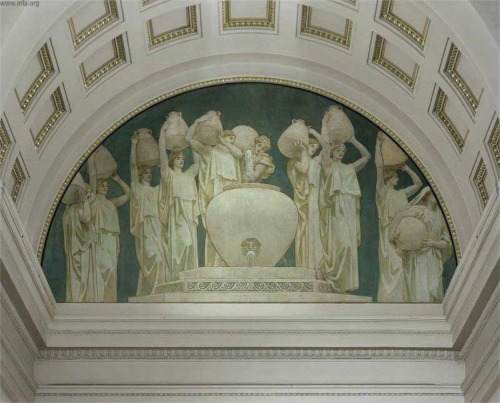
Here’s another housepainter of note. John Singer Sargent. The “house” is the magnificent Museum of Fine Arts in Boston. John Singer Sargent is the Greatest. Painter. Ever.

Of course art is not a competition, or shouldn’t be. American Idol and throwing people off an island one by one is about the process, not the end result, after all. The world is no smaller or crabbier if I tell you I saw Michaelangelo’s and DaVinci’s and Sargent’s daubs, a foot from my face, and it’s Sargent hands down for me. The rest don’t go on the bonfire after such a statement, I just look at them in a different order. Picasso shows up later on that same list, right after all of my children’s efforts, and several of my dropcloths.

Anyway, Sargent, like many of his brethren, got the urge to eschew the canvas altogether, and just start painting on the walls behind them. It’s a different animal, and he approached it differently than his other work. He painted this, on a tympanum above a doorway at the MFA, around 1920. It’s marvelous.

Well, AIN’T IT?

Sorry. You’re entitled to your own opinion about it, of course. It’s just that, if it differs from mine I don’t want to hear it.

Lots of people didn’t like this particularly when he painted it, along with a few acres of additional plaster at the MFA. They all sound like stooges now; Sargent sleeps serene.

It’s in what would be called Neo-Classical form, and some called Neo-Wedgewood eclectic, because of the chaste color schemes and themes, no doubt. It’s a testament to the train wreck in the art world that was going on at the time that those were hurled at him like epithets.

The Danaides is the theme. They are a Greek allegory, whose story is variously told. They were the fifty daughters of a king, ordered to marry the fifty sons of the king’s brother. Woody Allen doesn’t have anything on the ancient Greeks, does he? At any rate, they agreed to wed their cousins, while conspiring to murder them on their marriage bed. Only one of the brides declined to kill her spouse, as he was the only one to decline his marriage prerogatives.

The Danaides were consigned to Hades, and as their punishment, they were made to try to fill a vessel with water, but the vessel had holes in the bottom, and their chore could never be completed. The thankless task is a recurring theme with those crazy Pelopponesians, isn’t it?

Sargent knew what he was doing. That which we call art, or sophistication, or civilization, is the continous attempt to fill a bottomless well. You must strive always, or the urn will be quickly emptied. This artist is acknowledging perhaps that his work, no matter how famous or well regarded, is ephemeral; and that the process of trying to capture the beautiful, or the important, or the sublime, and hold it up like a roadmap — or better, a mirror — must always press forward, lest we slide backwards. There is no point of stability between barbarism or civilization; it’s just a matter of which way we are heading.

Sargent was cursed to pour it, over and over again, into our urn. We are grateful for the water, for as long as it lasts.

Month: May 2006

Find Stuff:

Archives