Again With Naperville

Well, some outfit named Relocate-America.com has a list of the best places in the country to live, and I’d link to it for you, but lists like these bring massive web traffic and make people with everyday servers powered by arthritic gerbils reach warp speed right quick, and I can’t even get to their home page. No matter; I’ll spoil it for you right now: They say Naperville, Illinois is the best place in America to live. I could have told you that.

As a matter of fact I did, a year ago, in the “What’s New” page on my furniture website. Now, CNN/Money had Naperville on their list last year in third place, But I guess Moorestown, NJ and Barrington RI are experiencing a plague or something; either that or Relocate-America made a mistake when they cut and pasted CNN/Money’s list while they were stealing it, trying to weasel some of their publicity. I’ll say one thing for CNN/Money; when they go looking for free publicity, their servers work.

There’ s nothing I like better than being right in advance, and getting to recycle old adjectives. Here’s a reprint; enjoy–

July 13th 2005-

You know me pretty well by now. You know I can’t leave this “Best Places to Live 2005” thing from CNN/Money alone. I’ve got to crawl underneath it, check the hoses, look for hidden rust and concealed damaged, and maybe loosen the oil drain plug a little before I come back from under there, just for mischief’s sake.

I’m not alone in this, I see. I’ve seen this thing referenced all over the web, and I’m sure that’s why CNN/Money goes to the effort of rating places to live and then hunkering down under their desks in anticipation of people disagreeing with their findings and throwing crockery.

My favorite item from the horde, perhaps, is this: “Pa. Town On ‘Best Towns’ List Does Not Exist.” Apparently, Wexford, Pennsylvania is simply a Post Office designation for areas of four suburbs of Pittsburgh. There’ s no such place, as it were. I will leave the effect of its non-existence on its suitability as a place to live up to the reader. I expect it’s a terrific place for you to live with your imaginary friends from preschool. What’s that? You had real friends in preschool? Well, get off the internet right now, this is a place for lonely shut-ins, not you. I also expect that despite the fact that the town doesn’t exist, you’ll still end up in jail if you don’t pay your property tax to somebody.

I noticed Barrington, RI, is number six on the list. That’s a short drive from where we are in Marion, Massachusetts, and that seaside town looks a lot like ours. I’ve got no beef with that one.

It’s number three that really caught my eye, though. Naperville, Illinois. I was in Naperville two months ago. I have friends in Naperville, who moved there from Marion. A few years back, I directed the construction of two big service stations on the tollway there as well. Well, my friends took CNN/Money’s advice, before CNN/Money even offered it, and moved to Naperville. And I’m in a position to tell if they’ve lost their minds, or lucked out.

Naperville is as far outside Chicago as Marion is outside Boston. Chicago is a great city. I’m not using “great” in the fashion of modern parlance, you know, swell, or nice, although it is a swell and nice city. I mean Chicago is a big, important city. I knew a lot about Chicago before I ever set foot in it, because I study architecture, and Chicago might be the most important architectural city in America. Louis Sullivan invented skyscrapers there. Frank Lloyd Wright annoyed the locals in Oak Park for a while, before spraying architecture all over the map, from Tokyo to Iraq and back. There are a lot of well known and notable buildings in Chicago. Boston is a great city, too, but it’s very insular and small compared to a place like Chicago. Hell, there’s only about 600,000 people living in all of what’s called Greater Boston, which includes lots of suburbs. There’s 130,000 people living in Naperville, never mind Chicago. Chicago is a big, booming, jostling, lively, friendly place. Even the panhandlers are polite. In Boston, even the beggars have a ‘tude.

Well my friends have been in Naperville for a little while, and have meshed into the life there fully, and showed us around. They’re not strangers to the midwest, and there’s no fish out of water or Green Acres vibe to their story. They liked Chicago, and they sold their tiny house in Marion and bought an enormous home in Naperville, with money left over. They live on a quiet street, with neighbors who all share their approximate worldview, which is more important than many people think. Variety is not always the spice of life, and if you must get up to go to work at 6:00 AM, and your neighbor is hosting MTV video type parties outside your window every night, neither of you is going to be happy. He’ll be dead, and you’ll be in jail for killing him, or vice versa, eventually.

Variety isn’t even always variety, now that I think about it. The guy annoying you next door might just be a jerk, but he might not even be an exotic jerk. And I often find myself more in tune with people who don’t look much like me, at least as far as the census takers think. America, thank god, has always been a place where you left tribalism at the door, and coalesced into communities and institutions voluntarily, with people whose company you enjoyed. And everyone seems to be enjoying each other’s company in Naperville.

Naperville had a very important story to tell city planners as well. The story is: mind your own business. Naperville got as big as it did because two big highways were run right through it, and made the bustle of Chicago available to it. My friend, oh, let’s call him Mr. Smith, works in Chicago and lives in Naperville. CNN/Money had a few trite and ill advised comments on how Naperville is tainted by the big roadways filled with megastores that have sprung up next to the highways. What nonsense. Here’s their own words:

Drive for two minutes out of town in any direction and you’re likely to be sitting in traffic on an ugly highway.

Duh. It’s that “ugly” highway that makes the whole thing possible. I cringe when I hear stuff like that, and it’s everywhere, you’ve seen it too, I’m sure. The only bosh worse is seeing people in print refer to wilderness or farmland that’s “lost” to development. “Lost?” Was it ground into powder and shot into the sun? Is there a black hole where it was before?

The word they should use, and never will, is converted. But converted doesn’t have that pejorative connotation that “lost” does, and they think it’s a shame that other people, people like the Smiths, have a comfortable, convenient and safe place to live. There’s a whiff of “Let them eat cake” to the term “lost to development.” Or maybe: “I’ve got mine, and to hell with anybody else.” I disagree with the sentiment, and I don’t like cake.

By the way, farmland is never “lost” to development. Any time you want, you can buy 100 or so of those houses, bulldoze them, and plant potatoes again. What’s stopping you? What’s that you say? That would cost over $100,000,000.00 to do? Well, maybe, just maybe, the land is being used for a more cost effective and important use than growing potatoes now. You’d have to grow A LOT of potatoes to make that 100 mil back. And this may be a surprise to you folks that think we’re “losing” farmland, but out near that highway that you find so objectionable, there’s dozens of supermarkets that I imagine you find objectionable too, surrounded by parking lots that I imagine you find objectionable as well, filled with decent, hardworking, busy people that you probably find objectionable to boot, and there’s still plenty of potatoes in those supermarkets for you to buy. And everything else from kiwi fruit to bok choi. So put a sock in it.

That last paragraph made me realize it’s probably unwise to ask a guy named Sullivan about potatoes.

Where were we? Oh yes; the real story in Naperville, besides the solid and decent Mr Smith, and his vivacious and attractive wife, and his four boisterous and lovely children, is the downtown. There’s a walkway along the river, which allows you to promenade, and sit a spell, and cool yourself on a hot day by sitting in the shade, and get away from the cars, but still get to dozens and dozens of interesting places. The City of Naperville didn’t try to pass laws against big box stores and all the other big businesses people love to profess hatred for and then shop at anyway. They zoned them out by the highway, on what we used to call “the main drag” around here, away from the downtown, where the acres of asphalt for multiple lanes and parking are a blessing, not a curse, because you drive there, and Napervillians can get what they need conveniently.

And those stores did what everyone fears they would do. They wiped out the little downtown businesses that tried to complete with Wal*Mart, and Home Depot, and all the rest. But why try to compete with those places? To extend that logic further, why not grow your own food? Get water from a well? Why not write plays and perform them in your back yard instead of watching TV?

Anyway, Naperville shrugged, got on with their more convenient lives, and used their tax money, including the massive tax receipts from those big stores by the highway, to improve the infrastructure of the downtown, and blessedly didn’t try to put the area on life support.
And pillar to post, downtown Naperville is a wonder. Really good restaurants, one after another. Upscale, downscale, ethnic, coffee shops, everything; and you can walk all over, because the real traffic is out near the highway, where it belongs. Antique stores, really good bookstores, one after another. Real clothing stores, not just places with acres of drop ceilings above and linoleum below and polyester in between. Pastry, candy, toys, stuff and junk, store after store. Nightspots you might like to visit, if you could find a babysitter, and you can, because you live in a neighborhood where everybody knows each other. In short, the precise thing that every planning board, zoning board, and conservation committee in the country is trying to legislate, and never seems to achieve. And nobody’s on business welfare, and they don’t exist because they have enough pull to legislate competition out of their town. They are there only because they Naperville public likes what they offer, and patronizes them.

I could live in Naperville, and I’m fussy about where I live. I bet you could too.

But there’s no ocean. Never mind.

Look At Her Arm


One of my readers asked if I wrote often about painting. I took that to mean: Write often about painting. OK.

I don’t know where I got this painting. It’s by an American fellow named William MacGregor Paxton, I made a note of that when I found it, but I can’t find out much of anything about him, and I can’t for the life of me remember where the digital picture came from. The MFA in Boston doesn’t seem to have it. Visit it anyway, it’s got lots of other neat stuff. Paxton was born in 1869, and died in 1941. That much we know.

I rolled those dates around in my head. Can you imagine being born in the United States just after the Civil War, and breathing your last thinking that civilization as you know it was winking out all over the globe? The Ecole de Beax Arts in Paris was mentioned in the few mentions of Paxton I could find, so I imagine he could very readily picture France itself under the yoke of the Axis. Did he perish before December 1941? I don’t know. I hope he did, I guess; why die without hope? But does any man die without hope? Does any man die with hope?

Every picture I can find by Paxton is a nude woman or a flower. God bless him. What else is worth painting, when you get right down to it?

You’re likely never going to see a flattened blue lady with her nose on the side of her head written about on this page. I never can get out of my mind’s eye a vision of Picasso — young and still trying to paint like Paxton and his brethren — saying to himself: I’m no good, I’d better fool them instead. It might not be true, but I can’t imagine it any other way.

I only have one rule for professional anythings: you have to do it better than me. Not different, not necessarily faster, better. The rule applies to plumbers and artists alike.

Paxton is a realist. Realism was getiing a real bad name about the time Paxton shuffled off this mortal coil, and that might have weighed on him too. I imagine Big Band singers got the same sensation when they heard Bill Haley and the Comets. The end is near, and no one cares what I know anymore.

Artists often know things that no one else cares to know. They look in their hearts, and minds, and pull their vision of the world out and try to pin it down before it flutters off. I think the fellows that absolutely must do it would do it even if you burned the canvasses right after they finished. Haven’t you ever spoken aloud when there’s no one else around to hear it? Some things must be expressed, whether it’s because you hit your finger with a hammer or you need to show the world you know how to depict a woman.

I wouldn’t presume to guess what the circumstances depicted in the painting are. The light is strong, reflected in the mirror through the blinds (showoff!) but the light leaves her face indistinct, and Paxton doesn’t care about her face anyway. He is revelling in the way the light reflects off her outstretched arm, and the gentle convex slope of her breast and belly. He simply stopped painting her left hand; it is superfluous, and I didn’t notice how indistinct it was until I’d looked at the picture ten times. In a photograph, I’d see it clearly. It’s hard to make a photograph capture important things; it captures everything. If you’ve ever had your picture taken by a really good photographer, they spend all their time arranging the lights. The human is easy compared to the light. Tell him a joke or call him name, and then click the button.

Now her right arm, reaching into the light, sublimely rendered, the cool blue and pink of her untanned flesh, her hand reaching with her delicate fingers for her clothes, you know it now– why she’s nude and reaching for her clothes in the shuttered bright of the day.

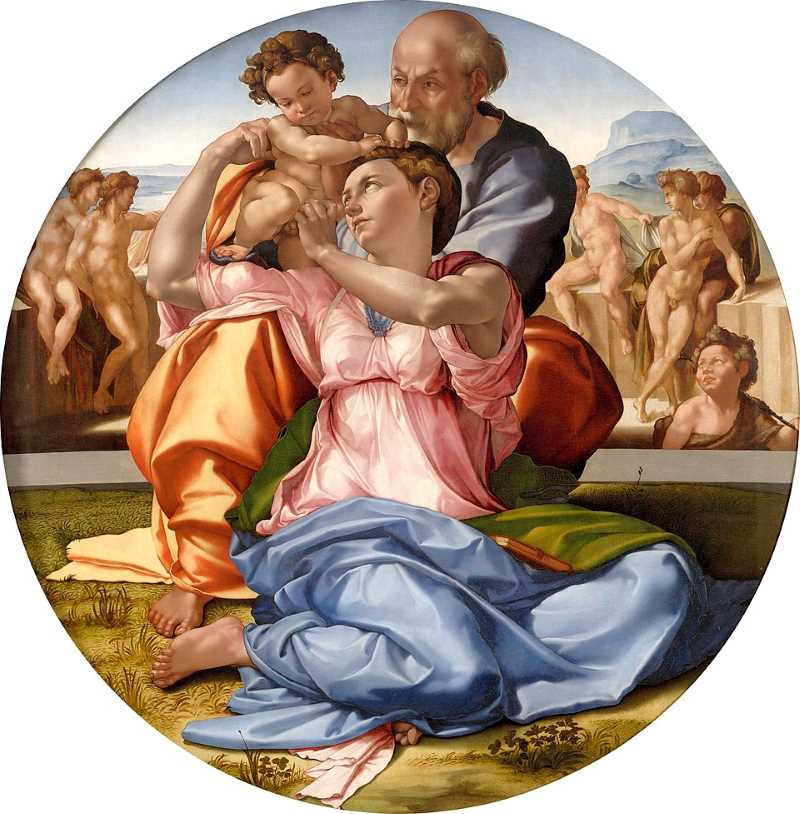
You can never really look at a painting until you see it for real, and I wish I could see this one. Pictures are great for reminding you what you’ve seen, but you need to see it to really get it. I’ve only been to Europe once. I ransacked the great Uffizi in Florence for the picture I had gazed at in a book a thousand times, but I still wasn’t ready for the effect of the real Madonna Doni, by Michaelangelo di Lodovico Buonarotti-Simoni.

I knew how the mannerists did it; how they moved their models into odd angles, contortions really sometimes, to put motion into static pose, to bring forth the musculature, to inject a kind of heroism into a simple Madonna and Child. It was Michaelangelo’s only easel painting. His patron didn’t want to pay for it. The patron eventually used the original frame to frame something else. Eventually, art critics would say the whole thing was unworthy of Michaelangelo’s effort anyway: “A Hercules at the spinning wheel.”

The composition is busy. There is a mother kneeling in the foreground, reaching over her shoulder for her baby, with her husband behind her too. They form an interesting circular racetrack for your eye to circle, and there’s all sorts of nude so and so’s loitering in the background. The Madonna is contorted, reaching over her shoulder for her baby, and it gets the ball rolling in what’s normally a very static sort of scene. And her arm comes right out of the picture. I looked at that Madonna’s arm. I was a foot from the painting. It had the most delicate line drawn around the outline, a line many artists would begin with, not end with. I had no idea how he managed it. I didn’t care how he did it. I could look at that painting forever and not be bored with it. A man understood the persons in the painting. He could make me understand what he knew, though the dust of five centuries lay atop him.

Look at Paxton’s nude’s arm. He knew. He knew how. So we could know too.

(Note: Maybe he’s not American. Maybe North American? William MacGregor Paxton sure sounds like it could be Canadian. I’m related to MacGregors in Canada, through a MacGinnis gene pool raiding party. Can anyone tell us something about Mr Paxton?)

The Unified Field Theory of Music

I don’t get the enjoyment out of music I used to. Perhaps when you are an adult, you put away childish things.

Forget that, that’s not it.

I used to make money at music. Like the cobbler’s children that go shoeless, I don’t have much interest in music when I’m not making it. Do pediatricians get home in the evening, open the door, kiss their wife and look at their children and think, “God, not another one of those!” Do veterinarians beat their dogs? I don’t know.

I listen to sports talk radio. People who remember me as a musician are agog to learn that. It’s not that I’m that interested in sports, exactly; my interest in it is more along the lines of a man visiting the zoo, while being very careful never to put his fingers in the cages. It’s just profoundly amusing to hear a guy driving a cab call up and explain how he wouldn’t run a 750-million-dollar franchise like that. He reminds the owners of the teams he follows — who aren’t listening — and his fellow sports enthusiasts — who are listening but aren’t paying attention, because the opposite of talking for them is waiting — and the hosts, who are eating cold pizza and reading the racing form with one eye on the clock and their thumb on the cough button, that if that owner doesn’t know enough to trade all his bad players to the other team for all their good players, he’s a dope.

You can listen to that, any time, all the time, if you want to. I remember when sports talk was on for 30 minutes on Sunday nights only. There was a time that the radio was a unifying force in America, as was the television. When I was lad, the television wasn’t really a novelty (mechanical dishwashers were, though) and the radio was ubiquitous.
There was a sense of shared experience about what was on television, mostly because there wasn’t much on it. What was on, was on at very regular and predictable intervals, and everybody saw the same things, more or less, if they saw anything. When Walter Kronkite said things, everybody heard them, and they discussed them the next day. When the Beatles were on the Ed Sullivan Show in the winter of 1964, if you had a pulse and a teenager in your house, believe me, you saw them.

The radio was AM then, and kinda iffy. The signal would drift, and crackle, and get mingled with some rogue frequency for a moment with people barking in Portuguese or French, and then return to its fabulous tinny treble warble.

There really weren’t very many stations, and what there were were very uniform from one to another, and they were marvelous. They were marvelous because they were everything. The shared experience of radio popularity meant you’d hear country, blues, rock, Motown, pop, broadway, big band, jazz, doo-wop, and just plain whatever — whatever the A and R man had in his briefcase along with the bag of money for the disc jockey. You’d hear it all in a great big wonderful mess.

The shared experience is gone from this now, like so many other things, because our circumstances are a lot better than they used to be. We’re all insanely lucky and wealthy and overrun with fistfuls of choices of every entertainment delicacy imaginable. There are some cable channels where the previously unimaginable is performed too, and they don’t always scramble them any more. People only object if the animals get hurt.

Beware people that are nostalgic for times when we were all in the same boat — solidarity brother! — because everything was dreadful, and life was hard. It can be very convivial to wait in line for your coupons to get rationed food, but there’s no law that says you can’t be friends when times get better, too. I don’t want to turn back the clock and listen to AM radio so we can all sing the lyrics to The Candy Man in unison because we were all forced to listen to it 14 times a day for four weeks whether we liked it or not. Pick your own poison.

But beware never venturing too far from your little sphere. You can construct a cocoon for yourself with minutely atomized choices in your entertainment, to the point where you’ve never heard anything other than Def Leppard covers of Styx songs, or something else as crabbily calibrated to keep you from hearing anything different. How would I know how much I’d enjoy hearing Roger Miller sing King of The Road again after all these years, if I didn’t hear it sandwiched between The Dave Clark Five and Ray Charles when we listened to the car radio on the way home from the supermarket in 1965?

You can make your own shared experience now, and it’s better. You can share it, easily, with people anywhere on the planet, instantly. I have many acquaintances, some I call my friends, who I’ve never met and never will. Technology killed the AM radio and Walter Kronkite newscasts, but it had a thousand children to take their place. It’s all good.

Get out you iPod. I’m going to take you to 1966, with a list of Billboard Top Forty Hits. Get your hands on every one of these, don’t skimp or say, “Hey, that’s not Def Leppard.” Listen to all of them, and you’ll know what it was like to be an eight year old boy, drowsing with your cheek on the cool vinyl in the back seat of the car, as your father fiddles with the big chrome knobs on the Rambler Wagon radio like a submarine radio operator, trying to keep the signal.

Some of it’s awful good. Some of it’s godawful. It was all awfully good fun:

SSgt Barry Sadler- Ballad Of The Green Berets
Diana Ross And The Supremes- You Can’t Hurry Love
Frank Sinatra- Strangers In The Night
The Young Rascals- Good Lovin’
The Four Tops- I’ll Be There
The Monkees- Last Train To Clarksville
The Association- Cherish
The Beatles- We Can Work It Out
The Byrds- Turn! Turn! Turn!
The Mamas And The Papas- Monday, Monday
Statler Brothers- Flowers On The Wall
The Righteous Brothers- Soul And Inspiration
Simon And Garfunkel- Sounds Of Silence
The Mamas And The Papas- California Dreamin’
The Lovin Spoonful- Summer In The City
Herb Alpert- Taste Of Honey
Roger Williams- Born Free (Okay, maybe you can skip this one)
Lou Christie- Lightin’ Strikes Again
The Rolling Stones- Paint It Black
The Happenings- See You In September
The Cyrkle- Rubber Ball
Question Mark and the Mysterians- 96 Tears
Tommy James- Hanky Panky
Diana Ross And The Supremes- You Keep Me Hangin On
The Rolling Stones- 19Th Nervous Breakdown
Nancy Sinatra- These Boots Are Made For Walking
New Vaudeville Band- Winchester Cathedral
The Troggs- Wild Thing
The Mindbenders- A Groovy Kind Of A Love
Sam The Sham and the Pharoahs- Li’l Red Riding Hood
The Left Banke- Walk Away Renee
The Beach Boys- Sloop John B
The Beatles- Nowhere Man
The Kinks- Well Respected Man
Bobby Hebb- Sunny
Percy Sledge- When A Man Loves A Woman
The Four Seasons- Let’s Hang On
The Beach Boys- Good Vibrations
Donovan- Sunshine Superman
The Beatles- Paperback Writer
Diana Ross And The Supremes- I Hear A Symphony

England, Eat Your Heart Out


I’m hanging around the Museum of Fine Arts in Boston again, at least in the Internet sense. Here’s a picture that’s… ahem… hanging around the museum too. It’s called Boy With A Squirrel, or, alternately: Portrait of Henry Pelham, and it was painted by John Singleton Copley, and it’s a wonder.

Copley is a fairly well known artist, at least in America, because he had the presence of mind to paint well, and paint famous and influential people, and people who would become so.

Copley was born in 1738 to Irish immigrants in what would become the most Irish of American cities, Boston, Massachusetts. Something untoward must have happened, because ten years later, Copley had a step-father, Peter Pelham, a British born engraver. Pelham taught young Copley about engraving, including a method called mezzotint, an extremely demanding technique that allowed engravers to achieve great subtlety in light and shadow, but that few could master well enough to use. His step-father also exposed Copley to a few painters who influenced him some, but he appears to be almost entirely self taught in oil painting, which as you can see, is a marvel.

He painted this portrait of his half brother, Henry Pelham, in 1765. It uses a method of depicting persons along with items from their daily life, called portrait d’apparat, which was very unusual for its time, especially in America. Portrait painting always had lots of symbolism in the items, dress, and setting of their patrons, but they generally weren’t quotidian things from a regular person’s life.

Copley painted all sorts of famous and interesting Americans, like John Adams, Paul Revere, John Hancock, Sam Adams, and all sorts of lesser colonial lights whose names ring a bell to anyone who’s lived in Boston: Codman; Quincy; Warren; Boylston; Pepperell.

Go back and look at the painting. There’s a kind of exactness of likeness that has long fallen out of favor in art. Even the greatest American artist ever, John Singer Sargent, eschewed exactitude and captured his likenesses with brushwork that up close looks like it was done with a housepainting brush. If you look at the studies Copley would do of his portrait subjects, they look almost mechanical, as if he were drawing up plans for the human in question, not painting their portraits.

But go back and look at the painting. The delicacy of effect, the absolute shimmering depth of the minutest detail of the composition, the obvious love of the artist for his medium and his manifest ability to see and convey to the viewer exactly what he sees, and more — what is important about the subject — is like a form of necromancy. It’s no wonder that some cultures think portraits steal one’s soul. Henry Pelham’s soul is in that portrait, and Copley’s to boot.

Before telegraph, and radio, and television, and all the other methods of telling a stranger what you think and about what you think it, the portrait artist did it. You don’t look at that portrait, you live in it for a moment. I’ve made a thousand tables, and looked at ten thousand more, and I can tell you that’s exactly the way the light catches the corner of one. I could look at the picture all day and not run out of things to look at, and marvel over.

There was a problem of course. Copley got married, and his father-in-law was a merchant. A tea merchant. And one of his portrait subjects, Sam Adams, and some of his compatriots, got dressed up in an unconvincing fashion as American Indians, and dumped Copley’s father-in-law’s tea into Boston Harbor. And like many concerned about their famlily’s safety if revolution came, he went to England where he remained for the rest of his life, well regarded, patronized by the rich and the regal, but never again reaching the sublime heights of his American paintings.

No one wants to look at his portrait of George the Fourth when he was the Prince of Wales, after all; not when you can see the young man with the pet squirrel, and know that the marrow of an entire country was in the brush that painted it.

England got him, but they can’t have him.

Month: April 2006

Find Stuff:

Archives