First, some housecleaning. Commenter Reader_iam brought to my attention a script glitch about the comments doohickie gizmo. Bravo she. The rest of you suffered in silence. I am proud of my audience of stoics, and grateful to Reader_iam at the same time.
If you’ve been receiving an e-mail error message after commenting here, it’s nothing personal. Your humble narrator is of course unfit for polite society and lashes out, left and right, at almost everything that comes into his view, but it doesn’t manifest itself by me hurling a bizarre e-mail error message back at you. Yet. As they say in the Godfather, it’s not personal, it’s strictly business.
We believe we have corrected the situation, and as far as the fellow in charge of our technical side, let’s just say the swamp here is very large, and it’s unlikely they’ll ever find him.
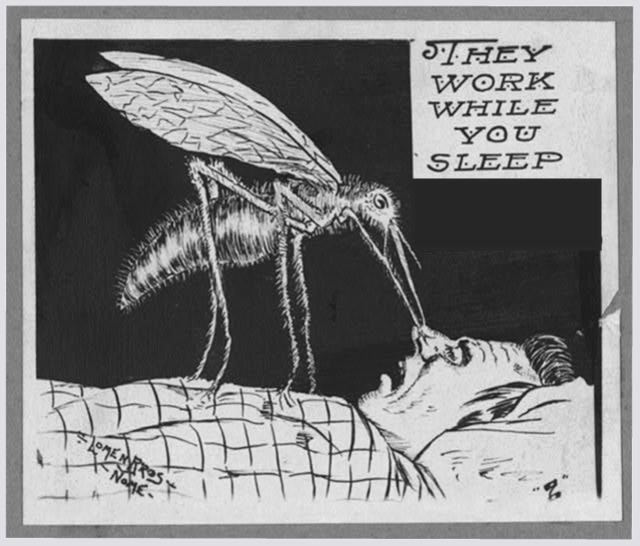
Now, to the business at hand. If you read the headline today, you’re figuring I’m throwing in my lot with some Zapatistas, or I’ve taken to the hills to battle some caudillo. Not so. Zancudo is the word a south american native would use to describe what colonial europeans called a gnat, and we call by its Spanish appellation: the mosquito.
I write amusing commentary for the fine computer hardware website HotHardware.com, and this week’s installment is called Death to the Zancudos. Believe me, here in the swamp, I know about mosquitoes. But it’s about more than that, this story. It’s about using your noggin to solve your problems. It’s a clarion call for New Thinkers. Won’t you answer the call?
Author’s Note: I received several hundred extra unexplained visits to my Sippican Cottage Furniture page two days ago, and they were looking for Micheline Bernardini. Apparently Fox News did a little style info item about the 60th anniviersary of the invention of the bikini. And if you search google images for the lovely lady’s picture, Sippican Cottage Furniture comes up second. The Fox item was on the main page of Fark as well, a raucus and profane news aggregator and message board, which is the biggest thing of its kind on the Internet. If the link was direct to me, it would have melted the servers.
July 5th is the actual anniversary, and I wrote about it on July 5th, 2005. That was back when I didn’t have an official blog, I had invented my own, of sorts, as “What’s New” on my own webpage. But Blogger’s Free, so now we have both. The big newsies are so behind the blogworld. Their audience seems somewhat larger than mine, though. Anyway, I reprint it here now for your amusement, and as I said last year, Micheline looks quite fetching, doesn’t she?
July 5th, 2005- Good day to you. I trust you all had a wonderful time celebrating the Fourth of July. The weather was extremely clement yesterday, and the yard beckoned, and we answered. Lovely. But now, is the thrill gone? I feared so, and began to wonder- What is the Fifth of July an anniversary for? Anything? Bueller?
Well, I didn’t really mean anything. I meant something really notable, or fun, or important. I looked around, but it all seemed trivial, all the July 5ths through the ages:
In 1687, Sir Isaac Newton published his Principia Mathematica. But Einstein shot that all to hell and ruined it for the rest of us.
In 1830, France invaded Algeria, lord knows why.
In 1920, Algeria declared its independence from France, lord knows why. But they’ve got that going for them.
In 1954, Elvis made his first recording, “The Blue Moon of Kentucky.” I didn’t hear that being covered at Live8, so I guess he’s not noteworthy, huh?
In 1884, Germany, no doubt envious of the Garden of Eden the French had found in Algeria, invaded Cameroon. They must have lost interest in the place on one of the other 364 days of the year, July 5th calendars are mute on the subject.
In 1811. Venezuela declared its independence from Spain, but waited until 2004 to declare its independence from any form of work not based on oil receipts and warmed over Castro politics.
In short, I was going to have to think of something else to bore you with on July fifth. Until… Omigod. 1946. THE INVENTION OF THE BIKINI. Hosannahs and ululations! Cinco De Mayo, Independence Day, gosh darnit, Christmas is nothing compared to that! Before 1946, ladies bathing suits were designed by the Taliban. And then- France, still stinging from their expulsion from Algeria, no doubt, decided to attract some attention to themselves the old fashioned way, by disrobing, and c’est magnifique! they gave us the most expensive garment per square inch in the world, and worth every penny, I say.
Now, to be a real bikini, we’ve got to look at that belly button. Various two piece swimsuits had been in vogue in Hollywood, for instance, before 1946, but It took Louis Reard, in Paris, France to get the girls out on the beach properly in a getup worthy of tanning in. Here it is, fashioned by one of the few women brave enough in 1946 France to model it. In 2005, we’re having trouble getting anyone to wear at least this much when sunbathing: Click anywhere on the picture (no wise comments, you) and you’ll be transported to Wikipedia, the online encyclopedia, and read all about Monsieur Reard and ol’ Michele Bernardini, the model, and lots of other interesting stuff about the Bikini Atoll, the islet in the Pacific the garb is named for, and our now thankfully forgotten habit of dropping atomic bombs on it.
And for all you Haute Couture weirdos infesting Paris right now, here’s my two cents: That picture was taken in 1946. Miss Bernadini looks quite fetching in that rig, and comfortable to boot. A woman wearing that suit would feel feminine, and attractive, not exhibitionist. And men don’t really need to see any more than that to get the general idea. So the next time you people get the urge to reinvent the bathing suit wheel again, like you do every year, and make it look like your model is wearing a bag, or a couple of bottle caps, or a window screen, or little boy’s pants, or little more than postage for an undersized envelope, look up this picture, and repeat after me:
Now when I was a kid, baseball was different. I’m not ancient, so you’ll be relieved to know there’ll be no talk of stickball in a Brooklyn street or Ty Cobb’s sharpened spikes. The players we admired on our playing cards are coaches now, not dead. And the playing cards we had were worthless, and the gum was precious, thank God, so we enjoyed them, and flipped them for Face up/Facedown on the bus seats on the way to school, or lined them up against the old brick wall in the playground and played Knockdown. And we gave shopping bags and shoe boxes filled with them to our cousins and younger brothers when we came of age, and laugh when we think of the fortune just one of those cards commands from memorabilia freaks now.
We did not have uniforms. We played with baseballs that looked much older than us, and cracked wooden bats with electrical tape holding them together, and had to mow the field before we could play on it. There were never enough of us, so we pitched to our own team members, and right field was an out. Period. And more often than not, right field went unmowed, too. We played in jeans and canvas sneakers, and a hole in the knee of your pants wasn’t yet stylish, it was a calamity when you had to face your mother, who knew what they cost. And we played until we heard our mothers yell our names for the second time, like a town crier, and hurried home to a scolding for tarrying, and dinner.
All of that is gone now, like so many things, changed by time, and prosperity, and other things. Our mothers thought nothing of turning us out of doors at daylight in the summer, though we were but small, because forty years ago, someone who would hurt a child would have more problems in this world than registering at the police station, and paying their lawyers. And we mowed the grass ourselves, with a mower that shot gravel out the unbaffled chute at our confederates, and we could barely reach up to the handle to push it, and we didn’t maim ourselves, and sue anybody, that I recall. And we settled the rules first and our disputes later among ourselves without the guiding hand of our parents, except what little sense they had managed to get into our heads, and rarely resorted to knuckles. Funny that. We had it sorted out in 1965, when we were but children, but forty years later we assault the umpires at our children’s games. Something was there, and has slipped away, I think.
I remember lots of things about that little diamond, carved out of the trees as an afterthought by the developer of our little neighborhood, long before the word “developer” became an epithet hurled at conservation committee meetings by people who live in houses made by a “builder.” The builder and the developer look identical to the unaided eye, but people who already have a house have a different perspective, and thesaurus, than those that need one.
And I remember Cookie. Now, our children should be collecting Cookie’s rookie trading cards, to put them through college when they sell them on ebay, and not community college either. But it was not to be. Because Cookie, although the greatest baseball player I ever saw, didn’t want to be a professional ballplayer. He wanted to be a barber.
Now that last sentence clanged to the floor at your house, and you thought: He’s kidding, or he’s nuts. Well, I’m not kidding, anyhow. Cookie wouldn’t have it if it was offered.
Now, Cookie was a little older than us, and that brought out the Paul Bunyan side of it a little I’m sure. Remember when you thought your father could lift a car, or paint the house by having you hold the brush while he moved the house up and down? Later you found out he was just another middle aged guy that emitted an audible gasp every time he sat down. Well, I’m sure that entered into it a little, that perspective from down where the little kids are, looking at big Cookie, but that wasn’t all of it. He really was a wonder, I think.
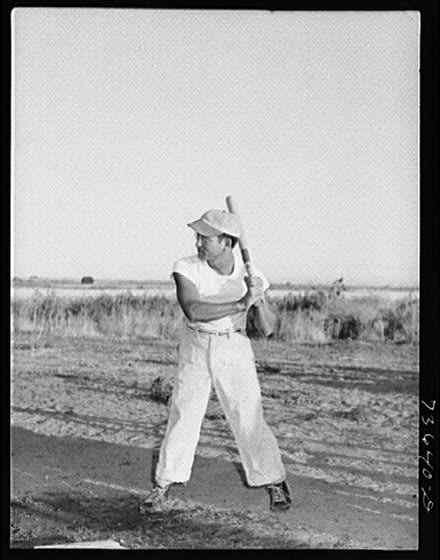
Cookie would show up when we had been playing all day, and to this day I don’t know his last name, or where he came from, or where he went to after he was done. But every time he came, we stopped whatever we were doing, and Cookie put on a Ruthian barnstorming exhibition. The biggest kid among us would pitch to Cookie, and the rest of us would scatter into the woods beyond the field, and wait for the balls to rain down on us. Because Cookie was a machine for hitting home runs. If the pitcher would wince during his delivery, human nature being what it is, knowing the ball might be coming back those 60′ 6″ in a big hurry- he’d maybe sail the ball wide and three feet off the plate. It didn’t matter. Cookie would step on the plate, and lean over, and flick his wrists, and it would rain down into the woods, every time.
And with Cookie, right field was in play for once, after a fashion. We’d grow tired of fishing our precious baseballs out of the oaks and poison ivy in center field, and beseech Cookie for a real show, and he’d get up lefty, his switch hitting a revelation to us, and hit it out over the unmowed grass. Right field had no natural end, so the balls would roll when they hit, like cannonballs that had missed their fortress, but occasionally Cookie would clear the whole distance, and hit the pavement at the foot of the road that entered the field. And we’d ululate like madmen, and didn’t care our precious baseball was no longer round. We adored him.
Cookie even sort of looked the part, if I recall correctly. The major leagues were filled with midwestern farmboy looking lummoxes like Mantle and Killebrew back then, and Cookie had the rangy frame, reddish blond stubble head, loping strides and laconic demeanor of our icons. But with glasses. But not coke bottle glasses. Those wouldn’t have brought a billboard into focus for Cookie. Cookie had the sort of glasses that seemed like the windows on a deep sea submarine. It was disorienting just to look at him, and if the barbering trade didn’t fly, I imagine mesmerism would have been a cakewalk for him.
And perhaps Cookie knew what we, in our innocence, did not; that his eyesight would forever make him an also-ran, and it was best not to dream overmuch and better to make use of your gifts to amuse your neighbors and spice your life than to try to squeeze every drop of mammon from them. Maybe. But I really think that Cookie didn’t care if he became what was to us an exalted thing: A big league ballplayer. He wasn’t interested. He wanted to be a barber, and that was that.
I recall reading a story about Eisenhower when he was young and a cadet at West Point, and not yet the general who beat the Axis armies or the President who presided over my birth, though perhaps he did not notice it. He was no longer a “plebe” then, and was allowed to order the newcomers around, and haze them, as he had been hazed the year before. And for amusement, he picked out a goofy looking recruit, and made him stand at attention in front of his peers, and lambasted him, for no good reason, simply because it was expected of him. And he wrote in his memoirs, that he always remembered, to his shame, that as a capstone to his string of abuse, he asked the plebe what he did in his civilian life before he entered West Point, because he seemed such a numbskull that he couldn’t be more than a barber. And the man, showing no emotion, but feeling some, no doubt, answered that he was indeed a barber in his short pre-military working life.
Eisenhower wrote that he had never known real shame before that, and he remembered that moment for the rest of his life, when he had disparaged the honest toil and effort of his fellow man. And he said he owed that man a great debt, though he couldn’t remember his name, and he never again wanted to look down his nose on any man.
Cookie, if you’re listening. I’m sure you’re a terrific barber.
A council of officials of uncertain importance decided that since Emperor Iyasus of Ethiopia had retired to a monastery, they could appoint Tekle Haymanot I to be the Emperor.
Over in Ramillies, the War of the Spanish succession had English, Dutch, and German troops defeating the French. They’d mix themselves up and fight one another in one form or fashion for 250 years or so.
George Farquar had gotten over stabbing another actor during a swordfight, and was wowing them on Drury Lane with his play: The Recruiting Officer.
John Machin the mathemetician was getting a little notoriety for computing pi to 100 decimal places.
And in Boston, Massachusetts, Josiah Franklin wiped the tallow renderings from his soap and candle manufactory off his hands, and held his newborn son – his tenth: Benjamin.
He’d have seven more children, too. But it’s Ben Franklin we all remember, because he’s the most American man that ever lived.
Franklin did every damn thing, and did it well. He wasn’t educated formally much — his father only had enough money for one year at Boston Latin –but Ben became an autodidact, and read voraciously. When Benjamin was fifteen, his older brother James started the first newspaper in Boston, the Courant. Ben was forced to do menial work only; setting type, sweeping up, and selling the papers in the street, which bugged him. So he invented a nom du plume, “Silence Dogood,” and started writing editorial letters about matters divers and sundry in the colony, and especially how poorly a woman like her was treated.
Ben would slip the screeds under the door of the shop at night, and his brother would print them in the paper. They were a big hit, and everyone wanted to know: Who was Silence Dogood? Ben knew he had catapulted his brother’s paper to prominence, and figured he’d admit his ruse to his brother and claim his place as a writer for the paper.
His brother hit him.
Back to the compositor’s bench. Eventually James got thrown in jail for annoying the local clergy about smallpox vaccinations, of all things, and Ben got to run the paper until they let his brother out of jail. He did a great job, and asked his brother if now he could write for the paper.
His brother hit him.
This grew tiresome. So he ran away to Philadelphia, on foot, though it was illegal to do so at the time — it made him a vagrant. Eventually he found a job working at the local printer. But that first day, he spent his last money on a few stale rolls, and sat eating them –wet, disheveled, footsore, broke, in a strange city — and still managed to attract the attention of the woman he’d marry seven years later: Deborah Read. And all that was before his eighteenth birthday.
Benjamin’s 300th birthday anniversary is this year, and the rest of his life is being endlessly dissected and pawed over for the glory and good sense in it, and like a very few men, his life can take almost endless scrutiny without running out of things to look at. I’ll leave the rest to others. But I had an adventure with Ben, and I’d like to share it.
I grew up in the first town in America named for Ben Franklin. It was part of Wrentham, which originally was part of Dedham, Massachusetts, but in 1738, when they got themselves a Congregational parish, they decided to break away, and call the new town Exeter. Later, someone got the bright idea that if they offered to flatter the most famous — and one of the richest — men in America, Ben Franklin, by offering to name the town after him, maybe they could flatter enough money out of the old patriot for a bell for their church steeple.
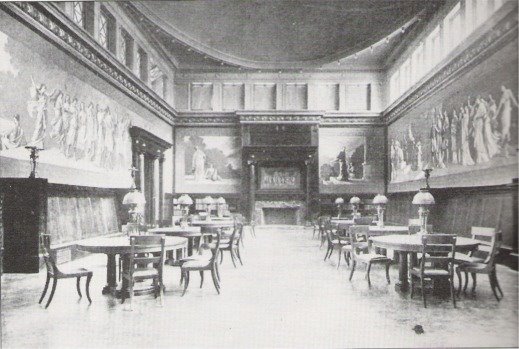
“Sense is preferable to sound,” Franklin wrote back, and sent them a crate of books instead. And so the first public library in the country was born. The town had other benefactors over the years, and in 1904, the daughters of the most prominent family in Franklin, the Rays, dedicated a magnificent NeoClassical library to honor their parents.
I spent more hours in that library than all the Italian stonemasons the Rays imported to build it ever did, combined. I haunted it. It looked almost exactly like the picture you see above when I was a child. How could you not know that books and words and scholarship were a noble and important thing when you sat in that magnificent reading room under the watchful eyes of the semi-nudes in the mural? You know, the formerly nude figures that Tommaso Juglaris had to return to paint additional clothes on, to shut the old biddy Ray sisters up.
A book was an expensive and rare thing for us then. I could list every book in my house in 1964 right now; it wouldn’t take long. I read eveything in the children’s library by the time I was seven. I wanted to go upstairs, where the adult books were, when adult books meant something else than they do now. They told me I was too young and I’d tear the pages from the books or put lollipops in the card files or roller skate around in there or something; my mother had to go and explain to them that I needed to see more than the four newspapers my father would bring home every night. They relented.
The library had massive bronze doors with big rings you had to turn to enter, and at first I was too small and had to wait for someone to enter or exit, and I’d dart in. It was a temple, and I was a votary. And there, in the reading room, were Ben Franklin’s Books. The books were just stuck in a glass-doored cabinet in the reading room. I had read every damn thing in that library, including all the encyclopedias. I had walked past Franklin’s books hundreds of times, and watched others go past them without giving them a glance thousands of times.
Like the Spanish Prisoner story, one day I just tried opening it. It was unlocked. It was a wonder no one, including me, had ever thought of that before. I get the feeling Ben Franklin was cleaning out his back room when he donated the books. No matter. I don’t remember exactly what any of them were. They’ve blended together with all the others I scoured for the next thing I wanted to know, and the next, and the one after that. And I put them back without anyone ever knowing. But I knew.
The library’s still there, because stone don’t burn; most every other stately Victorian era house the Rays built in town has been burned down by the dissipated Dean College students who eventually used them as dormitories. I wandered through the library a few years ago. They’ve ruined it of course; it’s full of lousy books and rental movies I’d cross the street to avoid seeing, crummy furniture and computers no one needs in a library much. And Franklin’s books aren’t out where you can see them any more.
What gets into your mind? Where does the inspiration come from? What gave me the idea I wanted to look at those books like the damned want icewater? Beats me. Why do you walk to Philadelphia and buy rolls? I can tell you it was fun to hold them in my hands, all those years ago, and think about the man that sent them, through the ages, for me.
Silence Dogood would understand.
Month: April 2006
sippicancottage
A Man Who Has Nothing In Particular To Recommend Him Discusses All Sorts of Subjects at Random as Though He Knew Everything.
 Good day everyone.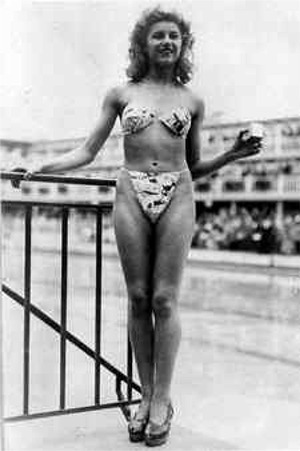



Recent Comments