Is This The Most Popular Thing Ever Painted?
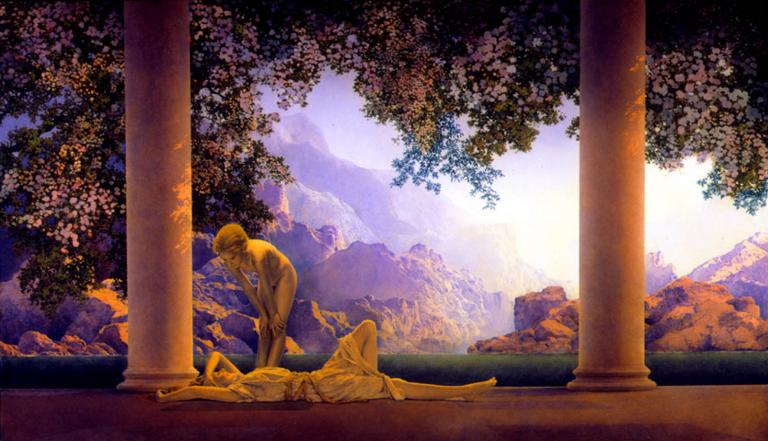
How would you measure such a thing? I imagine you could shove a copy of La Gioconda under the whole world’s nose, and 99 out of 100 might recognize the old girl. But everyone knows who Hitler is, too. (This is the Intertunnel. Eventually everyone mentions Hitler) Recognizable is not the same as popular.Would you plunk down money for a print of Mona Lisa? I wouldn’t. I live in a 1901 Free Classic Victorian, and I’d hang a Parrish print in any room in it. If the walls could take the weight, that is. Bang a hook around here, and you might end up outside. Still, the urge is there.
It is estimated that 25 percent of all the houses in the United States had a print of “Daybreak” by Maxfield Parrish hanging in them in the 1920s. That’s popular. Leonardo could only sell the smirky woman once. Parrish made a pile on his nymphs.
The actual painting changed hands in 2006 for $7.6 million. 7.6 mil will get you into the Louvre, it’s true, but you won’t be unscrewing much of anything recognizable from the walls for that sum, never mind the Mona Lisa. But that’s a lot of money for an American painting. I think it means something.
When I was younger, that painting was considered about par with Dogs Playing Poker by the intellectual set. I find lots of stuff like it having a bit of a renaissance recently. I’m not sure if the Intertunnel has anything to do with it. Say what you want about it, but the Internet does lend at least a veneer of democracy of interest to cultural things, even though it has huge blind spots. By Intertunnel standards, George Lucas painted the Sistine Chapel on a break from writing Shakespeare’s plays, but it’s still a useful way to see what people are interested in. Guys on the artistic “outs” like Parrish and Mucha and other contemporaries are comparatively everywhere on the Intertunnel. People are interested in them. That has not always been the case. Hell, Google even gave Mucha a Google Doodle salute on his birthday.

Parrish paintings and illustrations were immensely popular in their time, and when the great, glum, decade of the thirties followed the ebullient twenties, I think people associated it with a burp from a sumptuous meal they’d already eaten, but they couldn’t afford to buy a second time. It reminded them of plenty, and sackcloth and ashes doesn’t do plenty.
Parrish seems downright Byronic compared to the rest of the art world, living out in the woods in New Hampshire and tossing brilliant lightning bolts down on the world. The approach sounds familiar. Like all Romantics, he didn’t want to settle for the world as it was, and so made one of his own.
Or maybe the world really is like that, and all he did was transcribe it, and we’re too glum to see it.


Recent Comments