Before I Am Old I Shall Have Written Him One Poem Maybe As Cold And Passionate As The Dawn

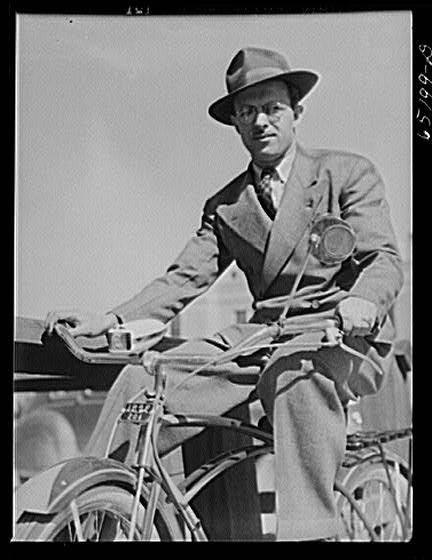
ALTHOUGH I can see him still,
The freckled man who goes
To a grey place on a hill
In grey Connemara clothes
At dawn to cast his flies,          5
It’s long since I began
To call up to the eyes
This wise and simple man.
All day I’d looked in the face
What I had hoped ’twould be   10
To write for my own race
And the reality;
The living men that I hate,
The dead man that I loved,
The craven man in his seat,   15
The insolent unreproved,
And no knave brought to book
Who has won a drunken cheer,
The witty man and his joke
Aimed at the commonest ear,   20
The clever man who cries
The catch-cries of the clown,
The beating down of the wise
And great Art beaten down.
  
Maybe a twelvemonth since   25
Suddenly I began,
In scorn of this audience,
Imagining a man
And his sun-freckled face,
And grey Connemara cloth,   30
Climbing up to a place
Where stone is dark under froth,
And the down turn of his wrist
When the flies drop in the stream:
A man who does not exist,   35
A man who is but a dream;
And cried, ‘Before I am old
I shall have written him one
Poem maybe as cold
And passionate as the dawn.’   40

-William Butler Yeats

Amplitude Modification (2007)


The naugahyde was cool against your cheek. I remember that.

Driving back from Roxbury. Rambling along the Charles on Storrow. The car pitched and yawed on its butt-sprung suspension and the spidered pavement . You could reach down and lift the floor mat and see the asphalt roll by through the rusty pinholes in the floor, where the road salt had done its work, and worked overtime, too.

Pop was operatin’. He was like a sub commander. Steering through shoals with vision obscured. Our moist breath clouded the windshield. The defroster exhaled on the windshield like the dying animal it was. Pop wiped the fog away with his hanky, and pressed on.

Little brother was already asleep on the seat next to you. Mom packed the blankets and pillow around him to hold him on the seat. I bivouacked on the rest, and tried to align my face on the part where the cushion wasn’t split from a thousand butts. The edge of the rip would cut your face and the foam would tickle you.

The scene was framed, imperfectly, through the lens of the side window. Left to right, the world ran past. The drops of condensation coalesced on the fogged window’s screen, ran down, and revealed the Cambridge shore through the mist. Low-watt Christmas everywhere. The enormous billboards shrunk by distance and time and poverty to faraway smears of luminous color with winking neon and the stink of death on their topics. FULLER OLDS. NECCO. KASANOF’S. The window made them into a kaleidoscope.

The useless wipers went scrreee-BAP, scrreee-BAP over and over, and Pop would fiddle with everything to no effect and keep going. Mom would look out the window and over her shoulder and her thoughts were her own. The Christmas presents from doting Aunts who asked you over and over “Which one are you?” would shift and tumble over in the trunk an inch behind my head when we got to the huge sign that said REVERSE CURVE — the one that caught Pop by surprise every time even though he was born a brisk walk from it.

There was sometimes a hand free to twist the huge, mostly useless dial on the radio. Snap, Crackle, Pop, for breakfast, lunch and dinner, came out of that thing. At night the big stations like BeeZee would bleed all over the place, and bizarre incursions of French from Canada would appear, unwonted, fight for primacy like radio chimeras, then disappear as Pop searched again for whatever you could catch and hold.

Papa Was A Rollin’ Stone…

We rolled on into the night.

Cubicle Farmers Of The World: Unite!


Reader and commenter Cameron, of Cultural Rumbles, wondered aloud in my little essay about the Punch Brothers if I wasn’t being too hasty when I remarked:

Oh, well; 2.3 children, a dog to kick and a cubicle makes for a dashed poor drinking song.

My favorite kind of people don’t take challenges lying down. No! They get drunk first, then lie down. Then they get up and write a Cubicle Protest/Drinking song!

Ohhhhhhhhhh,

Box me in, ya bloody bastards!
Pile them spreadsheets mountain high!
Ye won’t break me, you AP dastards!
Reconcile, then bloody die!

A fine effort, no doubt, and long overdue, but son, stand back, ’cause I’m a pro.

First, we need a tune. Why not the greatest drinking song ever? If you’re from Boston and can’t recite (or more precisely: haven’t already recited) this grand tone poem while standing on one foot and touching your nose over and over by the side of the road, while a bemused Statie looks on, you’re no true Bostonian!

OK, all you Dilberts, sing along!

* If you don’t speak “Cubicle,” which is like Klingon but less mellifluous, go here.

Charlie And His CLM

Let me tell you all the story
Of the PC LOAD LETTER
And poor Charlie’s dyspeptic day
He’d eaten Kung Pao in Woonsocket,
Walked the aisle to the printer
And cropdusted the entire way

Chorus:
Did he ever return,
No he never returned
But his smell is still discerned
Prairie Dog coworkers
wonder who was passing
He cropdusted, and never returned.

Charlie lingered at the printer
As the gas cloud settled
Shoved in two reams of foolscap plain
Then the LaserJet was blinking, saying
LOW ON TONER
Charlie rumbled, and started to strain

Chorus:
Did he ever return,
No he never returned
But his smell is still discerned
Prairie Dog coworkers
wonder who was passing
He cropdusted, and never returned.

Now all day long
Charlie stands at the Canon
Thinking, “What will become of me?”
Crying
There’s never any paper
In the Men’s Room holders
And he was going to need a whole Dead Tree

Chorus:
Did he ever return,
No he never returned
But his smell is still discerned
Prairie Dog coworkers
wonder who was passing
He cropdusted, and never returned.

Charlie’s boss goes down
To the handicapped bathrooms
Every day at a quarter past two
And Charlie knew the danger
If he toilet bombed his bosses
When the szechuan came rumblin’ through.

Chorus:
Did he ever return,
No he never returned
But his smell is still discerned
Prairie Dog coworkers
wonder who was passing
He cropdusted, and never returned.

As his lunch rolled on
underneath his spattered tieclip
Charlie looked around and then he sighed:
“Well, I’m sore and disgusted
And my bowels can’t be trusted,”
And he lay down by the fax and died.

Chorus:
Did he ever return,
No he never returned
But his smell is still discerned
Prairie Dog coworkers
wonder who was passing
He cropdusted, and never returned.

(Gagdad Bob Has Got Me Thinking Of) Bog Hockey

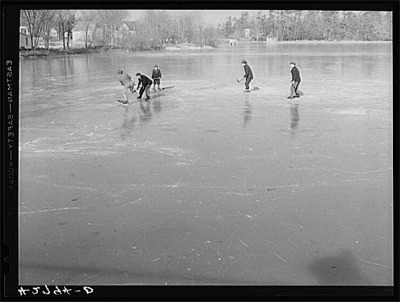
This picture is a lot older than I am. Probably thirty years older. But it is an exact rendering of my winter life in our little suburb — check that– exurb — check that — that word didn’t exist then– out in the sticks where we lived in the sixties.

I was born in Boston. When I was but small, we moved into the country. And my life was amazingly different from my cousins who remained in the city.

We didn’t have any money, really, but not so’s you’d notice. We lived in a little house on a little plot in a little neighborhood, and had little, salubrious lives. Our mother would turn us out of doors, no matter the season, and we’d take our battered belongings, pool them, and play self -organized sports. We’d sort out the teams, and the rules, and the size and shape of the playing surface, and rarely quarrelled, unless it seemed like more fun than playing any more. And we could have sorted out the Mideast thing, if they’d let us. Maybe their quarrelling is more fun than they let on.

In the summer, we’d play baseball, and have to mow the field before playing. Right field’s an out! In the winter, we’d play basketball in the elementary school gym. Shirts and skins. Onlookers were no doubt sorely tempted to play xylophone on many of the skins team’s ribs. Weight training was still far in the future. In the fall, we’d play tackle football in a cow pasture with no equipment. There were no hash marks or goal lines demarcated, of course, but in a field recently used by ruminant animals, those weren’t the things on the ground you would have been keeping an eye out for anyway. And in the winter, we’d dress in wool, gather our rusting hand-me-down skates that lacked steel toes, grab the sticks that were generally broken and discarded and then repaired with electrical tape, and we’d shamble on down to LaFleur’s Pond, and get up a game. The idea of actually owning and wearing a replica of the sweater worn by our local professional hockey team was as remote and mystical as a strawberry on the kitchen table in the winter.

We were always half frozen with the cold. We had no protective gear of any kind. Hell, at the time, there was only one professional hockey player who wore a helmet — Terrible Teddy Green– and he only wore it because he’d already had his head staved in from a stick fight, and needed to protect the steel plate in his head from any further persuasion. When we first started going to Boston Garden to see Bobby Orr’s mighty Bruins play, some of the goalies weren’t wearing masks yet.

The ice was never really frozen properly, one way or the other. If it was thick enough to be safe, it was so corrugated it would rattle your teeth out of your head. If it was fresh enough to offer a smooth surface, it was thin enough to drown you. We always skated anyway. If you got checked, you’d occasionally slide to the margins of the pond, get caught in the brambles reaching up through the ice, get tangled up, and fall in up to your waist, and you’d spend the rest of the day skating with your pants frozen to your legs. You wouldn’t stop.

“NO LIFTING!” you’d shout every time the more adept stickhandlers would get the puck up off the ice and crack your shins. We’d all readily and solemnly agree that there’d be no lifting, before we began each game, of course; some of us because we knew we were incapable of lifting it, and the others because they were incapable of not lifting it, so no one was much put out by the bargain.

We’d put two sticks five feet apart on the ice to mark out the goal, and get to it. Guys who never passed at basketball never passed at hockey either, we noticed. And they’d forever be taking shots from fifty yards from the goal, missing by fifty yards, and requiring a ticklish trip to the brambles to fetch the errant puck without swimming amongst the prickers.

When we got older, we’d fashion real nets out of scavenged lumber and chicken wire, and without fail we’d forget to fetch them off the ice in time for spring thaw, and we’d see them, on the bottom like scuttled privateers, winking at us beneath the new year’s ice.

I wanted to be a goalie, but had no equipment. My father drove an old Rambler Station Wagon. Underneath the carpet in the back, there was — check that — there originally was a layer of foam rubber.
My brother and I spent many a miserable car ride rolling around in the back of the car with only the thin carpet between us and the rivets and bolt heads because I cut the pad up into rectangles, wove olive drab straps from army surplus utility belts through slits in the foam, tied them to my legs, and played the net like that.

At the time, the Bruins had a goalie named Gerry Cheevers. He was cool. He wore a white plastic mask, and he’d draw the stitches he would have received had he not worn the mask right on it, in magic marker, adding one every time he got hit in the face. He looked fierce like that. Young boys like fierce. So I tried to fashion one for myself out of the plastic scavenged from a Clorox bottle, held on my head with an elastic band, and burned my face with the residue of the bleach. The plastic was as thin as a negligee, and wouldn’t protect me in any case; I didn’t care, I wore it anyway.

And some of the kids were real good. A few played college hockey. One played on the Olympic Team and the Bruins and is now an NHL coach. But by the time he had started coming around, there was a real rink next to the high school to play in. Real equipment started to show up. Right handed goalies didn’t use their brother’s left handed hand-me-down baseball glove and bleach bottle mask and Rambler foam as equipment. Time marched on, and the younger kid’s parents started getting up at 3:00 AM to make it to the rink for their allotted ice time, supplanting the older kid’s ritual: mothers sticking their heads out the back door when the light got weak and the sun skimmed the horizon, painting at the last only the very tops of the dormant oaks that ringed the pond with the winter dusk’s fire, shouting your name to call you to dinner.

My son played hockey on the Playstation once. Didn’t care for it.

The Gahden (A Melancholy Tale)

Pop knew everybody. Didn’t have a dime and took me everywhere. We’d pull up to the Garden parking lot in our old beater. No hope. It was full when I was born, and now I’m in grammar school. I cringed until the face leans out of the booth and it’s his nephew in there. Right over there, Uncle Buddy. Where the players park.

You couldn’t buy a ticket with money. The Garden would thrum with excitement and no one would miss it for filthy lucre. Pop had four. Conjured them like a wizard at work because the boss was already wearing white shoes for the season and wouldn’t sweat in a seat in that hellhole when he could be on the Vineyard. Pop says he’ll sit behind the pole and stare at the big rusty rivets but I’d always end up there because I fit.

Uncle Smokey would come and puff his tiparillos and jape with Dad and I was in the company of men and stood in awe like at the foot of marble Lincolns.

There was weather inside there. Cumulus clouds of smoke would meet the smog from the drunken exhalations and clash with the cold front coming up from Bobby Orr’s ice under the rickety parquet wood floor.

Then we’d stand and the floor was lost to me, nothing but the boles of men in an endless forest swaying in the breeze of excitement.

I’d kill ten innocent men to go back there for ten minutes.

Tag: Boston

Find Stuff:

Archives