I’m Part Of The World’s Oldest Profession

With apologies to prostitutes and politicians, until there was currency to bamboozle people out of, and rounds of drinks to be ordered but not paid for, their job descriptions were very, very, nebulous for a very long time. But I’m a turner. It’s the world’s oldest profession. The fellow in the video is a drechsler — which is German for turner. He’s shown at his craft in 1926, making Hitler’s fruitbowl or something, back when Hitler was still rubbing his eyes. I could immediately and without hesitation recognize and use everything in the video, although I don’t turn bowls. He has better gouges than I do, is all.

Well, it might be the oldest profession. Who knows? But the oldest mechanical apparatus more complicated than the jawbone of an ass known to be used regularly by humans is something called a fiddle drill. Old-school farmers recognized the term. A stick with ropes looped from both ends is pushed and pulled back and forth, turning an axle or wheel, and  the resultant spinning made useful for all sorts of things, like broadcasting seeds, for one. It’s one of the oldest ways to make a fire, too– right after waiting to be struck by lightning and throwing yourself on some sticks:

Cavemen didn’t have security deposits, but they probably didn’t use a fire bow in their living rooms while wearing socks based solely on principle, unlike Joe College here.

Anyway, it was just a matter of turning the apparatus on its side, and then carving the spinning axle with handheld tools to make the jump from fiddle drill to William and Mary turned legs. That, and thirty-four centuries. There’s evidence that artisans were turning bowls like you see in the first video, and many other things, in the seventh century BC. We know more about Etruscan bowls than we do about Etruscans.

Many people turn wooden ware, which can also be called treen, nowadays. Sixty Grit, who reads and comments here, is known to do it. I’m sure others do, too. It’s considered a gentlemanly way to work with your hands, and it’s more practical than the formerly popular pastime of making boats in the basement that don’t fit through the bulkhead when they’re done. Me, I’m going to go make a fire with a zippo and table leg with my lathe, and try to get my hands on some money. I try not to give any of the money to politicians, so that leaves… (What’s that, dear? Oh, nothing.)

Ahem. As I was saying; since I refuse to willingly give my lathe turning money to politicians, that only leaves, er, well, hmm… well, I can always buy more lathe tools with it.

Imperial Preference

What a fascinating piece of kit.

Color anything in 1927 was a treat. The big cinematic extravaganzas in ’27 were France’s Napoleon, Germany’s Metropolis, and America’s The Jazz Singer. They’re all black and white, but the Jazz Singer at least made its own noise. They’re all considered seminal by movie buffs, but I wouldn’t cross the street to look at them for free. I’d watch Friese-Greene documentaries, like that tour of London, all day.

London was the center of a real, live empire in 1927. It was a boxer that had just gotten a hammer blow and was staggering around the canvas at that point, built on too tough a frame to fall down right away, but not going anywhere but down. It still had far-flung Dominions that looked to it for guidance or succor or a handy enemy to overthrow, and they would all have sat in rapt attention in their garden spots and pest holes alike to get a sense of The Hum of Lunnon, the center of their universe.

I like telling stories, and having them told to me, as much or more than the next guy, but almost all artist’s storytelling is mawkish — if they can get the story to cohere enough to even achieve mawkishness.

Of course even a person making travelogues is an editor, and can show you only Potemkins all day if he chooses. But entertainment “portraying” real life is 100 percent Potemkin. This tour of London is not some other guy’s idea of the world. It’s my idea of the world, which I derive on the fly by looking at it. It’s worth a thousand David Copperfields.

Cinematographers will watch this and grab as many details about the surroundings as they can remember, and then use them to camouflage the gigantic fibs they wish to tell about the way people act. That’s Entertainment!

**Ring** Hobbit House Roofers. Peregrine Took Speaking

American house architecture was much more exuberant in the 1920s than since. I’ve worked on houses from the 17th century through the 21st, and the 1920s can lay a claim to being the most useful and practical without giving up anything in the style department. They’re generally smaller than a contemporary house, but that’s a feature, not a bug, if you ask me. Most contemporary houses are huge because they waste a lot of space, and waste it in multiples while the occupants try to find a corner of their caverns to actually live in. If the houses were designed better, they could be smaller. They aren’t, so they can’t.

They were, in the twenties. It’s important to remember that compared to the walk-up rented apartments and ramshackle shacks the twenties homebuyer was moving from, they weren’t all that small. But a 2012 female person takes one look at the modest closet, and the 2012 male person vainly searches for seven feet of blank wall for their TV, and are disconsolate.

One of the most exuberant style items afoot back then architecturally was the faux thatched roof. That’s what you’re looking at there. The Arts and Crafts retreat to rusticity was in full play. But hobbit house roofers are hard to find in the 21st century, and so the homeowners had to find someone willing and a little unusual to plan the necessary assault on their roof and their checkbook.

The roof is a very large visual element on a house. 90 percent of them are blah expanses of asphalt tab shingles. Back a hundred years ago, you might find asphalt shingles, of course –the house in the picture might have had them as original equipment — but you’d be just as likely find slate, or sawn cedar, or heavier split shakes, or metal. They’d be laid in interesting patterns and a wider palette of colors than now, too. “What color gray do you want” is all they ask you at the lumberyard now.

I’ve repaired curved roofs like this. I cheated. If you lay cedar shingles on the lawn in the early morning, the sunny side shrinks and the damp, grass side expands, and they “cup” a good deal. You can bend them the rest of the way by hand and nail them down if you’re in a hurry. The steam box in the video is a much better method, of course. Well, “better” until you get the bill, anyway.

You can see some more faux-thatched roof designs, among other wonders, inside Classic Houses of the Twenties (Dover Architecture)

Chicks Dig Guys With Skills. You Know, Like Nunchuck Skills; Bowstaff Skills; Computer Hacking Skills; Pinstriping Skills…


They’re building Royal Enfield motorcycles:
 

That’s a very cool bike. The company was founded in England in the 1850s; they originally made sewing needles. Then came boneshakers, springs for seats for “safety bicycles,” and then bicycles themselves. Then rifle parts –that’s where the “Enfield” moniker came from, and their slogan for all their stuff: Made like a gun. Then came motorcycle precursors: tricycles and quadricycles with small engines. They tried making cars around the turn of the twentieth century. They looked like lightly armored personnel carriers and had eight-horsepower engines, not considered enough to mow your lawn while sitting down nowadays. They got over that urge and started making true motorcycles, and sold a bunch to the army for World War I. They had a neato one with a stretcher sidecar.

The company was a pioneer in using the saddle tank (a fuel tank that sits atop and straddles the frame) which you see the fellow in the video striping so ably. In the late forties, the company opened up a shop in Madras, India, to supply motorcycles to the Indian army.  At first they just assembled parts sent from England; they eventually made the whole thing themselves. They made one design, unchanged, for thirty straight years. England gave up manufacturing pretty much anything in the second half of the twentieth century, and started importing the bikes from India.

Hand skills like that fellow in the video displays are always show-stoppers in any manufactory.

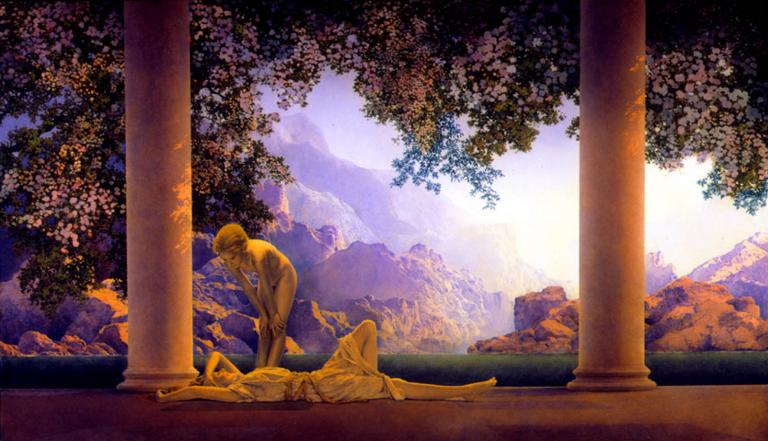
Is This The Most Popular Thing Ever Painted?

How would you measure such a thing? I imagine you could shove a copy of La Gioconda under the whole world’s nose, and 99 out of 100 might recognize the old girl. But everyone knows who Hitler is, too. (This is the Intertunnel. Eventually everyone mentions Hitler) Recognizable is not the same as popular.Would you plunk down money for a print of Mona Lisa? I wouldn’t. I live in a 1901 Free Classic Victorian, and I’d hang a Parrish print in any room in it. If the walls could take the weight, that is. Bang a hook around here, and you might end up outside. Still, the urge is there.

It is estimated that 25 percent of all the houses in the United States had a print of “Daybreak” by Maxfield Parrish hanging in them in the 1920s. That’s popular. Leonardo could only sell the smirky woman once. Parrish made a pile on his nymphs.

The actual painting changed hands in 2006 for $7.6 million. 7.6 mil will get you into the Louvre, it’s true, but you won’t be unscrewing much of anything recognizable from the walls for that sum, never mind the Mona Lisa. But that’s a lot of money for an American painting. I think it means something.

When I was younger, that painting was considered about par with Dogs Playing Poker by the intellectual set. I find lots of stuff like it having a bit of a renaissance recently. I’m not sure if the Intertunnel has anything to do with it. Say what you want about it, but the Internet does lend at least a veneer of democracy of interest to cultural things, even though it has huge blind spots. By Intertunnel standards, George Lucas painted the Sistine Chapel on a break from writing Shakespeare’s plays, but it’s still a useful way to see what people are interested in. Guys on the artistic “outs” like Parrish and Mucha and other contemporaries are comparatively everywhere on the Intertunnel. People are interested in them. That has not always been the case. Hell, Google even gave Mucha a Google Doodle salute on his birthday.

Parrish paintings and illustrations were immensely popular in their time, and when the great, glum, decade of the thirties followed the ebullient twenties, I think people associated it with a burp from a sumptuous meal they’d already eaten, but they couldn’t afford to buy a second time. It reminded them of plenty, and sackcloth and ashes doesn’t do plenty.

Parrish seems downright Byronic compared to the rest of the art world, living out in the woods in New Hampshire and tossing brilliant lightning bolts down on the world. The approach sounds familiar. Like all Romantics, he didn’t want to settle for the world as it was, and so made one of his own.

Or maybe the world really is like that, and all he did was transcribe it, and we’re too glum to see it.

Tag: 1920s

Find Stuff:

Archives